
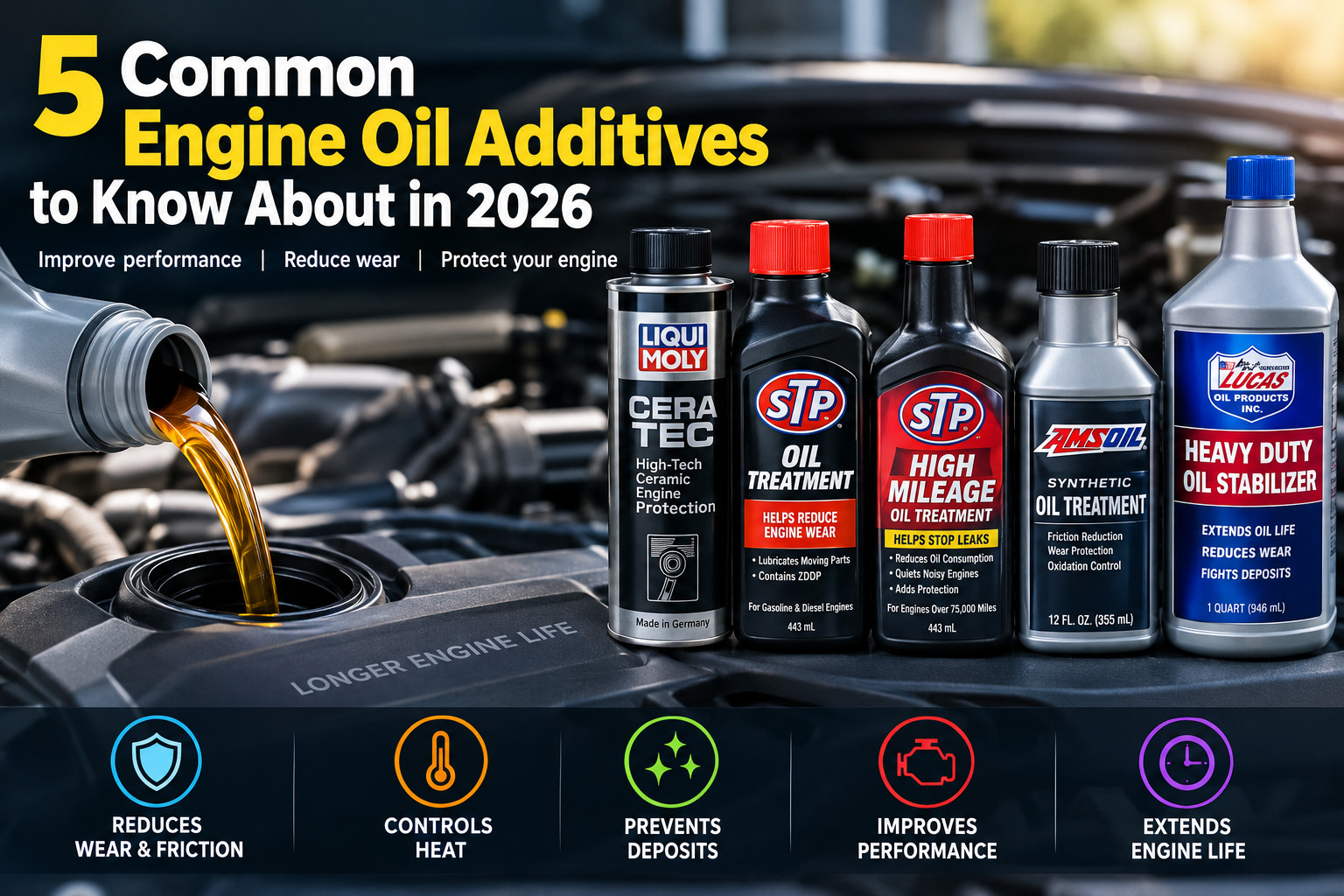
5 Common Engine Oil Additives to Know About in 2026
Engine oil plays a critical role in protecting internal engine components from friction, heat, deposits, and wear. Modern motor oils already contain carefully balanced additive packages, but there are also aftermarket engine oil additives designed for specific purposes.
In this guide, we explore 5 common types of engine oil additives in 2026, their main characteristics, potential benefits, and the situations in which they are commonly discussed. Before adding any aftermarket product to an engine, always check the vehicle manufacturer’s recommendations because using an unsuitable additive can affect the oil’s intended properties.
1. Ceramic Anti-Wear Oil Additives
Ceramic-based oil additives are designed around very small solid or ceramic compounds combined with friction-modifying chemistry. A well-known example is LIQUI MOLY Cera Tec, which the manufacturer describes as a ceramic anti-wear additive designed to reduce friction and wear.
According to LIQUI MOLY, Cera Tec is designed to reduce direct metal-to-metal contact and has high thermal and chemical stability. The company also states that it is compatible with many commercially available motor oils and has been tested for applications including turbocharged engines, catalytic converters, and particulate filters.
Key Characteristics:
- Ceramic-based friction reduction technology
- Designed to reduce friction and wear
- High thermal stability
- Compatible with many motor oils
- Designed for gasoline and diesel engines
- Intended for specific engine-oil applications
Compatibility should always be checked before use, particularly for vehicles with specialized lubrication systems.
2. Oil Treatments and Anti-Wear Additives
Traditional oil treatments are designed to supplement the lubrication characteristics of engine oil. These products commonly focus on reducing friction, improving lubrication between moving components, and helping protect against wear.
STP’s Oil Treatment, for example, contains the anti-wear compound ZDDP and is marketed to help protect against engine wear, lubricate moving components, and reduce oil burning. STP states that its formulation is intended to provide a thicker oil cushion between moving parts.
Key Characteristics:
- Anti-wear formulation
- Designed to improve lubrication
- May contain ZDDP
- Designed to reduce metal-to-metal friction
- Available for different engine applications
- Often used as a supplemental oil treatment
Modern engine oils are already formulated with their own additive packages, so adding another treatment is not automatically necessary. The vehicle manufacturer’s oil specification should remain the priority.
3. High-Mileage Oil Treatments
High-mileage oil treatments are formulated for engines that have accumulated significant mileage. These products are generally marketed around maintaining lubrication performance and addressing issues associated with aging engines, such as oil consumption, seals, deposits, or increased mechanical wear.
STP’s product range, for example, includes a High Mileage Oil Treatment aimed at vehicles with more than 75,000 miles. The manufacturer describes it as providing additional protection and helping address leaks, noise, and smoking.
Key Characteristics:
- Designed for higher-mileage vehicles
- Focuses on additional lubrication support
- May target oil consumption
- Some formulas include anti-wear chemistry
- Intended for engines with specific maintenance needs
A high-mileage additive should not be considered a replacement for repairing an actual oil leak, worn seal, damaged component, or other mechanical fault.
4. Synthetic Oil Treatments
Synthetic oil treatments are designed to complement motor oils used in modern engines. They may focus on friction reduction, lubrication, oxidation resistance, and maintaining oil performance under demanding operating conditions.
STP lists Synthetic Oil Treatment as a product category intended to provide additional protection for extended oil-drain applications and states that its formulation is designed for low-viscosity oils.
Lucas Oil also offers specialized synthetic and low-viscosity oil treatments. Its Low Viscosity Stabilizer is described as focusing on anti-wear protection, friction reduction, dispersancy, and oxidation inhibition.
Key Characteristics:
- Designed for modern synthetic motor oils
- Focuses on lubrication performance
- May provide oxidation protection
- Designed to reduce friction and wear
- Some formulas target low-viscosity engine oils
The exact formulation matters, so a product intended for one oil grade or engine design should not automatically be assumed to work for another.
5. Oil Stabilizers and Engine Treatments
Oil stabilizers are another category of aftermarket engine-oil products. They are generally designed to modify or supplement certain lubrication characteristics and may be marketed for applications involving heavy-duty use, high mileage, or demanding operating conditions.
Lucas Oil offers several engine-oil additive categories, including Heavy Duty Oil Stabilizer, Pure Synthetic Oil Stabilizer, High Mileage Oil Stabilizer, and Complete Engine Treatment. The company says its engine-oil additives can target friction, wear, oxidation, deposits, and lubrication performance depending on the specific formulation.
Key Characteristics:
- Designed to supplement engine-oil performance
- Different formulations for different applications
- Some focus on high-mileage engines
- Some target heavy-duty applications
- Some address oxidation and deposits
- Available for different types of motor oil
Because formulations vary considerably, the specific product documentation is more important than the general category name.
How to Choose an Engine Oil Additive in 2026
The most important point to understand is that more additives do not necessarily mean better engine protection. Modern engine oils already contain carefully engineered additive packages.
Before considering an aftermarket additive, check:
1. Your Vehicle Manufacturer’s Recommendation
The owner’s manual should be the first source of information. Some manufacturers specifically recommend using only approved engine oils and discourage additional additives.
2. Engine Oil Specification
Pay attention to the required viscosity, API classification, ACEA specification, and manufacturer approval. An additive should not be used to compensate for selecting the wrong engine oil.
3. Engine Type
Gasoline, diesel, turbocharged, hybrid, and modern low-emission engines can have different lubrication requirements.
4. The Actual Engine Problem
An additive should not be used as a substitute for diagnosing mechanical problems. Oil leaks, unusual engine noise, excessive oil consumption, low oil pressure, or warning lights can require professional inspection.
Final Thoughts
Engine oil additives come in many different formulations, including ceramic anti-wear additives, traditional oil treatments, high-mileage treatments, synthetic oil treatments, and oil stabilizers.
The right approach in 2026 is to focus first on using the correct manufacturer-approved engine oil and following the recommended maintenance schedule. An aftermarket additive should only be considered when its formulation is compatible with the specific engine and its intended application.
For the best long-term engine protection, regular oil changes, the correct oil specification, proper filtration, and professional diagnosis of mechanical problems remain more important than simply adding additional products to the engine oil.


