
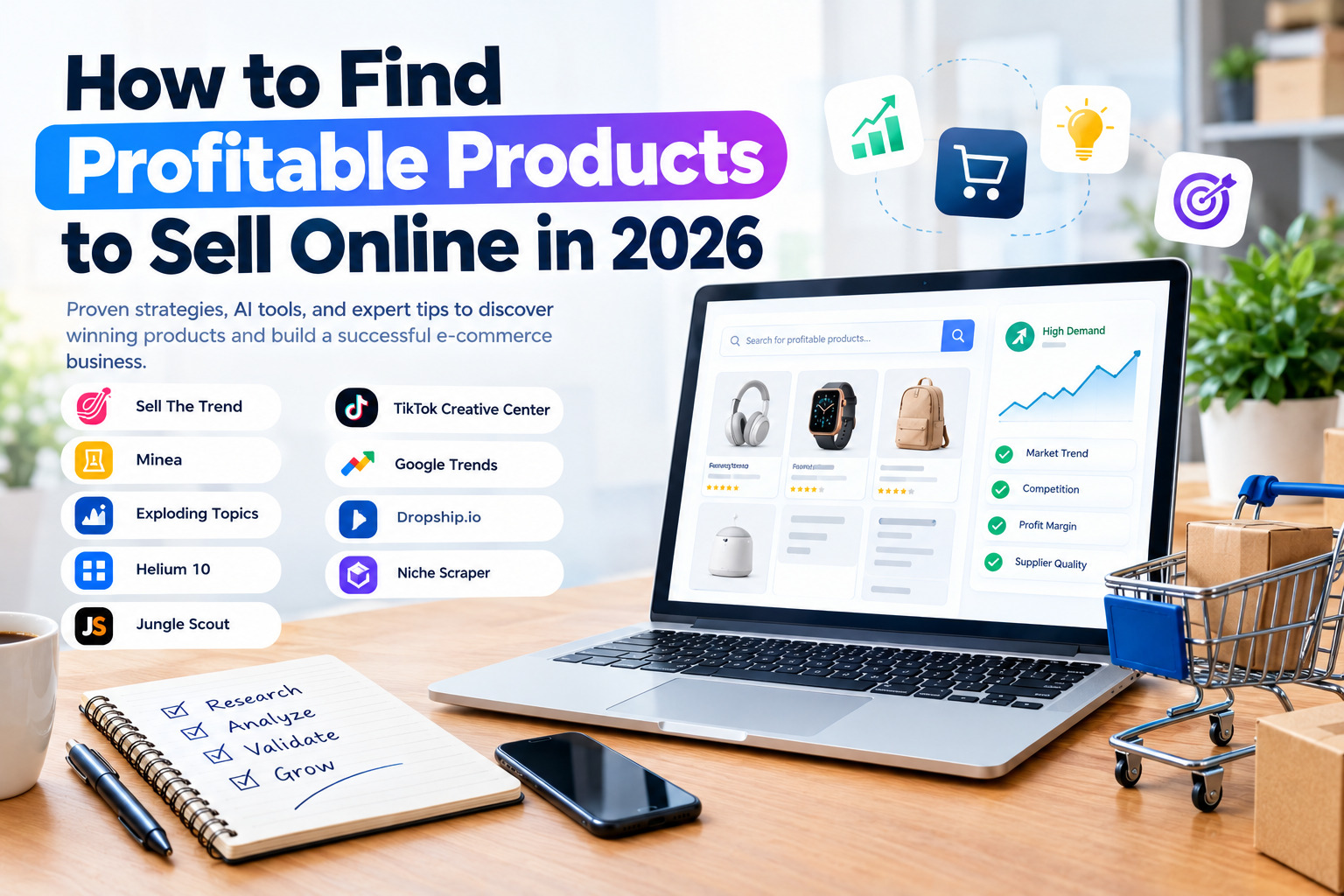
How to Find Profitable Products to Sell Online in 2026
Finding profitable products to sell online in 2026 requires more than following viral trends or copying successful stores. The most reliable approach combines market research, customer demand, competitor analysis, supplier evaluation, and careful profit calculations. Whether you are launching a dropshipping business, building a Shopify store, selling on Amazon, or starting an independent e-commerce brand, choosing the right product can make a significant difference to your long-term success.
The goal is not simply to find a product that attracts attention. It is to identify an item that solves a real problem, appeals to a specific audience, has manageable competition, and can generate a sustainable profit after all expenses are considered.
1. Start by Identifying a Real Customer Need
One of the best ways to find a profitable product is to understand what customers want to improve in their daily lives. Products that save time, simplify tasks, solve common problems, improve convenience, or serve a specific hobby can offer promising business opportunities.
Start by exploring customer complaints, frequently discussed problems, product reviews, and online communities. Look for repeated frustrations that existing products do not adequately address. For example, customers may want more convenient travel accessories, better storage solutions for small apartments, or practical products that make working from home easier.
Instead of asking whether a product looks popular, ask why someone would pay for it. A clear customer need gives you a stronger foundation for product selection, marketing messages, and product differentiation.
2. Use Google Trends to Analyze Market Demand
Google Trends is a useful starting point for understanding whether interest in a product is increasing, declining, or remaining relatively stable. You can compare search terms, explore interest across different regions, and examine historical patterns to identify seasonal demand.
Search for product categories and specific product ideas over several months or years. Compare related terms rather than relying on a single phrase. For example, compare searches for reusable water bottles, insulated bottles, and travel hydration products to understand which topics attract sustained interest.
A temporary spike does not necessarily indicate a profitable opportunity. Stronger candidates often demonstrate consistent interest or a clear upward trend supported by other market signals. Google Trends measures relative search interest rather than exact sales, so use it as an initial research tool rather than proof of profitability.
Official tool: Google Trends
3. Explore TikTok Trends and High-Performing Products
Short-form videos can reveal products that attract attention because they demonstrate a useful feature, solve a visible problem, or offer an entertaining experience. TikTok can be particularly helpful for discovering products that are easy to demonstrate visually and explain within a few seconds.
Use TikTok Creative Center to explore trending products, advertisements, and creative examples. Pay attention to how products are presented, which benefits appear repeatedly, and whether different creators are promoting similar items. Look beyond views and likes to evaluate comments, buying questions, audience reactions, and signs of genuine interest.
A viral video alone is not enough to establish product viability. Some products receive attention without generating meaningful sales, while others become popular briefly and quickly lose demand. Verify the product’s market potential, competition, price, and fulfillment requirements before investing.
Official tool: TikTok Creative Center — Top Products
4. Research Successful Products on Amazon
Amazon provides useful marketplace signals for sellers who want to understand established customer demand. Browsing best-selling products and category rankings can help you identify popular product types, common features, pricing patterns, and customer expectations.
Explore relevant categories and compare products with similar purposes. Read both positive and negative reviews to discover what customers appreciate and what they believe could be improved. Repeated complaints about durability, packaging, usability, or missing features may reveal opportunities to create a better offer.
However, high rankings do not automatically mean a product is easy to enter or highly profitable. Popular products may have intense competition, established brands, and expensive advertising costs. Use marketplace rankings to generate ideas, then investigate demand, differentiation, and margins before choosing a product.
Official resource: Amazon Best Sellers
5. Use AI-Powered Product Research Tools
AI-powered product research platforms can help organize large amounts of market information and identify promising products more efficiently. Depending on the platform, these tools may analyze advertising activity, product listings, competitor stores, estimated sales, and emerging trends.
They are especially useful when researching multiple niches or comparing potential products. Instead of manually browsing hundreds of listings, you can use filters to narrow your search by product category, price, engagement, demand, or competition.
Remember that AI-generated recommendations and estimated sales figures are not guarantees. Different tools use different data sources and estimation methods, and some features require paid subscriptions. Verify important findings independently before making purchasing or advertising decisions.
Sell The Trend
Sell The Trend provides product research features designed for dropshipping and e-commerce sellers. Its platform combines product discovery with advertising and store research, helping users investigate potential products and examine market signals before testing an offer.
Use it to generate product ideas, compare competing offers, and investigate whether a product appears across multiple stores or advertising campaigns. Pay particular attention to saturation, selling price, product differentiation, and the evidence supporting estimated profitability.
This tool can be useful when you want a more structured research process, but you should still verify supplier quality, delivery times, and your actual costs.
Official tool: Sell The Trend Product Research
Minea
Minea helps e-commerce sellers research advertisements and discover products being promoted across platforms such as Facebook, Instagram, and TikTok. Its advertising research features can help you investigate which products attract attention, how advertisements are presented, and whether certain promotional approaches continue to appear over time.
When evaluating a product, examine more than its engagement numbers. Look for advertising activity over time, different versions of the same offer, and evidence that multiple sellers are testing the product. These signals can help you decide which ideas deserve further investigation.
Minea is particularly relevant to dropshippers and sellers who use paid social advertising. However, ad performance indicators do not reveal every seller’s actual profit, so calculate your own acquisition costs and margins.
Official tool: Minea — Product and Ad Research
Helium 10
Helium 10 offers product research tools for Amazon sellers. Its features help users explore product opportunities, review estimated sales, analyze competition, and investigate demand across supported marketplaces.
Use its product research tools to compare products within a category and identify opportunities that match your budget and business model. Examine the relationship between demand, selling price, review counts, competition, and fulfillment costs rather than focusing on estimated sales alone.
Helium 10 is most useful when Amazon is a primary sales channel. Sellers using other platforms should combine its marketplace-specific insights with research that reflects their own target audience and sales channel.
Official tool: Helium 10 Product Research
Jungle Scout
Jungle Scout provides research tools for Amazon sellers who want to discover potential products and evaluate market opportunities. Its Opportunity Finder helps users investigate niches using demand and competition signals, while other features support product and competitor analysis.
Use the platform to compare several product ideas instead of selecting the first promising result. Review the estimated sales potential, number of competing listings, pricing conditions, and customer demand within the relevant category.
Product research estimates can be useful for screening ideas, but they should not replace supplier quotations, fee calculations, or a small-scale market test.
Official tool: Jungle Scout | Opportunity Finder Guide
6. Study Competitors Before Entering a Niche
Competitor research helps you understand how other businesses position their products, attract customers, and communicate value. Examine independent online stores, marketplace listings, product pages, advertisements, pricing, shipping policies, and customer reviews.
Look for gaps rather than simply copying successful products. Competitors may offer limited sizes, confusing instructions, weak product photography, slow delivery, or inadequate customer support. These weaknesses can help you develop a more attractive offer.
Also evaluate how crowded the market is. If many sellers offer nearly identical products at similar prices, competing primarily on price may reduce your margins. A more promising opportunity may involve a specific audience, a useful product bundle, improved packaging, or a better shopping experience.
For advertising and competitor-store research, you can explore Minea and Sell The Trend.
7. Find a Specific Niche Instead of Targeting Everyone
A niche helps you focus on a defined group of customers with shared interests, needs, or purchasing habits. Instead of selling general accessories to everyone, you might focus on travel organization, compact home storage, pet enrichment, or equipment for a particular hobby.
A clearly defined niche can make product selection, branding, content creation, and audience targeting more manageable. It can also help you differentiate your store from large retailers that compete across many categories.
To evaluate a niche, consider its audience size, purchasing frequency, level of competition, average selling prices, and potential for related products. Avoid niches that depend entirely on a short-lived trend unless you have a realistic plan for testing and exiting quickly.
A strong niche is not necessarily the most popular one. It is a market where you can reach customers effectively and offer something they have a reason to choose.
8. Calculate Profit Margins Before Choosing a Product
A product can generate substantial sales and still lose money. Before committing to an idea, calculate how much remains after product costs, shipping, transaction fees, advertising, returns, packaging, and other operating expenses.
Use this formula to estimate contribution profit per order:
Contribution Profit = Selling Price − Total Variable Costs
For example, imagine selling a product for $40. If the product costs $12, shipping costs $5, payment and marketplace fees total $3, and advertising costs $8 per order, the contribution profit is $12 before fixed overhead, taxes, and any additional expenses.
In this example, the contribution margin is 30% of the selling price. Actual results may be lower if return rates increase, advertising becomes more expensive, or unexpected fulfillment costs appear.
| Cost item | Example amount |
|---|---|
| Selling price | $40 |
| Product cost | $12 |
| Shipping and fulfillment | $5 |
| Transaction and marketplace fees | $3 |
| Advertising cost per order | $8 |
| Contribution profit | $12 |
Do not rely on a product’s apparent markup as a measure of profitability. Estimate realistic costs for your chosen platform and country, and leave room for discounts, refunds, customer service, and business overhead.
9. Evaluate Suppliers and Product Quality
A promising product idea can fail if the supplier delivers inconsistent quality, charges unexpected fees, or cannot meet customer expectations. Before choosing a supplier, compare unit costs, minimum order quantities, shipping options, processing times, return policies, and communication quality.
Whenever possible, order samples and inspect the product yourself. Test its durability, packaging, usability, and consistency with the supplier’s descriptions. If you plan to sell internationally, check applicable product standards, customs requirements, and shipping restrictions.
Do not select a supplier based on the lowest price alone. A slightly more expensive supplier may offer better quality control, reliable delivery, and fewer customer complaints, which can improve long-term profitability.
For dropshipping, confirm that the supplier can maintain stock and fulfill orders consistently. For private-label products, consider whether the supplier can support branding, packaging, and future production increases.
10. Look for Products With Repeat-Purchase or Upsell Potential
Products that encourage repeat purchases or naturally lead to complementary purchases can help build a more sustainable business. Examples include replacement accessories, refillable supplies, compatible add-ons, and products that customers purchase regularly.
Repeat-purchase potential is especially valuable when acquiring a new customer is expensive. If a customer returns to buy related products, the business may earn more revenue from the original customer relationship instead of relying entirely on new customer acquisition.
However, repeat purchases depend on the product category and actual customer behavior. Do not assume that every consumable or accessory will generate recurring revenue. Check purchase frequency, product lifespan, customer reviews, and the availability of compatible alternatives before making this part of your business plan.
11. Validate Demand Before Investing Heavily
After narrowing your research to a few promising products, test whether real customers are willing to buy them. Start with a manageable experiment rather than purchasing a large inventory or spending heavily on advertising.
Depending on your business model, validation may include a small inventory order, a simple product page, a limited advertising campaign, organic social content, or a small marketplace listing. Track meaningful indicators such as conversion rate, cost per purchase, customer questions, refund requests, and contribution profit.
Interest is useful, but actual purchasing behavior is stronger evidence. A product with many views and few sales may have a weak offer, an unsuitable price, or an audience that enjoys watching the content without intending to buy.
Set a budget and define the results you need before starting. If the product does not meet your criteria, investigate the problem, adjust the offer, or move on to another idea.
12. Choose Products That Are Easy to Demonstrate and Market
The ability to explain a product’s value clearly can influence its performance online. Products with visible benefits, straightforward use cases, and clear before-and-after demonstrations may be easier to promote through video, social media, and product-page content.
Consider whether you can demonstrate the product in a short video, show its main benefit in a photograph, or explain why it is better suited to a specific customer. A strong demonstration can help customers understand the product without requiring a lengthy explanation.
Use advertising libraries and creative research tools to study how other businesses present similar items. The goal is to learn which customer problems and product benefits are being communicated, then develop original content that reflects your own offer.
Useful resources include TikTok Creative Center and Minea.
13. Consider Shipping, Returns, and Product Risks
Product profitability depends on more than demand and purchase price. Large, heavy, fragile, or complicated products may create higher shipping costs, more damage claims, and greater customer-service demands.
Before selecting a product, consider its dimensions, weight, packaging requirements, delivery time, storage needs, and likely return rate. Check whether the product requires certifications, special handling, or compliance with local regulations.
Be particularly careful with products that make medical or safety claims, branded goods that may raise intellectual-property concerns, and items subject to import restrictions. Verify that you can legally sell and advertise the product in your intended market.
A practical product with manageable fulfillment requirements can sometimes be a better business choice than a more exciting product with uncertain delivery, quality, or compliance risks.
14. Build a Product Research Scorecard
A consistent scorecard makes it easier to compare potential products objectively. Instead of relying on excitement or personal preference, evaluate each candidate against the same criteria.
Consider scoring each product from 1 to 5 for the following factors:
| Evaluation factor | What to examine |
|---|---|
| Customer demand | Search interest, marketplace activity, and customer feedback |
| Competition | Number and strength of competing offers |
| Profit potential | Estimated contribution profit after variable costs |
| Product differentiation | Ability to offer a distinct benefit or customer experience |
| Supplier reliability | Quality, availability, shipping, and communication |
| Marketing potential | Ease of demonstrating the product and explaining its value |
| Business risk | Returns, regulations, damage, and fulfillment complexity |
A scorecard helps you identify weak points before spending money. It should not be treated as a scientific prediction of success: the quality of your research matters more than the total score.
For example, a product with strong demand but poor margins may need a different supplier or bundle. A product with moderate demand and low competition may be worth testing if you can reach the right audience at a reasonable cost.
15. Create a Repeatable Product Research Process
Successful product discovery is an ongoing process, not a one-time task. Customer preferences, competition, advertising costs, and market conditions can change throughout the year. A repeatable research routine helps you identify new opportunities while avoiding impulsive decisions.
Start by generating ideas from customer problems, search trends, marketplace rankings, and competitor research. Shortlist the most relevant products, investigate their demand and competition, calculate their margins, and verify supplier quality. Then test the strongest candidates with a controlled budget and measure actual results.
Keep a record of why each product was selected, which assumptions you made, and what happened during testing. Over time, these records can help you recognize patterns in your market and make better decisions about pricing, marketing, and product selection.
Using a combination of free resources such as Google Trends and Amazon Best Sellers, alongside specialist tools such as Helium 10 or Jungle Scout, can help you build a research process that fits your budget and sales channel.
Conclusion
Finding profitable products to sell online in 2026 is a process of researching demand, understanding customers, evaluating competitors, checking suppliers, and validating the numbers. Trends and AI-powered tools can help you discover ideas faster, but no tool can guarantee that a product will become profitable.
The strongest approach is to combine multiple sources of evidence, calculate realistic margins, and test promising products on a small scale before making a larger commitment. Focus on products that solve genuine problems, offer a clear reason to buy, and can be delivered reliably at a sustainable cost.
With consistent research and disciplined testing, you can reduce guesswork, make better product decisions, and build an e-commerce business around opportunities supported by real customer demand.


