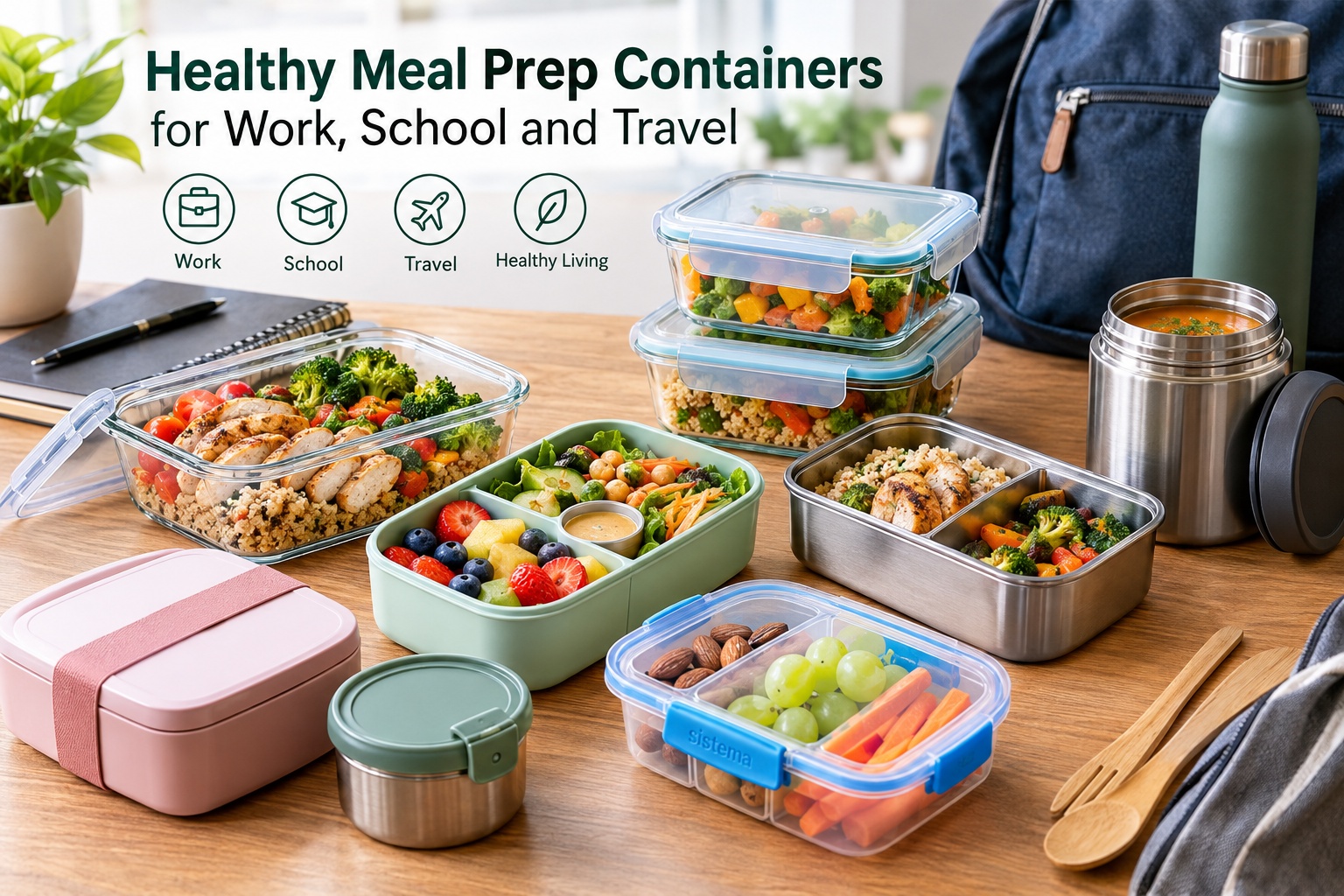
Best Healthy Meal Prep Containers for Work, School, and Travel in 2026
Why Healthy Meal Prep Containers Matter
Preparing healthy meals at home is one of the simplest ways to improve your daily eating habits, save money, and reduce dependence on fast food. Whether you are going to work, attending school, traveling, or spending a busy day away from home, having the right food container makes it easier to enjoy nutritious meals wherever you are.
The best healthy meal prep containers do more than hold food. They help keep meals organized, separate different ingredients, prevent leaks, preserve freshness, and make portioning more convenient. Some models are designed for reheating meals in the microwave, while others prioritize lightweight construction, insulation, or durability for everyday transport.
With so many options available, choosing the right lunch box can be challenging. Glass containers are popular for their resistance to stains and odors, plastic containers are lightweight and convenient, and stainless steel models offer durability for people who want reusable alternatives.
In this guide, we explore the best healthy meal prep containers for work, school, and travel, explain their essential features and benefits, and provide Amazon shopping links for Germany and other major European markets.
1. What Makes a Good Healthy Meal Prep Container?
A good meal prep container should make storing, transporting, and eating homemade food simple and convenient. However, not every lunch box is suitable for every situation.
The best choice depends on the meals you prepare, how far you travel, whether you have access to a refrigerator or microwave, and how much food you need to carry.
Leakproof Design
A leakproof container is essential if you plan to carry soups, sauces, yogurt, salads with dressing, or other moist foods.
Look for secure locking clips, silicone seals, and lids designed to prevent liquid from escaping during transport. Keep in mind that some containers are leak-resistant rather than completely leakproof, so check the manufacturer’s specifications before carrying liquids in a bag.
Food-Safe Materials
Meal prep containers are commonly made from glass, stainless steel, or food-grade plastic.
Glass containers are useful for storing cooked meals and reheating food in compatible microwave or oven-safe dishes. Stainless steel containers are durable and lightweight compared with many glass alternatives, although they generally cannot be used in a microwave.
Food-grade plastic containers are often affordable, easy to carry, and suitable for everyday lunches. Choose products clearly identified as suitable for food contact, and check whether they are BPA-free if that is important to you.
Separate Compartments
Containers with multiple compartments help keep different foods separate until lunchtime.
For example, you can pack grilled chicken, brown rice, and vegetables in different sections instead of allowing everything to mix together. Bento-style lunch boxes are particularly useful for children, students, and people who prefer varied meals.
Some containers also include small removable cups for dressings, nuts, sauces, or fruit.
Microwave and Dishwasher Compatibility
If you regularly prepare meals in advance, microwave and dishwasher compatibility can save considerable time.
Glass containers are often suitable for reheating food, while some plastic containers can also be microwaved when the manufacturer explicitly permits it.
However, lids may have different temperature restrictions from the containers themselves. Always follow the product instructions and remove the lid before reheating unless it is specifically designed for microwave use.
Stackable and Space-Saving Design
Stackable containers help organize meals in the refrigerator and reduce clutter in kitchen cabinets.
If you prepare several lunches at once, look for containers with uniform shapes and secure lids that make them easy to store and transport.
For people who commute by public transport or travel frequently, compact dimensions and a lightweight design can be just as important as capacity.
2. Best Types of Meal Prep Containers for Different Needs
Before choosing a specific product, it helps to understand the differences between the main types of food containers.
Glass Meal Prep Containers
Glass containers are popular among people who prepare meals at home and want durable storage for cooked food.
Borosilicate glass is designed to withstand temperature changes better than many ordinary types of glass, although it can still break if dropped or exposed to thermal shock.
Glass containers generally resist food stains and odors well and are convenient for storing meals that need to be reheated.
Main advantages:
- Good resistance to stains and lingering food odors.
- Suitable for reheating when the container is labeled microwave-safe.
- Easy to inspect because the contents are visible.
- Often dishwasher-safe, depending on the product.
- Useful for batch cooking and refrigerator storage.
Potential disadvantages:
- Heavier than plastic containers.
- Can break if dropped.
- Lids and seals may need separate cleaning.
- Not ideal for carrying heavy loads over long distances.
Glass is an excellent option for office workers who drive to work, people who prepare several meals in advance, and anyone who regularly reheats food at lunchtime.
BPA-Free Plastic Meal Prep Containers
Plastic meal prep containers are convenient for students, commuters, and travelers who need lightweight food storage.
Many models feature snap-lock lids, multiple compartments, and stackable shapes. Some are designed for microwave use, while others are intended only for cold food storage.
Main advantages:
- Lightweight and easy to carry.
- Often less expensive than glass alternatives.
- Available in a wide range of sizes.
- Convenient for school lunches and everyday snacks.
- Some models are microwave-safe and dishwasher-safe.
Potential disadvantages:
- Some plastics can become stained by tomato sauces or spices.
- Certain containers may retain odors over time.
- Lids can warp if exposed to excessive heat.
- Not every plastic container is suitable for microwaving.
Plastic containers are particularly useful when weight, portability, and affordability are the main priorities.
Stainless Steel Lunch Boxes
Stainless steel lunch boxes are a practical choice for people who want a durable reusable container.
They are generally resistant to rust when made from suitable food-grade stainless steel and maintained correctly. Many models are designed for sandwiches, salads, fruit, rice dishes, and other solid foods.
Some include removable dividers, while others feature insulated construction for transporting hot or cold food.
Main advantages:
- Durable construction.
- Lightweight compared with many glass containers.
- Generally resistant to stains and odors.
- Suitable for repeated everyday use.
- Available in simple, reusable designs.
Potential disadvantages:
- Most models cannot be used in a microwave.
- Some lids are not completely leakproof.
- Metal containers may be more expensive than basic plastic alternatives.
- Insulated models can be bulkier than standard lunch boxes.
Stainless steel is particularly suitable for school lunches, outdoor activities, and travel when microwave reheating is not required.
Bento Lunch Boxes
Bento boxes are designed to organize meals into separate compartments.
They are ideal for balanced lunches containing a main dish, vegetables, fruit, and small snacks. Some models include removable dividers, sauce containers, cutlery, or multiple stacked compartments.
Main advantages:
- Helps separate different foods.
- Makes portion organization easier.
- Suitable for work, school, and picnics.
- Encourages variety in packed lunches.
- Available in child-friendly and adult designs.
Potential disadvantages:
- Some compartments are too small for larger meals.
- Not every model is leakproof.
- Compartments may be difficult to clean if the design has many corners.
- Some models require separate bags for liquids.
Bento boxes are an excellent choice for people who prefer organized meals with several ingredients.
Insulated Food Containers
Insulated food containers are designed to help maintain food temperature during transport.
Depending on the design, they may be used for soups, oatmeal, stews, pasta, or other hot meals. Some insulated lunch boxes also include separate compartments for cold foods.
Main advantages:
- Helps maintain food temperature.
- Useful for long school or work days.
- Suitable for meals when a microwave is unavailable.
- Many models have secure screw-top lids.
Potential disadvantages:
- Usually heavier or bulkier than basic lunch boxes.
- Capacity may be limited by the design.
- Insulation performance varies between products.
- Requires proper cleaning to prevent odors and food residue.
For longer journeys, an insulated container can be especially useful when you need to carry a meal that is best enjoyed warm.
3. Best Healthy Meal Prep Containers to Buy in 2026
The following products and product lines offer different solutions for everyday meal preparation. The best option depends on your budget, preferred material, portion size, and intended use.
Amazon links below lead to product search results for Germany, France, Italy, and Spain. Product availability, prices, colors, and delivery options can change, so check the individual listing before ordering.
1. IKEA 365+ Food Containers: Best for Everyday Meal Preparation
The IKEA 365+ food storage range is worth considering if you regularly prepare lunches and dinners in advance.
The range includes containers made from different materials and in different sizes. Glass options are particularly useful for storing cooked meals, leftovers, vegetables, and prepared ingredients.
Depending on the specific product, compatible lids and containers may support refrigerator storage, freezing, dishwasher cleaning, or microwave reheating.
Key features:
- Multiple container sizes for different meal portions.
- Stackable designs for organized storage.
- Glass options for convenient food reheating.
- Reusable construction for regular meal preparation.
- Different lid options depending on the product.
Main benefits: The range is useful for people who prepare several meals at once and want containers that work well in the kitchen as well as for packed lunches.
Potential limitations: Not every container or lid has the same heat resistance or leakproof performance. Check the specifications of the exact model you choose.
Best for: Home meal prep, office lunches, and storing leftovers.
Where to buy:
Amazon Germany – IKEA 365+ Food Containers
Amazon France – IKEA 365+ Food Containers
Amazon Italy – IKEA 365+ Food Containers
Amazon Spain – IKEA 365+ Food Containers
2. Pyrex Glass Food Storage Containers: Best for Reheating Meals
Pyrex glass food storage containers are a practical choice for people who prepare meals at home and want to reheat them later.
Depending on the specific range, these containers may feature glass bases and plastic lids. They are useful for cooked vegetables, rice, pasta, chicken, fish, and other prepared meals.
Glass makes it easier to see what is inside and generally resists staining better than many plastic containers.
Key features:
- Glass construction on compatible models.
- Convenient storage for cooked meals and leftovers.
- Transparent sides for easy identification of food.
- Different sizes for individual meals and larger portions.
- Reusable designs for everyday kitchen use.
Main benefits: Glass containers are useful for preparing food in advance, storing it in the refrigerator, and reheating it in a compatible container.
Potential limitations: Glass is heavier than plastic and can break if dropped. Plastic lids may have different temperature restrictions from the glass base.
Best for: Office workers who prefer to reheat homemade meals and households that prepare food in batches.
Where to buy:
Amazon Germany – Pyrex Glass Food Containers
Amazon France – Pyrex Glass Food Containers
Amazon Italy – Pyrex Glass Food Containers
Amazon Spain – Pyrex Glass Food Containers
3. Mepal Bento Lunch Boxes: Best for Work and School
Mepal offers reusable lunch boxes designed for carrying sandwiches, salads, fruit, snacks, and prepared lunches.
Its Take a Break range includes different sizes and configurations, allowing users to choose a lunch box that suits their daily routine.
Some models include separate compartments or accessories that help keep different foods organized.
Key features:
- Compact designs for bags and backpacks.
- Different sizes for snacks and full lunches.
- Reusable construction.
- Selected models with removable compartments or accessories.
- Options designed for everyday use at work and school.
Main benefits: Mepal lunch boxes are convenient for people who want to carry a varied lunch without using multiple disposable packages.
Potential limitations: Features vary between models, and not every lunch box is suitable for liquids or microwave reheating. Check the exact product specifications.
Best for: Students, office workers, and people who carry sandwiches, fruit, salads, and snacks.
Where to buy:
Amazon Germany – Mepal Lunch Boxes
Amazon France – Mepal Lunch Boxes
Amazon Italy – Mepal Lunch Boxes
Amazon Spain – Mepal Lunch Boxes
4. Sistema Bento Lunch Boxes: Best for Lightweight Everyday Use
Sistema produces plastic food storage containers and lunch boxes designed for everyday convenience.
Selected Bento Box models include several compartments for keeping sandwiches, fruit, vegetables, and snacks separate. Some configurations also include smaller containers for dips or other additions.
Their relatively lightweight construction makes them convenient for carrying in school bags, backpacks, or work bags.
Key features:
- Lightweight plastic construction.
- Multiple compartments on selected models.
- Compact designs for packed lunches.
- Reusable storage for snacks and prepared food.
- Different sizes and configurations.
Main benefits: These containers are useful for people who want to pack different foods in one compact box without carrying several separate containers.
Potential limitations: Leakproof performance varies by model, and not all compartments are suitable for liquid foods. Follow the manufacturer’s instructions for microwave and dishwasher use.
Best for: School lunches, office snacks, and everyday commuting.
Where to buy:
Amazon Germany – Sistema Bento Lunch Boxes
Amazon France – Sistema Bento Lunch Boxes
Amazon Italy – Sistema Bento Lunch Boxes
Amazon Spain – Sistema Bento Lunch Boxes
5. Bentgo Lunch Boxes: Best for Compartmentalized Meals
Bentgo specializes in lunch boxes with practical compartments for organizing meals and snacks.
Depending on the model, the range includes plastic lunch boxes, glass containers, and designs intended for children or adults.
Compartmentalized lunch boxes make it easier to pack several food groups together without mixing everything into one large portion.
Key features:
- Separate compartments for different foods.
- Models for children and adults.
- Selected designs with removable trays.
- Options for different meal sizes.
- Reusable construction for regular use.
Main benefits: Bentgo lunch boxes can make packed lunches more organized and convenient, particularly when you want to include fruit, vegetables, protein, and a main dish.
Potential limitations: Capacity, leakproof performance, and heating compatibility vary by model. Some containers are designed for cold lunches rather than reheating.
Best for: School meals, office lunches, and people who like keeping different foods separate.
Where to buy:
Amazon Germany – Bentgo Lunch Boxes
Amazon France – Bentgo Lunch Boxes
Amazon Italy – Bentgo Lunch Boxes
Amazon Spain – Bentgo Lunch Boxes
6. Rubbermaid Brilliance Food Storage Containers: Best for Leak-Resistant Storage
Rubbermaid Brilliance containers are designed for food storage with secure lids and transparent construction.
Selected models use lightweight, clear plastic and feature locking closures intended to help prevent leaks and keep food contained during transport.
They are useful for prepared salads, pasta, chopped vegetables, fruit, and other foods that benefit from secure storage.
Key features:
- Clear containers for easy identification of food.
- Secure locking lids on compatible models.
- Multiple sizes for meal portions and snacks.
- Stackable designs.
- Reusable construction.
Main benefits: Their transparent design makes it easy to identify stored food, while secure closures are useful for transporting lunches.
Potential limitations: Product specifications differ by model, and containers that are suitable for liquids may still require careful handling. Check the manufacturer’s guidance for microwave and dishwasher compatibility.
Best for: Office workers, meal preppers, and people who frequently carry salads or moist foods.
Where to buy:
Amazon Germany – Rubbermaid Brilliance Containers
Amazon France – Rubbermaid Brilliance Containers
Amazon Italy – Rubbermaid Brilliance Containers
Amazon Spain – Rubbermaid Brilliance Containers
7. Stainless Steel Bento Lunch Boxes: Best for Durability and Travel
Stainless steel bento lunch boxes are a good option for people who want a sturdy container for daily use.
Many models include separate compartments, removable dividers, or secure clips. Some are designed for sandwiches and snacks, while larger versions can accommodate complete meals.
Stainless steel is particularly practical when you do not need to heat the container in a microwave.
Key features:
- Durable metal construction.
- Reusable design.
- Selected models with multiple compartments.
- Lightweight alternatives to many glass containers.
- Options for school, work, and outdoor activities.
Main benefits: Stainless steel containers are suitable for regular transport and can be a good long-term alternative to disposable packaging.
Potential limitations: They are generally not microwave-safe, and not all models are fully leakproof. Some metal lunch boxes also lack insulation.
Best for: Commuters, students, outdoor enthusiasts, and travelers who prioritize durability.
Where to buy:
Amazon Germany – Stainless Steel Bento Lunch Boxes
Amazon France – Stainless Steel Bento Lunch Boxes
Amazon Italy – Stainless Steel Bento Lunch Boxes
Amazon Spain – Stainless Steel Bento Lunch Boxes
8. Thermos Insulated Food Containers: Best for Hot Meals on the Go
Thermos insulated food containers are designed for people who want to carry hot or cold meals without relying on a microwave or refrigerator immediately before eating.
Depending on the model, they may be suitable for soups, stews, porridge, pasta, and other foods that benefit from temperature retention.
Their insulated construction is especially useful during long workdays, outdoor activities, and journeys.
Key features:
- Insulated construction on compatible models.
- Secure lids designed for food transport.
- Different capacities for snacks and complete meals.
- Suitable designs for soups and other hot foods.
- Reusable construction.
Main benefits: An insulated food jar can make it easier to enjoy a prepared meal while traveling or working away from home.
Potential limitations: Temperature retention varies by model and use. Insulated containers may be heavier than ordinary lunch boxes and generally cannot be used in a microwave.
Best for: Travelers, outdoor workers, students with long school days, and people who prefer hot homemade meals.
Where to buy:
Amazon Germany – Thermos Food Containers
Amazon France – Thermos Food Containers
Amazon Italy – Thermos Food Containers
Amazon Spain – Thermos Food Containers
4. Best Meal Prep Containers for Work
Choosing a lunch container for work depends on your commute, the type of food you bring, and the facilities available at your workplace.
If you have access to a microwave, a glass container with a suitable lid is an excellent choice for rice bowls, pasta, cooked vegetables, and other hot meals.
If you commute by train, bus, or bicycle, a lightweight plastic container with secure closures may be more convenient.
For salads, fruit, and cold lunches, a compartmentalized bento box can keep ingredients separate until you are ready to eat.
If your workday is long and you cannot reheat food, consider an insulated food jar designed to maintain temperature.
Recommended Features for Office Lunch Boxes
Look for a container with enough capacity for your usual lunch, a secure lid, and a shape that fits easily into your bag.
If you carry sauces or dressings, choose a genuinely leakproof container or pack liquids separately in suitable small containers.
Stackable designs are useful if you prepare several lunches at once, while microwave compatibility can simplify reheating at the office.
5. Best Healthy Lunch Boxes for School
School lunch boxes should be easy to open, durable, and appropriately sized for the child’s appetite.
A good lunch box can accommodate a sandwich or main dish, fruit, vegetables, and a small snack without making the school bag unnecessarily heavy.
Bento-style containers are particularly useful because they separate foods and encourage variety.
Features to Look For
Choose a lightweight container with secure closures that a child can open independently.
Rounded corners and removable compartments can make cleaning easier. If the lunch box will carry yogurt, sauces, or juicy fruit, pay attention to leakproof performance.
For younger children, simple designs with fewer small detachable parts may be easier to manage.
If food needs to stay hot or cold for several hours, use a suitable insulated container or lunch bag.
Remember that ordinary lunch boxes do not automatically keep perishable foods at a safe temperature. Pack foods that require refrigeration with an appropriate ice pack and follow food safety guidance.
6. Best Meal Prep Containers for Travel
Travel introduces additional challenges because food may need to remain secure and fresh for several hours.
The best travel container depends on whether you are driving, flying, hiking, or commuting between destinations.
For road trips, sturdy containers with secure lids can hold sandwiches, salads, cooked meals, and snacks.
For flights, compact containers may be more convenient, although airport security rules can restrict liquids and gels in carry-on baggage.
For hiking and outdoor activities, stainless steel or durable plastic containers may be preferable because they are easier to carry than glass.
If you need to transport hot soup or porridge, a suitable insulated food jar can be a useful alternative to a standard lunch box.
Important Travel Considerations
Choose a container that fits securely inside your bag and does not take up more space than necessary.
Check whether the lid can withstand repeated opening and closing, and consider whether the container can be cleaned easily during a trip.
For longer journeys, temperature control is particularly important. Use an insulated cooler bag with suitable ice packs for perishable foods when refrigeration is unavailable.
Do not assume that an airtight container will keep food safe at room temperature for an entire day.
7. How to Choose the Right Container Size
The ideal meal prep container size depends on the meal, your appetite, and how you organize your food.
A small container may be sufficient for nuts, fruit, yogurt, or a light snack. A medium-sized container can accommodate a sandwich, salad, or simple lunch, while larger containers are useful for complete meals and batch cooking.
Containers with separate compartments can help organize different ingredients without requiring several individual boxes.
Small Containers
Small containers are ideal for sauces, dressings, dips, nuts, seeds, and small portions of fruit.
They are also useful for keeping wet ingredients separate from dry foods.
Medium Containers
Medium containers are suitable for sandwiches, salads, snacks, and many individual lunches.
They offer a good balance between portability and capacity for everyday use.
Large Containers
Large containers are useful for rice bowls, pasta dishes, cooked meals, and substantial portions.
They are also practical for preparing meals in advance and storing leftovers in the refrigerator.
When choosing a size, consider the dimensions of your bag and whether you need room for cutlery, a water bottle, or additional snacks.
8. How to Prepare Healthy Meals for Work, School, and Travel
The right container makes healthy eating more convenient, but the contents matter just as much.
A balanced packed lunch can include a source of protein, vegetables or fruit, whole grains or another carbohydrate source, and a suitable source of healthy fats.
For example, you could prepare grilled chicken with brown rice and vegetables, a chickpea salad with olive oil dressing, or a whole-grain sandwich accompanied by fruit and yogurt.
Plan Meals in Advance
Preparing several meals at once can save time during busy weekdays.
Choose a few recipes that use overlapping ingredients so that you can prepare different combinations without cooking everything from scratch each day.
Store meals in appropriately sized containers and label them when necessary to keep track of preparation dates.
Keep Wet and Dry Ingredients Separate
Salad leaves, crunchy vegetables, bread, and some toppings can lose their texture when stored with moist ingredients.
Use separate compartments or small sauce containers to keep dressings, dips, and other wet ingredients apart until lunchtime.
This simple approach can improve the texture and overall quality of packed meals.
Use Proper Food Storage Practices
Cooked food should be cooled and refrigerated promptly according to established food safety guidance.
Use a refrigerator to store perishable meals and a suitable insulated cooler bag with ice packs when refrigeration is not available.
Follow recommended storage times and temperatures, and reheat food thoroughly when appropriate.
A leakproof lid helps prevent spills, but it does not replace proper temperature control.
9. How to Clean and Maintain Meal Prep Containers
Regular cleaning helps keep food containers hygienic and extends their useful life.
After eating, remove food residue as soon as practical rather than allowing sauces and oils to dry inside the container.
Wash the container according to the manufacturer’s instructions. If it is dishwasher-safe, check whether the lid and removable seals can also be washed in the dishwasher.
Silicone gaskets and small removable parts may require extra attention because food residue can collect around them.
Allow all parts to dry thoroughly before reassembling the container.
Inspect plastic containers for cracks, damaged lids, or persistent odors, and replace any container that is no longer in suitable condition.
For glass containers, check for chips or cracks before use. Damaged glass should not be used for food storage.
Stainless steel containers should also be cleaned and dried properly, particularly around hinges, seals, and locking mechanisms.
10. Common Mistakes to Avoid When Buying Meal Prep Containers
One common mistake is choosing a container based only on its appearance. A stylish lunch box may not have enough capacity for your meals or may be difficult to clean.
Another mistake is assuming that every airtight container is completely leakproof. If you regularly carry soup or dressing, verify that the model is designed for liquids.
It is also important not to assume that every glass container is oven-safe or that every plastic container is microwave-safe. Follow the manufacturer’s instructions for the exact model.
Buying a large set of containers without checking their sizes can also lead to unnecessary clutter. A small selection of containers that match your regular meals may be more useful than a large collection of unsuitable sizes.
Finally, do not overlook weight and portability. A heavy glass container may work well for driving to the office but be less convenient for a child carrying a school backpack.
11. Glass vs. Plastic vs. Stainless Steel: Which Is Best?
The best material depends on how you plan to use your container.
Choose glass if you regularly prepare cooked meals, want a container that resists staining, and need a convenient option for reheating food in the microwave.
Choose plastic if you want a lightweight, affordable container for school, work, or daily commuting. Look for food-safe materials and follow the manufacturer’s heating instructions.
Choose stainless steel if durability and portability are your main priorities and you do not need to microwave the container.
Choose an insulated container if maintaining food temperature during travel is particularly important.
There is no single material that is best for everyone. Your daily routine, preferred meals, budget, and available facilities should guide your decision.
12. Where to Buy Meal Prep Containers in Germany and the European Union
Amazon offers a broad selection of glass food containers, bento boxes, plastic lunch boxes, stainless steel models, and insulated food jars.
Shopping across different Amazon marketplaces can help you compare available sizes, materials, designs, and delivery options.
For buyers in Germany, Amazon.de is a convenient starting point. Customers in other European countries can also explore Amazon marketplaces serving France, Italy, and Spain.
Before placing an order, check the product dimensions, material specifications, lid design, microwave compatibility, dishwasher instructions, and customer feedback.
It is also worth comparing the number of containers included in a set and checking whether additional accessories, such as sauce cups or dividers, are supplied.
Choose products that meet your actual needs instead of paying for features you are unlikely to use.
Frequently Asked Questions About Healthy Meal Prep Containers
What are the best meal prep containers for work?
Glass containers are useful if you reheat food in an office microwave. Lightweight plastic containers are convenient for commuting, while stainless steel lunch boxes are suitable for people who prioritize durability and do not need microwave heating.
Are glass meal prep containers better than plastic ones?
Glass generally resists stains and odors well and is convenient for reheating food in compatible containers. Plastic is lighter and often easier to carry. The better choice depends on your routine and priorities.
Which lunch boxes are best for school children?
Lightweight bento boxes with easy-to-open closures and separate compartments are often practical for children. Choose an appropriate size and consider whether the box needs to carry wet foods or stay insulated.
Are stainless steel lunch boxes microwave-safe?
Most stainless steel lunch boxes should not be placed in a microwave. Check the manufacturer’s instructions and use a microwave-safe alternative if you need to reheat food.
How do I choose a leakproof lunch box?
Look for a model specifically described as leakproof, with secure closures and suitable seals. If you carry liquids, confirm that the container is designed to hold them and follow the manufacturer’s instructions.
Can I prepare meals for the whole week in advance?
You can prepare several meals in advance, but not all cooked foods remain safe in the refrigerator for an entire week. Refrigerate food promptly, follow food safety guidance, and freeze portions that will not be consumed within the recommended refrigerated storage period.
Are BPA-free plastic containers safe for food storage?
Food-grade containers designed for their intended use can be practical for everyday food storage. BPA-free labeling addresses one particular chemical, but it does not automatically establish that a product is suitable for every temperature or use. Follow the manufacturer’s instructions.
What size meal prep container should I buy?
The right size depends on your typical meal. Small containers are useful for snacks and sauces, medium containers work well for many lunches, and larger containers are suitable for substantial meals or batch cooking.
Conclusion: Choosing the Best Healthy Meal Prep Containers for Work, School, and Travel
The best healthy meal prep containers make it easier to enjoy nutritious homemade food wherever your day takes you. By choosing the right size, material, lid design, and compartment layout, you can organize meals more efficiently, reduce spills, and simplify your daily routine.
Glass containers are excellent for home meal preparation and reheating, plastic lunch boxes offer lightweight convenience for school and commuting, and stainless steel models provide durable options for everyday transport. Insulated food containers are particularly useful when you need to carry hot meals during longer journeys.
Products from IKEA 365+, Pyrex, Mepal, Sistema, Bentgo, Rubbermaid, and Thermos offer a range of solutions for different needs and budgets.
Before purchasing, compare the product specifications, check compatibility with your intended use, and choose a container that is easy to clean and comfortable to carry.
With the right meal prep containers and a little advance planning, preparing healthy lunches for work, school, and travel can become a simple, affordable, and sustainable part of everyday life.


