
African Politics and Development Challenges: Governance, Economic Growth, and Sustainable Progress
Introduction to African Politics and Development
African politics and development are closely connected to the continent’s economic performance, social transformation, institutional strength, and international influence. Africa includes countries with different political systems, economic structures, cultural traditions, and development priorities. While some economies are expanding through technology, manufacturing, services, and natural resources, others face persistent challenges involving poverty, unemployment, political instability, infrastructure shortages, and limited public finances.
Understanding African politics requires examining how governments develop policies, manage public resources, maintain institutions, and respond to the needs of their populations. Political decisions influence investment, education, healthcare, employment, trade, and environmental protection. Effective governance can create opportunities for sustainable development, while weak institutions and inconsistent policies can slow progress.
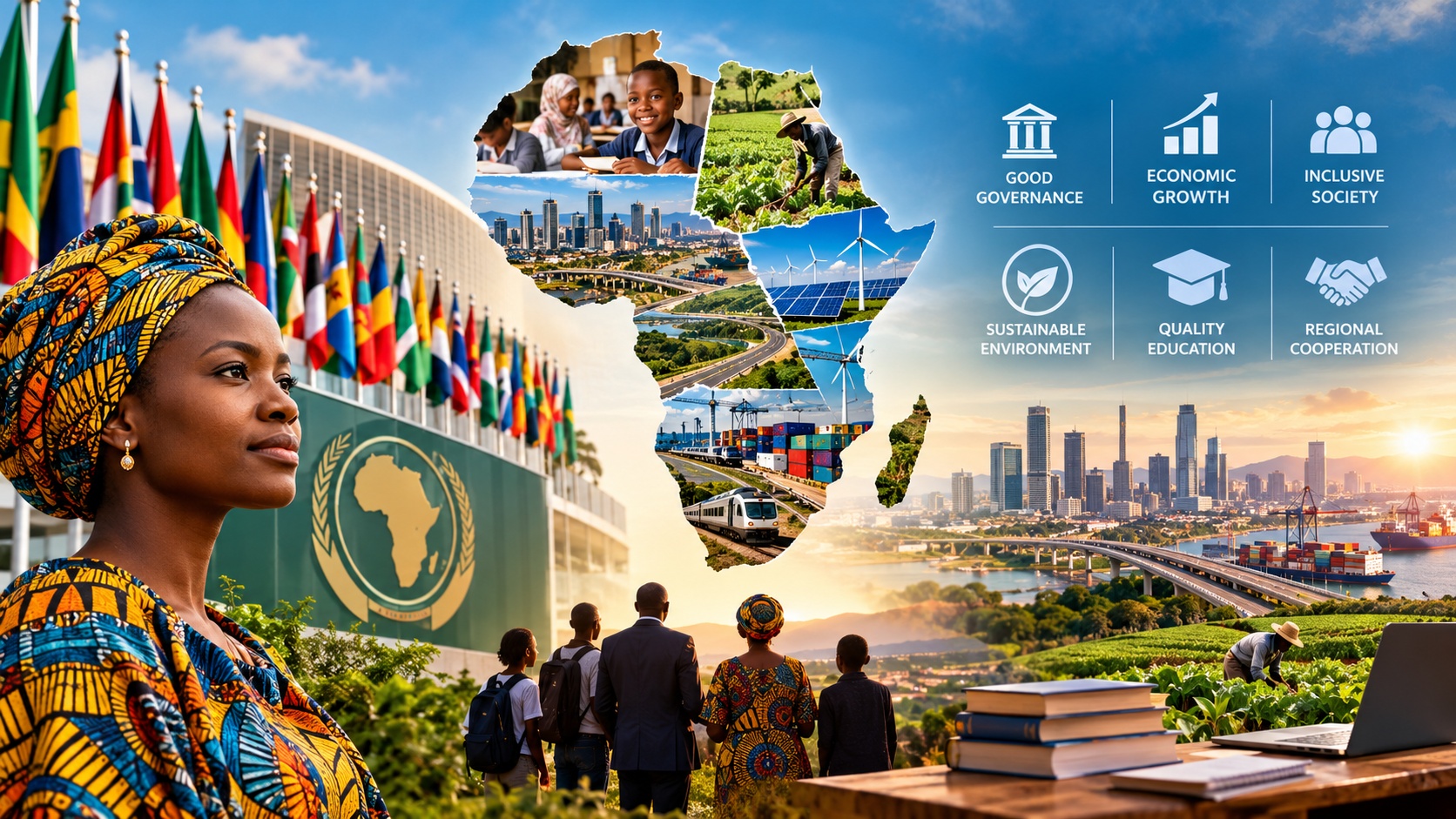
The African Union’s Agenda 2063 provides a long-term framework for building an integrated, prosperous, and peaceful continent. Its priorities include inclusive economic growth, stronger institutions, regional cooperation, industrial development, and improved living standards. Achieving these objectives requires practical policies that reflect the different circumstances of individual countries and communities.
Source: African Union – Agenda 2063
Political Systems and Governance Across Africa
African countries operate under diverse political systems, including presidential and parliamentary republics and constitutional monarchies. Their political institutions have developed through different historical experiences, constitutional arrangements, and social conditions. Consequently, political developments should be examined country by country rather than treated as a single continental experience.
Governance is a central factor in determining whether governments can translate national resources into meaningful development. Effective institutions establish clear rules, administer public services, enforce laws, and provide mechanisms for holding public officials accountable. When these systems function properly, they can improve public confidence and create a more predictable environment for businesses and communities.
However, some countries face persistent institutional challenges, including corruption risks, limited administrative capacity, political polarization, and inconsistent enforcement of laws. Addressing these issues requires transparent budgeting, professional public administration, independent oversight, and reliable access to public information.
Strong governance also depends on cooperation between national and local authorities. Local governments often understand community needs more directly, particularly in areas such as water supply, education, sanitation, and rural infrastructure. Clear responsibilities and adequate resources can help local institutions deliver services more effectively.
Source: African Union – National and Regional Development Priorities
Democracy, Elections, and Political Accountability
Democratic institutions can contribute to development by creating opportunities for peaceful political competition, public participation, and government accountability. Credible elections allow citizens to select their representatives, while legislatures, courts, independent oversight bodies, and civil society organizations can help monitor the exercise of political power.
Nevertheless, democratic progress varies across Africa. Some countries have established competitive electoral processes and peaceful transfers of power, while others have experienced disputed elections, restrictions on political participation, military takeovers, or prolonged political tensions. These differences affect institutional stability and the ability of governments to maintain consistent development policies.
Holding elections is only one element of democratic governance. Sustainable political systems also require the rule of law, protection of fundamental rights, transparent political financing, independent electoral administration, and opportunities for citizens to express their views peacefully.
Political accountability is especially important when governments manage limited public resources. Accessible budgets, independent audits, effective parliamentary scrutiny, and transparent procurement can help identify waste and improve public spending.
Strengthening these institutions can support development by improving the relationship between governments and citizens. Public trust is more likely to grow when authorities explain their decisions, respond to legitimate concerns, and demonstrate measurable progress in delivering essential services.
Source: African Union – Agenda 2063
Poverty and Economic Inequality
Poverty remains a major development challenge in many African countries, but its causes and severity differ across regions. Limited employment opportunities, low agricultural productivity, inadequate infrastructure, economic shocks, and unequal access to education and essential services can prevent households from improving their living conditions.
Economic growth is important, but growth alone does not guarantee that its benefits reach the wider population. An economy may expand while many households continue to experience insecure employment, low incomes, or limited access to clean water, electricity, and quality education.
Inclusive development requires policies that expand productive employment, improve access to public services, support small businesses, and reduce unnecessary barriers to economic participation. Social protection programmes can also help vulnerable households manage economic shocks without losing access to essential services.
Governments need reliable data to understand where deprivation is concentrated and whether policies are producing meaningful results. National averages can conceal substantial differences between urban and rural communities, regions, and income groups.
Reducing poverty therefore requires a coordinated approach that combines economic opportunity with effective public services, responsible fiscal management, and targeted support for disadvantaged communities.
Source: World Bank – Africa Economic Updates
Youth Unemployment and Employment Creation
Africa’s young population represents a significant opportunity for innovation, entrepreneurship, and economic transformation. However, realizing this potential depends on the capacity of national economies to create productive employment and provide young people with relevant skills.
In many countries, the number and quality of available jobs remain important concerns. Young people may encounter difficulties finding their first job, obtaining professional experience, accessing finance, or entering industries that require specialized qualifications. Informal employment also provides livelihoods for many workers but may offer limited income security and social protection.
Education and employment policies should be closely connected. Vocational training, apprenticeships, technical education, digital skills, and cooperation between schools and employers can help prepare young people for available opportunities. Training programmes are most effective when they respond to actual labour-market needs rather than focusing exclusively on qualifications.
Supporting small and medium-sized enterprises can also contribute to employment creation. Businesses are more likely to grow when they have access to affordable finance, reliable electricity, transport networks, digital services, and predictable regulations.
Youth participation in policymaking is equally important. Young entrepreneurs, researchers, workers, and community leaders can provide valuable perspectives on economic opportunities and barriers. Including these perspectives can help governments develop policies that respond to changing social and technological conditions.
Source: African Union – Development Priorities
Infrastructure and Digital Transformation
Infrastructure development is essential for improving productivity and connecting African economies. Reliable roads, railways, ports, electricity networks, water systems, and telecommunications allow businesses to operate more efficiently and help communities access markets and public services.
Infrastructure shortages can increase transportation costs, disrupt production, and limit economic opportunities in rural areas. For agricultural producers, inadequate storage and transport can lead to losses and restrict access to profitable markets. For manufacturers, unreliable electricity can increase operating costs and reduce competitiveness.
Digital transformation offers additional opportunities for economic development. Mobile financial services, digital payment systems, online education, electronic public administration, and digital commerce can improve access to services and help businesses reach new customers.
However, digital progress depends on affordable internet access, reliable electricity, appropriate digital skills, cybersecurity, and responsible data management. Without these foundations, digital technologies may benefit already connected communities while leaving other groups behind.
Governments should prioritize infrastructure projects according to their economic and social value, while considering maintenance costs, environmental effects, transparency, and financial sustainability. Regional infrastructure planning can also improve connectivity between neighbouring countries and strengthen trade.
Source: World Bank – Africa Economic Updates
Education and Human Capital Development
Education is one of the most important foundations of sustainable development. It supports individual opportunity, improves workforce skills, strengthens public institutions, and helps economies adapt to technological and industrial change.
Despite progress in expanding educational access in many countries, challenges remain. Some communities experience shortages of trained teachers, inadequate school facilities, limited learning materials, or difficulties accessing secondary and technical education. Poverty and geographical barriers can also prevent children from completing their education.
Improving education requires attention to both participation and learning outcomes. Governments can invest in teacher development, school infrastructure, early childhood education, technical training, and relevant learning materials. Educational programmes should also prepare students for changing labour markets and encourage critical thinking, problem-solving, and digital literacy.
Universities and research institutions can contribute to economic transformation by working with businesses, public agencies, and local industries. Research partnerships can support agricultural innovation, renewable energy, engineering, medicine, and the development of new technologies.
Education policy should form part of a wider development strategy. Better qualifications create the greatest benefits when economies also provide opportunities for skilled employment, entrepreneurship, research, and professional advancement.
Source: African Union – Agenda 2063 Development Priorities
Political Instability, Conflict, and Peacebuilding
Political instability and armed conflict can undermine development by damaging infrastructure, displacing populations, interrupting education, reducing investment, and placing additional pressure on public finances. In affected communities, insecurity may also restrict access to healthcare, food, clean water, and employment.
The causes of conflict differ across countries and may involve competition over political authority, weak institutions, unresolved grievances, armed groups, disputes over land, or unequal access to economic opportunities. In some situations, these factors interact with climate pressures and regional insecurity.
Effective responses require more than short-term security measures. Peacebuilding can involve political dialogue, local mediation, protection of civilians, accountable institutions, access to justice, and the restoration of essential services. Development programmes should be designed carefully to avoid reinforcing inequalities or excluding vulnerable communities.
Regional cooperation is important because conflict and insecurity can affect neighbouring countries through displacement, disrupted trade, and cross-border criminal activity. African regional organizations can support mediation, coordinated responses, and cooperation between governments.
Long-term stability depends on addressing the underlying conditions that allow violence to persist. Inclusive institutions, legitimate political processes, economic opportunity, and reliable public services can contribute to more peaceful and resilient societies.
Public Debt and Sustainable Economic Policy
Public debt is an important issue in African development because governments need financing for infrastructure, education, healthcare, energy, and other public services. Borrowing can support economic progress when funds are invested in productive projects that deliver lasting benefits. However, excessive borrowing costs and weak financial management can restrict future development spending.
Debt pressures can become particularly difficult when governments face declining revenues, currency depreciation, higher international interest rates, or unexpected economic shocks. Large debt-service obligations may reduce the funds available for schools, hospitals, transport, and social protection.
Responsible debt management requires transparent borrowing decisions, realistic assessments of project costs, and careful evaluation of long-term repayment capacity. Governments can also strengthen domestic revenue collection, improve tax administration, reduce wasteful expenditure, and support businesses that contribute to formal economic activity.
International financing can help fund development, but borrowing agreements should be evaluated for affordability, transparency, and potential economic and social consequences. Public-private partnerships also require careful oversight to ensure that financial risks and contractual obligations are clearly understood.
The objective should not simply be to reduce borrowing or increase spending. It should be to ensure that public finances support productive investment, economic resilience, and measurable improvements in living standards.
Source: World Bank – Africa Economic Updates
Natural Resources and Economic Diversification
Africa has significant natural resources, including minerals, energy resources, agricultural products, and marine assets. These resources can generate export revenue, support infrastructure investment, and create opportunities for industrial development.
However, dependence on a limited number of commodities can expose economies to fluctuations in international prices. Countries that export raw materials without developing local processing industries may also miss opportunities to create skilled jobs and retain more economic value domestically.
Economic diversification can reduce these risks by supporting manufacturing, agricultural processing, tourism, renewable energy, digital services, and other competitive industries. Diversification also helps create a wider range of employment opportunities and can make public revenues less vulnerable to changes in individual commodity markets.
Successful industrial development requires reliable infrastructure, skilled workers, access to finance, suitable technology, and consistent regulations. Governments can support these conditions while encouraging competition and avoiding inefficient subsidies that place unnecessary pressure on public finances.
Responsible natural-resource management is equally important. Transparent licensing, effective revenue collection, environmental safeguards, and meaningful consultation with affected communities can help ensure that resource development supports broader economic and social objectives.
Source: African Union – Agenda 2063
Regional Integration and the African Continental Free Trade Area
Regional integration is an important part of Africa’s development strategy because it can expand markets, encourage investment, and strengthen connections between national economies. When businesses can trade more easily across borders, they gain opportunities to reach additional customers, develop regional supply chains, and increase production.
The African Continental Free Trade Area, known as AfCFTA, aims to support a more integrated African market by reducing trade barriers and improving cooperation on trade-related rules. Its long-term potential depends on implementation, efficient customs procedures, suitable transport infrastructure, and the ability of businesses to meet relevant standards.
Trade agreements cannot eliminate every barrier to cross-border commerce. High logistics costs, delays at borders, inconsistent regulations, limited access to finance, and unreliable electricity can still make regional trade difficult, especially for small enterprises.
Governments can support regional integration by improving transport connections, simplifying administrative procedures, strengthening payment systems, and helping businesses understand export requirements. Regional cooperation in energy, digital infrastructure, and industrial development can also create opportunities that individual national markets may struggle to provide alone.
Effective integration can help African economies diversify production, improve competitiveness, and develop stronger commercial relationships. The main challenge is to turn continental commitments into practical benefits for businesses, workers, and consumers.
Source: World Bank – What’s Next for Africa’s Integration Agenda?
Climate Change, Agriculture, and Food Security
Climate change creates serious development risks for communities that depend on agriculture, livestock, fisheries, and other climate-sensitive activities. Droughts, floods, changing rainfall patterns, and extreme temperatures can affect food production, water availability, household incomes, and agricultural prices.
The impact varies across the continent because countries have different climates, infrastructure, economic resources, and adaptation capacities. Development policies must therefore reflect local environmental conditions and the needs of affected communities.
Agricultural resilience can be improved through suitable irrigation systems, soil conservation, climate-informed farming practices, agricultural research, improved storage, and better access to markets. Reliable weather information and early-warning systems can also help farmers and governments prepare for changing conditions.
Climate adaptation must be supported by effective water management and investment in resilient infrastructure. Energy planning is another important consideration because reliable electricity supports irrigation, food processing, cold storage, and other productive activities.
Governments can integrate climate risks into national budgets, agricultural strategies, and infrastructure planning. This can help protect livelihoods and strengthen food security while supporting long-term economic development.
Source: United Nations Development Programme – 2026 Africa Sustainable Development Report
Gender Equality and Inclusive Political Participation
Gender equality is an important element of inclusive development. Women contribute to agriculture, entrepreneurship, public administration, education, trade, and many other sectors. However, barriers involving access to finance, education, productive assets, employment, and decision-making can limit their economic opportunities.
The nature of these barriers varies across countries and communities. Appropriate responses may include improving access to vocational education, strengthening legal protections, supporting women-owned businesses, and expanding access to financial services and markets.
Women’s participation in political institutions can also broaden the range of perspectives represented in public decision-making. Effective participation requires meaningful opportunities to contribute, fair access to leadership, and institutions that hold all public officials accountable.
Governments should evaluate gender-related policies using measurable outcomes, including educational participation, employment conditions, income opportunities, business ownership, and representation in leadership positions.
Removing unnecessary barriers to economic participation can help households become more resilient and allow countries to make better use of their available skills and talent. Gender equality should therefore be integrated into wider strategies for economic growth, institutional development, and social inclusion.
Source: African Union – Agenda 2063 Development Priorities
International Partnerships and Africa’s Development Priorities
International partnerships can help African countries access development finance, technical expertise, research, technology, and international markets. Cooperation with multilateral institutions, regional organizations, private investors, and development partners can support infrastructure, education, agriculture, climate adaptation, and public-sector capacity.
However, international assistance is most effective when it supports locally defined priorities and strengthens national institutions. Projects that lack adequate maintenance plans, transparent procurement, or meaningful community participation may produce limited long-term benefits.
Governments should assess development partnerships according to their financial conditions, expected outcomes, transparency, and contribution to local capacity. Agreements should also be consistent with national development plans and designed to protect the public interest.
Mobilizing domestic resources is equally important. More effective tax administration, transparent public spending, productive private investment, and stronger local businesses can help countries finance development with greater resilience.
Africa’s development future also depends on its ability to participate more effectively in decisions affecting international finance, trade, technology, and climate policy. Stronger regional cooperation can help African countries coordinate their priorities and negotiate from a more effective collective position.
Source: UNDP – Agenda 2063 in a Post-ODA World: African Agency for Socio-Economic Transformation
Sustainable Development Strategies for Africa
Sustainable development requires coordinated action across political, economic, social, and environmental policy. Individual projects may achieve limited results when they are disconnected from broader national priorities. For example, vocational training may have a smaller impact when businesses cannot access reliable electricity, while infrastructure investment may fail to deliver its full value without effective maintenance and transparent procurement.
Governments can improve development outcomes by strengthening public institutions, investing in human capital, supporting productive industries, and improving access to reliable infrastructure. Transparent budgeting and independent evaluation can help ensure that limited resources are directed toward projects with clear social and economic benefits.
Development priorities should also reflect the circumstances of individual countries. Economies with large agricultural sectors may prioritize productivity and food processing, while others may focus on manufacturing, logistics, renewable energy, or digital services. Cooperation between countries can help expand markets and make shared infrastructure more effective.
Public participation should remain an essential part of development planning. Communities, researchers, businesses, workers, and civil society organizations can help identify practical needs and assess whether government programmes are delivering results.
The African Union’s Agenda 2063 and the United Nations Sustainable Development Goals provide complementary frameworks for pursuing inclusive growth, institutional development, environmental resilience, and improved living standards.
Source: United Nations Development Programme – 2026 Africa Sustainable Development Report
Conclusion: The Future of African Politics and Development
African politics and development are shaped by the relationship between governance, economic policy, institutional capacity, regional integration, and environmental change. Although countries across the continent face different challenges, many share the need to expand productive employment, improve public services, strengthen infrastructure, and manage financial and natural resources responsibly.
Sustainable progress depends on turning political commitments into measurable outcomes. Transparent institutions, accountable leadership, quality education, responsible investment, and effective economic policies can create stronger foundations for inclusive development. Regional cooperation can expand trade and industrial opportunities, while climate adaptation and technological innovation can help communities and businesses respond to changing conditions.
Africa’s future should not be defined only by its development challenges. The continent also possesses significant human talent, entrepreneurial capacity, natural resources, cultural diversity, and opportunities for innovation. Realizing this potential requires practical policies, reliable institutions, cooperation across borders, and sustained investment in people.
Ultimately, the success of African development should be measured by improvements in living standards, access to essential services, employment opportunities, institutional accountability, and the ability of future generations to participate in peaceful and prosperous societies.


