
Best Solar Inverters in 2026: Top Models, Features, Benefits, and Buying Guide
Why Choose the Best Solar Inverter in 2026?
Solar energy has become an increasingly attractive option for homeowners, businesses, and people looking to reduce their dependence on conventional electricity. However, solar panels alone cannot supply electricity in the form required by most household appliances. A solar inverter is an essential component that converts the direct current (DC) generated by solar panels into alternating current (AC), which can power household devices and, where permitted, feed electricity into the electrical grid.
Choosing one of the best solar inverters in 2026 can help improve energy management, support battery storage, and make a solar installation more convenient to monitor. The right model depends on several factors, including the size of the solar panel system, daily electricity consumption, roof conditions, battery requirements, and budget.
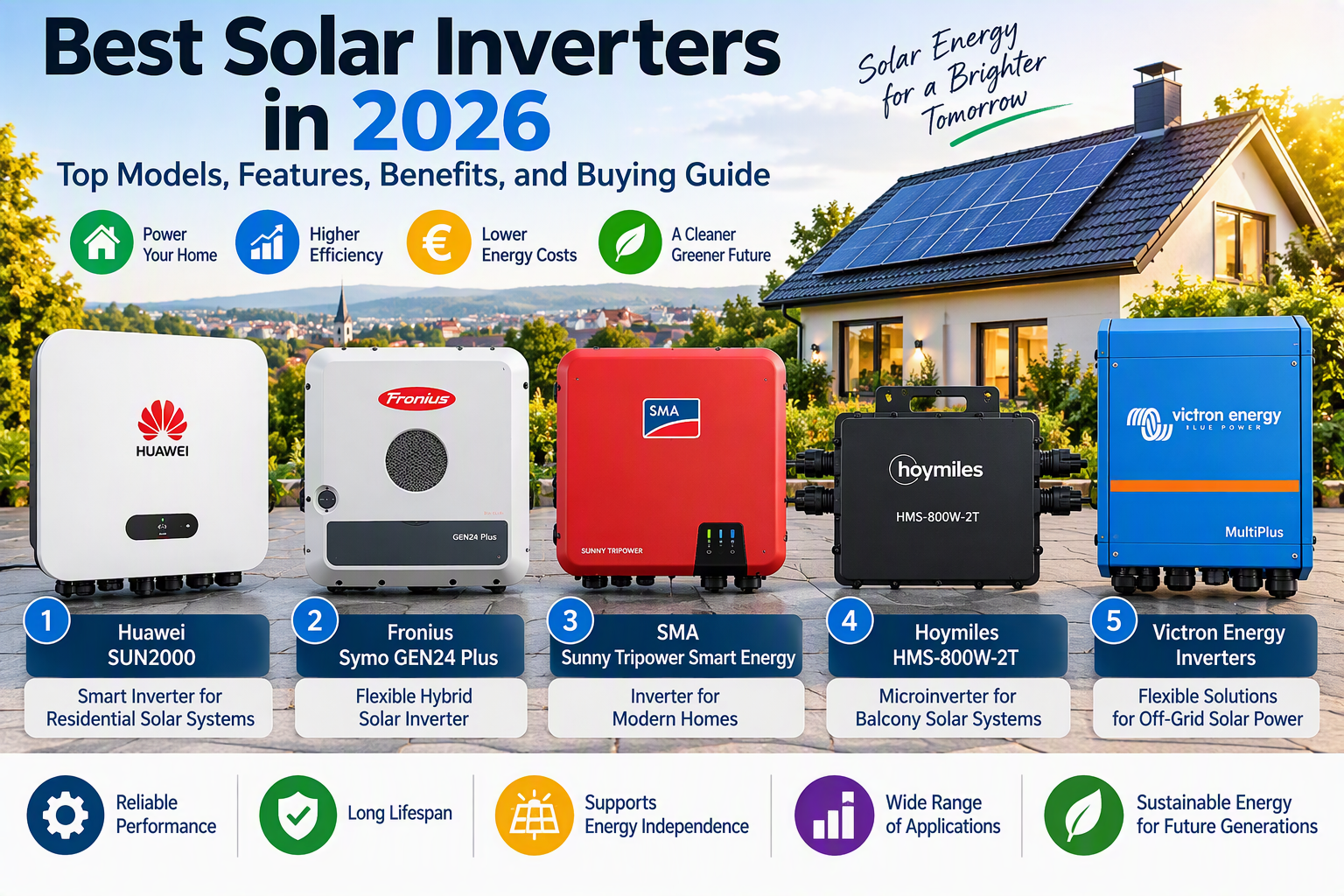
This guide explores several established solar inverter brands and product families, including Huawei SUN2000, Fronius GEN24 Plus, SMA Sunny Tripower Smart Energy, Hoymiles HMS-800W-2T, and Victron Energy inverter systems. These options serve different purposes, from residential rooftop installations to small balcony solar systems and off-grid applications.
1. Huawei SUN2000: A Smart Inverter for Residential Solar Systems
The Huawei SUN2000 series is designed for residential and commercial photovoltaic installations. Depending on the model, these inverters can support solar energy conversion, system monitoring, and integration with compatible battery storage products. They are available in different power ratings, allowing installers to select a model suited to the expected output of a solar installation.
One of the main advantages of the SUN2000 family is its smart monitoring functionality. Compatible configurations can connect to the manufacturer’s monitoring platform, allowing users to review solar production, electricity consumption, and other available system information.
Some models also support compatible energy storage systems, making them suitable for households that want to store excess solar electricity for later use. Depending on the configuration, additional energy management features may help households make better use of the electricity their panels generate.
Key Features and Benefits
The Huawei SUN2000 range includes different power ratings, monitoring options, and battery compatibility depending on the specific model. Selected versions offer multiple maximum power point tracking (MPPT) inputs, which help optimize energy collection when solar panel strings operate under different conditions.
Other potential advantages include compact installation designs, remote performance monitoring, and compatibility with selected Huawei energy storage products. Buyers should check the exact model specifications before purchasing because supported batteries, backup functions, and communication features vary across the range.
Best For: Homeowners installing rooftop solar panels who want monitoring features and the option to integrate compatible battery storage.
Amazon Germany and EU Purchase Links:
Amazon Germany: https://www.amazon.de/s?k=Huawei+SUN2000+solar+inverter
Amazon France: https://www.amazon.fr/s?k=Huawei+SUN2000+onduleur+solaire
Amazon Italy: https://www.amazon.it/s?k=Huawei+SUN2000+inverter+solare
Amazon Spain: https://www.amazon.es/s?k=Huawei+SUN2000+inversor+solar
2. Fronius Symo GEN24 Plus: A Flexible Hybrid Solar Inverter
The Fronius Symo GEN24 Plus is a hybrid inverter family designed for residential photovoltaic systems. A hybrid inverter can manage electricity from solar panels and work with compatible battery storage, depending on the installation configuration.
Fronius products are known for their system monitoring capabilities and integration with compatible energy management equipment. The GEN24 Plus range offers options for households seeking to increase solar self-consumption and potentially use stored electricity when solar production is low.
Selected models include backup power functionality. However, the available backup arrangement depends on the particular model, battery configuration, installation design, and additional equipment required. Buyers should not assume that every system can power an entire house during a grid outage.
Key Features and Benefits
The Fronius Symo GEN24 Plus range offers three-phase models for compatible residential electrical systems. Features may include solar production monitoring, battery integration, and energy management through the manufacturer’s software platform.
Its main advantage is the ability to combine solar electricity conversion with compatible storage and selected backup functions. This can help households use more of their own solar energy instead of purchasing all their electricity from the grid.
The exact supported battery models, output rating, efficiency, and backup capabilities should be confirmed using the official technical documentation for the chosen inverter.
Best For: Homeowners looking for a hybrid inverter with monitoring, battery integration, and optional backup functionality.
Amazon Germany and EU Purchase Links:
Amazon Germany: https://www.amazon.de/s?k=Fronius+Symo+GEN24+Plus
Amazon France: https://www.amazon.fr/s?k=Fronius+Symo+GEN24+Plus
Amazon Italy: https://www.amazon.it/s?k=Fronius+Symo+GEN24+Plus
Amazon Spain: https://www.amazon.es/s?k=Fronius+Symo+GEN24+Plus
3. SMA Sunny Tripower Smart Energy: An Inverter for Modern Homes
The SMA Sunny Tripower Smart Energy series is designed for residential solar installations that require three-phase electricity conversion and smart energy management. Selected models combine solar inverter functionality with hybrid capabilities, allowing compatible battery storage to be integrated into the system.
SMA provides monitoring and energy management solutions that help homeowners understand how much electricity their solar panels generate and how that electricity is used. This information can help households identify opportunities to shift electricity consumption toward periods of higher solar production.
For homeowners planning to install solar panels alongside a battery, selecting a compatible hybrid inverter can simplify system integration. However, the exact battery options and backup functions depend on the model and installation requirements.
Key Features and Benefits
The Sunny Tripower Smart Energy range offers different power ratings to accommodate different residential system sizes. Depending on the selected model, features may include solar production monitoring, battery charging management, and integration with compatible home energy management products.
A major benefit is the ability to coordinate solar generation and stored electricity within a suitable installation. This may help reduce reliance on grid electricity when solar production is limited, especially during the evening.
Before buying, compare the inverter’s rated output, supported battery systems, warranty conditions, and backup capabilities with your household’s requirements.
Best For: Residential solar installations requiring three-phase operation, battery compatibility, and smart energy management.
Amazon Germany and EU Purchase Links:
Amazon Germany: https://www.amazon.de/s?k=SMA+Sunny+Tripower+Smart+Energy
Amazon France: https://www.amazon.fr/s?k=SMA+Sunny+Tripower+Smart+Energy
Amazon Italy: https://www.amazon.it/s?k=SMA+Sunny+Tripower+Smart+Energy
Amazon Spain: https://www.amazon.es/s?k=SMA+Sunny+Tripower+Smart+Energy
4. Hoymiles HMS-800W-2T: A Microinverter for Balcony Solar Systems
The Hoymiles HMS-800W-2T is a microinverter designed for small photovoltaic installations, particularly balcony solar systems and other compact solar panel arrangements. Unlike a traditional string inverter that manages electricity from several connected panels, a microinverter converts the output of compatible panels into AC electricity at the panel level.
The HMS-800W-2T has a nominal AC output rating of up to 800 watts and two independent MPPT inputs. This design allows the inverter to manage two compatible solar panel inputs independently, which can be helpful when panels experience different sunlight conditions.
The model also supports monitoring through compatible Hoymiles equipment and software. Users should check the required communication accessories and monitoring configuration before purchasing.
Key Features and Benefits
One important advantage of this microinverter is its suitability for small solar installations. Its two MPPT inputs can help optimize the output of two connected panels when their operating conditions differ.
The compact design can also make it easier to incorporate the inverter into a suitable balcony or garden solar installation. Depending on the installation and monitoring setup, users may be able to review energy production through compatible monitoring tools.
The 800-watt rating refers to its maximum nominal AC output, not the amount of electricity it will produce continuously. Actual energy generation depends on sunlight, panel capacity, orientation, shading, and local weather.
Best For: People looking for a microinverter for a small balcony solar installation or a compatible two-panel photovoltaic system.
Amazon Germany and EU Purchase Links:
Amazon Germany: https://www.amazon.de/s?k=Hoymiles+HMS-800W-2T
Amazon France: https://www.amazon.fr/s?k=Hoymiles+HMS-800W-2T
Amazon Italy: https://www.amazon.it/s?k=Hoymiles+HMS-800W-2T
Amazon Spain: https://www.amazon.es/s?k=Hoymiles+HMS-800W-2T
5. Victron Energy Inverters: Flexible Solutions for Off-Grid Solar Power
Victron Energy offers inverter and inverter-charger products designed for applications such as off-grid solar installations, recreational vehicles, boats, and independent power systems.
Unlike a grid-connected solar inverter designed primarily to convert the output of rooftop panels for household use, an off-grid inverter works within a system designed to supply electricity independently of the public grid. Depending on the selected product, the system may include batteries, solar charge controllers, and other power management components.
Victron Energy offers several product families, including Phoenix inverters and MultiPlus inverter-chargers. These product categories serve different purposes, so buyers should choose a specific model based on the intended installation rather than treating every Victron inverter as interchangeable.
Key Features and Benefits
Victron Phoenix inverters are designed to convert DC electricity from a compatible battery into AC electricity for suitable appliances. MultiPlus products combine inverter and battery-charging functionality, with specific capabilities depending on the model.
Some systems can integrate with compatible solar charge controllers and monitoring equipment. This flexibility can be useful when building an off-grid power system for a cabin, campervan, boat, or other location where grid electricity is unavailable or unreliable.
A key consideration is that an inverter alone does not create electricity or provide unlimited backup power. Its practical operating time depends on the battery capacity, available solar generation, inverter rating, and electricity consumption.
Best For: Users building off-grid solar systems, mobile power installations, or battery-based backup systems.
Amazon Germany and EU Purchase Links:
Amazon Germany: https://www.amazon.de/s?k=Victron+Energy+solar+inverter
Amazon France: https://www.amazon.fr/s?k=Victron+Energy+onduleur
Amazon Italy: https://www.amazon.it/s?k=Victron+Energy+inverter
Amazon Spain: https://www.amazon.es/s?k=Victron+Energy+inversor
6. How to Choose the Best Solar Inverter for Your Needs
Choosing the best solar inverter requires more than comparing prices or selecting the model with the highest advertised efficiency. The inverter must be compatible with the solar panels, electrical system, battery configuration, and intended use.
The first step is to determine the type of solar installation you want to build. A small balcony system may need a microinverter, while a residential rooftop installation may benefit from a string inverter or hybrid inverter. An off-grid installation generally requires a system specifically designed to operate independently of the public electricity network.
Next, calculate the expected solar panel capacity and review the inverter’s input voltage, maximum input current, MPPT configuration, and rated AC output. These specifications must match the electrical characteristics of the connected panels and the installation design.
Battery compatibility is another important factor. If you plan to add energy storage, choose an inverter that supports the intended battery technology and voltage range. Some hybrid inverters only work with particular battery families, so compatibility should be confirmed before purchase.
You should also consider monitoring functions, warranty coverage, manufacturer support, and the availability of qualified installers. An inverter with clear monitoring information and reliable local service can make it easier to identify problems and maintain the installation over time.
Finally, compare the total installation cost rather than the inverter’s purchase price alone. Wiring, protection devices, mounting equipment, batteries, professional installation, and any required electrical upgrades can significantly affect the final budget.
7. Solar Inverter Efficiency: Why It Matters
Solar inverter efficiency measures how much of the DC electricity received from solar panels is converted into usable AC electricity. For example, if an inverter receives 1,000 watts of DC power and converts 970 watts into AC power under specified operating conditions, its conversion efficiency at that operating point is 97%.
Higher efficiency can reduce conversion losses, but the highest advertised peak efficiency does not necessarily guarantee the best real-world performance. Inverter efficiency varies with load, temperature, and operating conditions.
When comparing products, look for both maximum efficiency and European weighted efficiency when those figures are available. The European weighted value provides a more representative comparison across a range of operating conditions than a single peak measurement, although actual results still depend on the installation.
It is also important to consider how well the inverter performs when solar production is relatively low. A correctly sized inverter that matches the solar panel system can provide a better overall solution than a larger, more expensive unit that is poorly matched to the installation.
8. Hybrid Inverters vs. String Inverters vs. Microinverters
Different inverter technologies are suitable for different solar applications. Understanding their differences can help you avoid buying a product that does not meet your needs.
A string inverter converts electricity from a group of connected solar panels. It is a common option for residential rooftop systems with relatively straightforward panel layouts. Its advantages can include centralized equipment and a practical installation design. However, shading or differences between panels connected in the same string may affect overall production, depending on the system configuration and available optimization features.
A microinverter converts the output of an individual panel or a small group of panels into AC electricity. This arrangement can help manage differences in panel performance and is often suitable for smaller systems or rooftops with multiple orientations. The total cost per watt may be higher for some installations, and each microinverter must be compatible with the connected panels and electrical requirements.
A hybrid inverter supports solar electricity conversion and compatible battery storage within one system. Depending on the model, it may also provide backup power functionality. This type can be useful for households that want to store excess solar energy, but battery compatibility and backup capabilities must be checked carefully.
There is no single inverter type that is best for every installation. The right choice depends on roof conditions, system size, electricity consumption, battery plans, installation costs, and local electrical requirements.
9. Are Solar Inverters Available on Amazon Germany and Across the EU?
Amazon marketplaces in Germany, France, Italy, and Spain offer search results for various solar inverters, microinverters, and related equipment. Availability depends on the seller, model, stock levels, and delivery destination.
The Amazon search links in this guide are intended to help readers compare available listings. They do not guarantee that a particular model is in stock, that every seller ships to every EU country, or that a product is suitable for a specific installation.
Before ordering, check the exact model number, rated output, supported solar panel specifications, battery compatibility, warranty terms, seller details, and delivery conditions. It is also advisable to confirm that the inverter meets the electrical and grid-connection requirements applicable in your country.
For permanent residential installations, purchasing through an authorized distributor or a qualified solar installer may provide additional benefits, including technical support, warranty assistance, and help with system compatibility.
10. Safety and Installation Considerations
Solar inverters handle electrical energy that can present serious hazards when equipment is incorrectly installed, configured, or maintained. The appropriate installation procedure depends on the inverter type, system voltage, electrical design, and local regulations.
Grid-connected inverters must be suitable for the local electricity network and comply with the applicable connection and protection requirements. In Germany, for example, the relevant technical rules and certification requirements should be verified for the particular installation.
Battery-based systems also require careful attention to battery chemistry, voltage, current limits, protective equipment, ventilation requirements where applicable, and the manufacturer’s installation instructions.
Do not assume that an inverter automatically provides electricity during a power outage. Many grid-connected systems shut down when the public grid fails unless the installation includes a supported backup arrangement with the necessary equipment.
For permanent rooftop installations, three-phase systems, battery installations, or any work involving fixed electrical wiring, consult a qualified professional. Always follow the manufacturer’s documentation and the regulations applicable to the installation location.
Conclusion: Which Solar Inverter Is Best in 2026?
The best solar inverter in 2026 depends on your energy requirements, installation type, budget, and future plans. The Huawei SUN2000 family and Fronius Symo GEN24 Plus are options worth comparing for residential solar installations with compatible battery storage. The SMA Sunny Tripower Smart Energy series is another choice for homeowners interested in three-phase solar conversion and energy management.
For smaller balcony solar systems, the Hoymiles HMS-800W-2T offers a compact microinverter design with two independent MPPT inputs and an 800-watt nominal AC output. For off-grid installations, mobile power systems, and battery-based applications, Victron Energy offers several inverter and inverter-charger families designed for different configurations.
Before purchasing, compare technical specifications, efficiency, compatibility, warranty coverage, monitoring features, and total installation costs. Use the Amazon Germany and EU marketplace links to investigate available listings, but confirm the exact model and seller details before ordering.
By selecting a solar inverter that matches your solar panels, electrical requirements, and energy consumption, you can build a more practical solar power system and make better use of the electricity your panels generate.


