
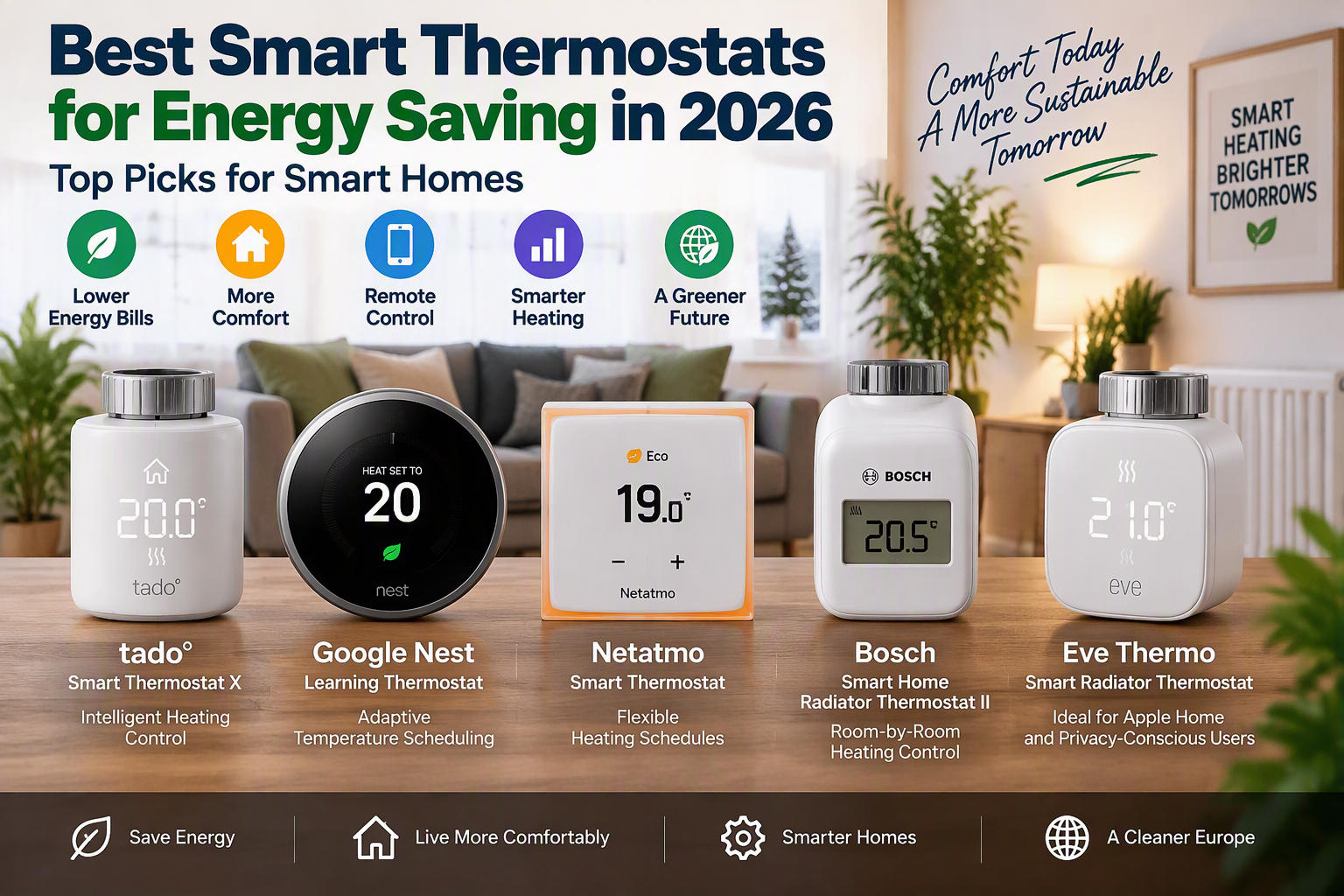
Best Smart Thermostats for Energy Saving in 2026: Top Picks for Smart Homes
Why Choose a Smart Thermostat in 2026?
Smart thermostats are becoming increasingly popular among homeowners who want to improve heating efficiency, reduce unnecessary energy consumption, and maintain a comfortable indoor temperature. Unlike conventional thermostats, smart models can offer programmable schedules, smartphone control, room-by-room temperature management, and automation features that adapt heating to everyday routines.
The best smart thermostats for energy saving in 2026 can help households avoid heating empty rooms, reduce unnecessary heating during the night, and manage temperatures more efficiently when occupants are away. Some models are designed for radiator valves, while others control central heating systems, boilers, or compatible underfloor heating installations.
Choosing the right thermostat depends on your existing heating system, home layout, preferred smart home platform, and budget. Compatibility is particularly important because a thermostat designed for a radiator valve may not be suitable for controlling a central boiler or a heat pump.
This guide explores five smart thermostat options worth considering for homes in Germany and the wider European market. It explains their key features, advantages, potential limitations, and purchase options to help you make an informed decision.
1. tado° Smart Thermostat X: Best Overall for Intelligent Heating Control
The tado° Smart Thermostat X range is designed to help households control heating through programmable schedules, smartphone access, and smart home integration. Depending on the selected product, the system can control individual radiators, compatible central heating systems, or suitable underfloor heating installations.
One of its main advantages is the ability to create heating schedules that reflect when rooms are actually used. For example, a household can maintain a comfortable temperature in the living room during the evening while reducing heating in bedrooms or unused rooms at other times.
The system also supports Matter and Thread in compatible configurations, helping it integrate with supported smart home environments. Buyers should check whether their existing smart home equipment provides the necessary Thread Border Router functionality.
Depending on the product and subscription, additional features may include geofencing, open-window detection, weather-based adjustments, and more advanced automatic heating optimisation. Basic features and premium features can differ, so it is important to check the current plan before purchasing.
The principal benefits include convenient remote control, flexible scheduling, and the ability to manage heating in different rooms. These features can help reduce wasted energy when a household’s existing heating schedule does not match its daily routine.
However, the tado° X range includes different devices for different heating applications. A radiator thermostat should not be confused with a wired room thermostat designed to control a compatible boiler or underfloor heating system.
Key features and benefits:
- Smartphone-based heating control.
- Programmable schedules for compatible rooms and heating systems.
- Matter and Thread support in compatible configurations.
- Options for individual radiator temperature control.
- Potential integration with compatible smart home platforms.
- Optional advanced automation features, depending on the subscription.
- Flexible configurations for different residential heating requirements.
Best for: Homeowners who want flexible heating schedules, remote control, and intelligent temperature management.
Purchase links:
- Amazon Germany: https://www.amazon.de/s?k=tado+Smart+Thermostat+X
- Amazon EU search: https://www.amazon.de/s?k=tado+smart+radiator+thermostat
- Official product information: https://www.tado.com/de/products/smart-thermostats
2. Google Nest Learning Thermostat: Best for Adaptive Temperature Scheduling
The Google Nest Learning Thermostat is designed to make temperature management more convenient by combining programmable schedules, remote control, and learning-oriented features in supported configurations.
Rather than relying entirely on a manually configured schedule, compatible Nest models can learn from user adjustments and develop a heating schedule based on household routines. The exact learning capabilities, compatibility, and available features depend on the model and market.
A major advantage is the ability to adjust heating settings remotely through compatible Google Home or Nest software. This can be useful when plans change and the original heating schedule no longer matches the household’s needs.
The system may also provide energy-related information that helps users understand heating patterns and make more informed adjustments. Availability of specific reports and automation features varies by product generation and regional configuration.
Before purchasing a Nest thermostat in Germany or elsewhere in Europe, buyers should confirm that the exact model is compatible with their boiler, heating controls, wiring, and regional requirements. Not every Nest model is available in every market, and compatibility with European heating systems should never be assumed.
A Nest thermostat may be particularly attractive to households already using compatible Google smart home products. However, users with radiator valves that require individual room control may need additional compatible equipment or a different type of thermostat.
Key features and benefits:
- Programmable temperature schedules.
- Learning-oriented heating control on supported models.
- Remote adjustment through compatible applications.
- Integration with supported Google smart home products.
- Energy-related information on compatible models.
- Convenient temperature management for compatible heating systems.
Best for: Users who want adaptive scheduling and already use compatible Google smart home technology.
Purchase links:
- Amazon Germany: https://www.amazon.de/s?k=Google+Nest+Learning+Thermostat
- Amazon EU search: https://www.amazon.de/s?k=Google+Nest+thermostat+heating
- Official product information: https://store.google.com/
3. Netatmo Smart Thermostat: Best for Flexible Heating Schedules
The Netatmo Smart Thermostat is designed to provide remote control and programmable heating schedules for compatible residential heating systems. It can be a useful option for homeowners who want to manage heating without relying entirely on manual adjustments.
Depending on the configuration, users can set target temperatures for different periods of the day and adjust heating through a compatible application. This makes it easier to lower temperatures during working hours or overnight and restore comfort before rooms are needed.
Some Netatmo configurations can also work with compatible smart radiator valves, allowing more detailed room-by-room temperature control. Buyers should verify the exact product package and confirm whether additional valves or other components are required.
A key benefit is flexibility. Households can build schedules around their normal routines and change settings when circumstances change. This can help avoid unnecessary heating when the home is empty or when certain rooms are not being used.
Compatibility remains essential. Before ordering, check whether the thermostat is designed for your type of boiler, whether a compatible relay is included, and whether your heating system requires a particular wiring arrangement.
As with other smart thermostats, energy savings depend on how the system is configured, the property’s insulation, the existing heating controls, and household behaviour.
Key features and benefits:
- Programmable heating schedules.
- Remote temperature adjustment through compatible software.
- Options for integration with compatible smart radiator valves.
- Flexible temperature management for daily routines.
- Potential reduction in unnecessary heating.
- Suitable for households seeking straightforward connected heating control.
Best for: Homeowners who want flexible schedules and remote management of compatible heating systems.
Purchase links:
- Amazon Germany: https://www.amazon.de/s?k=Netatmo+Smart+Thermostat
- Amazon EU search: https://www.amazon.de/s?k=Netatmo+smart+radiator+valves
- Official product information: https://www.netatmo.com/
4. Bosch Smart Home Radiator Thermostat II: Best for Room-by-Room Heating Control
The Bosch Smart Home Radiator Thermostat II is designed to control heating directly at compatible radiator valves. It is particularly useful for households that want to set different temperatures in different rooms without replacing their entire heating system.
Each compatible radiator thermostat can be configured according to the room’s schedule and comfort requirements. For example, a living room can follow an evening heating schedule while a bedroom uses a lower temperature overnight.
Depending on the wider Bosch Smart Home configuration, users can combine radiator thermostats with compatible room controls, sensors, and automation functions. Some advanced functions require a compatible Bosch Smart Home controller and other system components.
The main benefit is the ability to avoid treating the entire home as one heating zone. When rooms are used at different times, individual radiator control can help prevent unnecessary heating in spaces that do not need the same temperature.
The thermostat is designed for compatible radiator valve connections, so buyers should check the valve type and any required adapters before ordering. Smart home compatibility and the functions available without a controller should also be confirmed.
For households already using Bosch Smart Home equipment, this radiator thermostat can provide a convenient way to expand an existing heating automation system.
Key features and benefits:
- Individual temperature control for compatible radiators.
- Programmable room heating schedules.
- Integration with compatible Bosch Smart Home equipment.
- Potential automation with additional supported devices.
- Helps reduce heating in unused rooms.
- Suitable for homes with different temperature requirements across rooms.
Best for: Households seeking room-by-room radiator control within a compatible smart home system.
Purchase links:
- Amazon Germany: https://www.amazon.de/s?k=Bosch+Smart+Home+Radiator+Thermostat+II
- Amazon EU search: https://www.amazon.de/s?k=Bosch+Smart+Home+Heizk%C3%B6rper-Thermostat+II
- Official product information: https://www.bosch-smarthome.com/
5. Eve Thermo: Best for Apple Home Users and Privacy-Conscious Households
Eve Thermo is a smart radiator thermostat designed for users who want to manage room temperatures through a compatible smart home environment. It is particularly relevant to households that use Apple Home and compatible Thread or Matter equipment, depending on the product generation and configuration.
The device replaces a compatible manual radiator valve control and allows users to set target temperatures and heating schedules. This can help create different heating routines for rooms used at different times of the day.
One of its main advantages is its focus on connected temperature control without requiring every user to adopt a complex whole-house heating system. Compatible setups can integrate the radiator thermostat into a wider smart home environment.
Thread support on compatible models can help provide communication within a suitable smart home network. However, the exact requirements for remote access and integration depend on the model and the available Apple Home or other compatible infrastructure.
Eve Thermo can be a suitable option for users who prefer to manage their smart home through supported Apple devices. Buyers should confirm compatibility with their existing radiator valves and verify whether their chosen model requires a compatible Thread Border Router or other home hub.
As with any smart radiator thermostat, effective savings depend on suitable temperature settings and schedules rather than the device alone.
Key features and benefits:
- Programmable temperature schedules for compatible radiators.
- Integration with supported Apple Home environments.
- Thread support on compatible models.
- Convenient room-by-room heating management.
- Can help reduce heating in unused rooms.
- Suitable for users who prioritise smart home integration and data privacy.
Best for: Apple Home users who want convenient radiator temperature control and smart heating schedules.
Purchase links:
- Amazon Germany: https://www.amazon.de/s?k=Eve+Thermo+smart+radiator+thermostat
- Amazon EU search: https://www.amazon.de/s?k=Eve+Thermo+Thread
- Official product information: https://www.evehome.com/
How to Choose the Best Smart Thermostat for Energy Saving
Selecting the best smart thermostat begins with understanding the type of heating system installed in your home. A thermostat designed for a radiator valve may not be suitable for a boiler’s central control circuit, and a model intended for a particular wiring configuration may not work with every heating system.
1. Identify Your Heating System
Before buying, determine whether your home uses radiators connected to a central boiler, electric heating, underfloor heating, or a heat pump.
Radiator thermostats control the flow of hot water through individual radiators. Central room thermostats generally communicate with compatible heating equipment to request heat for the property or a particular zone.
Some smart thermostats support multiple applications, but compatibility varies. Check the manufacturer’s compatibility information and consult a qualified installer if your heating system uses specialised controls.
2. Choose Between Central and Room-by-Room Control
A central thermostat usually manages the heating system based on the temperature measured at a particular location. This can work well when the property has a relatively consistent heating schedule.
Room-by-room radiator thermostats allow different rooms to follow separate schedules. This may be useful when bedrooms, living rooms, and home offices are occupied at different times.
However, individual radiator controls must be compatible with the home’s wider heating system. In some installations, additional controls or configuration may be necessary to ensure reliable operation.
3. Look for Intelligent Scheduling
Programmable schedules allow users to set different temperatures for mornings, working hours, evenings, and overnight periods.
A well-designed schedule can reduce unnecessary heating while preserving comfort when rooms are occupied. Learning features may help some systems adapt to user preferences, but these functions vary by model.
Choose a system that makes it easy to review and change schedules rather than one that relies on complex settings you are unlikely to maintain.
4. Consider Open-Window Detection
Some smart thermostats detect a sudden temperature drop that may indicate an open window and temporarily reduce heating. This can help prevent the heating system from continuing to warm a room while cold outside air enters.
The effectiveness of this feature depends on the device, its location, and the conditions in the room. Certain systems may require a subscription or additional sensor for advanced automation.
Check whether open-window detection is automatic, notification-based, or dependent on extra equipment.
5. Check Geofencing and Presence Features
Geofencing uses a compatible smartphone’s location to help determine whether occupants are away from home. Some systems can use this information to adjust heating automatically.
This feature may be useful for households with changing schedules, but availability and automation behaviour vary between manufacturers and subscription plans.
If you prefer not to share location information, choose a thermostat that supports schedules and manual control without requiring geofencing.
6. Verify Smart Home Compatibility
Smart thermostats may support Matter, Thread, Apple Home, Google Home, Amazon Alexa, or proprietary smart home platforms. Compatibility is not identical across all models, even when products come from the same manufacturer.
Check which functions are available through your preferred platform and whether additional hardware is required for remote access or automation.
7. Compare Subscription Costs
Some manufacturers provide basic scheduling and remote control without an ongoing subscription, while advanced automation or energy reports may require a paid plan.
When comparing devices, calculate the total cost over several years. Consider the purchase price, required hubs, additional radiator valves, batteries, and any optional subscription fees.
A model with a lower initial price may not necessarily be the most economical option if important functions require recurring payments.
8. Review Installation and Maintenance Requirements
Many radiator thermostats are designed for straightforward installation by users who can safely replace a compatible valve control. Central thermostats may require wiring changes or work involving boiler controls.
Always follow the manufacturer’s installation instructions. If you are unsure about electrical connections, heating controls, or valve compatibility, consult a qualified professional.
Also consider battery replacement, firmware updates, app support, and the availability of replacement adapters or accessories.
Benefits of Smart Thermostats for Energy Efficiency
Reduce Heating When Rooms Are Empty
Smart thermostats can reduce heating during periods when rooms are not occupied. For example, a home office may need a comfortable temperature during working hours but less heating in the evening.
Scheduling temperatures around actual usage can help prevent unnecessary energy consumption.
Maintain Comfortable Temperatures
Smart thermostats make it easier to maintain different temperatures in different parts of a home. This can improve comfort without requiring every room to be heated to the same level.
The ideal temperature depends on room use, personal comfort, health needs, and the characteristics of the building.
Control Heating Remotely
Remote access allows users to change heating settings when plans change. For example, a household can adjust the schedule after returning home earlier than expected or prepare a room before it is needed.
This flexibility can help reduce the need to maintain unnecessarily high temperatures throughout the day.
Identify Heating Patterns
Some smart thermostat applications provide heating activity summaries, estimated energy use, or other information about system operation.
These insights can help users understand whether heating schedules are working as intended and identify opportunities for improvement.
The available information varies by manufacturer and system configuration, and estimated savings should not be confused with guaranteed reductions in energy bills.
Support More Efficient Heating Habits
A smart thermostat can make it easier to use lower temperatures when appropriate and avoid heating empty rooms. Over time, these changes may reduce energy consumption while preserving comfort.
The outcome depends on how the system is configured, the home’s insulation, the heating equipment, local weather, and occupant behaviour.
How Much Energy Can Smart Thermostats Save?
Smart thermostats can reduce heating energy consumption when they replace inefficient schedules or prevent unnecessary heating. However, there is no single savings percentage that applies to every household.
Homes with irregular schedules, frequently unused rooms, or heating systems that remain active when nobody is present may have more opportunities to benefit from automation.
In contrast, a household that already uses an efficient programmable thermostat and carefully manages its heating may experience smaller additional savings.
To estimate the potential benefit, compare energy consumption before and after installation while accounting for weather, occupancy, and changes in temperature settings. Where possible, use data from comparable periods rather than assuming that all changes in energy use are caused by the thermostat.
It is also important to remember that reducing the temperature excessively can affect comfort and may contribute to damp or condensation problems in some buildings. Follow appropriate heating guidance for the property and avoid allowing vulnerable rooms to become excessively cold.
Smart Thermostat vs. Traditional Programmable Thermostat
A traditional programmable thermostat can follow a schedule that sets different temperatures at different times of the day. For many households, this already provides useful control over heating.
A smart thermostat adds features such as smartphone access, remote adjustments, smart home integration, and, on supported models, automation based on occupancy or changing conditions.
The most useful option depends on your needs. If you only require a reliable weekly schedule, a conventional programmable thermostat may be sufficient. If you want remote control, room-by-room heating, or connected automation, a smart thermostat may offer additional benefits.
Before replacing an existing thermostat, consider whether the current system already supports the functions you need and whether the additional features justify the cost.
Where to Buy Smart Thermostats in Germany and the European Union
Amazon Germany provides a convenient starting point for comparing smart radiator thermostats, central heating controls, starter kits, and compatible accessories.
The purchase links in this guide lead to search results rather than guaranteeing the availability of a particular model. Prices, sellers, product bundles, and delivery conditions can change over time.
For buyers elsewhere in the European Union, check whether the selected seller delivers to your country and whether the product supports the electrical and heating standards used in your home.
Before ordering, confirm the exact model generation, valve compatibility, boiler compatibility, included accessories, warranty conditions, and any subscription requirements. For central heating controls or underfloor heating installations, consult the manufacturer’s compatibility documentation and a qualified installer where necessary.
The descriptions in this guide are original explanatory text. Product names are used to identify the devices discussed, and readers should consult the official manufacturers’ documentation for the latest specifications and compatibility information.
Frequently Asked Questions About Smart Thermostats
What Is the Best Smart Thermostat for Energy Saving in 2026?
The best thermostat depends on the heating system and smart home preferences. The tado° Smart Thermostat X is worth considering for flexible heating control, Google Nest may suit compatible systems that benefit from learning-oriented schedules, Netatmo offers programmable heating control, Bosch is a practical option for compatible radiator-based smart homes, and Eve Thermo may appeal to Apple Home users.
Do Smart Thermostats Really Reduce Heating Bills?
They can reduce heating costs when they help prevent unnecessary heating or improve temperature schedules. Actual savings depend on the home’s insulation, heating equipment, previous thermostat settings, weather, and household habits.
No thermostat can guarantee a particular reduction in heating bills for every property.
Are Smart Thermostats Compatible With Every Boiler?
No. Compatibility depends on the thermostat model, boiler type, control interface, and wiring configuration. Always check the manufacturer’s compatibility information before purchasing.
A qualified installer can help identify a suitable thermostat for a heating system with specialised controls.
Do Smart Thermostats Require Wi-Fi?
Some smart thermostats use Wi-Fi for remote access and cloud-connected features. Others communicate through protocols such as Thread or proprietary wireless systems and may require compatible hubs or controllers.
Local scheduling and other functions may continue to work without an internet connection, depending on the model and configuration.
Can Smart Thermostats Control Individual Rooms?
Smart radiator thermostats can generally control compatible radiator valves individually. Some central heating systems can also support multiple zones through compatible room thermostats and controls.
The available functions depend on the heating equipment, thermostat range, and installation configuration.
Are Smart Thermostats Worth Buying?
A smart thermostat may be worthwhile if you want convenient remote control, flexible schedules, room-by-room temperature management, or smart home automation.
To determine whether it is financially beneficial, compare the total purchase and installation costs with realistic potential savings and the value of the additional convenience.
Conclusion
The best smart thermostats for energy saving in 2026 offer practical ways to manage heating more efficiently, reduce unnecessary energy use, and improve everyday comfort. The tado° Smart Thermostat X is a flexible option for connected heating control, Google Nest offers learning-oriented features on compatible models, Netatmo provides programmable heating management, Bosch Smart Home Radiator Thermostat II supports room-by-room radiator control, and Eve Thermo is an attractive option for compatible Apple Home environments.
Before purchasing, verify compatibility with your heating system, compare smart home features, review any subscription costs, and consider whether you need central heating control or individual radiator management. By choosing a suitable thermostat and creating sensible heating schedules, households can improve temperature control and identify opportunities to reduce energy consumption without sacrificing comfort.


