
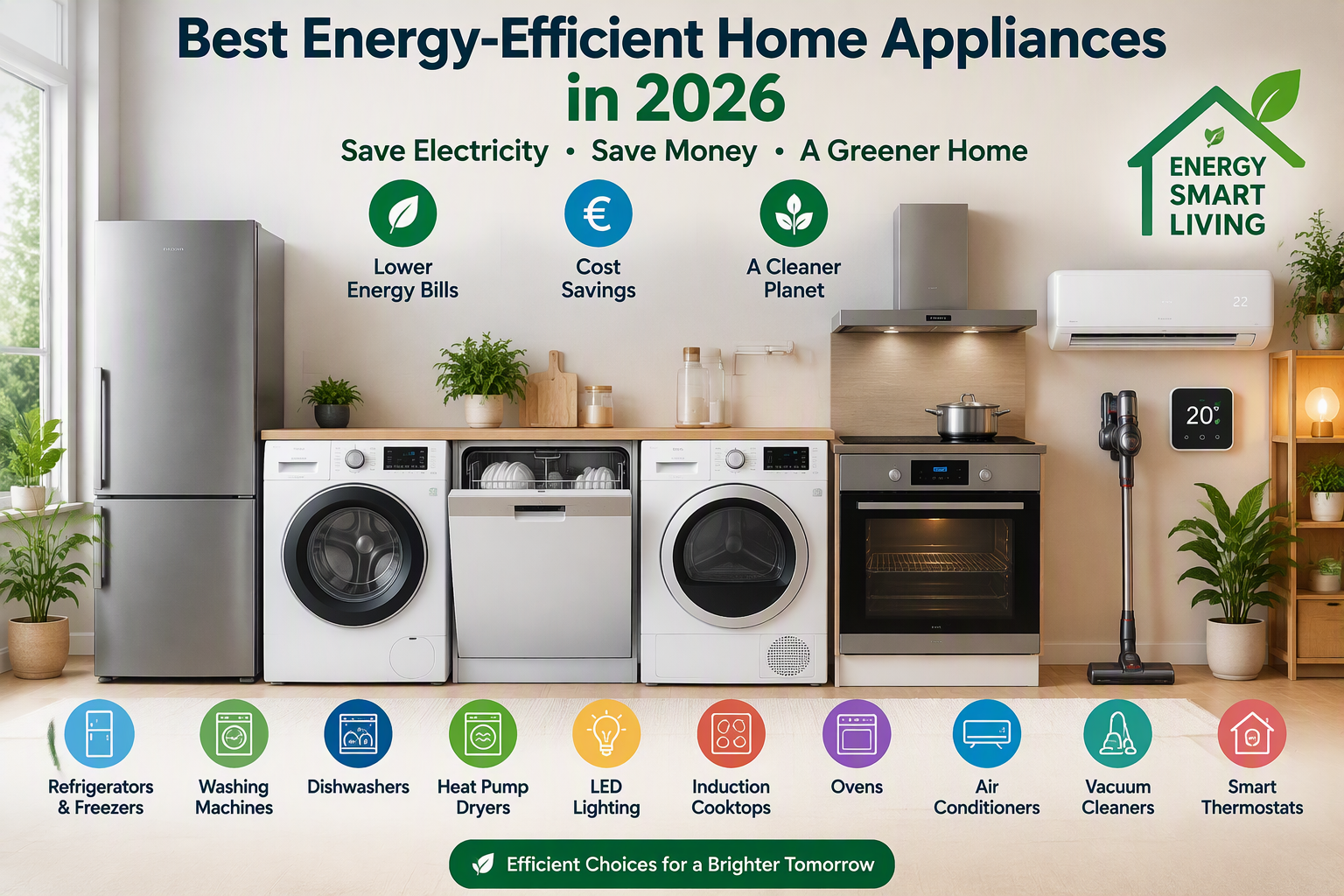
Best Energy-Efficient Home Appliances in 2026: A Complete Buying Guide
Choosing the best energy-efficient home appliances in 2026 is an effective way to reduce household electricity consumption, lower monthly energy bills, and make a home more environmentally friendly. Modern appliances offer improved energy management, advanced operating modes, and innovative technologies that help households use electricity more efficiently without sacrificing everyday comfort.
From refrigerators and washing machines to LED lighting, induction cooktops, and heat pump dryers, many appliances can help reduce unnecessary energy use. However, the most suitable choice depends on household size, usage habits, purchase price, and the appliance’s actual energy consumption.
For consumers in Germany and other European Union countries, the EU energy label is an important starting point. It allows buyers to compare the efficiency of eligible products using a scale from A to G, with A representing the highest efficiency and G the lowest. The exact information displayed depends on the product category.
1. Energy-Efficient Refrigerators and Freezers
Refrigerators and freezers operate throughout the day, making them important appliances to consider when trying to reduce household electricity consumption. An energy-efficient refrigerator can help keep food fresh while using less electricity than a comparable, less efficient model.
Modern refrigerators may include inverter compressors, improved insulation, precise temperature controls, and automatic defrosting systems. These features help maintain stable internal temperatures and manage cooling performance according to demand.
Key Features and Benefits
An efficient refrigerator should offer suitable storage capacity, reliable temperature control, well-designed compartments, and good insulation. Inverter compressor technology can adjust cooling output instead of relying exclusively on repeated full-power operation, potentially improving efficiency and reducing operating noise.
No-frost technology is another useful feature because it prevents excessive ice accumulation in compatible freezer compartments. Although convenience features can be valuable, buyers should compare the energy consumption shown on the product label rather than assuming that a particular feature automatically makes an appliance more efficient.
Choosing the correct size is equally important. A household that purchases a refrigerator much larger than necessary may use more electricity than it needs to. Checking the annual energy consumption, usually expressed in kilowatt-hours per year, makes comparisons easier.
Recommended buying options:
- Energy-efficient fridge-freezers with inverter compressors.
- Compact refrigerators for small households and apartments.
- Efficient upright freezers with suitable storage capacity.
- Models with clearly displayed EU energy labels and detailed product specifications.
Amazon Germany: Shop energy-efficient refrigerators on Amazon.de
Amazon EU: Find refrigerators on Amazon EU marketplaces
2. Energy-Efficient Washing Machines
An energy-efficient washing machine can reduce electricity and water consumption while keeping clothes clean. Because washing machines are frequently used in many households, selecting a suitable model can make a meaningful difference over its lifetime.
Modern machines often include eco-wash programmes, automatic load detection, adjustable spin speeds, and temperature settings designed to balance cleaning performance with resource consumption.
Key Features and Benefits
The eco programme is an important feature to consider because it is designed to clean laundry efficiently while controlling energy and water use. Depending on the programme and machine, eco cycles may take longer than standard cycles but can use less electricity.
Automatic load detection can adjust water consumption according to the amount of laundry. High spin speeds can also remove more water before clothes are transferred to a dryer, potentially reducing subsequent drying energy requirements.
When comparing washing machines in Germany and other EU countries, examine the energy efficiency class, electricity consumption per 100 cycles, water consumption per cycle, capacity, and noise emissions.
A washing machine with a suitable drum capacity can also help prevent unnecessary cycles. Small households may prefer compact models, while larger families may benefit from machines that accommodate bigger loads.
Recommended buying options:
- Front-loading washing machines with efficient eco programmes.
- Models with automatic load detection.
- Washing machines with adjustable temperature and spin settings.
- Appliances with an EU energy label and clearly documented consumption figures.
Amazon Germany: Shop energy-efficient washing machines
Amazon EU: Compare washing machines on Amazon Germany
3. Energy-Saving Dishwashers
Modern dishwashers can be an efficient alternative to washing dishes by hand, particularly when used with full loads and suitable programmes. Their actual electricity and water consumption depends on the model, selected cycle, load size, and household habits.
Energy-efficient dishwashers are designed to clean dishes effectively while managing water heating, circulation, and drying processes.
Key Features and Benefits
Eco programmes are especially useful for households that want to reduce energy consumption during regular dishwashing. These programmes generally use carefully controlled temperatures and longer cleaning times to achieve their results efficiently.
Other useful features include automatic soil detection, half-load settings, delayed starts, and efficient drying systems. Some models also provide quieter operation, making them suitable for open-plan kitchens.
Before buying a dishwasher, compare its energy class, electricity consumption per 100 eco cycles, water consumption per cycle, place-setting capacity, and noise rating.
A dishwasher that is too large for a small household may be used inefficiently if it is regularly operated with only a few dishes. Conversely, a larger family may benefit from a model that accommodates more dishes per cycle.
Recommended buying options:
- Freestanding energy-efficient dishwashers.
- Fully integrated dishwashers for modern kitchens.
- Compact dishwashers for apartments and smaller households.
- Models with eco programmes and efficient water management.
Amazon Germany: Shop energy-efficient dishwashers
Amazon EU: Find eco-programme dishwashers
4. Heat Pump Tumble Dryers
Heat pump tumble dryers are among the most important appliances to consider when reducing the electricity used for laundry. Unlike conventional electric resistance dryers, heat pump models reuse heat during the drying process, helping reduce energy requirements.
They are particularly useful for households that frequently dry clothes indoors or need a convenient alternative to outdoor drying.
Key Features and Benefits
A heat pump dryer typically uses a closed-loop system to recover and reuse heat. This approach can substantially reduce electricity consumption compared with older, less efficient dryer technologies, although the actual savings depend on the models being compared.
Useful features include moisture sensors, automatic programme adjustment, anti-crease options, and adjustable drying levels. Moisture sensors can help stop a cycle when clothes reach the selected dryness level, reducing unnecessary operation.
Buyers should check the EU energy label, energy consumption per 100 drying cycles, rated capacity, programme duration, and noise emissions. Since the European Union introduced a revised A-to-G energy label for household tumble dryers from July 2025, shoppers should pay attention to the current label rather than relying solely on older A+, A++, or A+++ ratings.
Regularly cleaning filters and maintaining airflow can also help a dryer operate as intended.
Recommended buying options:
- Heat pump dryers for frequent laundry use.
- Models with automatic moisture sensors.
- Dryers with capacities suitable for household washing loads.
- Appliances with transparent energy-consumption information.
Amazon Germany: Shop heat pump tumble dryers
Amazon EU: Compare energy-efficient heat pump dryers
5. Energy-Efficient LED Light Bulbs
LED lighting is one of the simplest ways to reduce electricity consumption at home. LEDs convert a large proportion of their electrical input into light and generally last longer than traditional incandescent bulbs.
They are suitable for bedrooms, living rooms, kitchens, hallways, bathrooms, and outdoor fixtures designed for the relevant bulb type.
Key Features and Benefits
LED bulbs are available in different brightness levels, colour temperatures, shapes, and fittings. Choosing the correct brightness in lumens is more useful than comparing bulbs only by wattage.
Warm-white lighting is often preferred for bedrooms and living rooms, while neutral or cool-white lighting can be useful in kitchens, work areas, and utility rooms.
Dimmable LEDs can help households adjust brightness to their needs, provided the bulbs are compatible with the dimmer. Smart LED bulbs offer scheduling, remote control, and automation features, although connected functions may introduce a small standby electricity requirement.
For the best results, check the bulb’s lumen output, wattage, expected lifetime, colour temperature, fitting type, and compatibility with existing fixtures.
Recommended buying options:
- Standard LED bulbs for everyday household lighting.
- Dimmable LEDs for living rooms and bedrooms.
- Smart LED bulbs with scheduling features.
- LED spotlights for kitchens and work areas.
Amazon Germany: Shop energy-saving LED bulbs
Amazon EU: Find efficient LED lighting
6. Induction Cooktops
Induction cooktops are an attractive option for households looking to improve cooking efficiency. Instead of heating a conventional cooking surface first, induction technology uses a magnetic field to heat compatible cookware directly.
This can make induction cooking more responsive and efficient than many conventional electric cooking methods, depending on the equipment and cooking task.
Key Features and Benefits
Induction cooktops offer rapid temperature adjustment, responsive heating, and a cooking surface that generally remains cooler than a conventional electric radiant cooktop. Many models include automatic pan detection, residual-heat indicators, child locks, and safety shut-off functions.
Portable induction cooktops are particularly useful in small kitchens, student accommodation, and homes where a permanent installation is impractical. Built-in models can provide multiple cooking zones for regular family use.
Induction cooking requires compatible cookware, typically with a magnetic base. Buyers should also check the appliance’s maximum electrical power, installation requirements, control options, and safety features.
An induction cooktop does not automatically reduce every household’s total electricity bill. Its benefits depend on cooking habits, the appliance it replaces, and the energy used for other household activities.
Recommended buying options:
- Portable induction cooktops for small kitchens.
- Built-in induction hobs with multiple cooking zones.
- Models with power-management functions.
- Cooktops with automatic pan detection and safety controls.
Amazon Germany: Shop induction cooktops
Amazon EU: Find energy-efficient induction hobs
7. Energy-Efficient Ovens
Ovens are useful household appliances, but their electricity consumption can vary considerably depending on cooking temperature, operating time, capacity, and insulation.
An efficient oven can help households prepare meals while limiting unnecessary energy use.
Key Features and Benefits
Modern ovens may include improved insulation, accurate temperature controls, convection cooking, programmable timers, and automatic cooking programmes.
Fan-assisted or convection cooking circulates hot air around food, which can improve heat distribution and may allow some dishes to cook at lower temperatures or in less time. Results depend on the recipe and oven design.
Self-cleaning systems can be convenient, but high-temperature cleaning programmes may consume substantial electricity during operation. Buyers should therefore consider the appliance’s energy label and normal cooking consumption rather than focusing on one feature alone.
Selecting an oven that matches the household’s cooking needs can also help avoid paying for unnecessary capacity.
Recommended buying options:
- Built-in electric ovens with efficient heat distribution.
- Fan-assisted ovens for everyday cooking.
- Compact ovens for small households.
- Models with programmable timers and accurate temperature controls.
Amazon Germany: Shop energy-efficient electric ovens
Amazon EU: Compare built-in electric ovens
8. Energy-Saving Air Conditioners
Air conditioning can account for a significant share of electricity consumption in hot weather. Choosing an efficient air conditioner and using it correctly can help households maintain comfortable indoor temperatures without unnecessary energy use.
Modern inverter air conditioners adjust compressor output according to cooling demand rather than relying only on repeated full-power operation.
Key Features and Benefits
Inverter technology can improve efficiency when the system is correctly sized and operated under suitable conditions. Other useful features include programmable timers, sleep modes, temperature sensors, and automatic operating modes.
Some models provide both cooling and heating, making them useful throughout the year. However, heating performance and energy consumption vary with outdoor temperatures and the appliance’s specifications.
Before purchasing an air conditioner, compare its energy efficiency information, cooling capacity, seasonal performance ratings, noise levels, and installation requirements.
A unit that is too small may struggle to cool the room, while an oversized unit may operate less effectively under some conditions. Correct sizing is therefore essential.
Cleaning filters, shading sun-exposed windows, and closing doors to cooled rooms can also reduce unnecessary cooling demand.
Recommended buying options:
- Inverter split air conditioners for regular room cooling.
- Portable air conditioners for situations where permanent installation is unsuitable.
- Models with programmable timers and sleep modes.
- Heating-and-cooling units with clearly documented seasonal efficiency ratings.
Amazon Germany: Shop inverter air conditioners
Amazon EU: Find energy-efficient air conditioners
9. Energy-Efficient Vacuum Cleaners
Vacuum cleaners help maintain clean floors and carpets, but their electricity consumption and cleaning performance depend on motor design, airflow, floor type, and usage frequency.
A suitable vacuum cleaner should provide effective cleaning without requiring unnecessarily high power consumption.
Key Features and Benefits
Modern vacuum cleaners may include adjustable suction settings, efficient floor heads, washable filters, and automatic power adjustment. These features can help users match cleaning performance to the surface and avoid using maximum power when it is unnecessary.
Cordless models offer flexibility and convenient storage, while corded models can provide continuous operation without battery charging. Buyers comparing cordless products should consider battery runtime, charging time, replacement battery availability, and the manufacturer’s stated performance.
For households with carpets, pets, or allergy concerns, filtration quality and suitable attachments may be particularly important. These features should be assessed alongside energy consumption and cleaning performance.
Instead of selecting a vacuum cleaner solely by its wattage, consider its actual cleaning effectiveness, usability, maintenance requirements, and expected lifetime.
Recommended buying options:
- Corded vacuum cleaners with adjustable suction.
- Cordless stick vacuums with suitable battery runtime.
- Bagged or bagless models with effective filtration.
- Vacuum cleaners with floor-specific cleaning heads.
Amazon Germany: Shop efficient vacuum cleaners
Amazon EU: Compare household vacuum cleaners
10. Smart Thermostats and Heating Controls
Heating controls can help reduce unnecessary energy use by managing when heating operates and maintaining appropriate indoor temperatures. Although a smart thermostat is not a major household appliance in the same category as a refrigerator or washing machine, it can be a useful part of a broader home energy-saving strategy.
Its potential benefits depend on the heating system, existing controls, building insulation, and household schedule.
Key Features and Benefits
Smart thermostats may offer programmable schedules, remote temperature adjustments, room sensors, and automatic heating control. Some systems can adapt to household routines or reduce heating when residents are away.
Compatible smart radiator thermostats can provide room-by-room temperature control, helping households avoid heating unused spaces unnecessarily.
Before purchasing, check whether the thermostat is compatible with the existing boiler, heat pump, radiator valves, or other heating equipment. Not every smart thermostat works with every heating system.
Installation requirements should also be considered. Some systems can be installed by the homeowner, while others require a qualified professional.
Recommended buying options:
- Programmable thermostats for conventional heating systems.
- Smart thermostats compatible with the existing boiler or heat pump.
- Smart radiator valves for room-by-room control.
- Temperature sensors for improving heating management.
Amazon Germany: Shop smart thermostats
Amazon EU: Find programmable heating controls
How to Choose the Best Energy-Efficient Home Appliances in 2026
Choosing energy-efficient appliances involves more than selecting the product with the highest advertised rating. Buyers should compare electricity consumption, purchase price, capacity, expected usage, maintenance requirements, and product lifespan.
The EU energy label is particularly useful for refrigerators, washing machines, dishwashers, tumble dryers, and other covered product categories. Depending on the appliance, it can provide information about energy efficiency, water consumption, capacity, noise emissions, and other performance characteristics.
When shopping online, check the exact model number and its official product information. Two appliances from the same brand can have different energy ratings and operating costs.
For additional verification, consumers can consult the European Product Registry for Energy Labelling (EPREL), which provides information about products covered by EU energy-labelling requirements.
Official resource: European Commission EPREL database.
Compare Electricity Consumption Before Buying
The energy label can help identify products that use less electricity under standardised testing conditions. However, actual household consumption may differ because of operating habits, installation conditions, room temperature, programme selection, and frequency of use.
For refrigerators and freezers, check annual consumption in kilowatt-hours. For washing machines and dishwashers, review the stated consumption per 100 cycles and the water usage per cycle. For tumble dryers, compare consumption per 100 drying cycles using the applicable current label.
These figures provide a more useful basis for comparison than marketing descriptions alone.
Calculate Potential Electricity Cost Savings
A simple calculation can help estimate the running cost of an appliance.
Multiply the appliance’s electricity consumption in kilowatt-hours by the price paid for each kilowatt-hour.
For example, an appliance that uses 150 kWh per year would cost €45 annually to operate at an electricity price of €0.30 per kWh.
If a comparable older appliance uses 300 kWh per year, the estimated annual cost would be €90 at the same electricity price. The difference would be €45 per year.
These figures are illustrative rather than guaranteed savings. Actual results depend on the appliances being compared, how they are used, and the electricity tariff.
Consider the Total Cost of Ownership
The cheapest appliance at checkout is not always the least expensive over its lifetime. A model with a higher purchase price but lower electricity consumption may offer better long-term value if the difference in running costs outweighs the additional initial expense.
Buyers should also consider repairability, warranty terms, spare-part availability, maintenance requirements, and expected service life.
For frequently used appliances, a small difference in annual electricity consumption can become more significant over several years. For rarely used appliances, the purchase price and other practical features may have a greater influence on overall value.
Use Appliances Efficiently
Even an efficient appliance can waste electricity if it is used incorrectly. Running washing machines and dishwashers with appropriately full loads, selecting suitable eco programmes, maintaining filters, and avoiding unnecessary standby consumption can all contribute to more efficient household energy use.
Refrigerators should have adequate ventilation and suitable temperature settings. Tumble dryer filters should be cleaned according to the manufacturer’s instructions, while air conditioners should be maintained to preserve airflow and performance.
For lighting, replacing frequently used incandescent bulbs with suitable LEDs is a straightforward improvement. For heating and cooling, using programmable controls and reducing unnecessary temperature adjustments can help avoid avoidable energy demand.
Where to Buy Energy-Efficient Home Appliances in Germany and the European Union
Amazon Germany provides a convenient starting point for comparing household appliances, checking product specifications, reading customer reviews, and viewing available delivery options.
The following Amazon Germany searches can help you compare different categories:
- Energy-efficient refrigerators
- Energy-efficient washing machines
- Energy-efficient dishwashers
- Heat pump tumble dryers
- Energy-saving LED bulbs
- Induction cooktops
- Smart thermostats
These links lead to product search results rather than guaranteeing the availability of a specific model. Amazon operates separate marketplaces across Europe, and product availability, prices, delivery options, and warranties may differ by country. Buyers should select the appropriate national marketplace and confirm that the product can be delivered to their address.
Conclusion
The best energy-efficient home appliances in 2026 combine practical features, reliable performance, and low electricity consumption. Efficient refrigerators, washing machines, dishwashers, heat pump dryers, LED bulbs, induction cooktops, and modern heating controls can all contribute to a more economical household when selected and used appropriately.
Before purchasing, compare the official energy label, actual consumption figures, capacity, maintenance requirements, and total ownership cost. Buying an appliance that suits your household’s needs is often more valuable than choosing a larger or more feature-rich model.
For consumers in Germany and across the European Union, Amazon product searches and the official EPREL database provide useful starting points for comparing available products and verifying energy information. With careful research and efficient everyday habits, households can reduce unnecessary electricity consumption, manage running costs, and make more informed purchasing decisions.


