
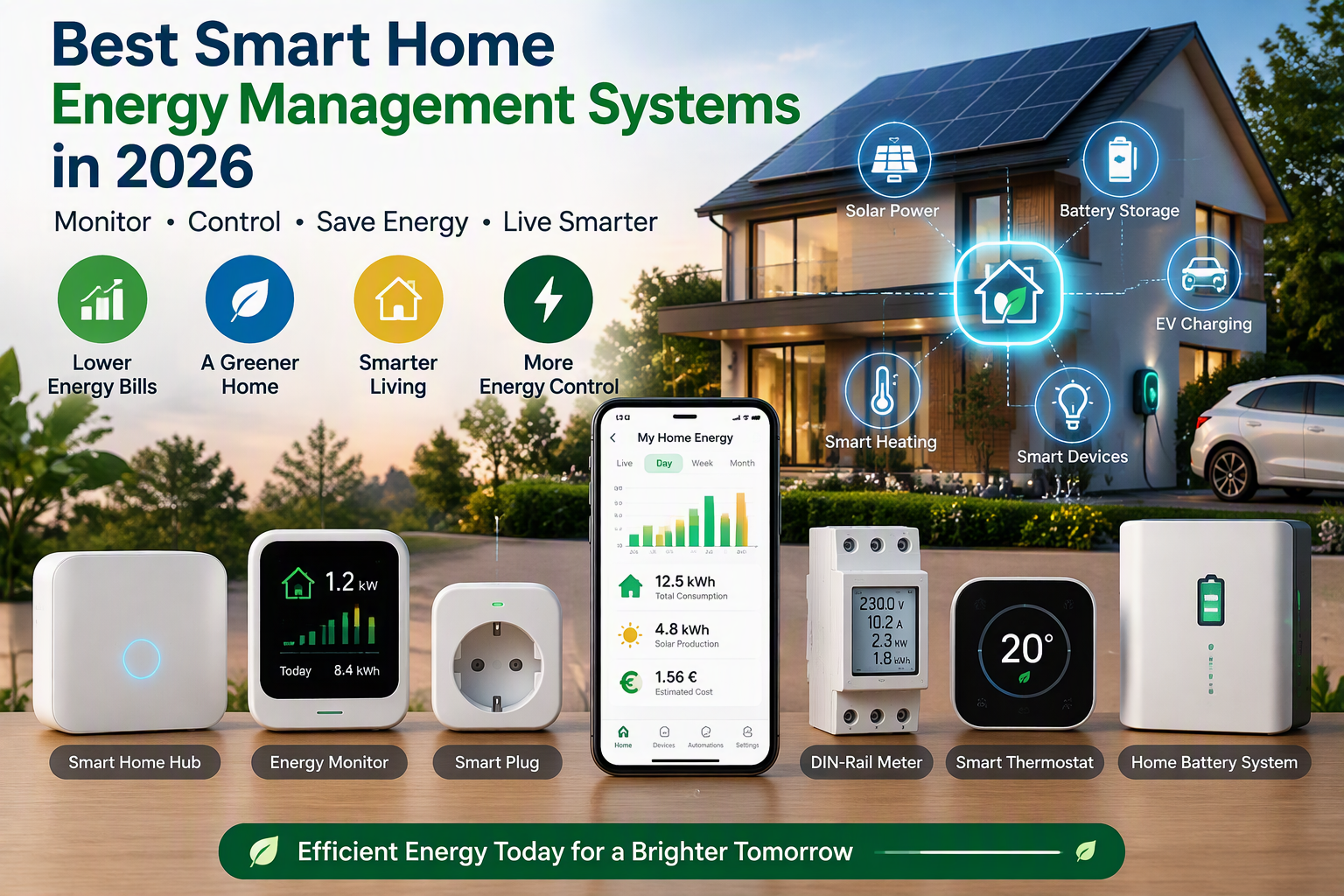
Best Smart Home Energy Management Systems in 2026: Features, Benefits, and Buying Guide
The best smart home energy management systems in 2026 help homeowners monitor electricity consumption, control connected appliances, and improve the way energy is used throughout the home. By combining smart meters, energy monitoring devices, intelligent plugs, automation hubs, and solar energy controllers, households can gain better visibility into their electricity usage and identify opportunities to reduce unnecessary consumption.
Smart home energy management is particularly useful for households with solar panels, battery storage systems, electric vehicles, heat pumps, or several energy-intensive appliances. Instead of relying only on monthly electricity bills, users can monitor energy consumption more frequently and make informed decisions about when and how to use electricity.
In Germany and other European Union countries, smart energy technology can also support more efficient use of electricity generated by rooftop solar panels. Depending on the system, users may be able to coordinate household appliances with solar production, monitor battery charging, or schedule flexible electricity consumption.
The best solution depends on the home’s electrical installation, existing smart devices, budget, and energy-saving goals. Some households only need a few smart plugs and an electricity monitor, while others may benefit from a complete home energy management system that integrates solar panels, batteries, heating equipment, and electric vehicle charging.
1. Smart Home Energy Management Hubs
A smart home energy management hub acts as a central platform for coordinating compatible smart devices and energy-related functions. Depending on the product, it can connect smart plugs, lighting systems, sensors, heating controls, and electricity monitoring equipment.
Some hubs also support energy automation, allowing homeowners to create rules that control devices according to schedules, sensor readings, or information supplied by compatible energy monitors.
Key Features and Benefits
A good smart home hub should provide reliable device connectivity, straightforward automation, and compatibility with the user’s existing equipment. Some systems support wireless technologies such as Zigbee, Thread, Wi-Fi, or Matter, although support varies between models.
Matter compatibility can make it easier to connect devices from different manufacturers, but it does not guarantee that every energy monitoring or control feature will work across all platforms. Buyers should verify compatibility for the exact devices and functions they intend to use.
Energy-related automations can help switch off unused equipment, schedule certain appliances, or coordinate devices with information from compatible electricity monitors. More advanced systems may integrate solar production, battery storage, or heating controls through supported integrations.
A hub does not automatically reduce electricity consumption simply by being installed. Its value comes from the monitoring and automation features it enables.
Recommended buying options:
- Smart home hubs with energy-related automation support.
- Matter-compatible controllers for supported devices.
- Zigbee hubs for compatible smart plugs and sensors.
- Systems that can integrate with existing energy monitors and solar equipment.
Amazon Germany: Shop smart home energy management hubs
Amazon EU: Find smart home automation hubs
2. Smart Electricity Meters and Energy Monitors
Smart electricity meters and energy monitors help homeowners understand how much electricity their properties consume. Depending on the device, measurements may be available for the entire home, an individual electrical circuit, or a connected appliance.
These products are useful for identifying energy-intensive equipment, investigating unusual consumption, and comparing electricity use at different times of the day.
Key Features and Benefits
Whole-home energy monitors may use compatible current sensors, electricity meter interfaces, or other measurement methods to collect consumption data. The information is then displayed through an application, web dashboard, or connected home automation platform.
Useful features include real-time power readings, historical consumption charts, configurable alerts, and estimated electricity costs. Some systems can distinguish between imported electricity and energy generated by a compatible solar installation.
Advanced monitoring equipment may also measure voltage, current, power factor, and individual circuit consumption. However, the availability and accuracy of these measurements depend on the product and installation.
For German households, compatibility with the installed electricity meter is particularly important. Not every monitor works with every meter, and some devices require access to a suitable optical interface, pulse output, or electrical circuit.
Equipment installed inside an electrical distribution board should be fitted by a qualified professional when required. Buyers should verify the device’s measurement method and installation requirements before purchasing.
Recommended buying options:
- Whole-home electricity monitors with application support.
- Smart meter readers compatible with the installed meter.
- Circuit-level energy monitoring systems.
- Energy monitors with historical reports and configurable alerts.
Amazon Germany: Shop smart electricity meters and energy monitors
Amazon EU: Compare home electricity monitoring devices
3. Smart Plugs with Energy Monitoring
Smart plugs with energy monitoring are among the simplest ways to begin managing household electricity consumption. They connect compatible electrical appliances to a controllable socket and allow users to monitor or switch their power remotely.
They are particularly useful for selected electronics, desk equipment, lamps, and other appliances that can safely be controlled through a compatible plug.
Key Features and Benefits
Many energy-monitoring smart plugs measure instantaneous power consumption and record electricity usage over time. Their companion applications may display daily or monthly consumption, helping users identify devices that consume electricity while operating or remaining in standby mode.
Scheduling is another valuable feature. A smart plug can automatically switch compatible equipment on or off at predetermined times, reducing the need for manual control.
Some models also support voice assistants, remote access, and integration with smart home hubs. Matter-compatible options may provide additional flexibility when used with supported controllers.
However, smart plugs are not suitable for every electrical appliance. High-power heaters, cookers, air conditioners, and other demanding equipment may exceed the plug’s rated load or require dedicated electrical connections. Buyers must follow the manufacturer’s maximum current and power specifications.
A smart plug also consumes a small amount of electricity itself. To achieve useful savings, the energy avoided by controlling the connected appliance should outweigh the plug’s own consumption.
Recommended buying options:
- Smart plugs with real-time power monitoring.
- Wi-Fi smart plugs with scheduling features.
- Matter-compatible plugs for supported smart home platforms.
- Multi-packs for monitoring several suitable devices.
Amazon Germany: Shop smart plugs with energy monitoring
Amazon EU: Find energy-monitoring smart sockets
4. Solar Energy Management Systems
Solar energy management systems help households coordinate electricity production from photovoltaic panels with household demand. They can provide useful information about solar generation, electricity imported from the grid, and energy exported from the property.
For households with rooftop solar panels, effective energy management can help increase the use of self-generated electricity rather than relying entirely on grid power when the sun is not producing enough energy.
Key Features and Benefits
A solar energy management system may monitor photovoltaic production, household consumption, and electricity flow between the property and the grid. More advanced systems can coordinate compatible batteries, electric vehicle chargers, heat pumps, or controllable household appliances.
Some products offer solar surplus management. This function detects when photovoltaic generation exceeds current household demand and can direct available surplus electricity toward compatible devices.
For example, a compatible electric vehicle charger may increase charging power when sufficient solar energy is available. A home battery system may also store surplus production for later use, depending on the equipment and configured operating strategy.
Before buying, check compatibility with the existing solar inverter, electricity meter, battery system, and communication interfaces. A product designed for one manufacturer’s ecosystem may not support all equipment from other brands.
Electrical installation and grid-connected configuration should follow local regulations and the equipment manufacturer’s requirements.
Recommended buying options:
- Solar energy monitoring systems.
- Compatible photovoltaic energy management controllers.
- Solar surplus management devices.
- Systems designed to integrate with supported batteries and electric vehicle chargers.
Amazon Germany: Shop solar energy management systems
Amazon EU: Find solar power monitoring and control devices
5. Smart Energy Meters for DIN-Rail Installation
DIN-rail energy meters are designed to measure electricity consumption within an electrical distribution board. They are commonly used in residential energy monitoring projects, solar installations, and smart home automation systems.
These devices can provide more detailed information than a simple plug-in energy monitor, particularly when monitoring dedicated circuits or equipment with high electricity demand.
Key Features and Benefits
Depending on the model, a DIN-rail energy meter may measure voltage, current, active power, and accumulated energy consumption. Some devices offer single-phase or three-phase measurement, making it important to select the correct type for the installation.
Communication options may include Modbus, Wi-Fi, Ethernet, or manufacturer-specific interfaces. Certain meters can send readings to a compatible energy management hub or monitoring platform.
These measurements can help households understand the consumption of electric vehicle chargers, heat pumps, workshops, or other dedicated circuits. When combined with an appropriate controller, the data may also support more advanced energy automation.
Accuracy specifications, supported electrical configurations, communication protocols, and installation requirements should be checked before purchase.
Because DIN-rail meters are installed inside electrical distribution equipment, installation should be performed by a qualified electrician. Incorrect wiring can create electric shock, fire, or equipment damage risks.
Recommended buying options:
- Single-phase DIN-rail energy meters.
- Three-phase electricity meters for compatible installations.
- Modbus-compatible meters for energy management platforms.
- Smart meters with documented accuracy and communication specifications.
Amazon Germany: Shop DIN-rail energy meters
Amazon EU: Compare smart electrical energy meters
6. Smart Thermostats and Heating Energy Controllers
Heating is an important part of household energy consumption, particularly in homes with heat pumps or electric heating equipment. Smart thermostats and heating controllers can help manage operating schedules and avoid heating rooms unnecessarily.
Their effectiveness depends on the existing heating system, the property’s insulation, the household’s routines, and the way temperature settings are configured.
Key Features and Benefits
Smart thermostats often include programmable schedules, remote temperature adjustment, room sensors, and automatic heating controls. Some products can adjust operating schedules according to occupancy or other available information.
Smart radiator thermostats provide another option for compatible heating systems. They allow users to set different temperatures for individual rooms, potentially reducing unnecessary heating in rooms that are rarely used.
Advanced energy management systems may coordinate compatible heat pumps with solar generation or electricity tariffs. For example, a controller may schedule some heating demand during periods when electricity is more affordable, provided that the system supports this function and comfort requirements are maintained.
Before purchasing a thermostat, confirm compatibility with the boiler, heat pump, radiator valves, or other heating equipment. Some installations require professional configuration.
Recommended buying options:
- Smart thermostats with programmable heating schedules.
- Smart radiator valves for compatible systems.
- Heating controllers with room temperature sensors.
- Compatible energy management systems for heat pumps.
Amazon Germany: Shop smart thermostats and heating controllers
Amazon EU: Find smart heating management devices
7. Home Battery Energy Management Systems
Home battery energy management systems coordinate electricity storage, charging, and discharge. They are particularly relevant for households with solar panels, although some battery products can also support other permitted energy management strategies.
The objective is to make stored electricity available when it is useful, rather than allowing available energy to be wasted or relying unnecessarily on electricity from the grid.
Key Features and Benefits
Depending on the equipment, a battery management system may monitor state of charge, charging power, discharge power, and energy flows. A complete home energy storage solution may also include an inverter, battery modules, monitoring software, and safety controls.
Some systems can prioritise solar charging during the day and supply selected household loads after sunset. Other configurations may support charging during designated low-cost tariff periods, subject to system capabilities and local electricity arrangements.
Buyers should compare usable battery capacity, maximum charging and discharging power, efficiency, backup capabilities, warranty conditions, and compatibility with the existing inverter.
Battery chemistry and installation requirements also matter. The battery should be installed in a suitable environment and operated according to the manufacturer’s safety instructions.
Not every battery management product is a complete storage system. Some products are controllers designed to work only with particular batteries and inverters, so compatibility should be confirmed before purchase.
Recommended buying options:
- Home battery monitoring and control systems.
- Compatible solar battery storage solutions.
- Hybrid inverters with energy management functions.
- Battery systems with monitoring applications and documented safety features.
Amazon Germany: Shop home battery energy management systems
Amazon EU: Find residential solar battery systems
8. Smart Electric Vehicle Charging Controllers
For households with electric vehicles, smart charging controllers can help coordinate vehicle charging with household electricity demand, solar generation, and supported electricity tariffs.
Charging an electric vehicle represents a significant flexible electricity load, so choosing when and how quickly to charge can be an important part of household energy management.
Key Features and Benefits
Smart electric vehicle chargers may include charging schedules, power monitoring, remote control, and dynamic load management. Dynamic load management adjusts charging power according to the electricity being used elsewhere in the home, helping prevent the combined load from exceeding the configured limit.
Solar-compatible charging systems can use available photovoltaic surplus to charge a vehicle when suitable generation is available. Depending on the equipment, users may be able to select between solar-only charging, scheduled charging, and faster charging modes.
Some systems can integrate with a home energy management platform or a compatible electricity meter. Buyers should check connector type, maximum charging power, installation requirements, communication features, and compatibility with their vehicle.
Fixed wall chargers and their electrical connections must be installed according to applicable local regulations. In Germany, buyers should also check relevant requirements with their electricity network operator and qualified installer.
Recommended buying options:
- Smart wall chargers with scheduled charging.
- Electric vehicle chargers with dynamic load management.
- Solar-surplus charging controllers.
- Charging systems compatible with existing home energy monitors.
Amazon Germany: Shop smart electric vehicle chargers
Amazon EU: Find intelligent EV charging systems
9. Smart Plugs and Controllers for Solar Self-Consumption
Smart plugs and compatible switching controllers can help households operate selected devices when solar electricity is available. They are a relatively accessible option for users who want to introduce basic energy automation without replacing their entire electrical installation.
Their suitability depends on the appliance’s electrical requirements and the controller’s ability to respond to actual energy measurements.
Key Features and Benefits
When connected to a compatible automation platform, a smart plug may switch a suitable appliance on or off according to a schedule or a solar surplus signal. Some systems can use energy monitor readings to make decisions about when to operate connected devices.
This approach may be useful for selected small appliances or equipment that can safely tolerate automatic switching. However, ordinary smart plugs should not be used to control equipment that requires a dedicated circuit, special switching hardware, or continuous power.
For more advanced solar automation, a dedicated energy management controller may offer better control than a basic smart plug. It can potentially coordinate several devices and use measurements from compatible electricity meters or inverters.
Buyers should verify the complete automation chain: the energy monitor must provide usable data, the controller must support the required logic, and the connected appliance must be safe to operate automatically.
Recommended buying options:
- Smart plugs with power monitoring.
- Compatible automation controllers.
- Energy meters with integration support.
- Solar surplus controllers for appropriate household loads.
Amazon Germany: Shop smart plugs for energy automation
Amazon EU: Find solar-compatible smart home controllers
10. Smart Home Energy Management Software and Applications
Energy management software brings together information from compatible meters, solar inverters, batteries, smart plugs, and other connected devices. Depending on the platform, it can display energy consumption, generate reports, and coordinate automation rules.
Some software works with a specific manufacturer’s equipment, while other platforms support multiple devices through documented integrations.
Key Features and Benefits
Useful features include live energy dashboards, historical consumption charts, configurable notifications, device-level monitoring, and automated control rules. Some applications can also display solar production and grid electricity flows in a single interface.
Open-source home automation platforms may be attractive to technically confident users because they can offer flexible integrations and local control options. However, setup may require compatible hardware, configuration, and ongoing maintenance.
Before selecting a platform, check the devices and communication protocols it supports. Also review whether energy data is stored locally or in the cloud, what information is collected, whether a subscription is required, and how software updates are provided.
A unified dashboard is most useful when the connected equipment provides accurate and consistent information. Some systems display estimated costs, so users should verify whether the calculations reflect their actual electricity tariff.
Recommended buying options:
- Energy management gateways compatible with multiple devices.
- Smart home controllers with electricity monitoring integrations.
- Manufacturer applications for supported solar and battery systems.
- Local home automation hardware for users who prefer greater control over their data.
Amazon Germany: Shop smart home energy management controllers
Amazon EU: Find home automation energy monitoring devices
How to Choose the Best Smart Home Energy Management System in 2026
Choosing the best smart home energy management system requires a clear understanding of the household’s electricity consumption, existing equipment, and long-term objectives.
A small apartment may benefit from smart plugs and a basic electricity monitor, while a home with solar panels, battery storage, a heat pump, and an electric vehicle may need a more advanced controller.
The best system is not necessarily the one with the most features. It is the one that provides reliable measurements, works with the equipment already installed, and enables useful changes to household energy consumption.
Check Compatibility Before Buying
Compatibility is one of the most important considerations when selecting smart energy equipment. A smart meter, inverter, battery, or thermostat may use a communication protocol that is not supported by every home automation platform.
Check the exact model number, supported protocols, installation requirements, and integration documentation. Matter, Wi-Fi, Zigbee, Thread, and Modbus are examples of technologies that may appear in smart home energy products, but they serve different purposes and are not automatically interchangeable.
For systems that use a manufacturer’s proprietary application, verify whether the required features remain available without a subscription or an internet connection.
Compare Monitoring Accuracy and Reporting
Energy monitoring is most useful when the measurements are reliable and easy to interpret. Check whether the device measures whole-home consumption, individual circuits, or individual appliances.
Some products measure instantaneous power in watts, while others also record accumulated energy in kilowatt-hours. These are different measurements: watts indicate the rate of power use at a particular moment, whereas kilowatt-hours measure energy consumed over time.
If the objective is to understand electricity bills, look for a device that records energy consumption over suitable periods and supports an accurate electricity tariff configuration.
Evaluate Automation Capabilities
Automation can help turn energy information into practical action. For example, a system may schedule compatible devices, switch off selected loads, or coordinate charging with available solar electricity.
However, automation should be configured carefully. Appliances that must remain continuously powered, medical equipment, refrigeration systems, and safety-critical devices should not be switched off automatically unless the equipment and intended use explicitly support it.
For heating, battery storage, and electric vehicle charging, choose a controller designed for the relevant equipment rather than relying on a general-purpose smart plug.
Consider Privacy and Cybersecurity
Smart energy systems can collect detailed information about household activity. Before purchasing, review the manufacturer’s privacy policy, application permissions, account requirements, and data storage arrangements.
Use strong, unique passwords, enable multi-factor authentication when available, and keep connected devices updated. Where supported, local control may reduce dependence on cloud services, although remote access and some advanced features may still require an internet connection.
Buyers should also consider how long the manufacturer provides software updates and whether the device can continue operating if a cloud service is discontinued.
Calculate the Potential Return on Investment
The financial value of an energy management system depends on its purchase price, installation cost, electricity tariff, household consumption, and the savings it actually enables.
For example, if a monitoring and automation system costs €200 and helps reduce electricity expenditure by €50 annually, the simple payback period would be four years.
This is an illustrative calculation, not a guaranteed result. Monitoring equipment does not necessarily reduce consumption on its own. Savings occur when the information or automation leads to meaningful changes in energy use.
For more expensive systems that integrate solar panels, home batteries, or electric vehicle charging, the calculation should include the complete installation cost and the expected operating benefits.
Best Smart Home Energy Management Systems for Different Needs
Different households require different levels of energy monitoring and automation. The following options can help buyers identify a suitable starting point.
Best for Beginners
Smart plugs with energy monitoring are a practical entry point for households that want to understand individual appliance consumption. They are generally easy to install and can provide useful information without requiring changes to the electrical distribution board.
A simple whole-home energy monitor can complement smart plugs by showing total electricity consumption.
Best for Homes with Solar Panels
A solar energy management controller can help coordinate electricity production with household demand. Systems that integrate the inverter, energy meter, battery, and compatible appliances provide a clearer picture of how solar electricity is being used.
Before choosing a controller, verify compatibility with the existing photovoltaic installation.
Best for Homes with Electric Vehicles
A smart EV charger with dynamic load management can coordinate charging with the rest of the home’s electrical demand. Solar-compatible charging can also help make better use of photovoltaic production when sufficient surplus energy is available.
The charging system should be selected according to the vehicle, electrical installation, and household energy requirements.
Best for Advanced Smart Homes
A central home automation platform with energy monitoring integrations can provide flexible control over supported devices. It may combine data from electricity meters, smart plugs, heating equipment, and solar systems in one dashboard.
This option is particularly suitable for users who are comfortable configuring automations and maintaining connected equipment.
Where to Buy Smart Home Energy Management Systems in Germany and the European Union
Amazon Germany offers a starting point for comparing smart electricity meters, monitoring devices, energy management hubs, solar controllers, and smart plugs. Product search results can help buyers compare available features, installation requirements, and customer feedback.
The following links lead to Amazon Germany search results for relevant product categories:
- Smart home energy management hubs
- Smart electricity meters and energy monitors
- Smart plugs with energy monitoring
- Solar energy management systems
- DIN-rail energy meters
- Smart thermostats and heating controllers
- Home battery energy management systems
- Smart electric vehicle chargers
These links are intended for product discovery and do not guarantee that a particular model is available, compatible, or suitable for every installation. Amazon operates different marketplaces across Europe, so buyers should select the appropriate country marketplace and check delivery availability, warranty conditions, technical specifications, and return policies.
For electricity meters, solar controllers, batteries, and EV charging equipment, professional advice may be necessary before purchasing or installing the product.
Conclusion
The best smart home energy management systems in 2026 help households monitor electricity consumption, improve automation, and coordinate compatible appliances with solar generation, battery storage, heating systems, and electric vehicle charging.
Smart plugs and basic energy monitors are suitable starting points for beginners, while homes with photovoltaic panels or several high-consumption devices may benefit from a more comprehensive energy management platform.
Before buying, compare device compatibility, measurement accuracy, automation features, privacy controls, installation requirements, and total cost. A well-chosen system can make household electricity use easier to understand and help users identify practical opportunities to reduce unnecessary consumption.
For consumers in Germany and across the European Union, Amazon product searches provide a convenient way to explore available smart energy devices. Checking official technical documentation and confirming compatibility before purchase can help ensure that the selected system meets the household’s needs.


