
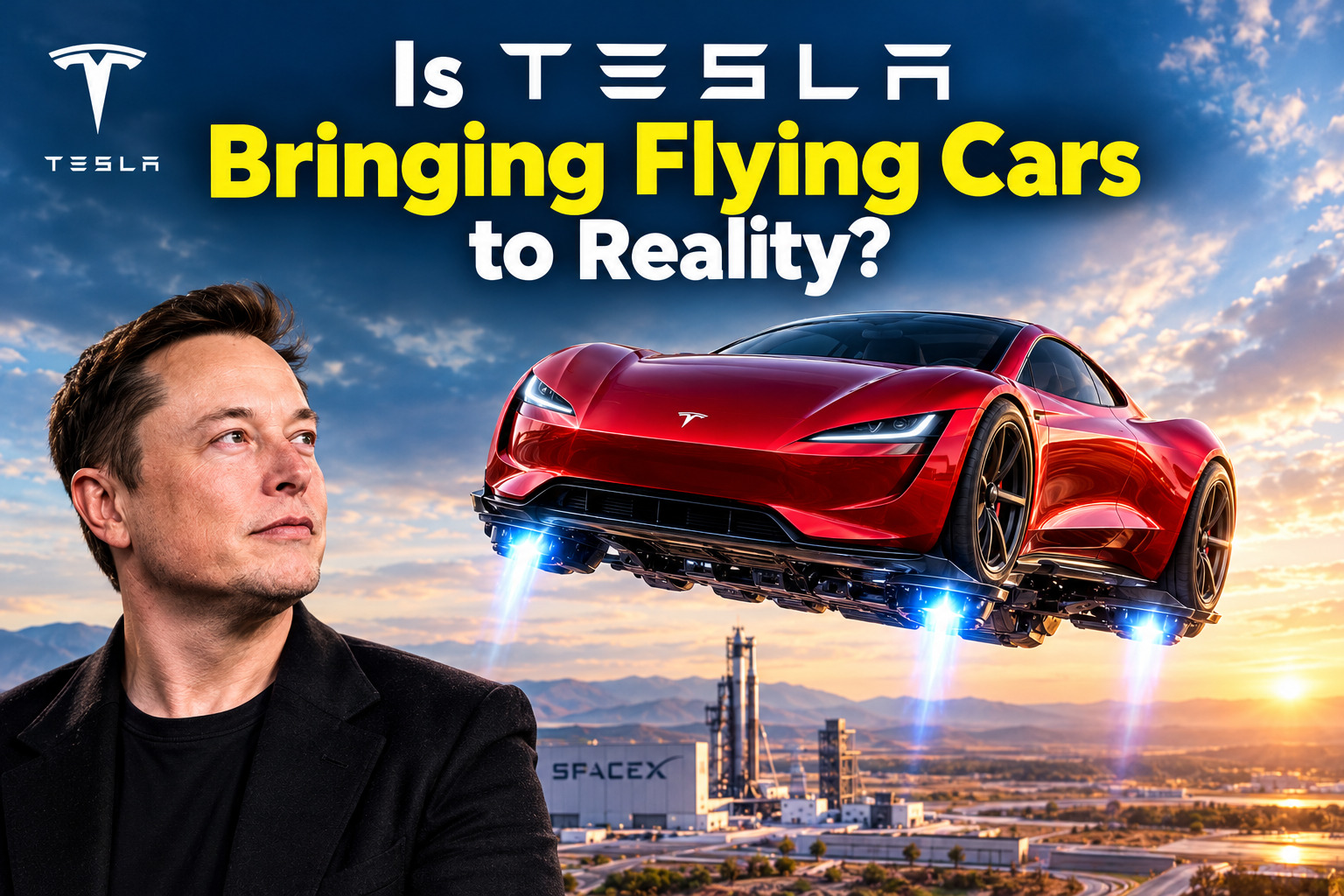
Introduction: Is Tesla Bringing Flying Cars to Reality?
On October 15, 2026, Tesla unveiled a redesigned version of its long-awaited next-generation Roadster at an event held at a SpaceX testing facility in Texas. The presentation attracted worldwide attention because the vehicle demonstrated capabilities beyond those of a conventional electric sports car, including brief airborne movements powered by compressed-gas thrusters.
Led by Elon Musk, Tesla presented the vehicle as a new milestone in high-performance automotive engineering. The demonstration combined electric-vehicle technology, aerodynamic suction, and aerospace-inspired propulsion hardware developed through collaboration between Tesla and SpaceX engineers.
However, an important distinction must be made: the demonstrated vehicle is not a conventional flying car capable of routinely transporting passengers through the sky. The Rocket configuration is a specialized, single-seat vehicle with flight-related capabilities, and Tesla states that it has not been approved for public-road use.
The company is targeting production in 2028, but several important questions remain unanswered, including the final purchase price, production specifications, regulatory approvals, and the availability of the most advanced configuration.
This comprehensive review examines the new Tesla Roadster’s design, engineering, reported performance, artificial intelligence, development history, production plans, costs, advantages, disadvantages, and commercial prospects.
1. What Is the New Tesla Flying Roadster?
The new Tesla Roadster is the second-generation version of the electric sports car first announced in 2017. Rather than introducing a completely separate flying vehicle, Tesla has developed an ambitious sports-car concept that incorporates additional propulsion technology.
The October 2026 presentation demonstrated how the vehicle could use aerodynamic suction to remain attached to a specially designed ramp and compressed-gas thrusters to perform brief aerial movements.
The event took place at SpaceX’s testing facility in Texas, highlighting the technical relationship between Tesla’s automotive engineering and SpaceX’s aerospace expertise.
Tesla’s Roadster reservation information identifies three configurations or performance packages:
- Performance: A road-oriented sports car designed for high-speed driving, featuring a multifunction fan-based suction system.
- Thrust: A configuration combining the suction system with additional propulsion hardware.
- Rocket: A specialized, single-seat configuration featuring a more extensive thruster system intended to enable brief flight-like movements. It is offered by invitation and is not approved for public-road use.
These distinctions matter because the most dramatic capabilities demonstrated at the event should not automatically be attributed to every Roadster configuration.
The vehicle remains a developing product, and its final specifications may differ from those demonstrated during the unveiling.
2. Exterior Design and Aerodynamic Engineering
The redesigned Roadster combines the proportions of a high-performance electric supercar with visual influences from aerospace engineering.
During the presentation, Tesla’s design team highlighted a clean exterior, a low-profile body, and an aerodynamic shape intended to support performance at high speeds.
A Lightweight, Performance-Oriented Structure
Reducing vehicle mass is important for electric sports cars because it can improve acceleration, handling, braking, and energy efficiency. It is even more significant when additional propulsion equipment and pressure-storage systems must be integrated into the vehicle.
Tesla’s chief designer, Franz von Holzhausen, discussed the vehicle’s design during the unveiling. The presentation also featured Tesla engineering vice president Lars Moravy, who explained aspects of the technology.
The company has not published a complete, independently verified production specification covering the final vehicle’s weight, structural materials, crash performance, or repair costs. Those figures should therefore be treated as unconfirmed.
The Fan-Based Suction System
One of the most unusual features is the multifunction fan-based suction system installed beneath the vehicle.
Tesla demonstrated the system by driving the car along a specially designed curved ramp and holding it upside down. The system creates suction that pulls the vehicle toward a surface, increasing the force holding it against that surface.
In conventional sports cars, aerodynamic downforce generally increases with vehicle speed. A fan-assisted system can generate additional downward force without relying entirely on airflow produced by forward motion.
Potential advantages include improved grip and increased cornering capability under certain conditions.
However, the demonstration does not establish that the system will provide the same results in every driving environment. Dust, water, surface irregularities, mechanical failures, and energy consumption could affect practical performance.
Steer-by-Wire Controls
Steer-by-wire technology replaces the conventional mechanical steering connection with electronic signals and actuators that control the wheels.
This approach can offer packaging flexibility and opportunities for software-based control adjustments. Nevertheless, production implementation requires carefully engineered redundancy, fault detection, and dependable responses to electronic or power-system failures.
The final safety architecture and its certification status have not been fully established publicly.
3. How Does Tesla’s Flying Roadster Work?
The Roadster’s flight-related demonstration relies on compressed gas rather than a conventional aircraft propulsion system.
According to information presented at the event, the vehicle combines an underbody suction system with cold-gas thrusters that release stored, highly pressurized air through directional nozzles.
Compressed-Gas Thrusters
Cold-gas propulsion generates thrust by releasing pressurized gas through a nozzle. The escaping gas creates a reaction force that can move a vehicle in the opposite direction.
Unlike a conventional rocket engine, a cold-gas thruster does not need to burn fuel to produce thrust.
The system can potentially provide short bursts of force for lifting or changing the vehicle’s orientation. However, its performance depends on factors such as stored gas pressure, gas mass, nozzle design, vehicle weight, and the duration of each release.
Tesla engineers discussed pressure-storage hardware and multiple thruster nozzles during the presentation. The complete production design, operating limits, service requirements, and independently verified flight specifications have not been released.
Can It Actually Fly?
The October 2026 demonstration showed the vehicle performing brief airborne movements and aerial maneuvers.
That is different from operating as an everyday flying car.
A practical flying vehicle would need to demonstrate reliable control, predictable landing behavior, sufficient operating endurance, emergency procedures, and compliance with applicable aviation and transportation regulations.
The Rocket configuration’s lack of approval for public-road use is particularly important. Consumers should not interpret the demonstration as evidence that they will soon be able to fly the car over public roads or use it as an alternative to an aircraft.
At present, the strongest supported conclusion is that Tesla demonstrated a prototype with unusual short-duration airborne capabilities. Broader claims about routine flight, passenger transportation, and everyday usability remain unproven.
4. Performance: Acceleration, Speed, and Driving Range
Tesla’s Roadster has long been positioned as an exceptionally fast electric sports car. The new demonstration reinforces that positioning, although the published performance information remains incomplete.
During the unveiling, Tesla engineering vice president Lars Moravy stated that the vehicle could accelerate from zero to 60 mph in less than one second in its most performance-focused configuration.
This is an extraordinary claim. Independent instrumented testing will be necessary to establish repeatability, measurement conditions, and the performance of production vehicles.
Acceleration
Rapid acceleration is one of the Roadster’s most prominent selling points. Electric powertrains can deliver substantial torque with little delay, while additional thrusters could potentially provide force beyond what the tires alone can transmit to the road.
However, acceleration claims should be evaluated alongside braking performance, tire grip, thermal management, repeatability, and passenger safety.
A single demonstration is not equivalent to a comprehensive performance test.
Top Speed and Driving Range
Tesla’s October 2026 presentation included claims of a top speed exceeding 230 mph and a driving range of more than 300 miles on a single charge.
These figures are manufacturer-reported targets rather than independently verified production results. The reported range is also substantially lower than the 620-mile range discussed when the next-generation Roadster was first announced in 2017.
The vehicle’s final battery capacity, certified driving range, charging performance, and energy consumption remain important outstanding questions.
In particular, the suction fans and propulsion-related hardware could introduce additional energy and packaging demands compared with a conventional electric sports car.
5. Artificial Intelligence and Software: What Is Actually Known?
Artificial intelligence is an important part of Tesla’s broader technology strategy. The company develops software for driver assistance, vehicle control, manufacturing, and autonomous-driving research.
Nevertheless, it is essential to distinguish Tesla’s existing AI capabilities from technologies specifically confirmed for the new Roadster.
Vehicle Control and Electronic Systems
The Roadster’s electronically controlled steering, braking, throttle, and propulsion systems could provide opportunities for sophisticated software-based coordination.
Potential applications include monitoring vehicle behavior, managing power delivery, detecting faults, and coordinating electronic subsystems.
However, Tesla has not publicly documented a complete Roadster-specific AI architecture, including the precise models, processors, sensor suite, software version, or functions responsible for its flight-related demonstrations.
Consequently, it would be inaccurate to claim that a particular AI model autonomously flies the Roadster or that a fully autonomous flying mode has been confirmed.
Tesla’s Broader AI Strategy
Tesla’s wider investments in autonomous driving and robotics provide relevant context. Its software and AI development activities demonstrate that intelligent vehicle systems are a major part of the company’s long-term direction.
Still, technology used in one Tesla product cannot automatically be assumed to be present in another.
For the Roadster, any claim about autonomous flight, AI-powered navigation through the air, or self-learning flight controls should remain clearly labeled as unconfirmed unless supported by detailed technical documentation from Tesla.
Why AI Could Matter in the Future
If advanced software is incorporated into later production versions, it could help coordinate traction, braking, steering, and propulsion systems.
Software may also contribute to predictive maintenance and system monitoring.
These are plausible engineering applications, not a confirmed list of production Roadster AI features. The final implementation will depend on the design, regulatory requirements, and Tesla’s published specifications.
6. Tesla and SpaceX: The Companies Behind the Project
Tesla is an electric-vehicle and energy-technology company led by Elon Musk. Its business includes electric cars, energy storage, charging infrastructure, vehicle software, and other technology initiatives.
SpaceX is a separate aerospace company founded by Musk that develops rockets, spacecraft, and related technologies.
The Roadster unveiling took place at a SpaceX testing facility, and the demonstration incorporated aerospace-inspired propulsion technology.
What Did SpaceX Contribute?
Tesla’s presentation described collaboration between engineers associated with the automotive and aerospace sides of Musk’s businesses.
The event highlighted cold-gas thrusters, pressure-storage technology, and propulsion-related engineering that would be unusual in a conventional production car.
However, the complete division of engineering responsibilities between Tesla and SpaceX has not been publicly documented in sufficient detail to identify every team’s contribution.
It is therefore more accurate to describe the Roadster as a Tesla vehicle incorporating aerospace technology developed in collaboration with SpaceX engineers, rather than claiming that SpaceX independently manufactured the car.
The two companies should also not be treated as a single legal entity simply because they share a prominent leader and collaborate on technology.
7. How Long Has the Tesla Roadster Been in Development?
The Roadster’s development history helps explain why the October 2026 unveiling attracted so much attention.
2017: The Second-Generation Roadster Is Announced
Tesla introduced the next-generation Roadster in 2017, presenting it as a high-performance electric sports car intended to demonstrate the potential of electric propulsion.
At the time, Tesla discussed ambitious performance targets and expected deliveries to begin around 2020.
2018: SpaceX Technology Enters the Discussion
Elon Musk subsequently discussed an optional SpaceX-related package involving small rocket-style thrusters.
This helped establish the idea that the Roadster might go beyond conventional automotive performance.
2020–2025: Repeated Delays
The planned launch and delivery schedule changed several times. The vehicle remained a highly anticipated project while Tesla focused on other vehicles, manufacturing priorities, and technology development.
These delays are relevant when assessing the credibility of any future delivery estimate.
October 15, 2026: The New Roadster Is Demonstrated
Tesla presented the redesigned vehicle at a SpaceX testing facility in Texas.
The event demonstrated the fan-based suction system and short-duration airborne maneuvers, bringing the flight-related concept into a public product presentation.
2028: The Current Production Target
Musk stated that production is targeted to begin in 2028.
That date represents a company target, not a guarantee that all configurations will be available to customers at that time.
The time from the original 2017 announcement to the 2028 target is approximately eleven years. The Rocket configuration’s development schedule and customer delivery timeline may differ from those of the conventional road-oriented version.
8. Who Are the Engineers Working on the Roadster?
The public presentation identified several senior figures involved in the vehicle’s development.
Elon Musk — Tesla CEO: Musk presented the vehicle and described the company’s performance ambitions and production target.
Franz von Holzhausen — Tesla Chief Designer: Von Holzhausen discussed the design direction and the vehicle’s exterior and interior concepts.
Lars Moravy — Tesla Vice President of Vehicle Engineering: Moravy explained aspects of the vehicle’s engineering and performance claims.
The presentation also acknowledged engineers working on the vehicle, including individuals identified by the first names Andy and Lamar during the event.
However, a complete public roster of all Roadster engineers, technicians, factory workers, contractors, and suppliers has not been disclosed in the sources available for this article.
It would be misleading to invent employee names, job titles, team sizes, or individual responsibilities. The same applies to claims about the total number of workers assigned to the project.
A vehicle of this complexity typically requires collaboration among specialists in vehicle dynamics, mechanical engineering, electrical systems, software, materials, manufacturing, testing, quality assurance, and safety. This is a general description of the disciplines involved in such a project, not a verified staffing list for the Roadster.
9. How Much Will the New Tesla Roadster Cost?
The final retail price of the redesigned Roadster has not been definitively confirmed.
Tesla’s earlier Roadster announcements included estimates and reservation arrangements, while recent reports have described different reservation payments for the newer configurations.
These payments must not be confused with the vehicle’s full purchase price.
Following the October 2026 unveiling, reports described reservation deposits of approximately $50,000 for the Performance configuration and $250,000 for the Thrust configuration. Availability and terms may differ by market, and the Rocket configuration has been described as invitation-only.
A deposit is not the same as the final vehicle price, and it does not independently establish a guaranteed delivery date.
What Will Determine the Final Price?
Several factors could affect the eventual cost:
- The battery pack and electric powertrain.
- The materials and structural components used in production.
- The fan-based suction system and its supporting hardware.
- Compressed-gas storage and thruster equipment.
- Manufacturing complexity and production volume.
- Certification, testing, servicing, and warranty requirements.
- Regional taxes, transportation, and import duties.
The Rocket configuration could have a substantially different cost structure from the road-oriented model because of its specialized equipment and limited availability.
However, no reliable total manufacturing cost, per-unit production cost, or confirmed profit margin has been publicly established for the new Roadster.
What About the Cost of Developing the Car?
Tesla has not published a complete project budget covering research, engineering, prototypes, testing, and the development work associated specifically with the redesigned Roadster.
It is therefore impossible to provide a reliable total development cost without making unsupported assumptions.
Any article stating an exact development budget, the cost of each prototype, or the salaries paid to individual project workers should provide a verifiable source. Otherwise, those figures should be omitted.
10. Manufacturing, Production, and Expected Availability
Tesla has identified 2028 as the target for beginning Roadster production.
Nevertheless, the start of production and the start of customer deliveries are two different milestones.
Before customer vehicles can be delivered, the company must finalize the design, validate the manufacturing process, establish quality controls, and satisfy applicable legal requirements.
Where Will the Roadster Be Built?
The October 2026 event took place at a SpaceX testing facility, but the location of a demonstration should not be confused with a confirmed production site.
A definitive production-facility assignment and a detailed manufacturing schedule should be established through Tesla’s official announcements rather than inferred from the event venue.
Will Every Version Launch at the Same Time?
Not necessarily.
The Performance configuration is positioned as the road-oriented version, while Thrust adds additional propulsion equipment and Rocket introduces more extensive flight-related hardware.
These differences could require separate validation, manufacturing arrangements, and regulatory treatment.
Tesla has not established a guaranteed customer-delivery schedule for every configuration.
Why Production Could Be Delayed
Potential challenges include:
- Completing engineering validation.
- Ensuring reliable operation of the pressure-storage and propulsion systems.
- Establishing consistent production quality.
- Meeting automotive safety and certification requirements.
- Determining where and under what conditions each version can legally operate.
- Managing the cost and complexity of limited-production hardware.
These are potential industry challenges, not confirmation that a specific future delay will occur.
11. Marketing Strategy and Commercial Potential
The Roadster occupies a distinctive position within Tesla’s product range.
Rather than being designed primarily as a mass-market vehicle, it serves as a technology showcase intended to attract attention, demonstrate engineering ambition, and reinforce the brand’s performance credentials.
A Halo Car for Tesla
In the automotive industry, a halo car is a high-profile model that draws attention to a manufacturer’s capabilities and influences public perceptions of its broader product range.
The Roadster could serve this role by combining electric performance with technology inspired by aerospace engineering.
The flight-related demonstration also provides a highly recognizable marketing story that differentiates the vehicle from conventional electric sports cars.
Digital Marketing and Global Attention
A dramatic unveiling can generate substantial interest through news coverage, social media discussions, automotive publications, and online searches.
For publishers and automotive websites, the most useful approach is to combine the excitement surrounding the launch with careful reporting on the technology’s limitations.
Will It Be a Mass-Market Vehicle?
The Roadster is unlikely to serve the same market as Tesla’s more affordable electric cars.
Its performance focus, specialized equipment, limited availability, and uncertain final pricing point toward a much narrower customer base.
The Rocket configuration, in particular, should not be described as a widely available consumer flying car while it remains invitation-only and unapproved for public-road use.
12. Advantages of the New Tesla Roadster
Despite the unanswered questions, the redesigned Roadster offers several potential advantages.
1. Unusual Engineering Ambition
Combining an electric sports car with a fan-based suction system and compressed-gas thrusters represents an unusual approach to automotive engineering.
The demonstration showed that Tesla has pursued a concept beyond conventional electric-car performance.
2. Potentially Exceptional Acceleration
Tesla’s stated acceleration target could place the Roadster among the most extreme performance vehicles if production versions reproduce the demonstrated results under independently verified conditions.
3. Advanced Vehicle-Control Possibilities
Electronically controlled steering and coordinated vehicle systems may offer flexibility in control design and system integration.
Their ultimate value will depend on the reliability and safety of the production implementation.
4. A Distinctive Brand Identity
The Roadster gives Tesla a high-profile product that connects its electric-vehicle identity with aerospace-inspired engineering.
This could help the company attract attention from automotive enthusiasts and technology-focused customers.
5. Potential Engineering Benefits From Cross-Industry Collaboration
Collaboration between automotive and aerospace specialists can encourage new approaches to materials, pressure systems, control systems, and performance engineering.
The extent of the practical benefits will become clearer as the vehicle progresses toward production.
13. Disadvantages, Risks, and Practical Limitations
The same features that make the Roadster unusual also introduce significant challenges.
1. Uncertain Production Timing
The project has experienced repeated delays since its initial announcement in 2017.
Although production is currently targeted for 2028, buyers should not assume that every version will be delivered on that schedule.
2. Regulatory Restrictions
The Rocket configuration has not been approved for public-road use.
Flight-related operation introduces additional safety and regulatory questions that do not apply in the same way to an ordinary electric sports car.
3. Limited Practical Use of the Flight System
Brief airborne movements do not provide the same benefits as sustained flight.
The demonstrated technology should not be interpreted as a replacement for conventional transportation, helicopters, or aircraft.
4. High and Uncertain Ownership Costs
The final purchase price remains unconfirmed, and specialized components could increase servicing complexity.
The long-term availability and cost of replacement parts, repairs, insurance, and specialist maintenance are not yet established.
5. Unverified Real-World Performance
Demonstration figures do not automatically establish the repeatable performance, reliability, or safety of production vehicles.
Independent testing will be necessary to evaluate acceleration, range, braking, durability, and system behavior.
6. Additional Mechanical and Software Complexity
A vehicle combining conventional automotive systems with fans, pressure-storage equipment, and thrusters has more specialized components than a typical electric sports car.
That complexity could create additional inspection and maintenance requirements.
7. Questions About Everyday Comfort
The most advanced Rocket configuration is described as a single-seat vehicle.
That limits its usefulness for ordinary passenger transportation and makes it fundamentally different from the original concept of a practical family flying car.
14. Safety and Environmental Considerations
Safety must be considered separately from performance.
A vehicle that can produce extraordinary acceleration or brief airborne movement must also demonstrate dependable control, predictable braking, structural integrity, and safe responses to failures.
Automotive Safety
The final production vehicle will need to meet the applicable requirements in each market where it is sold.
Electronic steering and braking systems require careful fault management, while specialized propulsion equipment creates additional engineering and maintenance considerations.
Tesla has not publicly established that the Rocket configuration is approved for public-road use. Readers should therefore avoid describing it as a fully certified road-and-air vehicle.
Environmental Impact
An electric powertrain can avoid tailpipe emissions during driving, but the vehicle’s total environmental impact depends on battery manufacturing, electricity generation, materials, manufacturing processes, and the vehicle’s lifetime use.
The fan-based suction system and compressed-gas propulsion hardware may also affect energy consumption and component requirements.
No complete, independently verified lifecycle environmental assessment for the redesigned Roadster has been established in the information available for this article.
Consequently, claims that it is entirely emission-free or environmentally superior in every respect would be too broad.
15. Tesla Roadster vs. a Conventional Electric Supercar
The Roadster’s defining feature is not simply electric acceleration. It is the combination of conventional sports-car engineering with additional systems intended to enable unusual demonstrations.
A conventional electric supercar generally focuses on road performance, battery efficiency, handling, braking, and driver comfort.
The Roadster introduces more specialized questions about the practicality of fan-assisted downforce and compressed-gas propulsion.
Its advantages will ultimately depend on how well the production vehicle performs in ordinary driving, not only on the spectacle of its unveiling.
For buyers who want a high-performance electric car for road use, the Performance configuration is the more relevant version to evaluate. The Rocket configuration is better understood as an experimental, highly specialized concept until its operating permissions, availability, and practical capabilities are clarified.
16. What Tesla Still Needs to Confirm
Several important details remain unresolved and should be checked against official announcements as development continues.
| Category | Current status |
|---|---|
| Vehicle identity | Redesigned second-generation Tesla Roadster |
| Public unveiling | October 15, 2026 |
| Development collaboration | Tesla and SpaceX-related engineering |
| Demonstrated flight-related capability | Brief airborne movements using compressed-gas thrusters |
| Production target | 2028 |
| Final retail price | Not definitively confirmed |
| Complete production specifications | Not fully published |
| Final manufacturing cost | Not publicly established |
| Total project development budget | Not publicly established |
| Complete project staffing list | Not publicly established |
| Rocket public-road approval | Not approved, according to Tesla’s published information |
| Guaranteed customer delivery date | Not established |
This distinction between confirmed facts and missing information is particularly important for publishers. It allows an article to provide detailed coverage without turning speculation into apparent fact.
17. Is the Tesla Flying Roadster Worth the Attention?
The new Roadster deserves attention because it demonstrates how far Tesla is willing to push the boundaries of electric-vehicle design.
Its combination of electric propulsion, fan-based suction, electronic controls, and compressed-gas thrusters is unusual and potentially influential as an engineering experiment.
However, the value of the production vehicle will depend on more than its ability to perform dramatic demonstrations.
Buyers will need clear information about pricing, battery range, reliability, maintenance, safety, legal operating conditions, and delivery schedules.
For technology enthusiasts, the Roadster is an intriguing example of automotive and aerospace ideas being combined in a single project.
For practical buyers, the more important question is whether Tesla can turn the demonstration into a dependable, legally usable, and commercially viable product.
The 2028 production target is an important milestone, but the vehicle’s final capabilities and availability will need to be confirmed as the program progresses.
Conclusion: A Remarkable Demonstration, but Not Yet an Everyday Flying Car
Tesla’s redesigned Roadster has brought the idea of a rocket-assisted electric sports car into the public spotlight.
The October 2026 unveiling demonstrated a vehicle that combined a fan-based suction system with compressed-gas thrusters, producing brief airborne movements that would be highly unusual in a conventional production car.
The project also highlights the engineering relationship between Tesla’s automotive ambitions and aerospace technology associated with SpaceX.
Nevertheless, the Roadster remains a developing vehicle. Its final retail price, full production specifications, total development cost, complete staffing details, and guaranteed delivery schedule have not been definitively established.
Most importantly, the Rocket configuration’s flight-related demonstration should not be confused with approval for routine flight or public-road use.
Tesla is targeting production in 2028. Whether the company can deliver the same capabilities reliably, safely, and at a commercially viable price will determine whether the Roadster becomes a lasting engineering milestone or remains best known for its extraordinary unveiling.
For now, the Tesla Roadster is an ambitious glimpse into a possible future for high-performance electric vehicles—not proof that practical flying cars are ready for everyday use.
Frequently Asked Questions
Is Elon Musk’s flying car real?
Tesla demonstrated a redesigned Roadster capable of brief airborne movements using compressed-gas thrusters in October 2026. However, this is not the same as a practical flying car designed for routine air transportation.
What is the name of Tesla’s new flying car?
It is the next-generation Tesla Roadster, with a Rocket configuration featuring additional flight-related hardware.
When will the new Tesla Roadster enter production?
Elon Musk stated that production is targeted for 2028. This remains a target rather than a guaranteed customer-delivery date.
How much will the Tesla flying Roadster cost?
The final retail price has not been definitively confirmed. Reported reservation deposits are not the same as the vehicle’s total purchase price.
Does the Tesla Roadster use SpaceX rocket technology?
The demonstrated vehicle uses compressed-gas thrusters and aerospace-inspired technology associated with collaboration between Tesla and SpaceX engineers. The complete production engineering specifications have not been publicly established.
Does the Roadster use artificial intelligence to fly?
Tesla has not publicly documented a complete Roadster-specific AI system responsible for autonomous flight. Claims about AI-controlled flight should therefore be treated as unconfirmed.
Can the Tesla Rocket Roadster be driven on public roads?
Tesla’s published information states that the Rocket configuration has not been approved for public-road use.
Who designed the new Tesla Roadster?
Tesla chief designer Franz von Holzhausen discussed the design during the unveiling, while engineering vice president Lars Moravy explained aspects of the vehicle’s technology.
How much did Tesla spend developing the Roadster?
Tesla has not published a complete, independently verifiable development budget for the redesigned vehicle.
Is the Tesla flying Roadster better than a conventional electric supercar?
It offers more unusual engineering features, but superiority depends on the intended use. A conventional electric supercar may be more practical for everyday driving, while the Roadster’s most advanced configuration remains specialized and subject to significant limitations.
Sources and Further Reading
Tesla — Official Roadster information: https://www.tesla.com/roadster
Reuters — Tesla’s redesigned Roadster and SpaceX thrusters: https://www.reuters.com/business/autos-transportation/tesla-set-unveil-next-generation-roadster-sports-ev-after-years-delay-2026-10-15/
Associated Press — Tesla’s new Roadster and its flight-related demonstration: https://apnews.com/article/7d5f19665435b7408025bfb7a2f2f0b7
The Guardian — Elon Musk reveals the new Roadster: https://www.theguardian.com/technology/2026/oct/16/elon-musk-reveals-worlds-first-flying-car-spacex
The Verge — Tesla’s Roadster demonstration and its practical limitations: https://www.theverge.com/transportation/1012783/tesla-roadster-flying-stunt-production-reality-musk
TechCrunch — Tesla reveals its SpaceX-powered Roadster: https://techcrunch.com/2026/10/15/tesla-reveals-spacex-powered-roadster-that-flies-and-falls-with-style/
.


