
Nobel Prize Winners 2026: Meet the Scientists, Writers and Changemakers Shaping Our World
The Nobel Prize winners of 2026 represent some of the most influential achievements in science, literature, economics and international peace. From research that allows scientists to control the activity of brain cells using light to discoveries that help explain the origins of life’s molecular asymmetry, this year’s laureates have demonstrated how years of curiosity, experimentation and intellectual persistence can transform our understanding of the world.
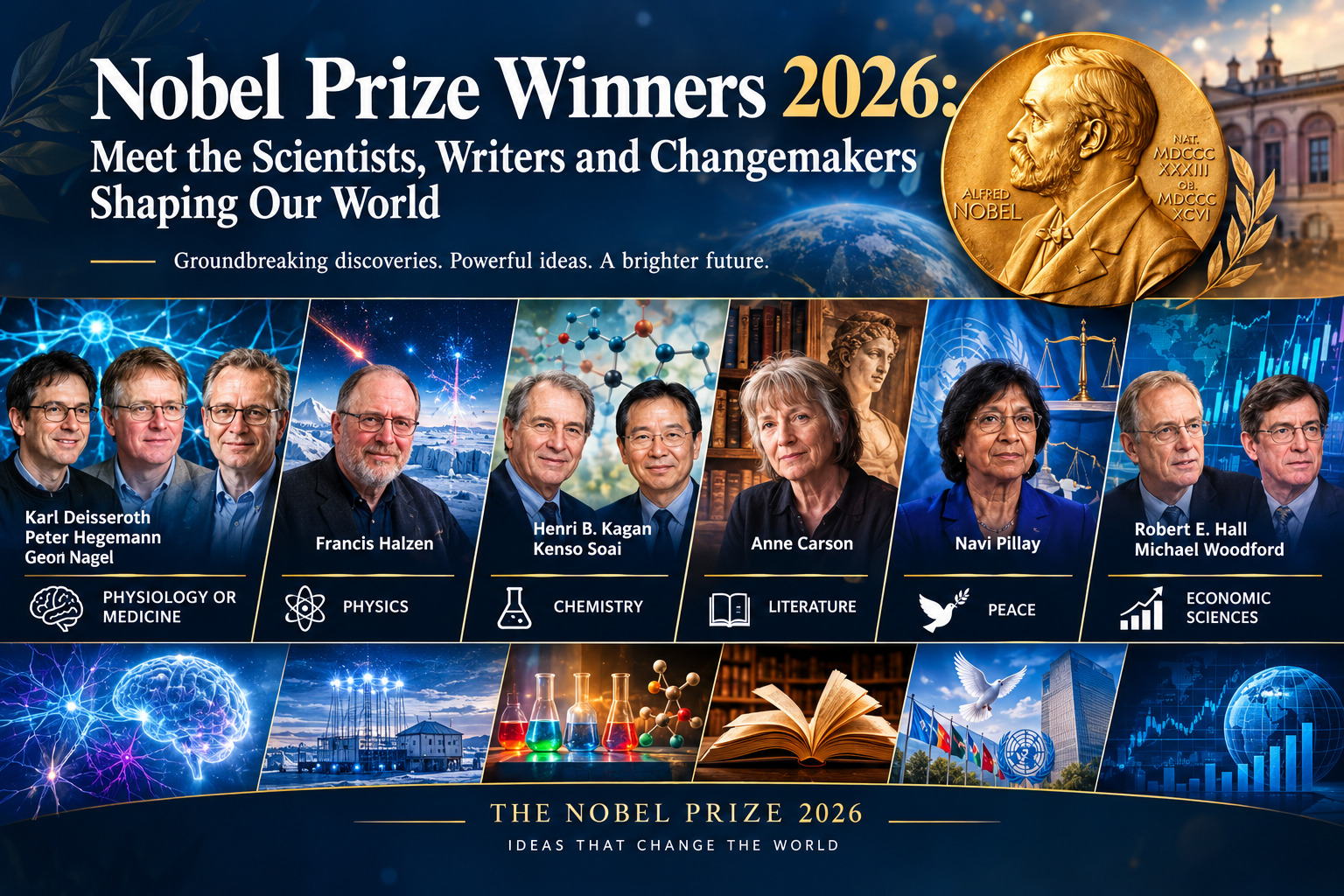
The 2026 Nobel laureates include neuroscientists Karl Deisseroth, Peter Hegemann and Georg Nagel; physicist Francis Halzen; chemists Henri B. Kagan and Kenso Soai; writer Anne Carson; peace laureate Navi Pillay; and economists Robert E. Hall and Michael Woodford. Their achievements span disciplines that may appear unrelated, yet each offers insights with consequences for human health, technology, culture, justice or economic stability.
According to the Nobel Prize announcements, the awards recognize discoveries and contributions that have helped advance human knowledge and address important global challenges. The prize money for 2026 is 12 million Swedish kronor per prize, shared among the laureates when an award is given jointly. This article explores the winners’ nationalities, careers, major discoveries, lesser-known scientific or professional details, and the potential impact of their work on future generations.
1. Nobel Prize in Physiology or Medicine 2026: Karl Deisseroth, Peter Hegemann and Georg Nagel
The 2026 Nobel Prize in Physiology or Medicine was awarded jointly to Karl Deisseroth, Peter Hegemann and Georg Nagel for discoveries concerning light-gated ion channels and optogenetics. Their work helped create a powerful way to investigate the brain by using light to control the electrical activity of selected nerve cells.
Karl Deisseroth is an American physician-scientist and professor at Stanford University in the United States. His research combines neuroscience, engineering, medicine and molecular biology. Peter Hegemann is a German biophysicist associated with Humboldt University of Berlin, while Georg Nagel is a German physiologist known for his work at the University of Würzburg. Although their careers developed in different research environments, their contributions converged on a discovery that changed how scientists study living neural circuits.
The story begins with a surprising biological observation. Certain single-celled algae use light-sensitive proteins to respond to their environment. Hegemann and Nagel helped identify and characterize channelrhodopsins, proteins that respond to light by allowing ions to cross cell membranes. These proteins offered researchers an unusual opportunity: instead of merely observing electrical activity in neurons, scientists could potentially trigger that activity using light.
Deisseroth and his collaborators helped turn this discovery into optogenetics, a research technique in which light-sensitive proteins are introduced into selected cells. Researchers can then activate or inhibit those cells with carefully controlled light pulses. This makes it possible to investigate which neural circuits participate in movement, memory, emotion, perception and behaviour. Before optogenetics, scientists often had to rely on methods that offered less precise control over particular groups of neurons.
One remarkable aspect of this achievement is that a discovery involving microscopic algae became a fundamental tool for understanding the human brain. A biological mechanism that evolved to help an organism respond to light became an instrument for studying complex neurological systems. Today, optogenetics is widely used in neuroscience laboratories to investigate conditions such as epilepsy, Parkinson’s disease, depression and other disorders, although research applications should not be confused with established routine treatments.
The future implications are significant. Researchers are investigating whether light-sensitive proteins could eventually help restore certain visual functions or support new approaches to neurological disorders. Such applications face substantial challenges, including delivering suitable proteins safely, reaching the correct cells and developing appropriate light-delivery systems. Nevertheless, the laureates’ work has given scientists a new way to test how specific brain circuits contribute to behaviour and disease.
For readers interested in the official scientific explanation, the Nobel Prize provides its 2026 Medicine Prize announcement and popular science background. These resources explain how research on light-sensitive proteins opened new possibilities in neuroscience.
2. Nobel Prize in Physics 2026: Francis Halzen
The 2026 Nobel Prize in Physics was awarded to Francis Halzen of the University of Wisconsin–Madison in the United States for his decisive contributions to the IceCube Neutrino Observatory and the discovery of high-energy neutrinos of astrophysical origin. His achievement helped establish a new way to investigate the universe using particles that are extraordinarily difficult to detect.
Neutrinos are elementary particles with no electric charge and extremely small masses. They interact so weakly with matter that enormous numbers pass through Earth and the human body without producing any noticeable effect. This makes them difficult to study, but it also gives them a unique scientific advantage: neutrinos can travel across vast cosmic distances while carrying information about energetic events in the universe.
Halzen recognized that Antarctic ice could provide an enormous natural detector. Rather than constructing a conventional detector above ground, the IceCube collaboration installed thousands of light sensors deep inside the ice near the South Pole. When a neutrino occasionally interacts with matter, it can produce charged particles that emit a faint flash of light. By recording and analysing that light, researchers can reconstruct the direction and energy of the incoming particle.
The scale of IceCube is extraordinary. Its detection array instruments approximately one cubic kilometre of Antarctic ice, turning a remote and frozen environment into a scientific observatory. This approach demonstrates how researchers can use naturally occurring materials to construct instruments that would be difficult or prohibitively expensive to reproduce using conventional engineering alone.
Halzen’s achievement is not simply the construction of a large detector. The observatory allows researchers to investigate violent cosmic environments that may be difficult to understand through visible light or other electromagnetic signals alone. High-energy neutrinos can provide clues about cosmic rays, energetic astrophysical objects and the physical processes operating in distant regions of space.
An important distinction is that detecting neutrinos does not automatically reveal every detail about their origin. Scientists must combine observations with other astronomical measurements and theoretical models. Nevertheless, IceCube has helped establish neutrino astronomy as a major field alongside traditional optical, radio and other forms of astronomical observation.
Future research may improve the identification of individual neutrino sources and deepen our understanding of extreme astrophysical environments. Larger or more sensitive neutrino observatories could also help researchers investigate questions about cosmic-ray acceleration and the most energetic processes in the universe.
Halzen’s work illustrates an important scientific principle: sometimes the best way to study the universe is to build an instrument capable of detecting something that almost never interacts with ordinary matter. The official announcement is available through the Nobel Prize in Physics 2026, while the University of Wisconsin–Madison provides institutional information about the university associated with his research.
3. Nobel Prize in Chemistry 2026: Henri B. Kagan and Kenso Soai
The 2026 Nobel Prize in Chemistry was awarded jointly to Henri B. Kagan of France and Kenso Soai of Japan for discoveries concerning nonlinear effects and autocatalysis in asymmetric organic synthesis. Their research has helped scientists understand how chemical reactions can favour one molecular form over its mirror image, a subject with important consequences for pharmaceutical chemistry and the study of life’s origins.
Henri B. Kagan is a French chemist recognized for his influential work in asymmetric synthesis and stereochemistry. Kenso Soai is a Japanese chemist whose research on asymmetric autocatalysis demonstrated how a chemical reaction can amplify a very small initial preference for one molecular form. Their contributions emerged from different research programmes but helped advance the broader understanding of how chemical reactions produce molecules with a particular three-dimensional arrangement.
To understand why this matters, consider the concept of molecular chirality. Some molecules exist in two forms that are mirror images of each other, much like a person’s left and right hands. Although the two forms contain the same atoms connected in the same general sequence, their three-dimensional arrangements differ. In biological systems, that difference can profoundly affect how molecules interact with enzymes, receptors and other compounds.
This is particularly important in medicine. Two mirror-image forms of a compound may behave differently in the body, affecting its biological activity, metabolism or safety. Chemists therefore need reliable ways to produce the desired molecular form when developing pharmaceuticals and other valuable compounds.
Kagan’s research contributed to a deeper understanding of asymmetric synthesis and nonlinear effects, which can influence how strongly a reaction favours one molecular form over another. Soai’s work demonstrated an especially striking phenomenon: asymmetric autocatalysis. In such a process, a reaction produces a chiral product that helps promote the formation of more product with the same handedness. Under suitable conditions, a small initial imbalance can therefore become greatly amplified.
One of the most intriguing aspects of Soai’s research is the sensitivity of the reaction to very small chiral influences. Experiments involving tiny sources of molecular asymmetry have helped researchers investigate how a preference for one molecular handedness might emerge from an initially almost balanced chemical environment.
This has implications beyond industrial chemistry. Many biological molecules, including amino acids and sugars, display a strong preference for one handedness. Scientists still investigate how this biological homochirality arose during the emergence of life. Asymmetric autocatalysis provides an important experimental system for studying possible mechanisms, although it does not by itself solve the origin-of-life question.
The future applications of these discoveries include improved methods for synthesizing complex molecules, more selective chemical manufacturing and the development of pharmaceutical compounds with carefully controlled structures. Such advances may support safer and more efficient drug development, although each medicine must still undergo appropriate testing and regulatory review.
The official Nobel Prize in Chemistry 2026 announcement explains the scientific achievement recognized by the award. The laureates’ work is a reminder that the orientation of atoms in space can be just as important as the identity of the atoms themselves.
4. Nobel Prize in Literature 2026: Anne Carson
The 2026 Nobel Prize in Literature was awarded to Anne Carson, a Canadian writer known for an unconventional body of work combining poetry, classical scholarship, translation and experimental literary forms. Her recognition highlights a style of writing that challenges traditional boundaries between genres and brings ancient literature into conversation with contemporary life.
Carson’s career is distinctive because she has worked across several intellectual traditions. She is not only a poet but also a scholar of classical Greek literature. Her writing frequently draws on ancient texts, philosophy, mythology and questions about human relationships. Rather than treating classical literature as a closed historical subject, she uses it as material for exploring desire, grief, identity, memory and the limits of language.
Among her best-known works is Autobiography of Red, a book that reimagines the ancient Greek myth of Geryon through a modern, hybrid literary form. The work combines elements of poetry, narrative and mythological reinterpretation. Another important book, Nox, is an experimental work of mourning that incorporates fragments of translation, images and reflections connected with the death of her brother.
These works help explain why Carson’s writing can appeal to readers who might not ordinarily approach classical literature. She often presents ancient material in ways that feel psychologically immediate, allowing readers to encounter familiar human experiences through unfamiliar literary structures.
A particularly interesting feature of her work is her willingness to challenge the separation between academic analysis and creative writing. In Carson’s hands, scholarly research can become part of a poetic experience, while poetry can function as a form of intellectual investigation. Her writing invites readers to move between different interpretations rather than follow a single, straightforward narrative.
The recognition also demonstrates that literature can have a lasting influence without following conventional commercial or stylistic expectations. Carson’s work has attracted readers in universities, literary communities and the wider public, although its fragmented and experimental forms can require more active participation than conventional storytelling.
Looking ahead, her influence is likely to continue through contemporary poetry, translation, literary criticism and the teaching of classical texts. Her work offers writers a model for engaging with the past without simply reproducing it, and for using form itself to express uncertainty, emotional complexity and intellectual discovery.
For readers wishing to explore the award directly, the official Nobel Prize in Literature website provides information about the 2026 laureate and the Academy’s announcement.
5. Nobel Peace Prize 2026: Navi Pillay
The 2026 Nobel Peace Prize was awarded to Navanethem “Navi” Pillay, a South African jurist and former United Nations High Commissioner for Human Rights, in recognition of her efforts to promote peace and international law. Her career illustrates how legal institutions and human-rights protections can contribute to the pursuit of justice in societies affected by discrimination, conflict and mass atrocities.
Born in Durban, South Africa, in 1941, Pillay grew up under apartheid, the system of institutionalized racial segregation and discrimination that shaped South African society for decades. Her experience of that system formed an important part of the historical context for her later commitment to equality and legal accountability.
Pillay became a lawyer and later served as a judge in South Africa before entering international judicial and human-rights institutions. Her professional career included service as a judge of the International Criminal Tribunal for Rwanda, where international justice mechanisms addressed crimes committed during the 1994 genocide. She subsequently became a judge of the International Criminal Court and served as United Nations High Commissioner for Human Rights from 2008 to 2014.
These roles placed her at the intersection of national law, international criminal justice and the global protection of human rights. Her work involved institutions responsible for addressing crimes that extend beyond ordinary national legal processes, including genocide, crimes against humanity and other serious violations of international law.
One of the most important aspects of Pillay’s career is the relationship between legal accountability and lasting peace. Peace agreements and political negotiations may help stop immediate violence, but societies can remain vulnerable to future conflict when serious crimes go unaddressed or when victims have no meaningful access to justice. International law provides mechanisms through which alleged perpetrators can be investigated and accountability pursued.
Pillay’s professional work also demonstrates that international justice depends on institutions, evidence, legal procedures and the willingness of states to cooperate. Courts and human-rights bodies cannot resolve every political dispute, and their effectiveness may be limited by geopolitical pressure, restricted access to evidence or a lack of enforcement. Nevertheless, these institutions can establish legal records, protect principles of accountability and give victims a formal avenue through which their experiences can be recognized.
The future relevance of her work lies in the continued effort to defend international law during conflicts and periods of political instability. Her career offers an example of how legal expertise can contribute to peacebuilding, while also highlighting the difficulties of applying universal human-rights principles in a divided world.
The award recognizes a lifetime of legal and human-rights work rather than a single scientific discovery. Readers can find biographical and institutional information through the United Nations’ profile of Navi Pillay and the official Nobel Peace Prize website.
6. Nobel Prize in Economic Sciences 2026: Robert E. Hall and Michael Woodford
The 2026 Sveriges Riksbank Prize in Economic Sciences in Memory of Alfred Nobel was awarded jointly to American economists Robert E. Hall and Michael Woodford for their contributions to the microeconomic foundations of macroeconomic stabilization. Their research has helped economists understand how the decisions of households and businesses influence the wider economy and how governments and central banks can respond to economic shocks.
Robert E. Hall is an American economist associated with Stanford University. His research has examined consumption, employment, productivity and the behaviour of households and firms. Michael Woodford is an American economist associated with Columbia University, known particularly for his work on monetary economics and the theoretical foundations of modern central banking.
Although Hall and Woodford developed their research in different academic settings, their work contributed to a common objective: building macroeconomic models from the decisions made by individual economic actors. Traditional macroeconomic models sometimes treated major economic relationships as broad patterns that could be observed in aggregate data. Micro-founded approaches instead seek to explain those patterns by examining the incentives, expectations and constraints faced by households and businesses.
Hall’s research on consumption helped economists understand why household spending cannot be explained simply by looking at current income. People also make decisions based on expectations about future income, employment, borrowing conditions and economic uncertainty. These insights are important because consumer spending represents a major part of economic activity in many countries.
Woodford’s work helped develop a framework for understanding monetary policy through the behaviour and expectations of households and firms. His influential 2003 book, Interest and Prices, presented a systematic treatment of modern monetary policy based on economic theory and forward-looking behaviour. The approach helped clarify why central-bank communication and expectations about future interest rates can influence economic conditions today.
One particularly important consequence of this research is the role of expectations in monetary policy. When a central bank changes interest rates or communicates its future intentions, households and companies may adjust spending, saving, borrowing and investment before the full effects of a policy decision appear in economic statistics. Policymakers therefore need to consider not only what they do, but also how people interpret and respond to their actions.
These ideas are relevant during periods of inflation, recession, financial instability and sudden increases in energy prices. Economic models cannot eliminate uncertainty or predict every crisis, but they can help policymakers evaluate how different policy choices may affect employment, prices and output.
Future research will continue to examine how these frameworks perform in changing economic environments, including economies affected by global supply disruptions, technological change, demographic shifts and financial instability. Economists must also account for the limits of their models, since real-world behaviour can differ from theoretical assumptions and unexpected events can produce outcomes that are difficult to forecast.
The 2026 Economics Prize is technically distinct from the five original Nobel Prizes established through Alfred Nobel’s will. It was established by Sweden’s central bank in memory of Nobel and is administered within the broader Nobel award framework. The distinction matters when describing the history and funding of the award.
For more information, readers can consult the official Nobel Prize in Economic Sciences announcement and the popular scientific explanation of the 2026 Economics Prize.
7. How Much Is the Nobel Prize Worth in 2026?
The Nobel Prize is not only an international mark of distinction; it also includes a monetary award. For 2026, the prize amount is 12 million Swedish kronor for each prize. When a prize is shared, the money is divided among its recipients according to the allocation determined by the relevant Nobel-awarding institution.
This means that a joint prize does not automatically provide each laureate with the full 12 million kronor. For example, a prize shared by two researchers represents a total award of 12 million kronor for that category, not 12 million kronor for each person. The same principle applies to awards shared by three researchers.
The value in another currency, such as US dollars, euros or Algerian dinars, changes with exchange rates. For that reason, a precise conversion should be calculated using the exchange rate applicable on the date of reference rather than treated as a permanent figure.
The monetary award is only one component of the prize. Nobel laureates also receive a medal and a diploma, and the recognition can influence their research opportunities, professional invitations, public visibility and ability to attract support for future work. However, receiving a Nobel Prize does not automatically guarantee additional research funding, commercial success or the practical application of every discovery.
The prize money is also not a salary paid for future work. It recognizes achievements judged to have made a significant contribution within the relevant field. Some laureates continue their research or writing for many years after receiving the award, while others use the recognition to support new initiatives, public engagement or the training of younger researchers.
The official Nobel Prize website provides information about prize amounts, laureates, award histories and the institutions responsible for each category.
8. What Makes the 2026 Nobel Prize Winners Important to the Future?
The 2026 Nobel laureates demonstrate that progress often begins with questions that appear highly specialized. A light-sensitive protein in an alga became a tool for studying the brain. The faint signals generated by rare interactions between neutrinos and matter became a means of investigating distant cosmic events. Research into molecular handedness advanced chemistry and offered new ways to study the origins of biological asymmetry.
In literature, Anne Carson’s work demonstrates how ancient ideas can be reinterpreted through experimental forms to illuminate contemporary human experiences. Navi Pillay’s career shows how legal institutions can contribute to the pursuit of justice and the protection of human rights. Robert E. Hall and Michael Woodford have helped clarify how individual economic decisions and expectations shape the broader economy, informing debates about inflation, employment and monetary policy.
These achievements should not be interpreted as guarantees that every scientific discovery will become a medical treatment, every economic model will prevent a crisis or every legal intervention will produce peace. Research takes time, applications require testing and institutions face real limitations. The importance of the Nobel Prize lies partly in recognizing the work that expands the possibilities available to future generations.
The winners also illustrate the international character of modern intellectual achievement. Their careers connect universities, research institutions, laboratories, courts, literary traditions and international organizations across national borders. Their work shows how ideas developed in one place can eventually influence people and institutions around the world.
For students, the 2026 Nobel laureates provide examples of different paths to achievement. Some made discoveries through laboratory experiments, others through theoretical models, creative writing or decades of legal service. Their experiences demonstrate that meaningful contributions can emerge from many disciplines and that sustained effort, careful reasoning and a willingness to question existing assumptions remain central to progress.
Conclusion: The 2026 Nobel Laureates and Their Lasting Global Impact
The Nobel Prize winners of 2026 have been recognized for achievements that expand human understanding across science, culture, economics and international justice. Karl Deisseroth, Peter Hegemann and Georg Nagel advanced the study of the brain through optogenetics; Francis Halzen helped establish neutrino astronomy through the IceCube Observatory; and Henri B. Kagan and Kenso Soai transformed understanding of asymmetric chemical reactions.
Anne Carson received recognition for a distinctive literary career that brings classical scholarship into modern poetry and experimental writing. Navi Pillay was honored for her work promoting peace and international law, while Robert E. Hall and Michael Woodford received the Economics Prize for research that deepened the foundations of macroeconomic stabilization.
Each achievement has a different relationship with the future. Some offer new research tools, others influence how societies interpret literature, pursue justice or manage economic instability. Their practical consequences will continue to develop through additional research, public institutions, technological innovation and the work of future generations.
The 2026 awards also remind readers that major achievements are rarely isolated events. They often depend on years of earlier research, collaboration across disciplines and the willingness to explore questions whose answers are not immediately obvious.
With 12 million Swedish kronor awarded for each prize, subject to division among joint recipients, the Nobel Prize remains one of the world’s most prominent forms of recognition for intellectual and humanitarian achievement. Yet its enduring significance extends beyond the medal or monetary award: it draws global attention to work that can reshape how people understand the brain, the universe, chemistry, literature, justice and the economy.
As the contributions of the 2026 laureates continue to be studied and applied, their stories offer a broader lesson: discoveries and ideas that begin with a narrow question can eventually change the way the world thinks, works and responds to its greatest challenges.


