
Best 5 Keyword Research Tools in 2026: Features, Benefits, and SEO Guide
The Best Keyword Research Tools for SEO
Keyword research is one of the most important steps in search engine optimization (SEO). It helps bloggers, website owners, affiliate marketers, content creators, and digital marketing professionals discover the words and phrases people use when searching for information, products, and services online. Choosing the right keyword research tools can help you understand search demand, evaluate competition, identify content opportunities, and build a more effective SEO strategy.
The best keyword research tools in 2026 offer features such as keyword suggestions, search volume estimates, keyword difficulty analysis, competitor research, search intent insights, long-tail keyword discovery, and performance tracking. Some tools provide comprehensive SEO data for professional marketers, while others offer simple interfaces and free features for beginners.
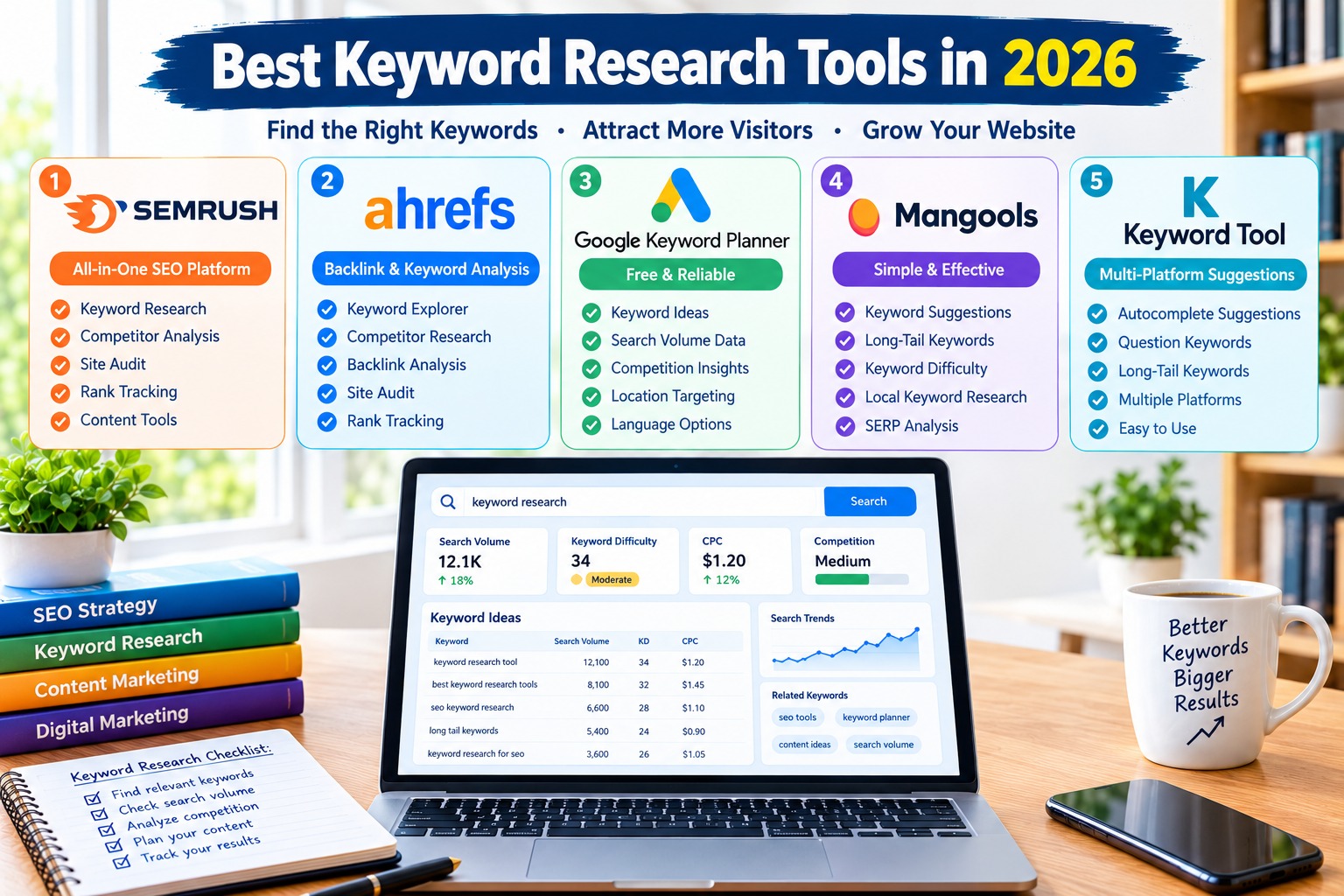
In this guide, we explore five useful keyword research tools: Semrush, Ahrefs, Google Keyword Planner, KWFinder by Mangools, and Keyword Tool. Each tool has different strengths, making it important to choose the option that best matches your website, budget, and marketing goals.
1. Semrush: Best All-in-One Keyword Research Tool
Official website: https://www.semrush.com/
Semrush is a comprehensive SEO and digital marketing platform that helps users discover valuable keywords, analyze competitors, evaluate search trends, and develop content strategies. It is particularly useful for professional bloggers, affiliate marketers, online businesses, and marketing agencies that need more than basic keyword suggestions.
One of the platform’s most useful features is Keyword Magic Tool, which generates keyword ideas related to a specific topic or search phrase. Users can explore related keywords, question-based queries, and longer search phrases that may be suitable for blog articles, product reviews, category pages, and informational guides.
Semrush also provides keyword metrics, including estimated search volume and keyword difficulty. These indicators help users compare opportunities and decide which terms deserve further investigation. Search volume estimates indicate potential demand, while keyword difficulty metrics help users assess the relative challenge of competing for particular search terms.
Another important feature is competitor keyword analysis. Users can investigate competing websites to discover the search terms associated with their organic visibility. This can reveal content gaps and inspire new article ideas without copying competitors’ original writing or proprietary materials.
Semrush also supports keyword grouping and content planning. Related keywords can be organized into topic clusters, helping website owners plan interconnected articles and build a logical website structure. This approach is especially useful for affiliate websites that publish multiple articles about related products.
For businesses targeting different countries, Semrush offers regional keyword research capabilities. This can help users investigate search behavior in Germany, the United Kingdom, and other markets, although language, search intent, and competition should be assessed separately for each audience.
The main advantage of Semrush is its combination of keyword discovery, competitor research, site auditing, and ranking analysis in one platform. However, its advanced features may be more than a beginner needs, and paid subscriptions can represent a significant expense for small websites.
Best for: Professional bloggers, affiliate marketers, SEO specialists, agencies, and businesses managing multiple websites.
Key features: Keyword suggestions, search volume estimates, keyword difficulty, competitor analysis, keyword grouping, content planning, and rank tracking.
Main advantages: Comprehensive research capabilities, extensive SEO functionality, and useful competitor insights.
Potential limitations: Advanced features may require a paid subscription, and the interface can take time to learn.
For additional learning resources, visit Amazon Germany: SEO and Keyword Research Books.
2. Ahrefs: Best for Keyword Analysis and Competitor Research
Official website: https://ahrefs.com/
Ahrefs is a widely used SEO platform that provides keyword research, backlink analysis, competitor investigation, website auditing, and rank tracking. It is particularly valuable for content publishers and SEO professionals who want to understand search opportunities and examine the websites competing for important keywords.
Its Keywords Explorer tool helps users discover search phrases related to a topic and evaluate metrics such as estimated search volume and keyword difficulty. It can also provide related keyword ideas and question-based searches that help content creators understand what their audience wants to learn.
One major benefit of Ahrefs is its connection between keyword research and competitor analysis. Users can examine the pages ranking for particular search terms, investigate competing websites, and identify topics that may deserve more detailed coverage on their own sites.
Ahrefs also provides information about search results and estimated traffic potential. These insights can help users understand why a keyword might be valuable beyond its estimated monthly search volume. A keyword with moderate search demand may still be worthwhile if it attracts a relevant audience with a clear interest in the subject.
Another important feature is its backlink analysis functionality. Although backlink research is different from keyword research, it can help users understand the competitive environment surrounding a topic and identify opportunities to create useful resources that other websites may reference naturally.
The platform also includes site auditing and rank tracking features, depending on the selected plan. These capabilities help users monitor technical issues and evaluate how their target keywords perform over time.
Ahrefs is particularly suitable for experienced marketers who need detailed competitive research and want to connect keyword discovery with content planning. However, users should review subscription limits and available features before choosing a plan.
Best for: SEO professionals, affiliate marketers, content publishers, digital marketing agencies, and established websites.
Key features: Keywords Explorer, keyword difficulty analysis, competitor research, backlink analysis, content discovery, site audits, and rank tracking.
Main advantages: Strong competitive research, detailed keyword discovery, and useful insights into competing pages.
Potential limitations: Some advanced features require a paid plan, and the available data and usage limits depend on the subscription.
For more information about SEO research, explore Amazon Germany: Keyword Analysis and SEO Strategy Books.
3. Google Keyword Planner: Best Free Starting Point for Keyword Research
Official website: https://ads.google.com/home/tools/keyword-planner/
Google Keyword Planner is a keyword research tool within Google Ads. It helps users discover search terms, examine estimated search demand, and develop keyword ideas for advertising campaigns. It can also provide useful starting points for organic SEO research.
One of its most valuable features is keyword discovery. Users can enter words related to a product, service, or topic and receive suggestions for related search terms. For example, someone creating a website about car accessories could investigate phrases related to car phone holders, tire inflators, vehicle organizers, and other relevant products.
The tool provides estimates of average monthly searches and advertising competition. It may also show suggested bid information for advertising purposes. These metrics can help users understand potential demand and commercial interest, but advertising competition should not be treated as an exact measurement of organic SEO difficulty.
Another advantage is the ability to investigate keyword ideas for different geographic locations and languages. This is particularly useful for websites targeting specific European markets. A publisher can compare English-language terms with relevant German-language phrases instead of assuming that direct translations reflect actual search behavior.
Google Keyword Planner is also useful for discovering variations of a primary keyword. These suggestions can help content creators plan article titles, headings, supporting sections, and related pages.
However, Keyword Planner is designed primarily for advertising research rather than comprehensive organic SEO analysis. Search volume data may be presented in ranges depending on the account and available access, and the tool does not provide all the competitive SEO metrics available in specialized platforms.
Despite these limitations, it is a practical starting point for beginners who want to explore keyword opportunities without immediately paying for a premium SEO subscription.
Best for: Beginners, small businesses, website owners, bloggers, and advertisers.
Key features: Keyword discovery, estimated monthly searches, geographic targeting, language targeting, advertising competition, and bid estimates.
Main advantages: Accessible keyword research, useful search-demand estimates, and support for multiple locations and languages.
Potential limitations: Primarily designed for advertising, with fewer organic SEO analysis features than specialized platforms.
For educational resources, visit Amazon Germany: Google Keyword Planner and SEO Books.
4. KWFinder by Mangools: Best Keyword Research Tool for Beginners
Official website: https://mangools.com/kwfinder/
KWFinder is a keyword research tool developed by Mangools. It focuses on helping users discover relevant keywords, evaluate ranking difficulty, and find search phrases that may offer realistic opportunities for their websites.
Its straightforward interface makes it suitable for bloggers, small business owners, affiliate marketers, and beginners who want keyword research to be easier to understand. Instead of overwhelming users with extensive marketing reports, KWFinder presents keyword ideas and important metrics in a relatively accessible format.
One of its main features is keyword difficulty analysis. This metric estimates how challenging it may be to rank for a particular keyword based on the tool’s methodology. It can help users compare different search phrases and identify candidates that deserve closer examination.
KWFinder also supports related keyword discovery and long-tail keyword research. Long-tail keywords are more specific search phrases that often reflect a particular question, need, or product requirement. For example, a broad term such as “coffee machine” can be expanded into more specific phrases related to automatic coffee machines, compact espresso machines, or coffee machines for small kitchens.
These more specific queries can help website owners develop focused articles that respond to particular search intentions. However, a lower difficulty score does not guarantee rankings, and search demand should always be considered alongside relevance and competition.
Another useful capability is location-based keyword research. Users can investigate keywords for particular markets, which is helpful when creating content for audiences in Germany or other European countries.
KWFinder is part of the broader Mangools SEO ecosystem, which offers additional tools for examining search results, backlinks, and website authority metrics. The available features and limits depend on the current plan.
Its primary advantages are ease of use and a focus on practical keyword discovery. Users managing large websites or requiring extensive competitive intelligence may eventually need a more comprehensive platform.
Best for: Beginner bloggers, niche website owners, affiliate marketers, freelancers, and small businesses.
Key features: Keyword suggestions, long-tail keyword discovery, keyword difficulty estimates, local keyword research, and search results analysis.
Main advantages: Beginner-friendly interface, straightforward keyword comparisons, and useful tools for finding specific search phrases.
Potential limitations: Advanced data access and usage limits depend on the subscription, and it may not replace a comprehensive SEO platform for larger projects.
For additional guidance, explore Amazon Germany: Long-Tail Keyword Research and Blogging Books.
5. Keyword Tool: Best for Long-Tail Keyword Suggestions
Official website: https://keywordtool.io/
Keyword Tool is a keyword discovery platform designed to generate search phrase suggestions from autocomplete data. It is useful for content creators who want to explore how people phrase searches across different online platforms.
One of its main strengths is its ability to generate many keyword variations from a single starting phrase. Users can enter a general topic and explore related suggestions that may inspire blog posts, frequently asked questions, product descriptions, and other content.
The platform supports research for multiple services and platforms, with available sources depending on its current features and plan. This can be valuable for marketers who create content for websites, online stores, video platforms, or other search-driven channels.
For traditional website SEO, Keyword Tool can help identify question-based searches and specific keyword variations. These phrases may reveal what users want to know before making a purchase or choosing a service.
For example, a website covering home appliances could investigate searches related to energy-efficient air conditioners, compact coffee machines, or the features to consider when choosing an air fryer. Such suggestions can help publishers build content around distinct user needs rather than relying on broad keywords alone.
Another advantage is its usefulness for brainstorming. A long list of keyword variations can help content teams create editorial calendars, organize related subjects, and identify questions that deserve detailed answers.
However, keyword suggestions should be validated before being used in an SEO strategy. Not every suggested phrase has substantial search demand, and autocomplete suggestions alone do not establish how difficult a keyword will be to rank for.
Some advanced metrics and research capabilities require a paid plan. Users should compare the available features and limits before subscribing.
Best for: Bloggers, content marketers, e-commerce businesses, video creators, and users seeking long-tail keyword ideas.
Key features: Autocomplete-based keyword suggestions, question-based queries, long-tail keyword discovery, and research across supported platforms.
Main advantages: Useful content ideas, a broad range of keyword variations, and support for different content channels.
Potential limitations: Advanced data may require a subscription, and suggestions should be checked against search demand and competition.
For additional educational materials, visit Amazon Germany: Content Marketing and Keyword Research Guides.
Comparison of the Best Keyword Research Tools in 2026
The best keyword research tool depends on your goals, budget, and level of experience. Semrush is a strong option for users who want keyword discovery, competitor analysis, and broader SEO features within one platform. Ahrefs is particularly useful for competitive research and understanding the pages that rank for valuable search terms.
Google Keyword Planner is an accessible starting point for discovering keyword ideas and examining estimated search demand. KWFinder is worth considering for users who prefer a simpler workflow and want to investigate long-tail keywords. Keyword Tool is useful when the priority is generating a wide variety of keyword suggestions for content planning.
Before selecting a tool, compare the available keyword database, target countries, search volume estimates, keyword difficulty metrics, competitor analysis features, reporting options, and subscription limits. Also consider how frequently you will use the platform and whether its additional features justify the cost.
A beginner managing one blog may not need several premium subscriptions. Starting with free resources and adding paid software when necessary can be a practical way to control expenses while developing an effective SEO workflow.
How to Choose the Right Keywords for Better SEO Results
Effective keyword research involves more than choosing phrases with the highest estimated search volume. The best keywords are relevant to your audience, aligned with your website’s purpose, and realistic opportunities for your current level of authority and competition.
Begin by identifying the main topics your audience cares about. Enter relevant seed keywords into a research tool and collect related search phrases, questions, and long-tail variations. Organize the results into groups based on subject and search intent.
Search intent describes the purpose behind a query. Informational searches seek explanations or guidance, commercial searches compare available options, and transactional searches indicate a stronger intention to take action or make a purchase. Matching your content to the user’s intention helps ensure that the page answers the right question.
Next, examine estimated search volume and keyword difficulty. A highly competitive keyword may be difficult for a new website to target immediately, while a more specific phrase could provide a more realistic starting point. Nevertheless, a keyword should not be selected solely because its difficulty score appears low.
Review the search results for your target phrase to understand the types of pages that rank. Look for common topics, content formats, questions, and information gaps. Use this research to create original content that is more helpful, accurate, and comprehensive for your intended audience.
Finally, organize related keywords into a clear content plan. Assign one primary topic to each page and include related phrases naturally where they improve the explanation. Avoid creating many nearly identical pages simply to target small keyword variations.
Best Free Keyword Research Resources for Website Owners
In addition to dedicated keyword research platforms, several free resources can help website owners understand search demand and improve their content strategies.
Google Trends helps users explore changes in search interest over time and compare topics across supported regions. It is useful for identifying seasonal patterns and understanding whether interest in a subject is increasing or decreasing.
Official website: https://trends.google.com/
Google Search Console provides information about how a verified website performs in Google Search. Website owners can review queries that generate impressions and clicks, identify pages receiving organic traffic, and discover opportunities to improve existing content.
Official website: https://search.google.com/search-console/about
Google Keyword Planner can help users discover keyword ideas and examine estimated search demand, particularly when researching potential advertising opportunities.
Official website: https://ads.google.com/home/tools/keyword-planner/
These resources serve different purposes. Google Trends helps explore relative interest, Search Console reports performance data for your own website, and Keyword Planner focuses on keyword discovery and advertising research. Using them together can provide a useful starting point before investing in additional SEO software.
How to Use Keyword Research Tools Without Copyright or Legal Problems
Keyword research generally focuses on search phrases, demand estimates, and competitive analysis. However, the content you create from that research should respect copyright, licensing terms, privacy requirements, and applicable website regulations.
Search terms and short phrases are generally different from protected creative works, but this does not mean that all content associated with a keyword can be copied freely. Do not reproduce another publisher’s articles, photographs, graphics, videos, or distinctive creative materials without permission or a valid legal basis.
Use keyword research to understand audience needs and then write original articles based on your own research, experience, and analysis. When referencing factual information, verify it against reliable sources and provide appropriate attribution where necessary. Do not assume that rewriting a few words from another article automatically makes copied content lawful or original.
For images and other media, use your own materials or resources with licenses that permit your intended use, including commercial publication where applicable. Check the license conditions and keep relevant records.
If your website uses affiliate links, disclose commercial relationships clearly and follow the rules that apply to your audience and business model. Websites serving visitors in Germany or elsewhere in the European Union should also review applicable requirements concerning privacy, cookies, personal data, advertising, and consumer information.
Finally, use SEO tools in accordance with their terms of service. Avoid unauthorized data collection, automated spam, deceptive practices, and manipulative techniques designed to mislead search engines or users.
Are Keyword Research Tools Available on Amazon Germany?
Most professional keyword research platforms are online services rather than physical products sold through Amazon. Semrush, Ahrefs, KWFinder, and Keyword Tool provide information about their software and subscription options through their respective official websites. Google Keyword Planner is available through Google Ads.
For this reason, the Amazon Germany links included in this article lead to searches for relevant educational books and guides rather than incorrectly presenting software subscriptions as Amazon products.
Books about SEO, keyword research, content marketing, and website optimization can help readers develop a better understanding of search behavior and content planning. Availability, editions, language, prices, and delivery options may vary across Amazon Germany and other European Union marketplaces.
Before purchasing a book, check its publication date and confirm that its recommendations remain relevant to current SEO practices.
Conclusion: Which Are the Best Keyword Research Tools in 2026?
The best keyword research tools in 2026 help website owners discover relevant search phrases, understand search demand, analyze competitors, and create more effective content strategies. Semrush is an excellent option for comprehensive SEO research, Ahrefs provides powerful competitor analysis, Google Keyword Planner offers an accessible starting point, KWFinder is suitable for users who prefer a straightforward interface, and Keyword Tool specializes in generating keyword suggestions.
The right choice depends on your budget, experience, target audience, and website goals. Beginners can start with free resources such as Google Keyword Planner, Google Trends, and Google Search Console before investing in a premium subscription.
By selecting relevant keywords, understanding search intent, creating original and useful content, and following responsible SEO and copyright practices, you can build a stronger search presence and develop a sustainable website strategy.


