
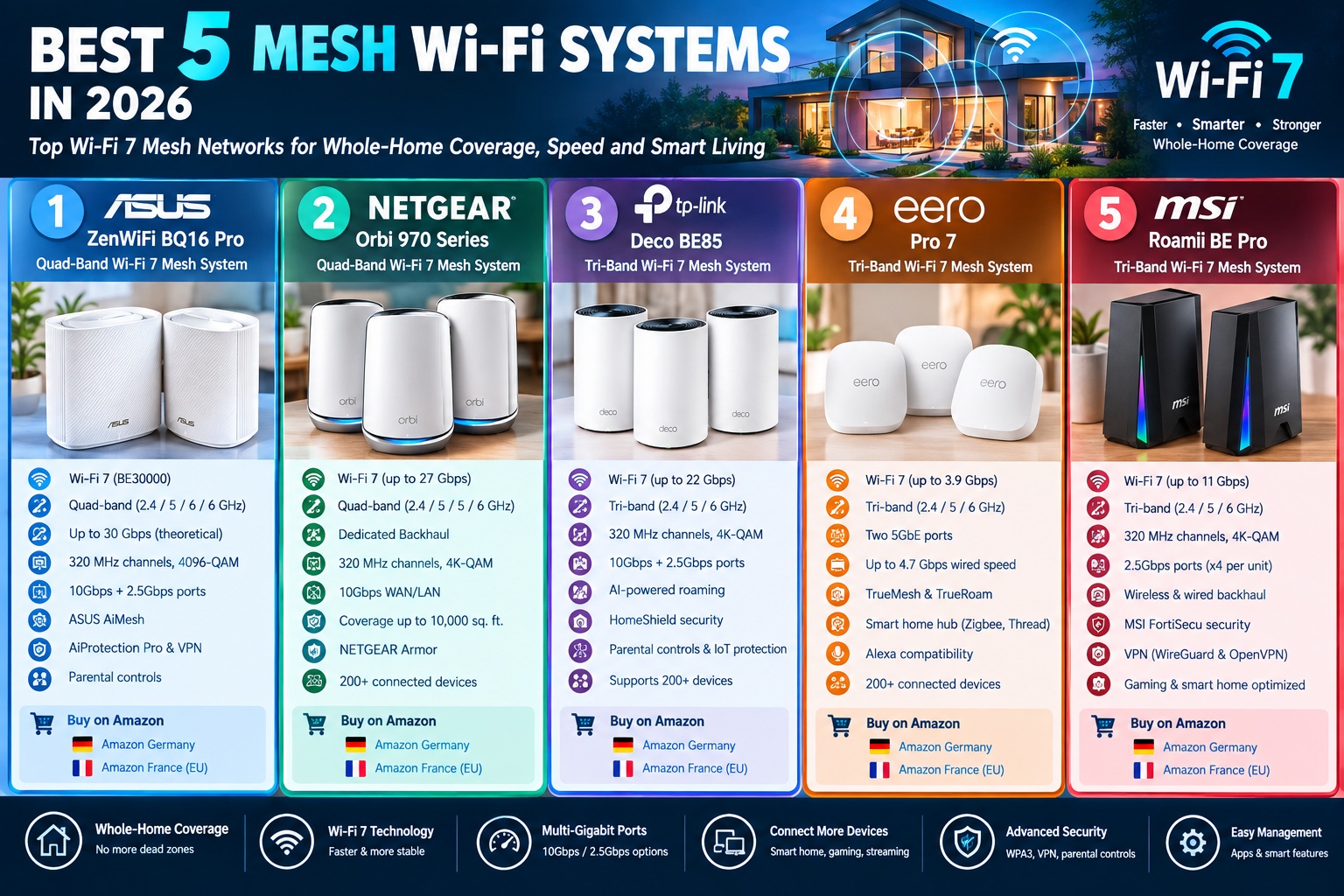
Best 5 Mesh Wi-Fi Systems in 2026: Top Wi-Fi 7 Mesh Networks for Whole-Home Coverage
1. ASUS ZenWiFi BQ16 Pro – Premium Quad-Band Wi-Fi 7 Mesh System
The ASUS ZenWiFi BQ16 Pro is an advanced quad-band Wi-Fi 7 mesh system designed for users who want extremely high wireless capacity, multi-gigabit networking and extensive network-management features.
The BQ16 Pro is rated up to BE30000, combining 2.4 GHz, 5 GHz and two 6 GHz bands for a theoretical aggregate wireless rate of up to approximately 30 Gbps. ASUS lists up to 11,529 Mbps on each 6 GHz band, 5,764 Mbps on 5 GHz and 1,376 Mbps on 2.4 GHz.
Key Features
- Wi-Fi 7 / IEEE 802.11be
- BE30000 class
- Quad-band configuration
- 2.4 GHz + 5 GHz + dual 6 GHz
- Up to approximately 30 Gbps theoretical aggregate speed
- 320 MHz channels
- 4096-QAM
- OFDMA
- 4×4 radios
- 12 internal antennas
- 2GB RAM
- 256MB flash storage
- 1 × 10Gbps WAN/LAN port
- 1 × 10Gbps LAN port
- 1 × Gigabit WAN/LAN port
- 2 × Gigabit LAN ports
- USB 3.0
- ASUS AiMesh
- Adaptive QoS
- AiProtection Pro
- Parental controls
- WireGuard VPN support
- OpenVPN and IPSec VPN
- Guest networks
- Traffic monitoring
Advantages
The biggest advantage of the ZenWiFi BQ16 Pro is its quad-band Wi-Fi 7 architecture. Having two 6 GHz bands provides substantial wireless capacity for demanding networks and can be particularly useful when multiple high-performance devices are connected simultaneously.
The system also provides two 10Gbps Ethernet connections per unit, giving users plenty of flexibility for high-speed fiber internet, NAS storage, gaming PCs and professional workstations. ASUS AiMesh also allows compatible ASUS routers to be integrated into a larger network.
Purchase Links
Amazon Germany: ASUS ZenWiFi BQ16 Pro
Amazon France / EU: ASUS ZenWiFi BQ16 Pro
2. NETGEAR Orbi 970 Series – High-End Wi-Fi 7 Mesh for Large Homes
The NETGEAR Orbi 970 Series is a flagship quad-band Wi-Fi 7 mesh system designed for large homes and demanding multi-gigabit networks.
NETGEAR rates the Orbi 970 at up to 27 Gbps of aggregate Wi-Fi 7 speed. The system uses a quad-band design with enhanced dedicated backhaul technology and supports up to 200 connected devices. Depending on the configuration, NETGEAR lists coverage of up to 10,000 square feet for a three-pack.
Key Features
- Wi-Fi 7 / IEEE 802.11be
- Quad-band architecture
- Up to 27 Gbps theoretical aggregate Wi-Fi speed
- 2.4 GHz, dual 5 GHz and 6 GHz connectivity
- Enhanced Dedicated Backhaul
- Multi-Link Operation
- 320 MHz channels
- 4K-QAM
- Preamble puncturing
- 10Gbps internet WAN
- 10Gbps LAN
- 4 × 2.5Gbps LAN ports
- Up to 200 connected devices
- Large-area whole-home coverage
- WPA3 security
- NETGEAR Armor security
- Orbi mobile app
- Wired and wireless backhaul support
Advantages
The Orbi 970 is built around a dedicated backhaul architecture, allowing mesh communication between the router and satellites without using the same capacity intended for client devices.
Its 10Gbps WAN and LAN connectivity is also useful for multi-gigabit fiber connections, high-speed NAS systems and gaming PCs. NETGEAR also supports wired 10Gbps backhaul for installations where Ethernet cabling is available.
For large properties, the combination of multiple wireless bands, high-capacity backhaul and expandable satellite support makes the Orbi 970 suitable for extensive whole-home networks.
Purchase Links
Amazon Germany: NETGEAR Orbi 970 Series
Amazon France / EU: NETGEAR Orbi 970 Series
3. TP-Link Deco BE85 – BE22000 Wi-Fi 7 Mesh System
The TP-Link Deco BE85 is a high-performance tri-band Wi-Fi 7 mesh system designed for modern homes with multi-gigabit internet, gaming PCs, smart-home devices and high-bandwidth streaming.
The BE85 is rated at up to approximately 22 Gbps, with 11,520 Mbps on 6 GHz, 8,640 Mbps on 5 GHz and 1,376 Mbps on 2.4 GHz. Each unit also provides 10Gbps and 2.5Gbps Ethernet connectivity.
Key Features
- Wi-Fi 7 / IEEE 802.11be
- BE22000 class
- Tri-band Wi-Fi
- 2.4 GHz / 5 GHz / 6 GHz
- Up to 22 Gbps theoretical aggregate speed
- 320 MHz channels
- 4K-QAM
- Multi-Link Operation
- AI-powered roaming
- 1 × 10Gbps Ethernet/Fiber combo WAN/LAN
- 1 × 10Gbps WAN/LAN
- 2 × 2.5Gbps Ethernet ports
- USB 3.0
- HomeShield security
- Parental controls
- IoT security
- VPN server and client support
- Alexa and Google Assistant compatibility
- Supports 200+ devices
- Mesh expansion with compatible Deco units
Advantages
One of the strongest features of the Deco BE85 is its combination of high-speed Wi-Fi and extensive wired connectivity.
Each unit includes two 10Gbps connections plus two 2.5Gbps ports, making the system particularly useful for fiber internet, high-speed NAS storage and wired gaming setups.
TP-Link also supports wireless and wired combined backhaul, allowing the system to use Ethernet and wireless connections together depending on the network configuration. The company lists coverage of more than 840 square meters for a three-pack and support for more than 200 devices.
Purchase Links
Amazon Germany: TP-Link Deco BE85
Amazon France / EU: TP-Link Deco BE85
4. eero Pro 7 – Easy-to-Manage Wi-Fi 7 Mesh System
The eero Pro 7 is a tri-band Wi-Fi 7 mesh system designed for users who want modern Wi-Fi performance combined with a simple setup and management experience.
It supports 2.4 GHz, 5 GHz and 6 GHz connectivity and includes two auto-sensing 5GbE ports. eero lists wireless speeds of up to 3.9 Gbps and wired speeds of up to 4.7 Gbps, with support for internet plans up to 5 Gbps.
Key Features
- Wi-Fi 7 / IEEE 802.11be
- Tri-band 2.4 GHz / 5 GHz / 6 GHz
- BE10800 rating
- Multi-Link Operation
- Two 5GbE Ethernet ports
- Up to 3.9 Gbps wireless speed
- Up to 4.7 Gbps wired speed
- Up to 2,000 square feet coverage per unit
- Supports 200+ connected devices
- Automatic channel selection
- TrueMesh technology
- TrueRoam
- TrueChannel
- WPA2 and WPA3
- Alexa compatibility
- Zigbee smart-home hub
- Thread support
- Matter controller support
- Automatic software updates
Advantages
The eero Pro 7 focuses heavily on ease of use and automated network management. Its TrueMesh technology coordinates the different eero units, while TrueRoam and TrueChannel are designed to keep devices connected to an appropriate access point and wireless channel as users move around the home.
The system is also useful for smart homes because the hardware includes support for Zigbee, Thread and Matter as a controller, together with Alexa integration.
The eero Pro 7 can be used as a gateway or as an extender within an existing eero network, providing flexibility for users who already own compatible eero hardware.
Purchase Links
Amazon Germany: eero Pro 7 Mesh Wi-Fi 7
Amazon France / EU: eero Pro 7 Mesh Wi-Fi 7
5. MSI Roamii BE Pro – Wi-Fi 7 Mesh for Gaming and Smart Homes
The MSI Roamii BE Pro is a tri-band Wi-Fi 7 mesh system designed for high-speed home networking, gaming, streaming and smart-home environments.
MSI lists theoretical wireless rates of up to 5,764 Mbps on 6 GHz, 4,323 Mbps on 5 GHz and 688 Mbps on 2.4 GHz, for a combined theoretical rating of approximately 11 Gbps. The system supports MLO, 4K-QAM, 320 MHz channels, adaptive puncturing and beamforming.
Key Features
- Wi-Fi 7 / IEEE 802.11be
- Tri-band 2.4 GHz / 5 GHz / 6 GHz
- Up to approximately 11 Gbps theoretical aggregate speed
- 320 MHz channels
- 4K-QAM
- Multi-Link Operation
- Adaptive puncturing
- MU-MIMO
- OFDMA
- Beamforming
- Adaptive roaming
- Four 2.5Gbps Ethernet ports per unit
- Wireless MLO backhaul
- 2.5Gbps wired backhaul
- Up to 6,000 square feet coverage with two units
- Support for up to 200 devices
- WireGuard VPN
- OpenVPN support
- FortiSecu security
- Parental controls
- Guest network isolation
- MSI Router 2.0 app
Advantages
The Roamii BE Pro is particularly interesting for gaming and high-bandwidth home networks because each unit provides four 2.5Gbps Ethernet ports and supports both wired and wireless backhaul.
Adaptive roaming is designed to provide seamless movement between mesh nodes, while MSI’s FortiSecu security platform adds network protection and parental-control features. MSI also provides WireGuard and other VPN options.
The system supports up to 200 devices and MSI lists coverage of up to 6,000 square feet with two units, although actual coverage will depend on building construction, interference and node placement.
Purchase Links
Amazon Germany: MSI Roamii BE Pro Mesh Wi-Fi 7
Amazon France / EU: MSI Roamii BE Pro Mesh Wi-Fi 7
Best Mesh Wi-Fi Systems in 2026 – Comparison Table
| Mesh Wi-Fi System | Wi-Fi Standard | Theoretical Speed | Bands | High-Speed Ethernet | Main Strength |
|---|---|---|---|---|---|
| ASUS ZenWiFi BQ16 Pro | Wi-Fi 7 | Up to 30 Gbps | Quad-band | 10Gbps | Advanced networking |
| NETGEAR Orbi 970 | Wi-Fi 7 | Up to 27 Gbps | Quad-band | 10Gbps | Large homes |
| TP-Link Deco BE85 | Wi-Fi 7 | Up to 22 Gbps | Tri-band | 10Gbps + 2.5Gbps | Multi-gig networking |
| eero Pro 7 | Wi-Fi 7 | Up to 3.9 Gbps wireless | Tri-band | 5GbE | Easy management |
| MSI Roamii BE Pro | Wi-Fi 7 | Up to 11 Gbps | Tri-band | 2.5Gbps | Gaming and smart homes |
The wireless figures shown above are theoretical manufacturer ratings. Real-world performance depends on client devices, distance, interference, walls, network traffic, backhaul configuration and internet-service speed.
What Should You Look for in a Mesh Wi-Fi System in 2026?
Wi-Fi 7
Wi-Fi 7 is an important feature for buyers looking for a new premium mesh network in 2026. It introduces technologies such as Multi-Link Operation, wider channels and higher-order modulation designed to increase throughput and improve efficiency.
However, Wi-Fi 7 client devices are needed to take full advantage of the newest capabilities.
Tri-Band vs Quad-Band
Tri-band mesh systems typically use 2.4 GHz, 5 GHz and 6 GHz. Quad-band systems add another wireless band, which can provide additional capacity for mesh backhaul and connected clients.
For larger homes with many devices, a quad-band system can be useful when the network relies heavily on wireless communication between nodes.
Dedicated Backhaul
Backhaul refers to the connection between the main mesh router and satellite nodes.
A dedicated backhaul can reserve wireless capacity for communication between mesh units rather than sharing all available bandwidth with client devices. NETGEAR’s Orbi 970, for example, uses Enhanced Dedicated Backhaul with dedicated 5 GHz and 6 GHz capacity.
Wired Ethernet Backhaul
If your home has Ethernet cabling, a wired backhaul can be an excellent option. It allows mesh nodes to communicate through Ethernet instead of relying entirely on wireless links.
Systems such as the TP-Link Deco BE85 and MSI Roamii BE Pro support high-speed wired backhaul options.
6GHz Support
The 6GHz band provides additional spectrum for compatible Wi-Fi 6E and Wi-Fi 7 devices.
It can be particularly useful for high-speed wireless transfers, gaming and other bandwidth-intensive applications, although range and local regulatory conditions can differ from the 2.4GHz and 5GHz bands.
10Gbps Ethernet
A 10Gbps Ethernet port can be valuable if you have multi-gigabit fiber internet or high-speed local networking equipment.
It can also help prepare your network for future internet upgrades and high-speed NAS or workstation connections.
Coverage
Do not choose a mesh system based only on its advertised maximum coverage. Walls, floors, building materials, interference and node placement can significantly affect actual coverage.
For a large home, multiple strategically positioned nodes can provide more consistent coverage than simply using one extremely powerful router.
Number of Devices
Modern homes can contain dozens or hundreds of connected devices, including smartphones, laptops, smart TVs, cameras, consoles, smart speakers and IoT products.
If your home has many simultaneous connections, look for a mesh system designed to handle a high device count and heavy network traffic.
Security
A modern mesh system should provide WPA3 support, guest networks, firewall functions and regular firmware updates.
Some premium systems also provide parental controls, malware protection, VPN support and IoT security. Always check which features are included and which may require a paid subscription.
Mesh Expansion
Another important consideration is whether you can add additional nodes later.
ASUS AiMesh, TP-Link Deco and eero ecosystems allow users to expand compatible networks with additional units, while NETGEAR Orbi systems can be expanded with compatible satellites.
Conclusion
The ASUS ZenWiFi BQ16 Pro, NETGEAR Orbi 970, TP-Link Deco BE85, eero Pro 7 and MSI Roamii BE Pro represent five different approaches to modern Mesh Wi-Fi in 2026.
Wi-Fi 7 has made premium mesh systems significantly more capable, with technologies such as 320 MHz channels, Multi-Link Operation, 6GHz connectivity, 4K/4096-QAM and multi-gigabit Ethernet.
The ASUS ZenWiFi BQ16 Pro and NETGEAR Orbi 970 focus heavily on high-capacity quad-band networking, while the TP-Link Deco BE85 combines high Wi-Fi throughput with extensive 10Gbps connectivity. The eero Pro 7 emphasizes simple management and smart-home integration, while the MSI Roamii BE Pro combines Wi-Fi 7, 2.5Gbps networking, adaptive roaming and gaming-oriented features.
When choosing a Mesh Wi-Fi system in 2026, consider the size of your home, number of floors, wall construction, internet speed, number of connected devices, availability of Ethernet cabling and whether your devices support Wi-Fi 7.
A properly configured mesh network can provide more consistent whole-home coverage, smoother roaming and better connectivity for gaming, streaming, remote work, smart-home devices and high-speed internet throughout the home.


