
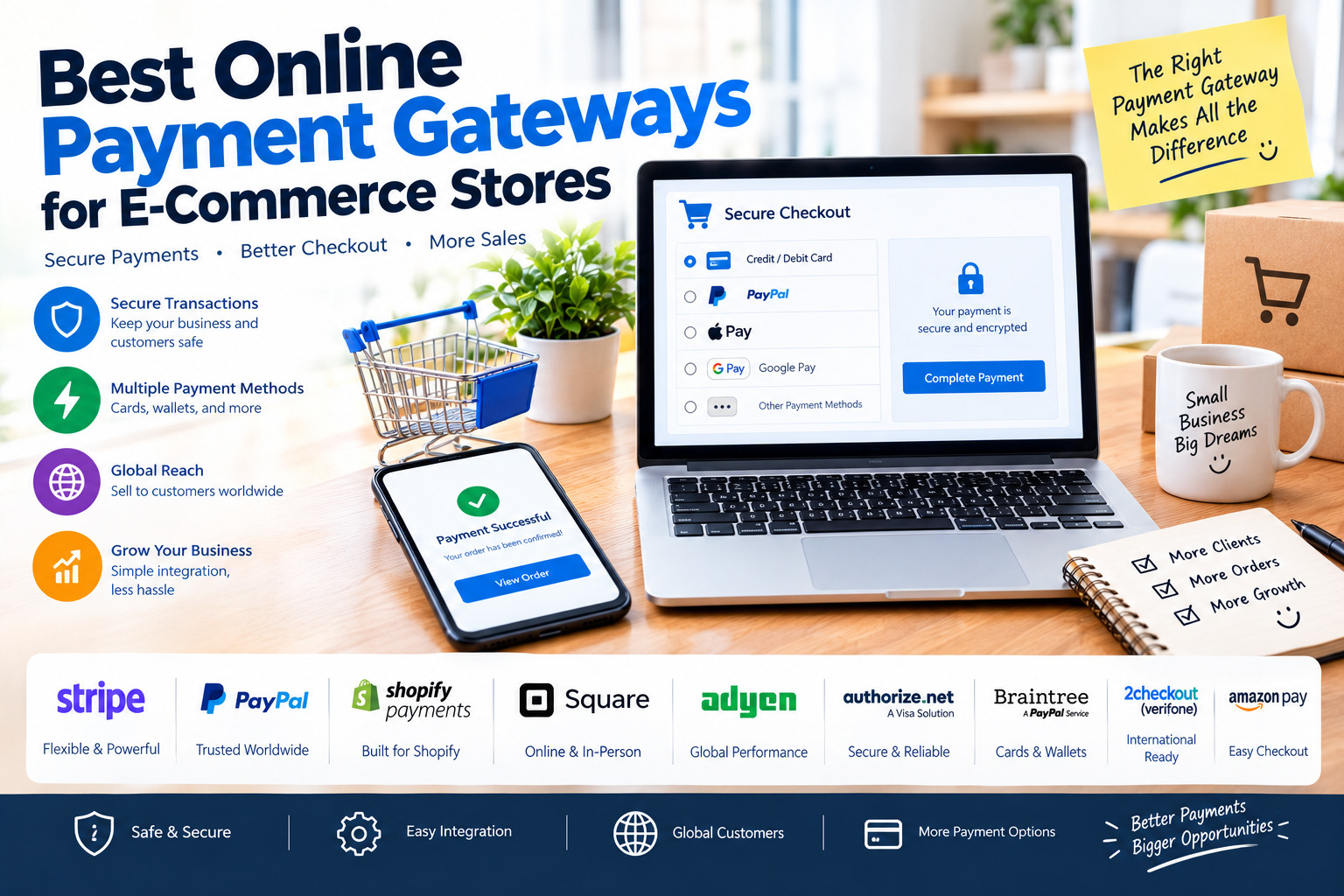
Best Online Payment Gateways for E-Commerce Stores
Choosing the right online payment gateway is an important step in building a successful e-commerce business. A reliable payment solution allows customers to pay securely, helps store owners manage transactions, and creates a smoother checkout experience that can encourage more shoppers to complete their purchases.
Whether you run a small online shop, a dropshipping business, a digital product store, or a large e-commerce brand, the payment gateway you choose can affect your operating costs, customer experience, and ability to sell internationally.
The best payment gateways offer secure card processing, support for popular payment methods, fraud prevention tools, straightforward integration with e-commerce platforms, and clear transaction reporting. However, fees, supported countries, currencies, and available features vary between providers.
This guide explores some of the best online payment gateways for e-commerce stores, including their main features, advantages, disadvantages, and the types of businesses they serve best.
1. Stripe — Best for Flexible Online Payments
Stripe is a widely used payment platform designed for online businesses, digital services, subscription companies, and e-commerce stores. It offers payment processing tools that can be integrated into websites, mobile applications, and supported shopping platforms.
Key Features
- Accept eligible credit and debit card payments.
- Support additional payment methods depending on the country.
- Integrate with e-commerce platforms and custom-built websites.
- Manage refunds, payment records, and transaction reports.
- Use fraud detection and risk management tools.
- Support recurring payments and subscription billing.
- Customize checkout experiences using developer tools and APIs.
Advantages
Stripe provides considerable flexibility for businesses that want to customize their checkout process. Its integrations can support both simple online stores and complex e-commerce systems. Detailed transaction information and automation features can also help businesses manage payments more efficiently.
Disadvantages
Some integrations require technical knowledge, particularly when creating a custom checkout. Processing fees apply, and additional charges may apply to certain services. Stripe is also available only to eligible businesses in supported countries, so merchants should verify their location before choosing it.
Best for: Online stores, digital businesses, subscription services, and merchants who want flexible payment integrations.
Official website: https://stripe.com/
2. PayPal — Best for Customer Familiarity and Convenient Checkout
PayPal is an established online payment service that allows eligible merchants to accept payments through supported PayPal checkout options. It can be particularly useful for stores selling internationally or serving customers who prefer paying through a digital wallet.
Key Features
- Accept eligible payments through PayPal.
- Offer supported card payment options.
- Integrate with various e-commerce platforms.
- Send payment confirmations and track transactions.
- Process refunds through supported workflows.
- Access transaction history and payment reports.
- Provide buyer and seller protection features subject to applicable terms.
Advantages
PayPal is recognizable to many online shoppers and can provide a convenient alternative to entering card details directly on a store’s checkout page. Its integrations can make setup relatively straightforward for merchants using popular e-commerce platforms.
Offering PayPal alongside another payment method may also give customers more flexibility at checkout.
Disadvantages
Transaction fees can affect profit margins, especially for businesses with low-value orders or significant international sales. Dispute handling and account reviews may also require attention. Features, payment acceptance, withdrawals, and merchant eligibility differ by country.
Best for: Small online stores, international sellers, and businesses whose customers prefer digital wallet payments.
Official website: https://www.paypal.com/
3. Shopify Payments — Best for Shopify Stores
Shopify Payments is Shopify’s integrated payment solution for eligible merchants. It allows store owners to manage supported customer payments through their Shopify administration area without necessarily setting up a separate third-party payment provider.
Key Features
- Accept supported card payments directly through a Shopify store.
- Manage transactions within the Shopify dashboard.
- Track payment status and process eligible refunds.
- Access payment reports and payout information.
- Support selected digital wallets and local payment methods.
- Integrate payment processing with Shopify’s checkout and order management.
Advantages
The main advantage of Shopify Payments is its integration with the Shopify platform. Store owners can manage orders and payment information in one place, reducing the need to coordinate multiple systems. This can simplify daily operations for merchants who want to focus on products, marketing, and customer service.
Disadvantages
Shopify Payments is not available in every country or for every business category. Merchants who cannot use it may need a supported third-party payment provider. Shopify subscription costs and payment-processing fees should also be considered when calculating total operating expenses.
Best for: Merchants who operate their online stores on Shopify and want an integrated checkout and payment management experience.
Official website: https://www.shopify.com/payments
4. Square Payments — Best for Businesses Selling Online and In Person
Square Payments offers payment processing tools for businesses that operate online, in physical locations, or through a combination of both channels. It can be useful for retailers that want to connect their online store with in-person payment operations.
Key Features
- Accept supported online card payments.
- Integrate with compatible online store tools.
- Manage transactions and refunds.
- Access sales reports and payment records.
- Connect online and in-person sales workflows.
- Use additional Square business services where available.
Advantages
Square can help businesses coordinate different sales channels rather than managing online and physical payments entirely separately. Its connected tools may be particularly valuable for retailers, local brands, and service businesses that sell through both a website and a physical location.
Disadvantages
Availability is limited to supported markets, and transaction fees vary by payment type and location. Businesses that only sell online may not need its in-person features. Merchants should also check whether their preferred e-commerce platform supports the required Square integration.
Best for: Retailers and small businesses that sell both online and in person.
Official website: https://squareup.com/
5. Adyen — Best for International and High-Volume E-Commerce
Adyen is a payment platform designed to support businesses with substantial payment needs across different countries and sales channels. It offers payment processing, fraud prevention, and payment management capabilities for companies operating at scale.
Key Features
- Accept supported card payments and local payment methods.
- Process payments across multiple markets.
- Integrate with online stores and custom e-commerce systems.
- Use risk management and fraud prevention tools.
- Manage transactions, refunds, and reporting.
- Connect online and in-person payment channels.
- Access payment optimization features for eligible businesses.
Advantages
Adyen is useful for businesses that need to coordinate payments across multiple markets. Its support for different payment methods can help international merchants adapt checkout options to local customer preferences. Its broader payment infrastructure may also suit companies managing complex operations or high transaction volumes.
Disadvantages
Adyen may be more complex than necessary for a small store with limited sales. Onboarding and commercial terms can depend on the business model, location, and transaction volume. Businesses should discuss eligibility, pricing, and technical requirements with the provider before implementation.
Best for: Established e-commerce companies, international retailers, and businesses with high or complex payment volumes.
Official website: https://www.adyen.com/
6. Authorize.Net — Best for Established Businesses Seeking Payment Controls
Authorize.Net is a payment gateway that helps eligible businesses accept and manage electronic payments. It is often considered by merchants who need configurable payment processing and want to connect their checkout with an existing merchant account or supported payment setup.
Key Features
- Process eligible online card payments.
- Integrate payment processing into websites and shopping carts.
- Manage transactions and refunds.
- Support recurring billing and customer payment profiles.
- Use fraud detection and transaction screening tools.
- Access reporting and payment administration features.
Advantages
Authorize.Net provides a range of tools for businesses that need more control over payment processing. Its recurring billing features can be useful for repeat purchases and service subscriptions, while its integrations can support established e-commerce workflows.
Disadvantages
Pricing can include gateway or subscription fees as well as transaction charges, depending on the selected setup. Availability, merchant account requirements, and integrations vary by market. Small stores should compare the total cost against simpler payment solutions before deciding.
Best for: Established merchants and businesses that need configurable online payment processing and recurring billing features.
Official website: https://www.authorize.net/
7. Braintree — Best for Card Payments and Digital Wallets
Braintree, a PayPal service, provides payment processing tools for businesses that want to accept online payments through cards and supported digital wallets. Its integration options can suit e-commerce websites, mobile applications, and businesses with more customized checkout requirements.
Key Features
- Accept eligible credit and debit card payments.
- Support selected digital wallets and alternative payment methods.
- Integrate payments into websites and mobile apps.
- Manage transactions and refunds.
- Support recurring billing for eligible use cases.
- Access tools for fraud management and transaction monitoring.
Advantages
Braintree can be useful for businesses that want to combine card processing with digital wallet options in a single payment setup. Its developer resources can also support customized checkout experiences and integrations with other business systems.
Disadvantages
Implementation may require technical resources for custom integrations. Fees, supported payment methods, and merchant eligibility depend on the country and business requirements. Some stores may find a simpler hosted checkout solution easier to maintain.
Best for: Online retailers and digital businesses that need integrated card and wallet payment processing.
Official website: https://www.braintreepayments.com/
8. 2Checkout (Verifone) — Best for International and Digital Product Sales
Verifone provides payment solutions for online businesses, including services associated with the 2Checkout brand. Depending on the selected product and eligibility, its solutions can help merchants sell digital products, software, subscriptions, and other products to customers in different markets.
Key Features
- Accept eligible online payments.
- Support international payment workflows.
- Offer subscription and recurring billing capabilities on applicable products.
- Integrate with supported websites and commerce platforms.
- Manage transactions and payment information.
- Access additional commerce features depending on the chosen service.
Advantages
Verifone’s commerce and payment offerings may suit businesses that sell digital products or serve customers in multiple countries. Depending on the product, merchants can access capabilities beyond basic card processing, which may help streamline online sales and recurring billing.
Disadvantages
Pricing, supported countries, available payment methods, and service terms vary by product. Businesses should carefully review the current offering rather than assuming every feature associated with the 2Checkout name is included in every plan. Integration requirements may also vary.
Best for: Eligible digital product sellers, software businesses, and merchants looking for international commerce capabilities.
Official website: https://www.verifone.com/
9. Amazon Pay — Best for Eligible Stores Targeting Amazon Customers
Amazon Pay allows eligible shoppers to use supported Amazon account payment information when purchasing from participating merchants. It can provide an alternative checkout method for online stores that want to offer customers a familiar payment experience.
Key Features
- Provide an Amazon Pay checkout option where supported.
- Use eligible payment information associated with the customer’s Amazon account.
- Integrate with supported e-commerce platforms.
- Manage transactions through the merchant’s payment tools.
- Access transaction and order information according to the integration.
Advantages
Amazon Pay can reduce the amount of payment information customers need to enter manually when the service supports their account and purchase. For eligible merchants, offering an additional trusted checkout option may help accommodate different customer preferences.
Disadvantages
Amazon Pay is not available to every merchant in every country. Eligibility, supported integrations, and transaction fees should be checked before installation. It is also not a complete replacement for every card processor, so merchants may still need additional payment options.
Best for: Eligible online retailers whose target customers can use Amazon Pay and who want to offer an additional checkout method.
Official website: https://pay.amazon.com/
Quick Comparison of the Best E-Commerce Payment Gateways
| Payment Gateway | Main Strength | Best For | Important Consideration |
|---|---|---|---|
| Stripe | Flexible integrations and automation | Online-first businesses | Country eligibility and processing fees |
| PayPal | Familiar digital wallet checkout | Small stores and international sellers | Fees and withdrawal availability |
| Shopify Payments | Native Shopify integration | Shopify merchants | Supported countries and business categories |
| Square Payments | Online and in-person payments | Omnichannel retailers | Market availability and integration compatibility |
| Adyen | Multi-market payment infrastructure | Large and international businesses | Onboarding and commercial requirements |
| Authorize.Net | Configurable payment processing | Established merchants | Total gateway and processing costs |
| Braintree | Cards and digital wallets | Digital businesses and online retailers | Integration complexity and regional support |
| 2Checkout / Verifone | International commerce options | Eligible digital product businesses | Product-specific terms and fees |
| Amazon Pay | Amazon account checkout | Eligible online retailers | Merchant and country eligibility |
How to Choose the Right Payment Gateway for Your Online Store
Selecting a payment gateway involves more than comparing transaction fees. The right choice depends on where your business operates, what you sell, how customers prefer to pay, and which e-commerce platform you use.
1. Check Country and Business Eligibility
Start by confirming that the provider accepts merchants in your country and supports your type of business. Some gateways have geographical restrictions, while others require business registration, identity verification, or a supported bank account.
If you plan to sell internationally, distinguish between the countries where customers can pay and the countries where merchants can open and maintain an account.
2. Compare the Total Cost of Processing Payments
Payment costs may include a percentage of each transaction, a fixed fee, international payment charges, currency conversion, refunds, chargebacks, or monthly subscription fees.
A gateway with a low advertised rate may not be the least expensive option once all additional costs are included. Compare fees against your average order value, expected sales volume, and customer locations.
3. Offer the Payment Methods Your Customers Prefer
Different audiences may prefer credit cards, debit cards, digital wallets, or local payment methods. Research your target market and select a provider that supports the methods your customers are most likely to use.
Where practical, offering more than one trusted payment option can make checkout more convenient.
4. Evaluate Security and Fraud Prevention
Choose a provider that offers appropriate security measures, transaction monitoring, and tools for handling suspicious payments. Review how the provider supports disputes, refunds, and chargebacks.
Also verify that your store and payment integration meet applicable security and regulatory requirements.
5. Check E-Commerce Platform Compatibility
Make sure the payment gateway works with your existing platform, such as Shopify, WooCommerce, or a custom-built website. A supported integration can reduce setup time and simplify order management, refunds, and payment reporting.
6. Consider International Payments and Currency Conversion
If you sell across borders, check which currencies the provider can present to customers, which currencies it can settle to your business, and what conversion fees may apply.
Accepting an international card does not automatically mean that your business can receive payouts in every country or currency.
7. Review Payout Timing and Customer Support
Understand when funds become available, whether payout schedules can change, and what happens when a transaction is flagged for review. Reliable documentation and responsive support can be especially important when payment problems interrupt sales.
Final Thoughts
The best online payment gateway for an e-commerce store depends on its location, business model, budget, and target audience.
Stripe is a strong option for businesses seeking flexible integrations, while PayPal can provide a familiar digital wallet checkout. Shopify Payments is convenient for eligible Shopify merchants, and Square Payments can suit businesses that sell both online and in person.
For international and high-volume operations, Adyen is worth evaluating. Authorize.Net and Braintree offer additional payment processing options for businesses with specific integration needs, while Verifone’s 2Checkout-related solutions may suit eligible international digital commerce businesses. Amazon Pay can provide another checkout option for merchants who qualify.
Before making a final decision, confirm the provider’s current availability, fees, supported currencies, integration requirements, and payout rules. Choosing a payment gateway that fits your customers and business operations can help create a smoother checkout experience and support sustainable e-commerce growth.


