
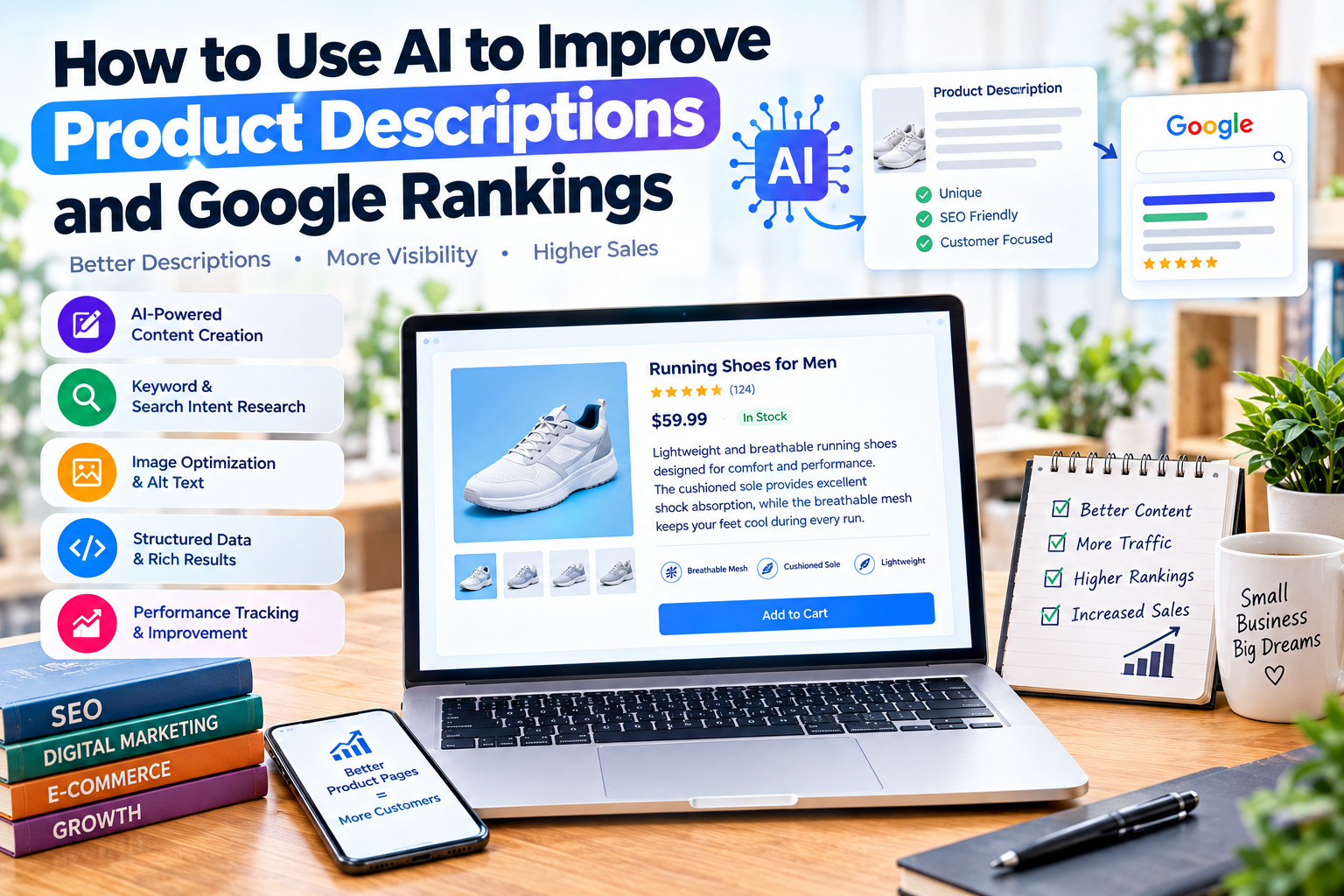
How to Use AI to Improve Product Descriptions and Google Rankings
Artificial intelligence is changing the way e-commerce businesses create product descriptions, optimize product pages, and attract customers through Google Search. For online store owners, AI can reduce the time required to write product content, organize product information, identify relevant search terms, and improve the shopping experience.
However, successful search engine optimization requires more than generating text with an AI tool. Product pages must provide accurate information, explain real customer benefits, answer important purchasing concerns, and make it easy for search engines to understand what each product offers.
Whether you run a Shopify store, a WooCommerce website, or another e-commerce business, this guide explains how to use AI to improve product descriptions, strengthen on-page SEO, and increase your chances of reaching relevant customers through Google.
1. Use AI to Write Clear and Persuasive Product Descriptions
One of the most practical uses of AI in e-commerce is turning basic product specifications into clear, engaging descriptions. Instead of manually writing every product page from scratch, you can provide an AI tool with the product name, materials, dimensions, features, target audience, and intended use.
The AI can use these details to create an initial draft that explains what the product does, why it is useful, and which customer needs it addresses. You can then edit the draft to match your brand voice, remove unnecessary wording, and ensure that every statement accurately reflects the product.
For example, a basic description such as “Stainless steel water bottle, 750 ml, leak-resistant lid” can be developed into a more informative description explaining its capacity, practical everyday uses, and lid design. However, the AI must not invent properties such as guaranteed temperature retention or dishwasher safety unless those details are verified.
How to do it: Provide the AI with verified product specifications, the intended customer, the main benefits, and the desired writing style. Ask it to produce an original description that is easy to scan and avoids unsupported claims.
Useful tool: ChatGPT
2. Generate SEO-Friendly Product Titles
Product titles help shoppers and search engines understand what a product is. A vague title may fail to communicate the product category, its main feature, or its intended use, while an excessively long title can become difficult to read.
AI can help transform unclear product names into descriptive, natural titles. For example, a title such as “Bottle X750” might become “750 ml Stainless Steel Water Bottle with Leak-Resistant Lid,” provided that all the stated details are correct.
When generating titles, focus on the product type first, followed by the most useful distinguishing feature. Include size, material, model, compatibility, or color when these details help customers identify the correct product. Avoid repeating the same phrase unnaturally or adding unrelated search terms simply to attract more traffic.
How to do it: Give AI your existing title, verified product specifications, and the main search intent you want to address. Request several concise alternatives, then choose the one that is most accurate and useful to shoppers.
Useful tool: ChatGPT | Shopify Magic
3. Find Relevant Search Terms With AI and Keyword Research Tools
AI can help brainstorm the language customers may use when searching for a product. It can suggest alternative product names, common use cases, specific attributes, and related phrases that can guide your research.
For example, a store selling ergonomic office chairs might investigate searches related to adjustable office chairs, lumbar support, chairs for home offices, and chairs for long working hours. These ideas can help you understand the different needs behind a broad product category.
However, AI-generated suggestions are hypotheses, not verified search-volume data. Validate promising terms with keyword research tools and actual search performance information. Prioritize terms that accurately describe the product and reflect what potential customers want to find.
How to do it: Ask AI to generate search-intent groups for a specific product, then investigate those ideas using search research tools. Select a primary topic and a small number of relevant supporting terms rather than forcing every suggestion into the description.
Useful tools: Google Keyword Planner | Google Trends
4. Match Product Descriptions to Search Intent
Search intent refers to the purpose behind a search. Someone searching for “wireless headphones” may be exploring different options, while someone searching for “wireless headphones with noise cancellation and long battery life” has more specific requirements.
AI can help you organize product information around the needs of different shoppers. It can identify which features deserve attention, suggest clearer explanations, and help distinguish informational content from product details that support a purchasing decision.
For example, a product page for running shoes might explain the intended activity, available sizes, materials, fit information, and relevant design features. These details can help customers decide whether the product matches their needs without forcing them to search through unrelated content.
How to do it: Provide AI with the product specifications and the intended audience. Ask it to identify the main purchasing considerations, then ensure that the product page addresses those considerations using verified information.
Useful tool: ChatGPT
5. Improve Product Descriptions With Shopify Magic
Shopify Magic offers built-in AI assistance for generating product descriptions directly within Shopify’s product editor. It can use information supplied by the merchant, including product titles, features, and other details, to produce a draft that can be edited before publication.
This is especially useful for store owners managing large product catalogs. Instead of starting each description from a blank page, you can generate an initial version, adjust its tone, and refine the text to fit your store’s style.
The main limitation is that generated content still requires human review. AI may introduce benefits or specifications that were not supplied, and the description may sound generic if the input contains very little product information. Shopify also distinguishes description generation from other SEO tasks, such as creating SEO titles and meta descriptions.
How to do it: Open the product in your Shopify admin, use the text-generation feature where available, provide detailed product information, and edit the result before saving. Check every claim against the actual product.
Official guide: Automatically Generating Product Descriptions With Shopify Magic
6. Make Product Descriptions More Specific and Helpful
Generic descriptions often fail to explain why a product is worth buying. Statements such as “high quality,” “excellent design,” or “perfect for everyone” provide little evidence and can make several competing products sound identical.
AI can help replace vague language with concrete information. Instead of describing a backpack as “stylish and practical,” a more useful description might explain its verified capacity, number of compartments, material, closure type, and intended uses.
The strongest product descriptions combine specifications with benefits. Specifications explain what the product contains or how it is designed, while benefits explain why those features matter to a customer. Both should be based on accurate product information.
How to do it: Ask AI to review your current description and flag vague claims, repetitive phrases, missing specifications, and opportunities to explain practical benefits. Supply additional verified information wherever necessary.
Useful tool: ChatGPT | Shopify’s Guide to Writing Engaging Product Descriptions
7. Optimize Product Page Headings and Structure
A well-organized product page makes information easier to understand for both shoppers and search engines. AI can help arrange content into a logical order, using concise headings and short sections to separate product benefits, specifications, compatibility, care instructions, and delivery information.
For example, a product page could include a short introduction, key features, technical specifications, sizing information, and relevant usage instructions. This structure helps shoppers locate the information they need without reading a long block of text.
Keep the product’s main name and purpose clear, and use headings only where they improve navigation. Avoid adding unnecessary sections or repeating the same search phrase throughout the page. Good structure should make the page more useful, not simply longer.
How to do it: Provide your existing product content to AI and ask it to organize the information into a clear, customer-friendly structure without adding unsupported details. Review the headings in your store editor before publishing.
Useful tool: ChatGPT
8. Improve Product Image Alt Text With AI
Product images help customers evaluate appearance, color, design, and other visual characteristics. Descriptive alternative text, commonly called alt text, can also help explain an image’s content to people using assistive technology and provide search engines with useful context.
AI image tools can help draft alt text by describing visible elements, such as a black leather wallet photographed against a white background. For product images, the description should identify the item and relevant visible details without adding claims that cannot be confirmed from the image.
Avoid using identical alt text for every image or filling it with unrelated search terms. Different views of the same product may need different descriptions if they show distinct features. Decorative images may not need descriptive alt text at all.
How to do it: Use an image-capable AI tool to draft descriptions, compare each draft with the actual image, and edit the result for accuracy and accessibility. Do not rely on AI to determine hidden product specifications that cannot be seen.
Useful tools: ChatGPT | Google’s Image SEO Best Practices
9. Use AI to Create Unique Descriptions Across Large Product Catalogs
Stores with hundreds or thousands of products often struggle to create consistent, useful descriptions. AI can help organize product data and generate drafts in batches, allowing a business to process large catalogs more efficiently.
A structured workflow can use product names, categories, specifications, materials, sizes, colors, and verified benefits as input fields. The AI can then create descriptions that follow a consistent format while adapting the wording to each product.
The main risk is publishing many pages with nearly identical or low-value content. Changing only a product name or color may not produce a genuinely useful description, especially when customers need meaningful information to distinguish similar items.
How to do it: Standardize your product data, generate drafts in manageable batches, and prioritize products with incomplete or weak descriptions. Review the output for accuracy, duplication, and useful product-specific information before publishing.
Useful tools: ChatGPT | Shopify Magic
10. Add Product Structured Data to Help Google Understand Your Pages
Product structured data is machine-readable information that helps search engines interpret details about a product. Depending on the implementation and eligibility, it can help Google understand information such as product names, prices, availability, and review details.
AI can assist developers and store owners by explaining structured-data requirements, drafting implementation examples, and identifying information that may be missing from a product page. However, generated markup must be checked carefully, and the structured data must accurately match the visible content on the page.
Structured data does not guarantee enhanced search results or higher rankings. Google decides whether eligible pages receive particular search appearances, and incorrect or incomplete markup can prevent a page from qualifying.
How to do it: Check whether your e-commerce platform or theme already generates Product structured data. Validate eligible pages, correct errors, and make sure the product information stays consistent with the actual price, availability, and customer-facing content.
Useful resources: Google’s Product Structured Data Guide | Google’s E-commerce Structured Data Guide
11. Improve Product Visibility Through Google Merchant Center
Google Merchant Center allows eligible businesses to provide product information for use across Google’s shopping experiences. Product data can include titles, descriptions, prices, availability, images, and other attributes required by the relevant product listing program.
AI can help merchants clean up product titles, standardize descriptions, organize product attributes, and identify missing information in product feeds. For stores with large catalogs, this can reduce repetitive work and make it easier to maintain consistent product data.
However, product information must comply with Google’s policies and accurately reflect what is being sold. AI-generated content should not introduce unsupported claims, misleading attributes, or discrepancies between the product feed and the landing page.
How to do it: Review your product feed, identify incomplete or inconsistent attributes, use AI to draft improvements, and verify every change before submitting it. Check feed diagnostics and resolve any policy or data-quality issues that appear.
Official resource: Google Merchant Center
12. Use Google Search Console to Find Product Pages That Need Improvement
Google Search Console helps website owners understand how their pages perform in Google Search. It provides information such as impressions, clicks, click-through rates, and average search positions for eligible reports, along with indexing and technical information.
AI can help interpret exported Search Console data by grouping pages, identifying patterns, and suggesting which product descriptions may deserve closer review. For example, pages receiving impressions but relatively few clicks may need a clearer search presentation, while pages with declining traffic may require investigation into competition, demand, indexing, or content quality.
These patterns do not prove that a description is the cause of poor performance. Use the data to prioritize investigation rather than automatically rewriting every page with low clicks or rankings.
How to do it: Export relevant page and query data, use AI to summarize patterns, and compare the findings with the actual product pages. Make targeted changes and monitor results over time.
Official tool: Google Search Console
13. Use AI to Improve Product Page Conversion Rates
Search visibility matters, but attracting visitors is only part of the process. Product pages also need to help customers understand the offer, evaluate its suitability, and feel confident about purchasing.
AI can suggest clearer benefit statements, reorganize product information, identify missing details, and draft alternative versions of product copy. It can also help generate hypotheses about why customers may hesitate, such as unclear sizing, insufficient product specifications, confusing shipping information, or an absence of useful images.
Do not assume that a more persuasive description will automatically increase sales. Product price, delivery options, trust signals, product quality, and the overall shopping experience also influence purchasing decisions.
How to do it: Identify a specific issue using analytics, customer feedback, or support inquiries. Use AI to develop a small number of possible improvements, test them where practical, and compare meaningful results such as conversion rate, revenue per visitor, and return rate.
Useful tool: Google Analytics
14. Translate and Localize Product Descriptions With AI
Businesses selling internationally may need product pages in several languages. AI can help translate descriptions, adapt measurements and terminology, and adjust wording to better suit the expectations of customers in different markets.
However, translation alone does not guarantee effective localization. Product names, sizing conventions, currency, shipping information, warranty terms, and common search phrases can vary between regions. A phrase that sounds natural in one language may be awkward or misleading in another.
How to do it: Provide AI with the original verified product information, the target language, the intended market, and any terminology that must remain consistent. Have a fluent speaker review important pages, especially those involving technical specifications, safety information, or legal claims.
Useful tool: DeepL Translator
15. Avoid Common AI SEO Mistakes
AI-generated product content can save time, but careless use may introduce factual errors, repetitive wording, and unsupported claims. Publishing hundreds of lightly edited descriptions can also leave a store with pages that provide little unique value to shoppers.
Another mistake is treating keyword frequency as the main measure of SEO quality. Repeating the same phrase unnaturally can reduce readability without improving the usefulness of the page. Search optimization should focus on clear product information, relevant language, and a satisfying customer experience.
How to do it: Establish a review checklist for accuracy, originality, product-specific details, readability, and compliance. Review important pages manually, and give additional attention to products with technical specifications, safety requirements, or claims that could affect customer decisions.
For guidance, read Google’s Guidance on Generative AI Content.
16. Measure Results and Continuously Improve Product Pages
SEO improvements should be evaluated using real performance data rather than assumptions about what an AI tool recommends. Track organic clicks, impressions, click-through rates, product page engagement, conversions, and sales where reliable data is available.
After improving a description, allow sufficient time for search engines to recrawl the page and for enough performance data to accumulate. Compare results with the previous period while considering seasonality, changes in demand, advertising campaigns, and competitor activity.
Prioritize pages where a change could have a meaningful business impact. Improving a high-value product with an incomplete description may be more useful than rewriting dozens of pages that already provide clear information and perform well.
How to do it: Maintain a record of the original page, the changes made, and the date of publication. Review results regularly, investigate unexpected changes, and use the findings to improve your next round of product-page updates.
Useful tools: Google Search Console | Google Analytics
Conclusion
Using AI to improve product descriptions and Google visibility can help e-commerce businesses work more efficiently, create clearer product pages, and maintain consistent information across large catalogs. AI is especially useful for drafting descriptions, improving titles, organizing product specifications, researching customer needs, and identifying opportunities for content improvement.
The most effective approach combines AI assistance with accurate product data, genuine customer insights, technical SEO, and regular performance analysis. Tools such as ChatGPT and Shopify Magic can help with content creation, while Google Search Console, Google Analytics, and Google’s e-commerce resources help you evaluate performance and improve your website.
AI should support your expertise rather than replace it. Review every generated description, avoid unsupported claims, and make sure each product page provides real value to customers. Over time, this disciplined process can help you build more useful product pages and create stronger opportunities to attract relevant organic traffic from Google.


