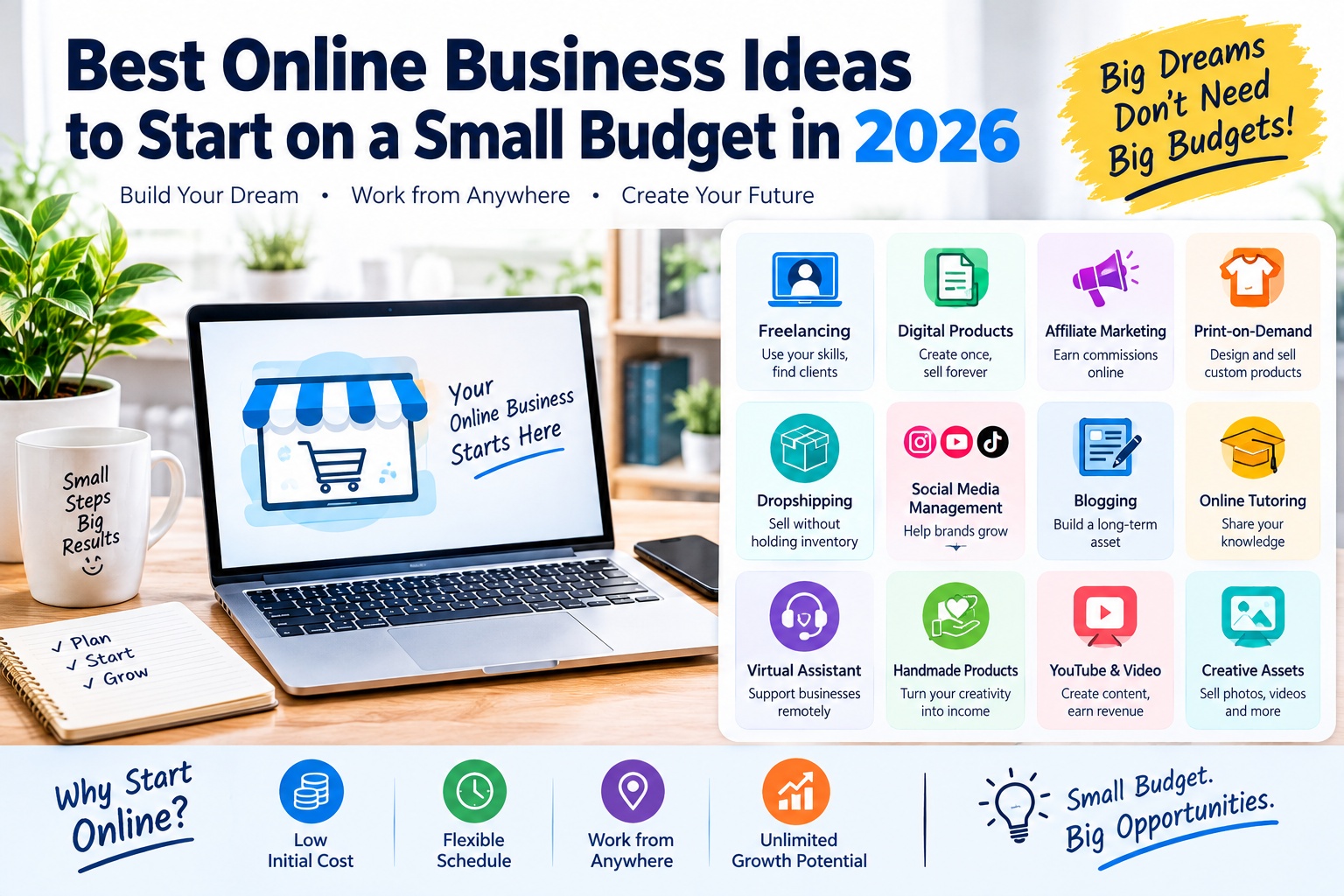
Starting an Online Business with a Small Budget in 2026
1. Freelancing: The Best Online Business for Beginners
Freelancing is one of the most accessible online business models because you can start by offering skills you already possess. Instead of creating a product or investing in inventory, you provide services to individuals, entrepreneurs, and companies that need professional assistance.
Popular freelance services include content writing, graphic design, website development, translation, video editing, search engine optimization, virtual assistance, and social media management.
For example, a person who understands SEO can help small businesses improve their website content, optimize product pages, and conduct keyword research. Someone with graphic design skills can create social media graphics, logos, advertisements, and marketing materials.
Main Features and Benefits
Freelancing generally requires little initial investment if you already own a computer and have access to the internet. You can begin with one service, develop a portfolio, and gradually expand your offerings as you gain experience.
Another advantage is the possibility of working with clients from different countries. This allows freelancers to explore international markets rather than relying exclusively on customers in their local area.
Freelancing can also help you discover which services customers are willing to pay for. Later, you may turn your experience into a specialized agency, a digital product, or a recurring service business.
How to Start Freelancing with a Small Budget
Choose one service that matches your abilities and identify a specific group of customers. For example, instead of offering general writing services, you could specialize in SEO articles for technology blogs or product descriptions for online stores.
Create several sample projects that demonstrate your skills. You can then approach potential clients directly or explore freelance marketplaces such as Upwork and Fiverr.
Focus on delivering reliable work, communicating clearly, and collecting genuine client feedback. Avoid spending heavily on branding or advertising before you have tested your service with real customers.
Best for: Beginners with writing, design, technical, administrative, or marketing skills.
Official platforms: Upwork — https://www.upwork.com/ | Fiverr — https://www.fiverr.com/
Useful resources on Amazon Germany: https://www.amazon.de/s?k=freelancing+business+books
Useful resources on Amazon France: https://www.amazon.fr/s?k=freelancing+business+books
2. Selling Digital Products: A Low-Cost Business with Growth Potential
Selling digital products is an attractive online business idea because you can create a product once and sell copies to multiple customers without manufacturing or shipping a physical item.
Digital products include ebooks, printable planners, budgeting spreadsheets, website templates, social media templates, design assets, educational worksheets, photography presets, and downloadable guides.
For example, someone with experience in personal budgeting could create a spreadsheet that helps users track monthly expenses. A graphic designer could sell editable social media templates, while a teacher could create printable learning activities.
Main Features and Benefits
Digital products generally do not require physical inventory, storage space, or shipping. Once a product is created, delivery can often be automated through a suitable ecommerce platform or digital marketplace.
Another benefit is the potential for attractive margins because the cost of delivering an additional digital copy can be relatively low. However, payment processing, platform fees, advertising, customer support, and product updates still create costs.
Digital products can also complement other online businesses. A freelancer, blogger, consultant, or content creator can develop downloadable resources related to the problems their audience wants to solve.
How to Start Selling Digital Products
Start by identifying a specific problem that people are willing to pay to solve. Research existing products, read customer feedback, and look for gaps in the available solutions.
Create a simple, useful product rather than spending months developing a large collection. Test it with a small audience, gather feedback, and improve it before investing heavily in promotion.
You can sell digital products through suitable marketplaces or your own website. Make sure the product is original or that you have the appropriate commercial rights to the material you use.
Best for: Designers, writers, teachers, professionals, and creators who can package useful knowledge into downloadable resources.
Useful platforms: Gumroad — https://gumroad.com/ | Etsy — https://www.etsy.com/
Useful resources on Amazon Germany: https://www.amazon.de/s?k=digital+product+business+books
Useful resources on Amazon Italy: https://www.amazon.it/s?k=digital+product+business+books
3. Affiliate Marketing: Earn Commissions by Recommending Products
Affiliate marketing is an online business model in which you promote products or services and earn a commission when someone completes a qualifying purchase or action through your referral link.
You do not need to manufacture products, manage inventory, or handle shipping. Instead, your main responsibility is helping potential customers discover suitable products through useful content and recommendations.
Common affiliate marketing channels include blogs, comparison websites, YouTube videos, newsletters, and social media accounts.
For example, a technology website could publish laptop buying guides and compare different models. A home improvement blog could recommend tools and equipment, while a fitness website could review exercise accessories.
Main Features and Benefits
Affiliate marketing can be started with a relatively small budget, especially if you already have a website or an established audience. It also allows you to explore different product categories without purchasing inventory.
Another advantage is flexibility. You can create content around a subject you understand and promote products that genuinely match your audience’s needs.
However, commissions depend on the affiliate program, product category, qualifying actions, and applicable terms. Income is not guaranteed, and a new website may need considerable time to attract search traffic.
How to Start an Affiliate Marketing Business
Choose a niche with a clear audience and products that people actively research before buying. Examples include consumer electronics, home office equipment, educational resources, photography accessories, and fitness equipment.
Build a website or another suitable publishing channel. Create original product comparisons, detailed buying guides, tutorials, and answers to common customer questions.
Apply to relevant affiliate programs and follow their rules for using links and describing products. Clearly disclose affiliate relationships so readers understand that you may earn a commission from qualifying purchases.
For European audiences, review applicable advertising, consumer protection, privacy, and affiliate disclosure requirements.
Best for: Bloggers, content creators, reviewers, and people who enjoy researching and explaining products.
Useful platform: Amazon Associates — https://affiliate-program.amazon.com/
Amazon Germany product research: https://www.amazon.de/
Amazon France product research: https://www.amazon.fr/
4. Print-on-Demand: Sell Custom Products Without Holding Inventory
Print-on-demand is a business model that allows you to sell customized products without purchasing large quantities of stock in advance.
You create designs for products such as T-shirts, hoodies, mugs, tote bags, posters, and phone cases. When a customer places an order, a print-on-demand provider produces the item and ships it to the customer.
This model is particularly attractive to entrepreneurs who enjoy graphic design or understand a specific audience, hobby, profession, or community.
Main Features and Benefits
The main advantage of print-on-demand is that products are manufactured after customers order them. This reduces the need to invest in inventory and storage before validating demand.
You can also test different designs and product categories without committing to large production runs.
Print-on-demand providers may handle printing, packaging, and shipping, allowing you to focus on product design, branding, and marketing.
However, product costs and fulfillment fees can reduce profit margins. Shipping times, product quality, customer service, and returns also require careful management.
How to Start a Print-on-Demand Business
Choose a clearly defined niche rather than creating generic designs for everyone. For example, you could create products for gardening enthusiasts, book lovers, teachers, or people who enjoy a particular outdoor activity.
Prepare original designs and use a print-on-demand provider that supports your target countries. Order samples when possible to check print quality, materials, packaging, and delivery times.
Calculate your selling price carefully. Include production costs, shipping, platform fees, taxes where applicable, and a reasonable allowance for refunds or customer service.
Avoid copyrighted characters, protected logos, trademarks, and artwork that you do not have permission to use commercially.
Best for: Designers, creative entrepreneurs, and people who understand a specific customer niche.
Useful platforms: Printful — https://www.printful.com/ | Printify — https://printify.com/
Useful resources on Amazon Germany: https://www.amazon.de/s?k=print+on+demand+business+books
Useful resources on Amazon Spain: https://www.amazon.es/s?k=print+on+demand+business+books
5. Dropshipping: Start an Online Store Without Buying Inventory in Advance
Dropshipping is an ecommerce model in which you sell products through your online store while a supplier stores and ships the products directly to customers.
Unlike a traditional retail business, you do not usually purchase inventory in bulk before making sales. Instead, you pay the supplier to fulfill an order after a customer buys from your store.
This can reduce the initial cost of testing an ecommerce idea, but it does not eliminate the financial risks of running a store.
Main Features and Benefits
Dropshipping allows entrepreneurs to test different products without renting storage space or managing a warehouse.
It can also provide flexibility when selecting a niche, building a branded storefront, and testing product demand.
Store owners can focus on customer acquisition, product presentation, customer service, and improving the shopping experience while suppliers handle physical fulfillment.
However, product margins can be relatively small, and you remain responsible for the customer experience. Supplier mistakes, delayed deliveries, poor-quality products, and complicated returns can damage your reputation.
How to Start a Dropshipping Business
Begin with a specific product category rather than listing hundreds of unrelated products. Research demand, competition, supplier reliability, product quality, and expected shipping costs.
Whenever possible, order product samples before selling them. Confirm delivery estimates, return arrangements, and the supplier’s ability to maintain stock.
Choose an ecommerce platform that supports your required integrations, payment methods, and shipping settings. Shopify and WooCommerce are two possible starting points.
If you target Germany or other European Union countries, pay particular attention to delivery times, VAT obligations, consumer rights, product safety, and any applicable import requirements.
Best for: Entrepreneurs interested in ecommerce who want to test physical products without buying large quantities of inventory.
Useful platforms: Shopify — https://www.shopify.com/ | WooCommerce — https://woocommerce.com/
Useful resources on Amazon Germany: https://www.amazon.de/s?k=dropshipping+business+books
Useful resources on Amazon Italy: https://www.amazon.it/s?k=dropshipping+business+books
6. Social Media Management: Help Small Businesses Grow Online
Social media management is a service-based online business in which you help companies plan, publish, and manage content on platforms such as Instagram, Facebook, TikTok, LinkedIn, and Pinterest.
Many small businesses understand the importance of social media but lack the time or expertise to manage it consistently. This creates opportunities for freelancers who can create useful content and communicate a brand’s message effectively.
Main Features and Benefits
Social media management can be started with a relatively small investment if you already have a computer and a smartphone. Free or affordable design and scheduling tools may be sufficient when working with your first clients.
Services can include content planning, caption writing, graphic design, short-form video editing, community management, and monthly performance reporting.
Another advantage is the potential for recurring revenue. Instead of charging only for individual projects, you can offer monthly packages with clearly defined deliverables.
However, clients may expect measurable results, frequent communication, and consistent content quality. You should set realistic expectations and avoid promising specific follower counts or sales outcomes that you cannot control.
How to Start a Social Media Management Business
Choose a target industry, such as restaurants, fitness studios, local retailers, online stores, or professional service providers.
Create a small portfolio with sample posts, captions, and a content calendar. Contact businesses that could benefit from better social media content and explain how your service could address their specific needs.
Start with a manageable service package. For example, you could offer a set number of posts, basic visual design, and a monthly performance report.
As your experience grows, you can specialize in a particular industry or expand into paid advertising, video production, and broader digital marketing services.
Best for: Creative people with communication, marketing, writing, and design skills.
Useful platforms: Canva — https://www.canva.com/ | Buffer — https://buffer.com/
Useful resources on Amazon Germany: https://www.amazon.de/s?k=social+media+marketing+books
Useful resources on Amazon France: https://www.amazon.fr/s?k=social+media+marketing+books
7. Blogging and Niche Websites: Build a Long-Term Online Asset
Blogging is an online business model based on publishing useful content for a specific audience. A niche website focuses on a defined subject, such as technology, personal finance, home improvement, travel, education, or fitness.
A website can generate revenue through affiliate marketing, advertising, sponsored content, digital products, or paid services.
For example, a website about home office equipment could publish buying guides, product comparisons, and workspace improvement tips. A website about language learning could provide educational articles, downloadable worksheets, and online lessons.
Main Features and Benefits
Blogging has relatively low entry costs compared with businesses that require physical inventory. A basic website, a domain name, and suitable hosting may be enough to begin publishing.
Another benefit is that useful articles can attract visitors from search engines over an extended period. Unlike social media posts that may receive most of their attention shortly after publication, well-maintained articles can continue to bring visitors when they remain relevant and competitive.
However, organic search traffic is not guaranteed. Building a successful website requires consistent publishing, technical maintenance, keyword research, and a clear monetization strategy.
How to Start a Niche Website
Choose a topic that combines genuine interest, audience demand, and realistic monetization opportunities.
Research the questions your target readers ask. Create original articles that provide practical answers, compare relevant products, and help visitors make informed decisions.
Use descriptive page titles, logical headings, internal links, useful images, and fast-loading page layouts. Avoid publishing large volumes of shallow content simply to target keywords.
You can start with WordPress and add affiliate links or other monetization methods as your audience grows.
Best for: Writers, researchers, educators, and entrepreneurs who can publish useful content consistently.
Useful platform: WordPress — https://wordpress.org/
Useful resources on Amazon Germany: https://www.amazon.de/s?k=blogging+SEO+business+books
Useful resources on Amazon Netherlands: https://www.amazon.nl/s?k=blogging+SEO+business+books
8. Online Tutoring and Digital Courses: Monetize Your Knowledge
Online tutoring and digital education allow you to earn money by teaching skills or subjects you understand well.
Possible topics include languages, mathematics, programming, graphic design, academic subjects, music, professional development, and business skills.
You can offer individual lessons through video calls, create group classes, or develop recorded courses that customers can purchase online.
Main Features and Benefits
Online education can be started with a small budget if you already have the necessary subject knowledge and basic equipment.
Tutoring offers a direct way to test demand because you can begin with individual sessions before investing time in producing a full course.
Digital courses can become more scalable because recorded lessons may be sold to multiple students. However, successful courses still require updates, marketing, learner support, and a clear educational structure.
Another advantage is specialization. A focused course that solves a specific problem may be easier to market than a broad course aimed at everyone.
How to Start an Online Education Business
Identify a skill or subject that people actively want to learn. Define the audience, learning outcomes, lesson format, and appropriate price.
Start by offering a few individual lessons or a short workshop. Use student feedback to improve your teaching materials before building a larger course.
If you create recorded lessons, ensure that the videos, documents, images, and other materials are original or properly licensed.
Best for: Teachers, professionals, language speakers, and people with demonstrable expertise in a useful subject.
Useful platforms: Udemy — https://www.udemy.com/ | Teachable — https://teachable.com/
Useful resources on Amazon Germany: https://www.amazon.de/s?k=online+course+creation+books
Useful resources on Amazon France: https://www.amazon.fr/s?k=online+teaching+books
9. Virtual Assistant Services: Start a Remote Business with Basic Skills
A virtual assistant provides remote administrative and operational support to businesses, entrepreneurs, and professionals.
Typical tasks include email management, appointment scheduling, document formatting, online research, data organization, customer support, and basic ecommerce administration.
This business model is especially suitable for people who are organized, dependable, and comfortable using common office software.
Main Features and Benefits
Virtual assistance generally requires little initial investment beyond a computer, internet access, and the tools needed to communicate with clients.
It can also provide opportunities for recurring work. Businesses may need assistance every week or month, allowing you to build longer-term client relationships.
As you gain experience, you can specialize in areas such as ecommerce administration, podcast management, bookkeeping support, customer service, or executive assistance, provided you have the relevant skills and comply with applicable professional requirements.
How to Start a Virtual Assistant Business
List the tasks you can perform confidently and select a target customer group. For example, you might help online store owners manage product listings, organize customer inquiries, and update spreadsheets.
Prepare a clear service description and explain exactly what clients will receive. Use written agreements to define responsibilities, working hours, confidentiality, payment terms, and deadlines.
Start with a small number of clients and establish reliable workflows before expanding your services.
Best for: Organized beginners, administrative professionals, and people with strong communication skills.
Useful platforms: Upwork — https://www.upwork.com/ | Fiverr — https://www.fiverr.com/
Useful resources on Amazon Germany: https://www.amazon.de/s?k=virtual+assistant+business+books
Useful resources on Amazon Italy: https://www.amazon.it/s?k=virtual+assistant+business+books
10. Selling Handmade Products Online
Selling handmade products is a suitable online business idea for people who enjoy creating physical items and want to turn a practical skill into a business.
Potential products include jewelry, personalized gifts, handmade decorations, candles, knitted accessories, stationery, artwork, and customized home accessories.
You can sell through an online marketplace or create your own ecommerce website.
Main Features and Benefits
A handmade business allows you to differentiate your products through design, personalization, craftsmanship, and storytelling.
You can often begin with a small collection rather than producing a large inventory. Making items in small batches also allows you to test customer interest before purchasing more materials.
Personalized products may help you stand out from mass-produced alternatives, especially when customers are buying gifts or items for special occasions.
However, handmade production requires time, material costs, packaging, and shipping. You must calculate these expenses carefully so that each sale contributes enough to cover your labor and other costs.
How to Start Selling Handmade Products
Choose a product category that matches your skills and can be produced consistently. Calculate material costs, production time, packaging expenses, shipping, and marketplace fees before setting prices.
Photograph your products clearly and write accurate descriptions that explain their materials, dimensions, uses, and customization options.
Start with a limited selection of products and track which items attract the most interest. Use customer feedback to improve your designs and production process.
If you sell in Germany or elsewhere in the European Union, review relevant product safety, labeling, consumer protection, and tax requirements.
Best for: Craftspeople, artists, makers, and entrepreneurs who enjoy creating physical products.
Useful platform: Etsy — https://www.etsy.com/
Useful resources on Amazon Germany: https://www.amazon.de/s?k=handmade+business+books
Useful resources on Amazon Spain: https://www.amazon.es/s?k=handmade+business+books
11. YouTube and Short-Form Video Content
Creating video content can become an online business when you build an audience around a subject and develop suitable ways to monetize that audience.
Possible topics include educational tutorials, technology reviews, cooking, language learning, software demonstrations, home organization, and product comparisons.
Revenue may come from advertising, sponsorships, affiliate commissions, memberships, digital products, or services. Eligibility for platform monetization depends on the applicable rules and requirements.
Main Features and Benefits
Video content can help explain complicated subjects, demonstrate products, and build a stronger connection with an audience.
You do not necessarily need expensive equipment to begin. A smartphone, clear audio, adequate lighting, and useful content can be enough for early experiments.
Videos can also complement a blog or online store. For example, product demonstrations can support buying guides, while educational videos can direct viewers to downloadable resources or courses.
However, audience growth can take time, and income is unpredictable. Content production also requires planning, editing, publishing, and responding to viewers.
How to Start a Video Content Business
Choose a topic that you can discuss regularly and that has a clearly defined audience.
Plan a small series of videos that answer common questions or solve practical problems. Focus on clear explanations, useful examples, and honest recommendations rather than relying exclusively on trends.
Review audience retention, search traffic, and engagement to understand which topics deserve further attention.
Best for: Educators, reviewers, presenters, and people who enjoy explaining topics through video.
Useful platform: YouTube — https://www.youtube.com/
Useful resources on Amazon Germany: https://www.amazon.de/s?k=video+creation+equipment
Useful resources on Amazon France: https://www.amazon.fr/s?k=video+creation+equipment
12. Selling Stock Photography, Video, and Creative Assets
If you enjoy photography, illustration, video production, or graphic design, you can consider selling creative assets through suitable marketplaces.
Products may include stock photographs, short video clips, icons, illustrations, presentation templates, sound effects, and other digital resources.
Businesses, publishers, designers, and content creators purchase licensed assets to support their projects.
Main Features and Benefits
Creative assets can be produced in advance and licensed to multiple customers, depending on the marketplace’s licensing rules.
This model can be started with equipment you already own. Photographers may begin with a smartphone or an existing camera, while illustrators can create digital assets using suitable software.
A well-organized portfolio can contain many different assets, allowing customers to discover your work through marketplace searches.
However, competition can be intense, and individual sales may generate modest royalties. Consistent quality, relevant subject matter, and accurate keywording are important.
How to Start Selling Creative Assets
Choose a category that matches your skills and research the types of assets customers need.
Create original, high-quality work and check the licensing requirements of your chosen marketplace. When necessary, obtain appropriate model releases or property permissions before commercial distribution.
Write descriptive titles, relevant keywords, and accurate descriptions so customers can understand what each asset contains.
Best for: Photographers, illustrators, designers, and video creators.
Useful platform: Adobe Stock — https://stock.adobe.com/
Useful resources on Amazon Germany: https://www.amazon.de/s?k=stock+photography+business+books
Useful resources on Amazon Italy: https://www.amazon.it/s?k=photography+business+books
13. AI-Assisted Digital Services for Small Businesses
Artificial intelligence tools have created additional opportunities for entrepreneurs who can use technology to solve specific business problems.
Possible services include content editing, research assistance, document formatting, product catalog organization, transcription cleanup, presentation preparation, and workflow automation.
The most useful approach is to combine AI tools with human judgment, subject knowledge, and quality control rather than simply reselling generic automated output.
Main Features and Benefits
AI-assisted services can help reduce the time needed for certain repetitive tasks. This can make it easier for a solo entrepreneur to offer useful services without hiring a team.
For example, a freelancer might help an online store organize product information, prepare draft product descriptions, or create a structured content calendar.
Another benefit is that many services can be delivered remotely to customers in different markets.
However, tools alone are not a competitive advantage. Customers pay for accurate results, reliability, confidentiality, and solutions to real problems. Poorly checked AI output can contain errors or misleading information.
How to Start an AI-Assisted Service Business
Choose one specific task that customers need help with. Learn the relevant tools, develop a repeatable process, and test the quality of your results.
Create sample work that demonstrates the value of your service. Be transparent about how you use AI when relevant, and obtain permission before uploading confidential customer information to third-party tools.
Check the terms of the software you use and ensure that your service respects copyright, privacy, and other applicable requirements.
Best for: Tech-savvy beginners, freelancers, and professionals who want to improve existing services with AI tools.
Useful platform: Canva — https://www.canva.com/
Useful resources on Amazon Germany: https://www.amazon.de/s?k=AI+business+books
Useful resources on Amazon Netherlands: https://www.amazon.nl/s?k=artificial+intelligence+business+books
14. Low-Budget Online Business Ideas Compared
The following table summarizes the main differences between the business models discussed in this guide.
| Online Business Idea | Typical Initial Investment | Main Advantage | Main Challenge | Best For |
|---|---|---|---|---|
| Freelancing | Very low if you already have equipment | Directly monetizes existing skills | Finding clients and meeting deadlines | Skilled beginners |
| Digital products | Low | Products can be sold repeatedly | Product demand and marketing | Creators and professionals |
| Affiliate marketing | Low | No inventory or fulfillment | Building traffic and earning trust | Bloggers and reviewers |
| Print-on-demand | Low | No need to hold product inventory | Competition and profit margins | Designers and niche creators |
| Dropshipping | Low to moderate | Tests physical products without bulk purchasing | Supplier quality and delivery | Ecommerce entrepreneurs |
| Social media management | Very low | Potential for recurring client revenue | Consistent quality and client expectations | Marketers and creatives |
| Blogging | Low | Builds a long-term content asset | Slow and uncertain traffic growth | Writers and researchers |
| Online tutoring | Very low | Monetizes subject knowledge | Finding students and scheduling sessions | Teachers and specialists |
| Virtual assistance | Very low | Can lead to recurring contracts | Time management and client acquisition | Organized professionals |
| Handmade products | Low to moderate | Differentiation through creativity | Materials, production time, and shipping | Craftspeople and artists |
| Video content | Low if you own basic equipment | Multiple potential revenue sources | Audience growth and consistent publishing | Educators and creators |
| Creative asset licensing | Low if you own equipment | Assets may generate repeated licensing sales | Competition and uncertain demand | Photographers and designers |
| AI-assisted services | Low if suitable tools are available | Faster delivery of selected tasks | Quality control and differentiation | Tech-savvy freelancers |
These investment categories are general estimates rather than guaranteed costs. Actual expenses depend on your location, equipment, platform choices, professional requirements, and marketing strategy.
15. How to Choose the Best Online Business for Your Budget
The right online business depends on the resources you already have, the skills you can offer, and how much time you can invest.
If your budget is extremely limited, consider starting with freelancing, virtual assistance, tutoring, or social media management. These service-based models can help you test demand without purchasing physical inventory.
If you enjoy creating resources that solve specific problems, digital products may be a suitable option. You can start with one useful template, guide, or downloadable resource and improve it based on customer feedback.
If you prefer building a long-term website, consider blogging or affiliate marketing. These models can support each other, but they generally require consistent publishing and patience while you develop traffic and trust.
If you want to sell physical products, print-on-demand can reduce inventory risk, while dropshipping can help you test product demand. Both models still require careful supplier selection, pricing, marketing, and customer service.
If you already possess a creative skill, you may be able to monetize it through handmade products, stock assets, video content, or design services.
Avoid choosing a business solely because someone claims it generates easy or passive income. Look for a model that fits your abilities and that you can test with a small, manageable investment.
16. Essential Tools for Starting an Online Business on a Small Budget
You do not need to purchase every available business tool when starting. A small collection of reliable tools is usually enough to test your idea and serve your first customers.
Website and Online Store Tools
A simple website can help you explain your services, publish useful content, collect inquiries, and sell products.
WordPress is a flexible option for content-focused websites. Shopify and WooCommerce may be appropriate when your business requires ecommerce functionality.
Choose the simplest setup that meets your immediate needs instead of paying for advanced features you are unlikely to use.
Design and Content Tools
Design tools can help you create product images, social media posts, presentations, and marketing materials.
Canva is one option for visual content creation. Word processors, spreadsheets, and basic image-editing tools can also support many early-stage business tasks.
Prioritize tools that help you produce better work or save meaningful time.
Communication and Productivity Tools
Email, video calls, calendar applications, and task management tools can help you communicate with clients and organize your work.
If you offer services, establish a clear process for receiving requests, confirming deadlines, delivering projects, and collecting payment.
Good organization can improve customer satisfaction without requiring expensive software.
Marketing and SEO Tools
Search engine optimization can help potential customers discover your website through relevant searches.
Start by researching the questions your audience asks and creating useful content that answers them. Use descriptive page titles, clear headings, internal links, and accurate product descriptions.
Social media can complement search traffic, but you should select channels based on where your intended customers spend time.
Business and Financial Management
Keep track of income, expenses, platform fees, subscriptions, and taxes from the beginning.
Use a spreadsheet or appropriate accounting software to record transactions and understand whether your business is generating a profit.
If you operate in Germany or another European country, check local requirements for business registration, invoicing, VAT, consumer protection, and data protection. Your obligations depend on your business structure and activities.
17. How to Start an Online Business in 30 Days
A simple 30-day plan can help you move from researching ideas to testing a real offer.
Week 1: Research and Select Your Business Idea
List your existing skills, interests, available equipment, and budget. Choose two or three business models that fit your circumstances.
Research potential customers, existing competitors, common problems, and the prices of similar products or services.
Select one idea that you can test without making a large financial commitment.
Week 2: Develop a Simple Offer
Define exactly what you will sell, who it is for, and what problem it solves.
If you are freelancing, prepare a sample project and a clear service description. If you are selling digital products, create a basic version of your first product. If you want to start an online store, identify a small number of products and confirm the supplier arrangements.
Avoid spending too much time perfecting your brand before validating the offer.
Week 3: Build Your Online Presence
Create a simple website, portfolio, marketplace listing, or professional social media profile.
Write clear descriptions, add useful images, explain your pricing or purchasing process, and make it easy for interested customers to contact you.
Test the customer experience before sharing your offer widely.
Week 4: Promote and Improve
Contact potential customers, publish helpful content, and share your offer through relevant channels.
Track meaningful results, including inquiries, sales, conversion rates, customer feedback, and expenses.
Use this information to improve the offer. If customers show little interest, investigate whether the problem is demand, pricing, presentation, or audience targeting before investing more money.
A 30-day plan is a starting point, not a guarantee of profitability. The goal is to learn from real customer behavior and make informed decisions about your next steps.
18. Common Mistakes to Avoid When Starting an Online Business
One of the most common mistakes is spending too much money before validating demand. Expensive branding, premium software, large product orders, and paid advertising can consume a limited budget before you know whether customers want your offer.
Another mistake is trying to operate several business models simultaneously. A beginner who launches a blog, an online store, a YouTube channel, and a print-on-demand business at the same time may struggle to make meaningful progress in any of them.
Choosing a broad niche can also make it difficult to attract the right customers. A specific audience and a clear offer can make marketing more focused and help you differentiate your business.
Some beginners underestimate customer acquisition. Publishing a product or launching a website does not guarantee that people will find it. You need a realistic plan for reaching potential customers through search engines, marketplaces, direct outreach, social media, partnerships, or other suitable channels.
It is also important to calculate your real costs. Revenue is not the same as profit. Consider payment processing, platform fees, refunds, taxes, materials, shipping, advertising, and the time you spend delivering the product or service.
Finally, avoid promises of guaranteed earnings and expensive schemes that require large upfront payments. A legitimate business should have a clear value proposition, understandable costs, and a way to test customer demand.
Conclusion: What Is the Best Online Business to Start on a Small Budget in 2026?
The best online business to start on a small budget in 2026 depends on your skills, interests, available time, and financial resources.
Freelancing, virtual assistance, tutoring, and social media management are practical options for beginners who want to monetize existing skills without purchasing inventory. Digital products offer an opportunity to create useful resources that can be sold repeatedly, while affiliate marketing and blogging can help build long-term online assets through informative content.
Print-on-demand and dropshipping are worth considering if you want to sell physical products without purchasing large amounts of inventory upfront. Handmade products, creative asset licensing, video content, and AI-assisted services can also provide opportunities for people with the right skills and a clear understanding of their target customers.
Before choosing a business model, research your audience, estimate your expenses, and test a simple offer. Start with the tools you already own, avoid unnecessary spending, and reinvest only when you have evidence that your business is attracting genuine demand.
If you are unsure where to begin, choose one idea that matches your current abilities and commit to testing it consistently. A successful low-budget online business starts with solving a real problem for a specific audience, delivering genuine value, and improving your offer based on customer feedback.


