
Retinol vs. Retinal: What Is the Difference in Skincare?
Retinol and retinal are two popular vitamin A derivatives used in skincare to improve the appearance of uneven skin texture, fine lines, and certain types of pigmentation. Both belong to the retinoid family, but they differ in how the skin converts them into their biologically active form. Understanding this difference can help you choose a product that suits your skin, experience level, and skincare goals.
Although retinal is often marketed as a faster-acting alternative to retinol, the best choice is not determined by the ingredient name alone. Concentration, formulation, frequency of use, and individual skin tolerance all influence the results. This guide explains how retinol and retinal work, compares their main differences, and outlines how to introduce either ingredient into a skincare routine responsibly. American Academy of Dermatology: Retinoid or Retinol?
What Is Retinol?
Retinol is a form of vitamin A commonly used in over-the-counter skincare products. It is valued for its potential to improve the appearance of fine lines, uneven skin tone, rough texture, and some mild acne-related concerns. Retinol works through a biological conversion process in the skin before becoming retinoic acid, the active form that interacts with skin cells.
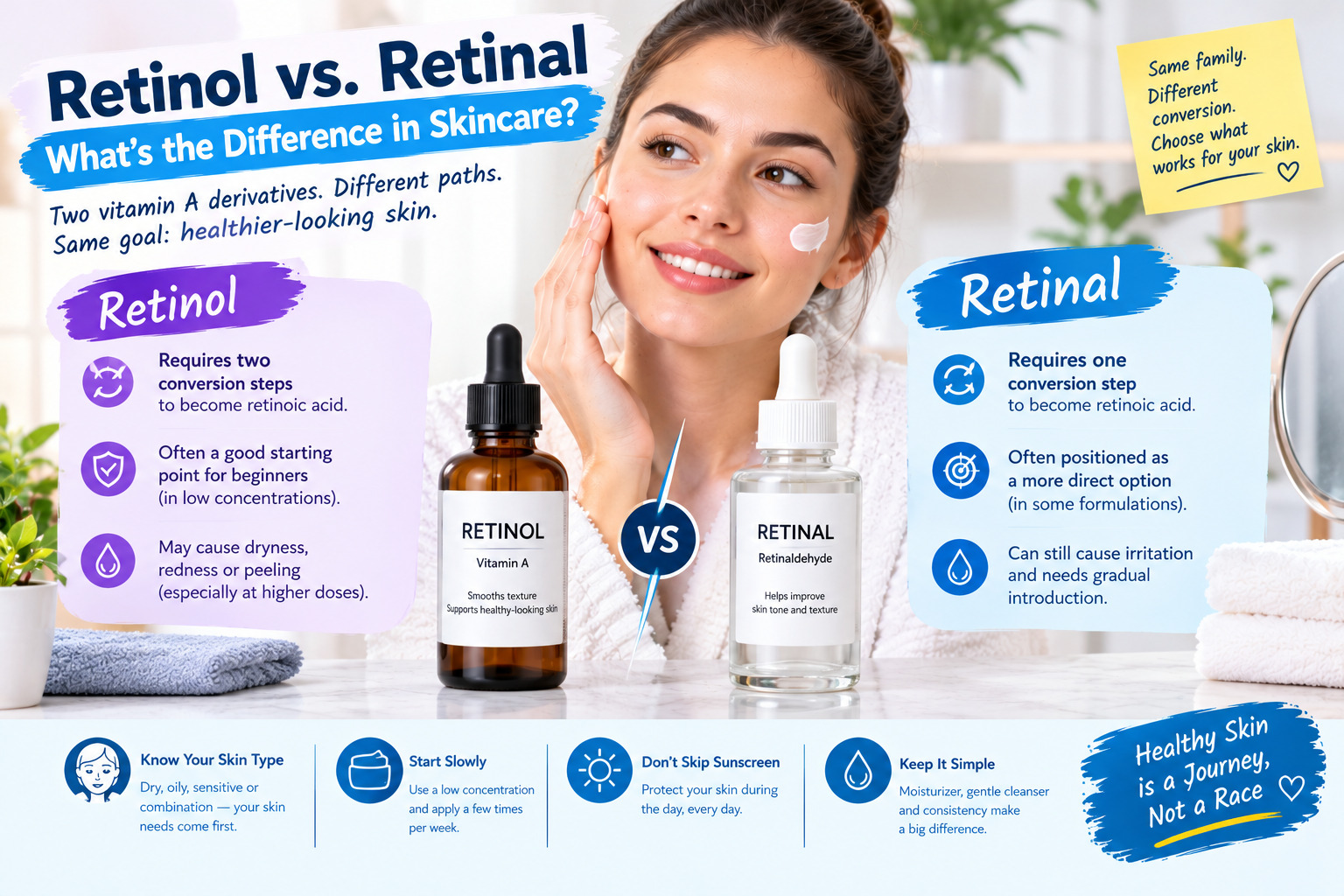
Because retinol requires two conversion steps to become retinoic acid, it is often considered a gentler starting point than more direct retinoid options. However, this does not mean that every retinol product is mild or irritation-free. Higher concentrations, unsuitable formulations, and excessive use can still cause redness, dryness, peeling, or discomfort. American Academy of Dermatology: Retinoid or Retinol?
What Is Retinal?
Retinal, also called retinaldehyde, is another vitamin A derivative used in cosmetic skincare. It is chemically closer to retinoic acid than retinol because it requires only one conversion step to become retinoic acid in the skin. This difference is one reason retinal is often described as a more direct or potentially faster-acting cosmetic retinoid.
Retinal products are marketed for concerns such as fine lines, uneven texture, and skin tone. Nevertheless, a shorter conversion pathway does not automatically prove that every retinal product performs better than every retinol product. The finished formula, concentration, stability, and the way a person uses the product all matter. Research comparing retinoids also shows that tolerability and outcomes depend on the specific formulation and treatment conditions. PubMed: Tolerance Profile of Retinol, Retinaldehyde and Retinoic Acid
Retinol vs. Retinal: The Main Differences
The main distinction between retinol and retinal is their position in the skin’s vitamin A conversion pathway. Retinol is converted into retinaldehyde and then into retinoic acid, while retinaldehyde needs only the final conversion step. This biochemical difference helps explain why retinal is frequently positioned between retinol and prescription retinoids in cosmetic discussions.
| Feature | Retinol | Retinal |
|---|---|---|
| Ingredient name | Retinol | Retinaldehyde, often shortened to retinal |
| Conversion pathway | Two steps to retinoic acid | One step to retinoic acid |
| Common skincare purpose | Fine lines, texture, uneven tone | Fine lines, texture, uneven tone |
| Beginner suitability | Often a reasonable starting point at a low concentration | May suit some beginners, but careful introduction is still important |
| Irritation potential | Can cause dryness, redness, and peeling | Can also cause dryness, redness, and peeling |
| What determines results | Concentration, formulation, stability, and consistency | Concentration, formulation, stability, and consistency |
This comparison describes general differences, not a universal ranking. There is no reliable rule that every retinal serum is more effective or less irritating than every retinol serum. The concentration and formulation must be considered alongside the ingredient itself. American Academy of Dermatology: Retinoid or Retinol?
Which Is More Effective: Retinol or Retinal?
Retinal has a biochemical advantage because it requires one fewer conversion step before becoming retinoic acid. This is why some cosmetic brands position it as a more advanced option for people seeking visible improvements in skin texture and signs of aging. However, the number of conversion steps alone does not establish the clinical superiority of a finished product.
Retinol can also be effective when formulated appropriately and used consistently. A well-designed retinol product may be a better choice for someone who tolerates it comfortably than a stronger retinal product that causes persistent irritation. Direct comparisons between different commercial products are difficult because they may use different concentrations, delivery systems, stabilizing ingredients, and testing methods.
For this reason, choose based on your skin’s needs and the product’s full formulation rather than assuming that retinal always delivers better results. PubMed: Research on Retinol, Retinaldehyde and Retinoic Acid
Which Ingredient Is Better for Beginners?
Retinol at a low concentration is often a practical first option for someone who has never used a retinoid. Starting with a less intensive product and using it infrequently can make it easier to assess skin tolerance. This is especially relevant for people whose skin becomes dry or irritated easily.
Retinal may also be suitable for some beginners when the formulation is designed for gradual use and the skin tolerates it well. However, choosing retinal simply because it is marketed as advanced can lead to unnecessary irritation if the product is too strong for your skin. A gradual approach is more important than moving quickly to a higher-strength ingredient. American Academy of Dermatology: Tips for Using Retinoids
Benefits of Retinol and Retinal in a Skincare Routine
Improving the Appearance of Fine Lines
Retinoids are commonly used to improve the appearance of fine lines and other visible signs of skin aging. With consistent use, an appropriate product may help improve the appearance of skin texture over time. Results vary, and neither retinol nor retinal can completely stop or reverse the natural aging process.
Smoothing Uneven Skin Texture
Both ingredients may help improve the appearance of rough or uneven skin texture. They are not instant exfoliants, and visible changes generally require consistent use over time. Applying more product or using it more frequently than directed does not guarantee faster improvement and can increase irritation.
Improving the Appearance of Uneven Skin Tone
Retinoids may help improve some forms of uneven pigmentation. However, irritation can itself trigger dark marks in some people, particularly in skin that is prone to post-inflammatory hyperpigmentation. Introduce the ingredient gradually, avoid pushing through persistent inflammation, and use daily sun protection. American Academy of Dermatology: Retinoid or Retinol?
Supporting Acne Management
Some retinoids are used in acne treatment, but cosmetic retinol and retinal products should not be treated as interchangeable with prescription acne medication. If you have persistent, painful, or scarring acne, a dermatologist can help identify an appropriate treatment. Using multiple strong acne treatments alongside a retinoid without guidance may increase dryness and irritation. American Academy of Dermatology: Acne Treatment
How to Choose Between Retinol and Retinal for Your Skin Type
For Dry Skin
Dry skin may tolerate a retinoid better when it is introduced slowly alongside a fragrance-free moisturizer. Choose a formula that feels comfortable and avoid starting with a high concentration. If your skin is already cracked, inflamed, or persistently irritated, postpone use and seek professional advice if necessary.
For Oily or Acne-Prone Skin
A lightweight, non-comedogenic moisturizer can help support the skin barrier while using a retinoid. Retinol or retinal may be appropriate for some cosmetic concerns, but neither guarantees that acne will clear. If acne is persistent or severe, a dermatologist can recommend treatments with better-established roles in acne care.
For Sensitive Skin
Sensitive skin requires extra caution because both ingredients can cause redness, stinging, dryness, or peeling. Consider whether your skin is already affected by eczema, rosacea, or another inflammatory condition before introducing a retinoid. People with significant redness or inflammation should seek advice from a dermatologist rather than experimenting with increasingly strong products. American Academy of Dermatology: Retinoid or Retinol?
For Mature Skin
People concerned about fine lines or uneven texture may consider either ingredient. Retinal may appeal to someone who wants a product with a shorter conversion pathway, while retinol may offer a more familiar starting point. Neither ingredient is automatically the best choice for mature skin; comfort, product quality, and consistent use remain important.
How to Use Retinol or Retinal Safely
Start by choosing one product rather than using retinol and retinal together. Apply it at night according to the manufacturer’s directions, beginning with a low concentration and a low frequency, such as once or twice a week if the product instructions allow. Increase frequency gradually only if your skin tolerates it. Use a small amount, avoid the eyelids and the corners of the nose and mouth unless the product specifically directs otherwise, and follow with a moisturizer.
During the adjustment period, mild dryness or peeling can occur, but persistent burning, significant redness, swelling, or painful irritation should not be ignored. Stop using the product if a concerning reaction develops. Avoid adding several exfoliating acids or other potentially irritating active ingredients at the same time, particularly when you are first introducing a retinoid. American Academy of Dermatology: Tips for Using Retinoids
Why Moisturizer and Sunscreen Matter
Moisturizer helps reduce dryness and supports the skin barrier, making a retinoid routine more comfortable for many users. Apply a moisturizer that suits your skin type, and consider using it before the retinoid if this approach helps reduce irritation and is compatible with the product instructions.
Daily broad-spectrum sunscreen with SPF 30 or higher is also important. Sun protection helps limit UV damage and reduces the risk of sunburn while maintaining a skincare routine focused on improving skin appearance. Reapply sunscreen as directed, especially when spending time outdoors. American Academy of Dermatology: Sunscreen Guidance
Retinol and Retinal During Pregnancy
Retinoids should generally be avoided during pregnancy as a precaution. This includes over-the-counter skincare products containing retinol; do not assume that a cosmetic product is appropriate simply because it does not require a prescription. Anyone who is pregnant, planning pregnancy, or unsure whether a product is suitable should discuss skincare ingredients with a qualified healthcare professional.
If you discover that you have used a topical retinoid during pregnancy, stop using it and contact your healthcare professional for individualized advice rather than assuming harm has occurred. American Academy of Dermatology: Pregnancy Skin Care · American College of Obstetricians and Gynecologists: Skin Conditions During Pregnancy
Common Mistakes When Using Retinol or Retinal
Using too much product, starting with a high concentration, or applying a retinoid every night immediately can increase the likelihood of irritation. Combining several exfoliating products at the beginning of a routine may also make dryness and peeling worse. More frequent application does not necessarily mean better results.
Another mistake is neglecting moisturizer and sunscreen or continuing to use a product despite persistent inflammation. A retinoid routine should be adjusted to skin tolerance, not forced through discomfort. People with existing skin conditions or a history of strong reactions should seek professional guidance before starting.
Final Verdict: Retinol or Retinal?
Retinol and retinal are both vitamin A derivatives used to improve the appearance of fine lines, uneven texture, and certain pigmentation concerns. Retinol requires two conversion steps to become retinoic acid, while retinal requires one. This makes retinal a potentially more direct option, but it does not prove that every retinal product is more effective or better tolerated than every retinol product.
For many beginners, a low-strength retinol is a sensible starting point. Retinal may be worth considering for someone who understands retinoid use and finds a suitable, well-tolerated formula. In either case, gradual introduction, moisturizer, and daily sunscreen are essential parts of a responsible routine.
The best choice is the product that suits your skin, is used correctly, and can be tolerated consistently. If you have persistent acne, significant irritation, a skin condition, or questions about pregnancy-related safety, consult a qualified dermatologist or healthcare professional before starting.


