
Why Start Strength Training at Home?
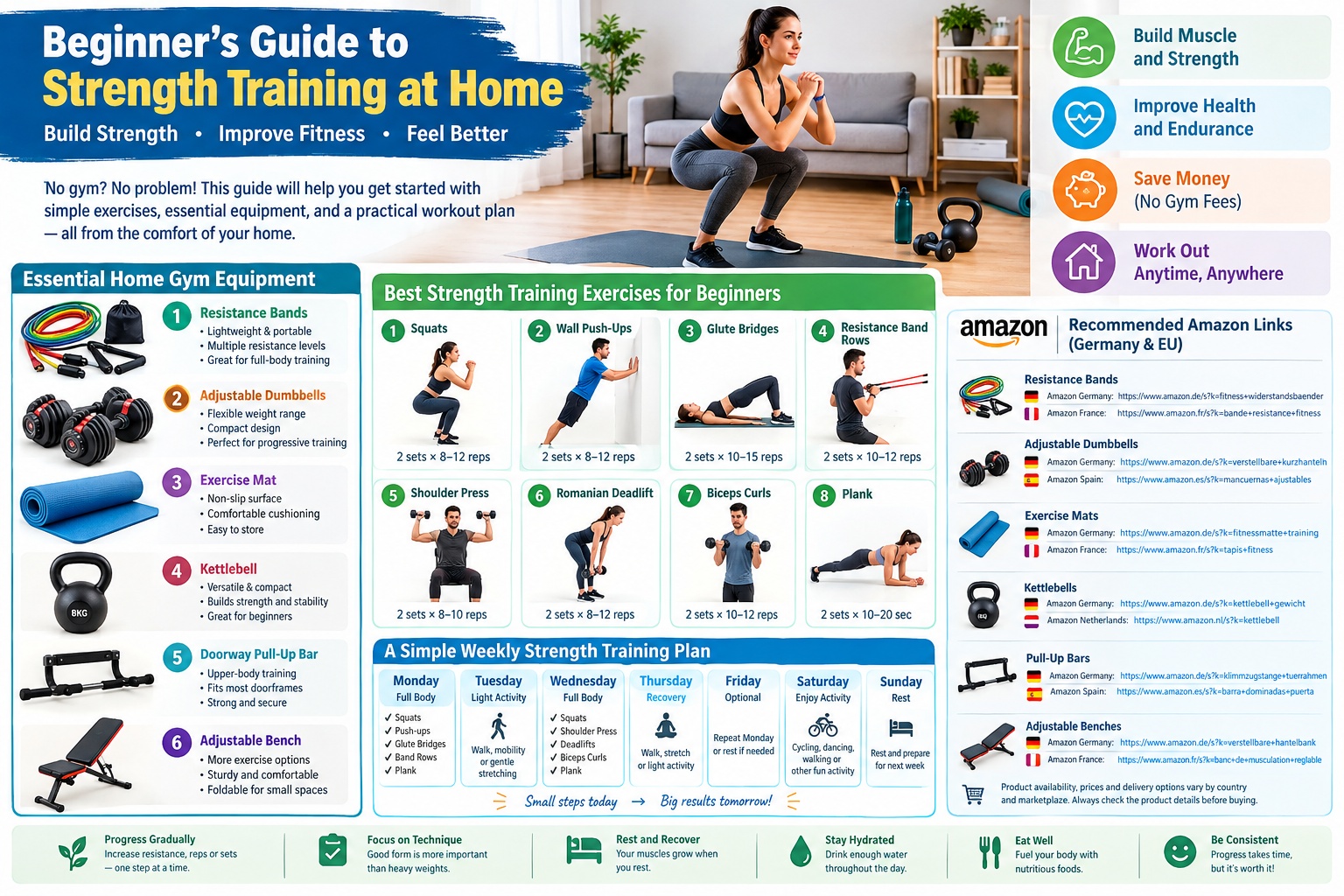
Strength training at home is one of the most convenient ways to improve fitness, build muscle, and develop a healthier lifestyle without paying for a gym membership. Whether you are completely new to exercise or returning after a long break, you can begin with simple bodyweight movements and gradually introduce resistance bands, dumbbells, and other affordable fitness equipment.
The best part is that you do not need an expensive home gym to get started. With a small workout area, a consistent routine, and the right exercises, you can train your entire body in your living room or bedroom.
For beginners, the most important factors are proper technique, manageable resistance, regular practice, and gradual progression. Learning these fundamentals early can help you develop a sustainable exercise habit while reducing the risk of avoidable injuries.
This beginner’s guide to strength training at home explains the benefits of resistance training, the essential equipment worth considering, the best exercises for beginners, and a simple weekly workout plan to help you get started in 2026.
What Is Strength Training?
Strength training is a type of physical exercise that makes your muscles work against resistance. This resistance can come from your own body weight, dumbbells, kettlebells, resistance bands, or weight machines.
When performed consistently, strength training can help increase muscular strength, improve endurance, support bone health, and make everyday activities easier. It can also contribute to better balance, coordination, and overall physical fitness.
For beginners, bodyweight exercises are an excellent starting point because they allow you to learn movement patterns before introducing additional weights. Exercises such as squats, wall push-ups, glute bridges, and planks can help develop a foundation for more challenging workouts.
As your strength improves, you can gradually increase resistance, perform additional repetitions, or choose more demanding variations. This approach is known as progressive overload, and it is an important principle for continued strength development.
Benefits of Strength Training at Home
1. Build Muscle and Increase Strength
One of the main benefits of strength training is its ability to improve muscular strength. Exercises that challenge your major muscle groups encourage your body to adapt to resistance over time.
Beginners can develop strength through simple movements such as squats, push-ups, rows, and lunges. Adding resistance bands or dumbbells provides more options for increasing the difficulty as your abilities improve.
You do not need to lift extremely heavy weights to begin making progress. Instead, choose a resistance level that allows you to perform each exercise with controlled movements and proper technique.
2. Save Money on Gym Memberships
Working out at home can reduce the recurring costs associated with commercial gyms. You do not need to pay monthly membership fees, purchase expensive workout clothing, or spend money commuting to a fitness facility.
A basic home workout setup can be relatively inexpensive. Bodyweight training requires almost no equipment, while resistance bands and a simple exercise mat can provide additional training options at a modest cost.
If you later decide to invest in adjustable dumbbells, you can expand your workout routine without purchasing an entire collection of separate weights.
3. Enjoy Greater Flexibility
Home workouts make it easier to exercise according to your personal schedule. You can train before work, during a lunch break, or in the evening without travelling to a gym.
This flexibility is particularly useful for students, remote workers, parents, and people with busy schedules.
Short sessions can also be effective when performed consistently. A beginner may start with 20 to 30 minutes per workout and gradually increase the duration as fitness improves.
4. Improve Everyday Movement
Strength training can help prepare your muscles for everyday tasks, including carrying shopping bags, climbing stairs, lifting objects, and getting up from a seated position.
Exercises that strengthen the legs, hips, back, shoulders, and core can support these movements when performed with appropriate technique and resistance.
Regular training can also improve muscular endurance, making some physical activities feel easier over time.
5. Develop a Consistent Fitness Habit
One of the biggest advantages of training at home is convenience. When your workout space is nearby, it becomes easier to fit exercise into your daily routine.
You can begin with a manageable schedule rather than attempting intense workouts every day. As your confidence grows, you can increase the number of exercises, adjust your resistance, and introduce new training goals.
Consistency is more important than purchasing large amounts of equipment or following complicated routines.
Essential Home Gym Equipment for Beginners
Choosing the right home gym equipment can make strength training more comfortable, convenient, and effective. However, beginners should avoid purchasing unnecessary items before understanding their training needs.
The following equipment options offer useful features for different budgets, workout preferences, and available spaces.
1. Resistance Bands: Affordable and Versatile
Resistance bands are among the most practical pieces of equipment for beginner strength training at home. They are lightweight, portable, and suitable for a wide range of exercises targeting the upper body, lower body, and core.
A good resistance band set typically includes several bands with different resistance levels. Some sets contain loop bands, while others include longer tube bands with handles and accessories for attaching them securely.
Key features to look for:
- Multiple resistance levels for gradual progression.
- Durable materials, such as natural latex or suitable latex-free alternatives.
- Comfortable handles if the set uses tube bands.
- A secure door anchor when included and needed for specific exercises.
- Compact storage and a carrying bag.
Main advantages:
Resistance bands are generally affordable and require very little storage space. They can be used for squats, rows, chest presses, shoulder exercises, glute bridges, and other movements.
They are particularly useful for beginners who want to learn resistance training without immediately investing in heavy weights.
However, always inspect bands for cracks, tears, or other damage before exercising. When using a door anchor, follow the manufacturer’s instructions and check that the anchor is secure.
Where to buy: Browse resistance bands on Amazon Germany or resistance bands on Amazon Spain.
2. Adjustable Dumbbells: Flexible Strength Training
Adjustable dumbbells are an excellent option for beginners who want to develop strength and gradually increase their training resistance.
Unlike traditional fixed-weight dumbbells, adjustable models allow you to change the weight using removable plates, locking mechanisms, or selector systems. This makes it possible to perform different exercises with varying resistance without needing an entire rack of weights.
Key features to look for:
- A suitable weight range for your current strength and future progress.
- Secure locking mechanisms.
- Comfortable, nonslip handles.
- Small weight increments for gradual progression.
- A compact design that fits your storage space.
Main advantages:
Adjustable dumbbells can be used for biceps curls, shoulder presses, bent-over rows, goblet squats, lunges, and floor presses.
Their versatility makes them useful for full-body strength training. As you become stronger, you can increase the resistance rather than replacing your entire equipment collection.
They are particularly valuable for people who want to develop a home gym without sacrificing too much floor space.
Before purchasing, check whether the listed price includes one dumbbell or a complete pair. Also verify the maximum weight per dumbbell and ensure that the adjustment mechanism is appropriate for your needs.
Where to buy: Explore adjustable dumbbells on Amazon Germany or adjustable dumbbells on Amazon Italy.
3. Exercise Mat: Comfort and Stability
An exercise mat provides a comfortable surface for floor-based movements and stretching. It is especially useful when training on hard floors, where exercises such as planks, glute bridges, and abdominal movements can otherwise feel uncomfortable.
Key features to look for:
- A nonslip surface.
- Sufficient cushioning for floor exercises.
- Durable, easy-to-clean materials.
- Enough length and width for your body and movements.
- A thickness appropriate for your preferred exercises and flooring.
Main advantages:
A good exercise mat can improve comfort during floor workouts and help create a dedicated training area at home.
It is easy to roll up or store when not in use, making it suitable for apartments and small rooms.
Choose a mat that offers a balance between cushioning and stability. Very soft mats may make standing exercises less stable, while thin mats may provide insufficient comfort for kneeling movements on hard surfaces.
Where to buy: Browse fitness mats on Amazon Germany or exercise mats on Amazon France.
4. Kettlebell: A Compact Strength Training Tool
A kettlebell is a weight with a handle that can be used for a variety of strength and conditioning exercises. It is suitable for people who want a compact alternative to a larger home gym setup.
Beginners can use kettlebells for goblet squats, deadlift variations, carries, and other controlled movements.
Key features to look for:
- A weight appropriate for your experience and strength.
- A secure, comfortable handle.
- A stable base for models designed to rest on the floor.
- A durable exterior.
- A shape that allows a comfortable grip.
Main advantages:
Kettlebells are versatile and can train several muscle groups through different movement patterns.
A single kettlebell can be sufficient for a basic workout routine, particularly when combined with bodyweight exercises.
Beginners should learn proper technique before attempting ballistic exercises such as kettlebell swings. Starting with controlled movements and a manageable weight is a more suitable approach.
Where to buy: Explore kettlebells on Amazon Germany or kettlebells on Amazon Netherlands.
5. Doorway Pull-Up Bar: Upper-Body Training
A doorway pull-up bar can expand your home workout options by providing a way to perform pull-ups and related exercises. However, it is an optional purchase rather than a requirement for beginners.
Key features to look for:
- Compatibility with your doorway dimensions.
- A suitable maximum user weight.
- Secure installation according to the manufacturer’s instructions.
- Comfortable grip positions.
- A design appropriate for your doorframe and wall structure.
Main advantages:
Pull-ups target the back and arms while also challenging grip strength. Depending on the model and your training level, a bar may also support other upper-body exercises.
However, not every doorway can safely accommodate every pull-up bar. Check the installation requirements carefully, and never use a bar that is loose, damaged, or incompatible with your doorway.
Beginners who cannot yet perform a full pull-up can start with other back exercises, including resistance band rows and dumbbell rows.
Where to buy: Browse doorway pull-up bars on Amazon Germany or pull-up bars on Amazon Spain.
6. Adjustable Workout Bench: More Exercise Options
An adjustable workout bench can be a useful addition to a home gym once you become comfortable with basic strength exercises.
Depending on its design, it may support flat or incline pressing movements, seated shoulder presses, and other dumbbell exercises.
Key features to look for:
- A stable frame.
- A clearly stated maximum load capacity.
- Secure adjustment mechanisms.
- Comfortable padding.
- Foldable storage if space is limited.
Main advantages:
An adjustable bench expands the variety of exercises you can perform with dumbbells and can make some movements more comfortable.
However, beginners do not need a bench to begin strength training. Consider purchasing one only when it would meaningfully improve your routine.
Where to buy: Explore adjustable workout benches on Amazon Germany or workout benches on Amazon France.
Best Strength Training Exercises for Beginners at Home
A beginner-friendly strength training program should include exercises that target the major muscle groups. You can start with bodyweight movements and introduce resistance bands or dumbbells as your technique improves.
The following exercises are suitable starting points for many healthy beginners. Adjust the difficulty to your ability, and stop if you experience sharp pain, dizziness, or unusual symptoms.
1. Bodyweight Squats
Bodyweight squats strengthen the quadriceps, glutes, and other muscles involved in lower-body movement.
To perform a squat, stand with your feet approximately shoulder-width apart. Keep your chest comfortably lifted, bend your knees and hips, and lower yourself as far as you can while maintaining control. Push through your feet to return to the starting position.
Start with two sets of 8 to 12 repetitions.
If a full squat is difficult, use a chair behind you as a target and lower yourself toward it with control.
2. Wall Push-Ups
Wall push-ups are a beginner-friendly way to develop upper-body strength while reducing the load compared with traditional floor push-ups.
Stand facing a wall and place your hands against it at approximately shoulder height. Step back slightly, keep your body aligned, and bend your elbows to bring your chest toward the wall. Push back to the starting position.
Start with two sets of 8 to 12 repetitions.
As the exercise becomes easier, you can progress to push-ups against a stable countertop or bench before attempting floor push-ups.
3. Glute Bridges
Glute bridges target the glutes and help strengthen the muscles involved in hip extension.
Lie on your back with your knees bent and your feet flat on the floor. Keep your arms by your sides, tighten your abdominal muscles gently, and lift your hips until your body forms a comfortable line from your shoulders toward your knees.
Pause briefly, then lower your hips slowly.
Start with two sets of 10 to 15 repetitions.
Avoid arching your lower back excessively at the top of the movement.
4. Resistance Band Rows
Resistance band rows strengthen the muscles of the upper and middle back while also engaging the arms.
Secure the band according to its instructions. Hold the handles, keep your torso stable, and pull your elbows backward while bringing your hands toward your body. Return slowly to the starting position.
Start with two sets of 10 to 12 repetitions.
If the exercise involves a door anchor, ensure that the anchor is installed correctly and cannot slip during use.
5. Dumbbell Shoulder Press
The dumbbell shoulder press targets the shoulders and triceps.
Hold a light dumbbell in each hand at approximately shoulder height. Keep your wrists comfortable and your torso stable. Press the weights upward without forcing your elbows into an uncomfortable position, then lower them slowly.
Start with two sets of 8 to 10 repetitions.
Choose a weight that allows you to maintain control throughout the movement. If you cannot press the weights without leaning backward or arching your lower back excessively, reduce the resistance.
6. Dumbbell or Resistance Band Romanian Deadlift
This exercise targets the glutes, hamstrings, and other muscles involved in hip extension.
Stand with your feet approximately hip-width apart and hold light dumbbells or a suitable resistance band. Keep your knees slightly bent and push your hips backward while lowering the resistance along the front of your legs.
Maintain a neutral spine and stop when you reach a comfortable range of motion. Return to standing by moving your hips forward.
Start with two sets of 8 to 12 repetitions.
Focus on moving through your hips rather than rounding your back. Beginners should practice the movement without weights before adding resistance.
7. Standing Biceps Curls
Biceps curls strengthen the muscles at the front of your upper arms.
Hold a light dumbbell in each hand with your arms by your sides. Keep your elbows close to your torso and bend them to raise the weights toward your shoulders. Lower the dumbbells slowly without swinging your body.
Start with two sets of 10 to 12 repetitions.
You can also perform this exercise using resistance bands.
8. Plank
The plank is a core exercise that challenges the abdominal muscles and other muscles responsible for stabilizing the torso.
Place your forearms on the floor and extend your legs behind you. Keep your body aligned, tighten your core, and breathe normally.
Start with two sets of 10 to 20 seconds.
If a full plank is too challenging, perform a modified plank with your knees on the floor. Focus on maintaining a stable position instead of holding the exercise for as long as possible.
A Simple Weekly Strength Training Plan for Beginners
A structured schedule can make it easier to establish a consistent exercise routine. Beginners can start with two or three nonconsecutive strength training sessions per week, allowing time for recovery between workouts.
The following schedule is an example that you can adapt to your fitness level and personal commitments.
Monday: Full-Body Workout
Begin with five minutes of comfortable walking in place and gentle mobility movements.
Perform the following exercises:
- Bodyweight squats: 2 sets of 8–12 repetitions.
- Wall push-ups: 2 sets of 8–12 repetitions.
- Glute bridges: 2 sets of 10–15 repetitions.
- Resistance band rows: 2 sets of 10–12 repetitions.
- Plank: 2 sets of 10–20 seconds.
Rest for approximately 60–120 seconds between sets, or longer if needed to recover.
Tuesday: Light Activity
Take a comfortable walk, perform gentle mobility exercises, or participate in another low-intensity activity you enjoy.
The purpose is to remain active without placing unnecessary demands on muscles that are recovering from the previous workout.
Wednesday: Full-Body Workout
Warm up for five minutes, then perform:
- Bodyweight squats: 2 sets of 8–12 repetitions.
- Dumbbell shoulder presses: 2 sets of 8–10 repetitions.
- Dumbbell Romanian deadlifts: 2 sets of 8–12 repetitions.
- Biceps curls: 2 sets of 10–12 repetitions.
- Plank: 2 sets of 10–20 seconds.
Use bodyweight or resistance band alternatives when appropriate.
Thursday: Recovery or Light Activity
Choose an easy activity such as walking or gentle stretching. Avoid pushing through significant soreness or pain.
Friday: Optional Full-Body Workout
If you feel recovered and comfortable with the exercises, repeat Monday’s routine.
If you are still experiencing substantial soreness or fatigue, take another recovery day instead.
Saturday: Enjoyable Physical Activity
Consider walking, cycling, dancing, or another activity that helps you stay active without making your routine feel repetitive.
Sunday: Rest and Preparation
Take a rest day and prepare for the following week. Review your progress, check your equipment, and decide whether your current exercises remain challenging but manageable.
This plan is a starting point rather than a strict requirement. Two well-performed strength sessions per week can be a reasonable initial goal, and you can adjust the schedule as your fitness and recovery improve.
How to Progress Safely With Strength Training
Progression is important because exercises that initially feel challenging may become easier as your body adapts.
However, progress does not require increasing the weight every session. Beginners should focus on mastering the movements before making their workouts more demanding.
Start With Manageable Resistance
Choose a resistance level that allows you to complete your target repetitions with good technique.
The final repetitions should feel challenging without forcing you to hold your breath, swing the weights, or change your body position to finish the set.
If you cannot maintain proper form, reduce the weight or choose an easier variation.
Increase Repetitions Gradually
Suppose you begin with two sets of eight squats. When this becomes comfortable, gradually increase the repetitions until you can complete two sets of 12 with good technique.
You can then consider a more challenging variation or add a small amount of resistance.
This gradual approach makes it easier to track progress without making unnecessary jumps in difficulty.
Use Progressive Overload
Progressive overload means gradually increasing the challenge placed on your muscles as your fitness improves.
You can apply this principle by increasing the weight, performing more repetitions, adding a set, or selecting a more demanding exercise variation.
Change one factor at a time whenever possible so you can evaluate how your body responds.
Prioritize Rest and Recovery
Muscles need time to recover between demanding workouts. Beginners should generally avoid training the same muscle groups intensely on consecutive days.
Adequate sleep, regular meals, sufficient protein, and appropriate hydration can also support recovery.
If you experience persistent pain, unusual weakness, or symptoms that concern you, stop the exercise and seek appropriate medical advice.
Track Your Workouts
A simple notebook or fitness app can help you record exercises, repetitions, sets, and resistance levels.
For example, you might record that you completed two sets of 10 squats and two sets of eight wall push-ups during your first session.
Over time, these records can help you identify improvements and decide when to progress.
Common Beginner Mistakes to Avoid
Buying Too Much Equipment Too Soon
A common mistake is spending money on a large home gym before establishing a regular exercise habit.
Start with bodyweight exercises, a mat, or resistance bands if necessary. Add dumbbells or other equipment when you understand which exercises you enjoy and which training options would benefit you.
Using Weights That Are Too Heavy
Heavy weights are not automatically better for beginners. Excessive resistance can make it harder to control movements and maintain proper technique.
Start with manageable weights and increase them gradually when you can complete your exercises comfortably.
Skipping the Warm-Up
Beginning an intense workout without preparation may make the first exercises feel uncomfortable or difficult.
Spend approximately five minutes warming up with light activity, followed by gentle movements related to the exercises you plan to perform.
Training Too Frequently
Working out every day is not necessary to build a strong foundation.
Frequent intense sessions without sufficient recovery can contribute to fatigue and make it harder to maintain good technique.
Begin with two or three strength sessions per week and adjust according to your recovery.
Ignoring Proper Technique
Correct movement patterns are more important than completing a large number of repetitions.
Move in a controlled manner, avoid using momentum to lift weights, and select exercises that match your current ability.
If you are unsure how to perform an exercise safely, consider consulting a qualified fitness professional.
Expecting Immediate Results
Strength improvements develop gradually, and visible changes in muscle size or body composition can take longer.
Rather than judging success by daily changes in appearance or body weight, focus on measurable improvements such as performing more repetitions, using better technique, and maintaining a consistent training schedule.
How to Choose the Best Home Gym Equipment on Amazon Germany and the EU
Amazon offers a wide range of fitness products, but the best purchase depends on your budget, training goals, available space, and experience.
Before ordering equipment, compare the following features.
Quality and durability: Look for well-made products with clear specifications, appropriate safety features, and useful product documentation.
Adjustable resistance: Resistance bands with multiple levels and adjustable dumbbells can accommodate different exercises and make gradual progression easier.
Storage requirements: Compact equipment is often more practical for apartments and smaller homes. Consider where you will store your equipment between sessions.
Comfort and usability: Choose exercise mats with appropriate cushioning, dumbbells with comfortable grips, and resistance bands that suit the exercises you intend to perform.
Safety: Check maximum weight limits, locking mechanisms, installation requirements, and the manufacturer’s instructions. Avoid equipment with damaged components or unclear safety information.
Customer feedback: Read recent reviews carefully and look for recurring comments about durability, comfort, and usability. Do not rely exclusively on star ratings.
Price and value: Compare the total cost, including delivery where applicable. A simple product that you use regularly may provide more value than an expensive piece of equipment that remains unused.
Recommended Amazon Shopping Links
The following links lead to product search pages rather than specific product listings. They can help you compare available models, features, and current prices across European Amazon marketplaces.
- Resistance bands: Amazon Germany | Amazon France | Amazon Italy.
- Adjustable dumbbells: Amazon Germany | Amazon Spain | Amazon Italy.
- Exercise mats: Amazon Germany | Amazon France | Amazon Spain.
- Kettlebells: Amazon Germany | Amazon Netherlands | Amazon France.
- Doorway pull-up bars: Amazon Germany | Amazon Spain | Amazon France.
- Adjustable workout benches: Amazon Germany | Amazon France | Amazon Italy.
Product availability, prices, shipping options, and delivery eligibility vary by marketplace and destination. Check the individual listing before purchasing, especially if you are ordering from outside the European Union.
Frequently Asked Questions About Beginner Strength Training at Home
Can Beginners Build Muscle at Home?
Yes. Beginners can build muscle at home using bodyweight exercises, resistance bands, dumbbells, and other suitable forms of resistance.
The key factors include choosing sufficiently challenging exercises, using proper technique, increasing the training challenge gradually, eating adequately, and allowing time for recovery.
You do not need access to a commercial gym to begin developing strength.
How Many Days a Week Should Beginners Train?
Two or three strength training sessions per week are a reasonable starting point for many beginners.
Try to leave recovery time between demanding sessions that target the same muscle groups. You can increase your training frequency later if your schedule, experience, and recovery allow it.
Can I Train Without Equipment?
Yes. Bodyweight squats, wall push-ups, glute bridges, lunges, and planks can provide a useful starting routine without additional equipment.
As you become stronger, you may need more challenging variations or external resistance to continue progressing.
What Is the Best Home Gym Equipment for Beginners?
For many beginners, resistance bands and an exercise mat provide an affordable starting point. Adjustable dumbbells are a useful addition for those who want more options for progressive resistance training.
The best equipment is the equipment that matches your goals, fits your available space, and allows you to exercise safely and consistently.
How Long Should a Beginner’s Home Workout Last?
A beginner’s strength training session may last approximately 20 to 40 minutes, including a short warm-up, the main exercises, and rest periods.
The appropriate duration depends on the number of exercises, your fitness level, and how much recovery you need between sets.
A shorter workout performed consistently can be more practical than a long routine that is difficult to maintain.
When Will I See Results From Strength Training?
Results vary according to your starting fitness level, training consistency, nutrition, recovery, and other individual factors.
You may notice improvements in exercise technique and strength before seeing substantial changes in muscle size or appearance.
Focus on consistent training and gradual progress rather than expecting a fixed timeline for results.
Is Strength Training Suitable for Older Adults?
Strength training can be beneficial for many older adults, but exercises should match individual abilities, balance, mobility, and health considerations.
People with chronic health conditions, significant joint problems, or concerns about exercising safely should consult an appropriate healthcare professional before starting a new program.
A qualified fitness professional can also help adapt exercises to individual needs.
Conclusion
Strength training at home is an accessible way for beginners to develop muscle strength, improve fitness, and establish healthier exercise habits without investing in an expensive gym membership.
Start with simple movements such as squats, wall push-ups, glute bridges, rows, and planks. Practice proper technique, choose manageable resistance, and increase the difficulty gradually as your strength improves.
When you are ready to purchase equipment, resistance bands, exercise mats, and adjustable dumbbells offer practical options for building a versatile home workout setup. Kettlebells, pull-up bars, and adjustable benches can provide additional variety as your experience grows.
Use the Amazon Germany and European marketplace links in this guide to compare products, specifications, and prices before buying. Most importantly, remember that consistent training, appropriate recovery, and gradual progression matter far more than owning a large collection of fitness equipment.
With a realistic plan and a commitment to regular practice, you can build a strong foundation for long-term fitness from the comfort of your own home.


