
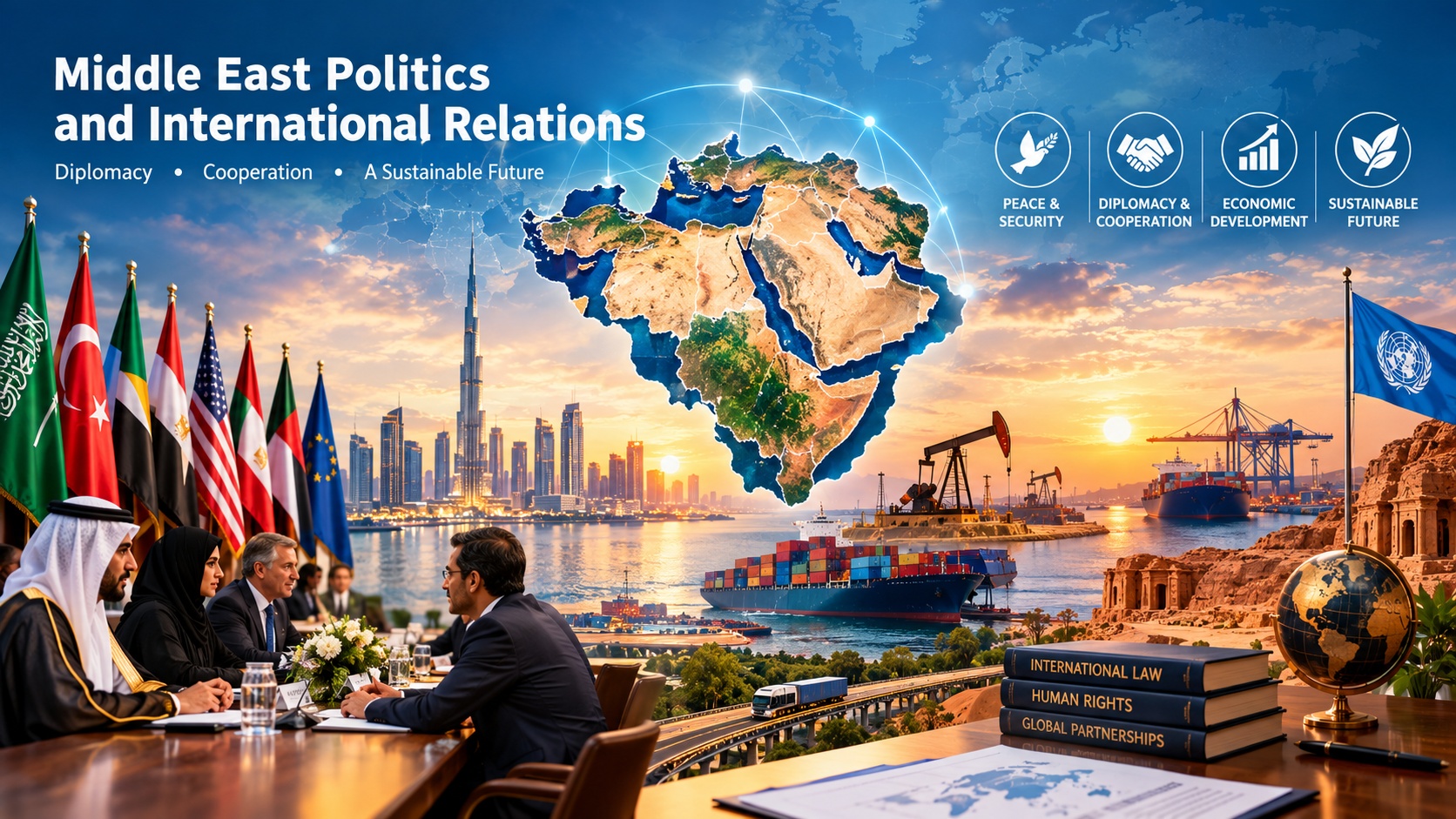
Middle East Politics and International Relations: Regional Power, Diplomacy, and Global Challenges
Introduction to Middle East Politics and International Relations
Middle East politics and international relations play an important role in global security, international trade, energy markets, and diplomatic cooperation. The region connects Asia, Africa, and Europe and includes countries with diverse political systems, economic structures, cultural traditions, and strategic priorities. Its international relationships influence global energy supplies, maritime transportation, investment, migration, and international security.
Political developments in the Middle East are shaped by several interconnected factors, including national interests, regional rivalries, economic partnerships, territorial disputes, security concerns, and international diplomacy. Governments must balance domestic priorities with relationships involving neighbouring countries, major world powers, and international organizations.
The region should not be understood as a single political bloc. Countries have different foreign policy objectives, security concerns, economic resources, and approaches to diplomacy. Some emphasize economic diversification and international investment, while others prioritize security, political influence, territorial questions, or regional cooperation.
Understanding these differences provides a stronger foundation for examining the Middle East’s political landscape and its relationship with the wider international system.
Source: United Nations – The UN Charter and International Relations
The Strategic Importance of the Middle East
The Middle East occupies an important geographical position between major international markets. Its proximity to Europe, Asia, and Africa, together with its energy resources and maritime routes, makes regional stability relevant to governments, businesses, and consumers worldwide.
Several important shipping corridors connect the region to global commerce. The Suez Canal links the Mediterranean Sea with the Red Sea, while the Strait of Hormuz is a major route for international oil and gas shipments. Disruptions to these routes can increase transportation costs, delay deliveries, and affect energy and commodity markets.
The region’s importance extends beyond energy. International investment, tourism, aviation, logistics, financial services, technology, and infrastructure development increasingly contribute to economic relationships between Middle Eastern countries and international partners.
Strategic importance also creates challenges. Competition over regional influence, maritime security, military presence, and access to resources can complicate diplomatic relationships. Governments therefore have strong incentives to protect important trade routes and maintain reliable international connections.
Understanding the geography of the Middle East helps explain why developments within the region can have consequences far beyond its borders.
Source: World Bank – Middle East, North Africa, Afghanistan and Pakistan
Political Systems and Government in the Middle East
The Middle East contains a wide variety of political systems, including constitutional monarchies, presidential republics, parliamentary systems, and other forms of government. Their institutions have developed through different historical experiences, constitutional arrangements, social structures, and relationships between political authorities and citizens.
These differences influence how governments make decisions, organize public administration, manage national resources, and conduct foreign policy. In some countries, executive authority is concentrated within particular institutions, while others have more extensive parliamentary structures or different arrangements for political representation.
Domestic politics can directly influence international relations. Leadership changes, public opinion, economic pressures, institutional priorities, and national security assessments may affect decisions involving alliances, trade agreements, diplomatic recognition, and regional negotiations.
Governance also influences a country’s ability to implement long-term economic reforms and maintain consistent foreign policy objectives. Effective public institutions, transparent decision-making, and reliable legal frameworks can improve policy implementation and strengthen international confidence.
A balanced assessment of Middle Eastern politics must therefore consider the distinct institutions and circumstances of individual countries rather than assuming that the region follows one political model.
Source: United Nations – Rule of Law and Peace and Security
Regional Powers and the Balance of Influence
Regional power in the Middle East is shaped by a combination of economic resources, military capabilities, diplomatic relationships, geographical position, population, and technological development. Countries use these resources differently to protect their interests, strengthen partnerships, and influence regional decisions.
Saudi Arabia, Iran, Türkiye, Israel, Egypt, Qatar, and the United Arab Emirates are among the countries whose policies can significantly affect regional diplomacy, although their roles and priorities differ. Other states also influence regional developments through their diplomatic relationships, geographical positions, cultural connections, and participation in international organizations.
Competition between regional powers can involve security arrangements, economic partnerships, political influence, and disagreements over regional conflicts. However, competition does not prevent cooperation in areas such as trade, infrastructure, investment, environmental protection, and diplomatic mediation.
The balance of influence is not fixed. Changes in economic performance, domestic politics, international partnerships, security conditions, and technological capabilities can alter how countries assess their interests and negotiate with one another.
Regional stability depends partly on whether governments can manage disagreements through diplomatic channels while identifying shared interests that support cooperation and reduce the risk of escalation.
Source: United Nations – Charter Principles and International Cooperation
International Relations Between the Middle East and Major World Powers
The Middle East maintains extensive political, economic, and security relationships with major international powers, including the United States, China, Russia, and European countries. These relationships vary according to national interests, historical connections, trade requirements, defence arrangements, energy policies, and diplomatic priorities.
The United States has maintained significant security and diplomatic relationships with several countries in the region. China has expanded its economic engagement through trade, infrastructure, energy cooperation, and investment. Russia has pursued diplomatic, economic, and security interests in selected regional contexts, while European countries maintain important trade relationships and participate in diplomatic and development initiatives.
These relationships are not uniform across the region. Middle Eastern governments often maintain connections with multiple international partners rather than relying on a single power. Such diversification can expand economic opportunities and give governments greater flexibility in responding to changing international conditions.
At the same time, competition among major powers can complicate regional diplomacy. Differences over security arrangements, international sanctions, military conflicts, energy policy, and political settlements may place pressure on countries that maintain relationships with several competing partners.
International relations in the Middle East are therefore best understood as a changing network of national interests, economic interdependence, diplomatic negotiations, and security considerations.
Source: United Nations – International Cooperation and the UN Charter
The Israeli-Palestinian Conflict and International Diplomacy
The Israeli-Palestinian conflict remains one of the region’s most consequential political and diplomatic issues. It involves questions concerning security, territory, statehood, displacement, settlements, Jerusalem, access to resources, and the rights and future of Palestinians and Israelis.
The conflict has generated extensive international diplomatic activity involving the United Nations, regional governments, and international partners. Negotiations and diplomatic initiatives have sought to address security concerns, establish political arrangements, improve humanitarian conditions, and identify a framework for a lasting settlement.
Different governments disagree about the best path forward, the sequence of negotiations, security arrangements, and the political conditions required for an agreement. These differences can complicate diplomatic coordination and delay progress.
International humanitarian law and the principles of the United Nations Charter provide important legal frameworks for evaluating conduct during conflict and the obligations of relevant parties. Humanitarian access, civilian protection, the treatment of detainees, and respect for applicable international law remain central concerns.
Sustainable progress requires serious diplomatic engagement, attention to the rights and security of affected populations, and political arrangements capable of addressing the underlying issues. Humanitarian needs should not be treated as secondary to political negotiations.
Source: United Nations – The Question of Palestine
Iran, Regional Security, and International Negotiations
Iran is an important actor in Middle Eastern politics because of its geographical position, population, energy resources, military capabilities, and relationships with regional and international partners. Its foreign policy intersects with issues involving regional security, maritime transportation, nuclear activities, sanctions, and diplomatic relations with neighbouring countries.
Disagreements between Iran and other governments have influenced regional security calculations and international negotiations. Different assessments of military risks, nuclear activities, sanctions, and regional political movements have created recurring diplomatic challenges.
Nuclear diplomacy is particularly important because international concerns about nuclear proliferation are connected to broader questions of security, verification, and compliance with international commitments. The International Atomic Energy Agency plays a central technical role in nuclear safeguards and verification within its mandate.
Negotiations can provide mechanisms for clarifying commitments, addressing verification concerns, and reducing uncertainty. Their effectiveness depends on the terms of agreements, the willingness of parties to participate, the implementation of commitments, and the ability to address disputes through established diplomatic channels.
Regional security also depends on communication between governments and efforts to reduce the risk of miscalculation. Diplomatic engagement does not eliminate differences, but it can create opportunities to manage them without further destabilizing the region.
Source: International Atomic Energy Agency – Iran
The Gulf States and Economic Diplomacy
The Gulf states play an important role in international economic relations through energy exports, sovereign investment, financial services, aviation, logistics, tourism, and infrastructure development. Their economic relationships extend across Asia, Europe, Africa, and the Americas.
Several Gulf economies have pursued diversification strategies designed to reduce dependence on oil and gas revenues. Investment in tourism, renewable energy, technology, manufacturing, finance, and international transport reflects efforts to develop additional sources of economic growth.
Economic diplomacy supports these strategies by attracting investment, negotiating trade arrangements, developing transport connections, and establishing partnerships with foreign businesses and governments. Such initiatives can also increase the international influence of Gulf countries.
However, economic diversification involves challenges. Governments must develop skilled workforces, support competitive private-sector activity, manage financial risks, and ensure that large investment projects produce sustainable returns. Changes in global energy demand and international economic conditions can also influence government revenues and investment priorities.
Cooperation between Gulf countries and international partners can create opportunities in clean energy, digital infrastructure, food security, logistics, and technological development. The long-term success of these partnerships depends on sound planning, transparent institutions, and realistic assessments of costs and benefits.
Source: World Bank – Middle East, North Africa, Afghanistan and Pakistan
Energy Security and Global Economic Relations
Energy remains an important factor in Middle Eastern international relations. Several countries in the region are major producers or exporters of oil and natural gas, making energy markets an important part of their relationships with importing economies.
Changes in production, demand, shipping conditions, investment, and geopolitical risk can influence global energy prices. These changes may affect transportation, manufacturing, electricity generation, household costs, and government revenues in different parts of the world.
Energy relationships also influence diplomatic cooperation. Producing and importing countries may negotiate long-term supply agreements, invest in energy infrastructure, and cooperate on market stability. However, their priorities can differ because exporting countries often focus on revenue, investment, and production planning, while importing countries may emphasize affordability, supply security, and diversification.
The energy transition adds another dimension to regional economic policy. Renewable energy, electricity networks, energy storage, and emerging technologies create opportunities to diversify national economies and respond to changing global demand.
Countries that combine responsible resource management with economic diversification may be better positioned to manage market volatility. Long-term resilience depends on sound fiscal planning, reliable infrastructure, and investment strategies that account for both present energy needs and future technological change.
Source: International Energy Agency – Middle East
Maritime Security and International Trade Routes
Maritime security is an important component of Middle Eastern international relations because the region contains shipping corridors that connect major energy producers, manufacturing centres, and consumer markets. Commercial shipping supports the movement of oil, gas, food, industrial materials, and consumer goods.
The Strait of Hormuz, the Red Sea, and the Suez Canal are particularly important to international trade. Disruptions caused by conflict, attacks on shipping, political tensions, or other security incidents can increase insurance costs, delay cargo, and encourage shipping companies to consider alternative routes.
Such disruptions can affect countries that are not directly involved in regional disputes. Higher transport costs may influence supply chains, commodity prices, and delivery schedules, while uncertainty can affect investment and business confidence.
Protecting commercial navigation requires cooperation between relevant governments, maritime organizations, and international partners. Measures may include diplomatic engagement, information-sharing, maritime safety procedures, and adherence to applicable international law.
Governments must balance security concerns with the need to maintain safe, predictable, and lawful commercial navigation. Reducing tensions and preventing escalation can help protect both regional stability and international economic activity.
Source: United Nations – Convention on the Law of the Sea
Regional Conflicts, Mediation, and Peacebuilding
Regional conflicts can have consequences that extend beyond the countries directly involved. They may contribute to displacement, humanitarian emergencies, disrupted trade, damaged infrastructure, and greater uncertainty in international relations.
The causes of conflict vary and can include territorial disputes, competition over political authority, security concerns, external intervention, and unresolved historical grievances. In some cases, local disputes become connected to wider regional rivalries, making negotiations more difficult.
Diplomacy provides several methods for managing these challenges. Negotiation allows parties to communicate directly, while mediation can help establish dialogue when trust is limited. International organizations and regional partners may provide diplomatic forums, humanitarian coordination, or support for agreed political processes.
Peacebuilding also requires attention to conditions after a ceasefire or political agreement. Restoring essential services, rebuilding infrastructure, supporting displaced communities, strengthening institutions, and creating economic opportunities can help reduce the risk of renewed instability.
No single diplomatic formula works in every conflict. Effective peace processes require careful consideration of local circumstances, the interests and rights of affected populations, security arrangements, and the implementation of agreed commitments.
Source: United Nations – Peaceful Settlement of Disputes
International Law, Human Rights, and Regional Stability
International law provides a framework for relations between states and helps establish rules for managing disputes, protecting civilians, and supporting international cooperation. The United Nations Charter emphasizes sovereign equality, peaceful settlement of disputes, and restrictions on the threat or use of force inconsistent with the Charter.
These principles are particularly relevant in the Middle East, where territorial disputes, armed conflicts, security concerns, and competing national interests can create difficult legal and diplomatic questions.
International humanitarian law governs important aspects of armed conflict, including the protection of civilians and the treatment of people who are not participating, or are no longer participating, in hostilities. Human rights law also establishes obligations and protections that remain relevant under the applicable legal framework.
The interpretation and application of international law in particular situations may involve complex factual and legal questions. Reliable analysis should distinguish between verified events, allegations, official positions, and findings made by competent legal institutions.
Respect for international law can help create predictable rules for state conduct and support diplomatic efforts to resolve disagreements. Consistent application of legal principles is important for maintaining institutional credibility and strengthening international confidence.
Source: United Nations – Rule of Law and Peace and Security
Economic Diversification and Regional Development
Economic conditions influence foreign policy because governments must manage employment, public revenue, investment, infrastructure, and social expectations. Countries with diversified economies may have more options for responding to international market disruptions than those that depend heavily on a narrow range of exports.
Middle Eastern countries have different economic structures. Some rely significantly on oil and gas exports, while others have larger agricultural, industrial, tourism, or service sectors. These differences affect trade relationships, fiscal priorities, and exposure to international economic shocks.
Economic diversification can involve investment in manufacturing, logistics, technology, education, renewable energy, tourism, and financial services. Such efforts require skilled workers, reliable infrastructure, transparent regulations, and access to domestic and international markets.
Regional economic cooperation can expand commercial opportunities by improving transport connections, supporting investment, and facilitating trade. However, political disagreements and differences in regulation may limit the full benefits of integration.
The World Bank’s regional economic publications examine growth, employment, investment, and structural challenges affecting countries across the broader Middle East and North Africa region. These resources provide a useful foundation for understanding how domestic economic policies interact with international conditions.
Source: World Bank – Middle East and North Africa Economic Updates
Climate Change, Water Security, and Regional Cooperation
Climate change and water scarcity are important policy concerns in parts of the Middle East. Many countries experience limited freshwater resources, high temperatures, and substantial demand for water in urban areas, agriculture, and industry.
These pressures can affect food production, infrastructure planning, public budgets, and long-term economic development. Population growth, water-intensive economic activity, environmental changes, and the management of shared water resources can increase the complexity of national and regional planning.
Governments can respond through improved water management, wastewater treatment and reuse where appropriate, efficient irrigation, desalination, and investment in resilient infrastructure. These measures require careful planning because they can involve significant energy costs, environmental considerations, and long-term maintenance requirements.
Shared water resources can also create opportunities for international cooperation. Data-sharing, technical coordination, environmental monitoring, and agreements on resource management may help governments reduce uncertainty and manage competing needs.
Climate and water policy should be integrated into broader development strategies rather than treated solely as environmental issues. Cooperation in these areas can support economic resilience and create practical areas of collaboration even when countries disagree on other political questions.
Source: World Bank – Middle East and North Africa
The Role of the United Nations and International Organizations
International organizations provide important platforms for diplomacy, cooperation, humanitarian assistance, and the development of international rules. In the Middle East, the United Nations works on issues involving peace and security, humanitarian needs, development, human rights, and political dialogue.
The United Nations Security Council has primary responsibility within the UN system for maintaining international peace and security. Other UN bodies and agencies support humanitarian operations, development programmes, refugee protection, and international cooperation within their respective mandates.
International organizations can help coordinate responses when crises affect multiple countries or when individual governments lack the resources to meet urgent needs. They can also provide forums for negotiations and mechanisms for monitoring certain international commitments.
However, their effectiveness depends on legal mandates, available resources, cooperation from member states, and the political circumstances surrounding each situation. Disagreements between powerful states can limit collective action or delay decisions.
Regional organizations and diplomatic initiatives can complement international efforts by providing additional channels for dialogue and cooperation. Coordination between national governments, regional bodies, and international institutions can improve the prospects for practical and sustainable outcomes.
Source: United Nations – Peace and Security
The Future of Middle East Politics and International Relations
The future of Middle East politics will depend on how governments manage security concerns, economic transformation, regional rivalries, international partnerships, and changing environmental conditions. The region’s political landscape will continue to reflect differences between national interests and the opportunities created by cooperation.
Diplomacy can help governments reduce uncertainty, establish communication channels, negotiate practical agreements, and prevent local disputes from escalating into wider crises. Confidence-building measures, economic cooperation, and sustained political dialogue may create opportunities for progress even when comprehensive settlements remain difficult.
Economic diversification, technological development, and investment in human capital can strengthen resilience by creating additional sources of employment and revenue. Regional cooperation in transport, energy, water management, and trade may also help countries address shared challenges.
The future will not be determined by geography or natural resources alone. Institutional capacity, policy choices, public participation, international cooperation, and the ability to respond to crises will all influence development outcomes.
A balanced understanding of the Middle East requires examining both its conflicts and its opportunities for cooperation. Accurate information, careful analysis, and respect for international law are essential for understanding the region’s evolving role in global affairs.
Source: United Nations – The UN Charter
Conclusion: Understanding Middle East Politics and Global Relations
Middle East politics and international relations are shaped by regional power dynamics, economic interests, security concerns, diplomatic negotiations, and the broader international system. The region’s strategic geography and economic connections mean that political developments can affect global trade, energy markets, international investment, and security.
At the same time, the Middle East is not politically or economically uniform. Each country has its own institutions, priorities, international partnerships, and development challenges. Understanding these differences is essential for avoiding generalizations and evaluating political events accurately.
Long-term regional stability depends on effective diplomacy, responsible governance, economic resilience, respect for applicable international law, and sustained efforts to manage disagreements peacefully. Cooperation on trade, infrastructure, climate change, water security, and development can provide practical benefits even when political differences remain.
Ultimately, international relations in the Middle East are best understood through careful examination of evidence, national interests, institutional responsibilities, and the consequences of political decisions. A balanced and well-informed perspective helps readers understand both the complexity of regional challenges and the possibilities for greater cooperation and stability.


