
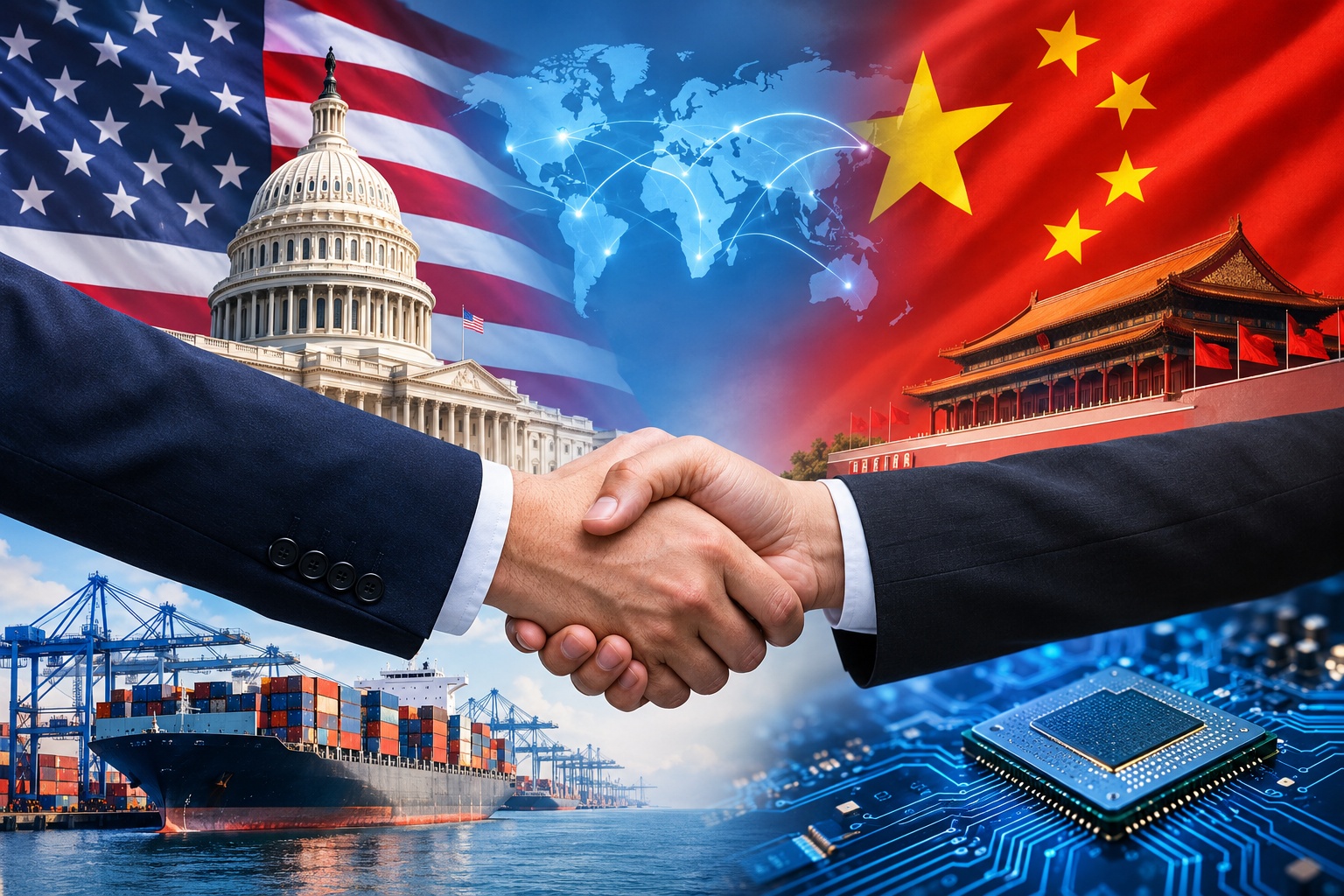
US-China Relations in 2026: Trade, Technology, Diplomacy, and Global Challenges
Introduction
US-China relations are a defining force in the modern international system. The United States and China are two major economic powers whose decisions influence global trade, technological innovation, international investment, energy markets, and security. Their relationship combines extensive economic connections with strategic competition and disagreements over trade policies, advanced technologies, Taiwan, and regional influence.
In 2026, both governments continue to face the challenge of protecting their national interests while maintaining channels for economic cooperation and diplomatic communication. Recent negotiations have focused on trade arrangements, investment opportunities, critical minerals, and emerging technologies. Understanding these developments provides valuable insight into the future of the global economy and the international political landscape.
Source: Office of the United States Trade Representative
The History of US-China Relations
The modern relationship between Washington and Beijing developed through decades of diplomatic change. A major turning point occurred in February 1972, when US President Richard Nixon visited China. This historic visit opened a new phase of diplomatic engagement after years of limited official relations. The two countries subsequently established formal diplomatic relations on January 1, 1979.
Economic engagement expanded significantly in the following decades as China developed its manufacturing sector and became increasingly integrated into international markets. American businesses gained access to new commercial opportunities, while Chinese manufacturers became important suppliers for international industries. However, differences in political systems, economic policies, and strategic priorities continued to influence bilateral relations.
Source: US Department of State — Office of the Historian
US-China Trade Relations in 2026
Trade remains a central element of US-China relations, despite growing disagreements over tariffs, market access, and industrial competition. The United States exports agricultural products, machinery, services, and other goods to China, while Chinese companies supply American markets with electronics, manufactured products, equipment, and consumer goods.
According to the Office of the United States Trade Representative, total US trade in goods and services with China reached an estimated $494.6 billion in 2025, representing a decline of 25.1% compared with 2024. Goods trade totaled approximately $414.6 billion, while services trade reached an estimated $80 billion. These figures demonstrate the continuing importance of the relationship alongside substantial changes in bilateral commerce.
Source: USTR — China Trade Statistics
Tariffs and Economic Negotiations
Tariffs have become one of the most important tools in the economic competition between the United States and China. They can influence import prices, manufacturing costs, supplier decisions, and the competitiveness of domestic industries. Both governments have used trade measures while seeking changes in market access and addressing economic concerns.
In September 2026, the two countries reported progress in economic and trade consultations. According to China’s Ministry of Commerce, the discussions included a proposed reciprocal tariff-reduction framework covering approximately $30 billion worth of products imported from each country. The governments also discussed agricultural market access, investment-related concerns, and the implementation of previous understandings.
The practical impact of these arrangements depends on the applicable product lists, implementation schedules, and official customs rules. Importers and exporters should verify current tariff rates and requirements before making commercial commitments, since negotiated frameworks do not automatically eliminate all existing trade restrictions.
Sources: China Ministry of Commerce | US Trade Representative
Technology Competition Between the United States and China
Technology has become a major source of strategic competition between the two countries. Both invest in artificial intelligence, semiconductors, telecommunications, robotics, advanced manufacturing, and digital infrastructure. Leadership in these industries can influence productivity, economic growth, national security, and international technological standards.
The United States has imposed export controls on certain advanced computing products and semiconductor technologies, citing national security concerns. China has pursued greater technological self-reliance through domestic research, industrial investment, and the development of its own technology supply chains.
Despite these differences, technology also offers opportunities for dialogue. During September 2026 economic consultations, the two governments discussed establishing a bilateral dialogue on artificial intelligence and agreed to continue exchanging views on related risks and benefits. Such communication may help address shared concerns while allowing each country to maintain its own regulatory and security priorities.
Sources: US Bureau of Industry and Security | China Ministry of Commerce
Taiwan and Regional Security
Taiwan remains one of the most sensitive issues in US-China relations. Beijing considers Taiwan part of China and opposes formal Taiwanese independence. Taiwan, meanwhile, operates with its own elected government. The United States maintains unofficial relations with Taiwan and provides defensive support under its domestic legal framework.
Washington’s approach is guided by the Taiwan Relations Act, the three US-China Joint Communiqués, and the Six Assurances. The United States states that differences across the Taiwan Strait should be resolved peacefully and opposes unilateral changes to the status quo. Beijing regards American arms sales and certain official interactions with Taiwan as interference in its internal affairs.
The issue has implications beyond diplomacy. Taiwan plays an important role in global semiconductor manufacturing, while the surrounding waters are important to international shipping and regional commerce. A major disruption could affect electronics production, transportation costs, and international supply chains. Maintaining stability and reducing the risk of military escalation therefore remain important concerns for regional governments and global businesses.
Sources: US Department of State — Taiwan Relations | Council on Foreign Relations
Military Competition in the Indo-Pacific
The Indo-Pacific is central to the strategic interests of both countries. The United States maintains military alliances and security partnerships throughout the region, while China seeks to protect its maritime interests and expand its strategic influence. These overlapping objectives shape military planning, diplomatic relations, and regional security discussions.
The South China Sea remains an important area of disagreement because of overlapping maritime claims, freedom of navigation concerns, and military activities. Disputes involving individual islands, reefs, and maritime zones must be evaluated according to the relevant facts and international law.
Military communication and crisis-management mechanisms can reduce the possibility that misunderstandings develop into serious confrontations. Although strategic rivalry is likely to remain a feature of the relationship, diplomatic engagement can help manage risks and preserve regional stability.
Source: Council on Foreign Relations — US-China Relations
Diplomacy and the 2026 US-China Relationship
Diplomatic engagement is essential to managing disagreements between Washington and Beijing. Regular negotiations provide opportunities to clarify government positions, discuss economic concerns, and establish procedures for addressing disputes.
In September 2026, the White House reported that President Donald Trump and Chinese President Xi Jinping had advanced discussions on trade, investment, critical minerals, and broader strategic stability during a reciprocal state visit. The announced arrangements included the establishment of US-China boards focused on trade and investment, as well as further discussions about supply-chain concerns.
These announcements indicate an effort to establish more structured channels for economic dialogue. However, official statements about agreements should be distinguished from their implementation and measurable results. The long-term effectiveness of these arrangements will depend on compliance, follow-up negotiations, and the resolution of outstanding differences.
Sources: The White House — September 2026 | China Ministry of Commerce
The Importance of Critical Minerals
Critical minerals have become increasingly important in US-China economic relations because they are essential to many modern industrial and technological applications. Rare earth elements and other specialized materials are used in electronics, electric motors, renewable energy equipment, and various advanced manufacturing processes.
Supply-chain concentration can create vulnerabilities when trade restrictions or export controls interrupt access to essential materials. Companies may respond by diversifying suppliers, developing alternative processing capacity, increasing recycling, or investing in new sources of raw materials.
During the 2026 trade discussions, both governments addressed concerns about critical-mineral supplies and related processing technologies. These discussions highlight the importance of reliable access to industrial inputs and the economic consequences of supply disruptions.
Source: US Geological Survey — Mineral Resources
Global Supply Chains and International Business
US-China relations influence global supply chains because many products depend on manufacturing networks that span several countries. A single product may require raw materials from one region, electronic components from another, assembly in a different country, and distribution to consumers worldwide.
Tariffs, export restrictions, and changing trade policies can encourage businesses to reconsider their sourcing strategies. Some companies diversify production across multiple countries to reduce dependence on individual suppliers or markets. However, relocation requires investment, infrastructure, qualified workers, and reliable alternative suppliers.
Supply-chain diversification does not necessarily mean ending trade with China or the United States. Businesses often seek a balance between cost, reliability, regulatory compliance, and resilience. The best approach depends on the industry, product requirements, and the stability of the relevant trading environment.
Source: World Trade Organization
Climate Change and Clean Energy
Climate change creates potential opportunities for cooperation between the United States and China. Both countries have substantial industrial capacity, scientific expertise, and influence over global energy markets. Their decisions can affect the development of renewable energy, energy efficiency, battery technology, and lower-emission industrial processes.
At the same time, competition over electric vehicles, solar equipment, batteries, and clean-energy manufacturing can create trade disputes. Governments may use industrial incentives, tariffs, or other policies to support domestic producers, sometimes increasing tensions over market access and fair competition.
International climate progress depends on a combination of domestic policies, technological innovation, investment, and cooperation between major economies. Even when broader strategic disagreements persist, practical engagement on environmental issues can support efforts to reduce emissions and improve energy efficiency.
Source: United Nations Framework Convention on Climate Change
The Impact on the Global Economy
The economic relationship between the United States and China affects international investment, manufacturing, commodity demand, and consumer markets. Changes in trade policy can influence businesses directly involved in bilateral commerce as well as companies that depend on their suppliers and customers.
Developing economies may benefit when manufacturers diversify production locations or seek new investment opportunities. However, countries that depend heavily on imported components or demand from major economies may also face higher costs and economic uncertainty.
The impact differs by country and industry. Businesses can improve their ability to respond to changes by monitoring official announcements, evaluating supplier exposure, reviewing relevant regulations, and avoiding excessive dependence on a single market.
Source: World Trade Organization
The Future of US-China Relations
The future of US-China relations will depend on how both governments manage strategic competition while preserving opportunities for negotiation. Trade policy, advanced technology, Taiwan, critical minerals, and regional security are likely to remain important issues. Domestic political priorities and economic conditions will also influence future decisions.
Structured economic dialogue may help the countries resolve specific disputes and improve policy predictability. Nevertheless, progress in one area does not necessarily mean that broader disagreements have disappeared. Lasting improvements will require implementation of commitments, transparent communication, and practical mechanisms for managing future disputes.
For international businesses, investors, and policymakers, a balanced assessment of US-China relations should consider both the risks of confrontation and the economic importance of continued engagement. Neither complete cooperation nor constant escalation should be assumed as the inevitable outcome.
Source: Council on Foreign Relations — US-China Relations
Conclusion
US-China relations in 2026 combine economic interdependence, technological competition, diplomatic negotiations, and strategic disagreements. The countries remain important trading partners, but changes in tariffs, supply-chain policies, and technology regulations continue to reshape their economic relationship.
Recent discussions on trade, investment, and critical minerals demonstrate the importance of maintaining communication even when significant differences remain. Developments concerning Taiwan and regional security also underline the international consequences of decisions made by Washington and Beijing.
Understanding US-China relations requires examining historical events, verified economic data, official agreements, and developments across multiple policy areas. As the relationship evolves, reliable information and careful analysis will remain essential for businesses, policymakers, and readers seeking to understand the forces shaping the global e


