
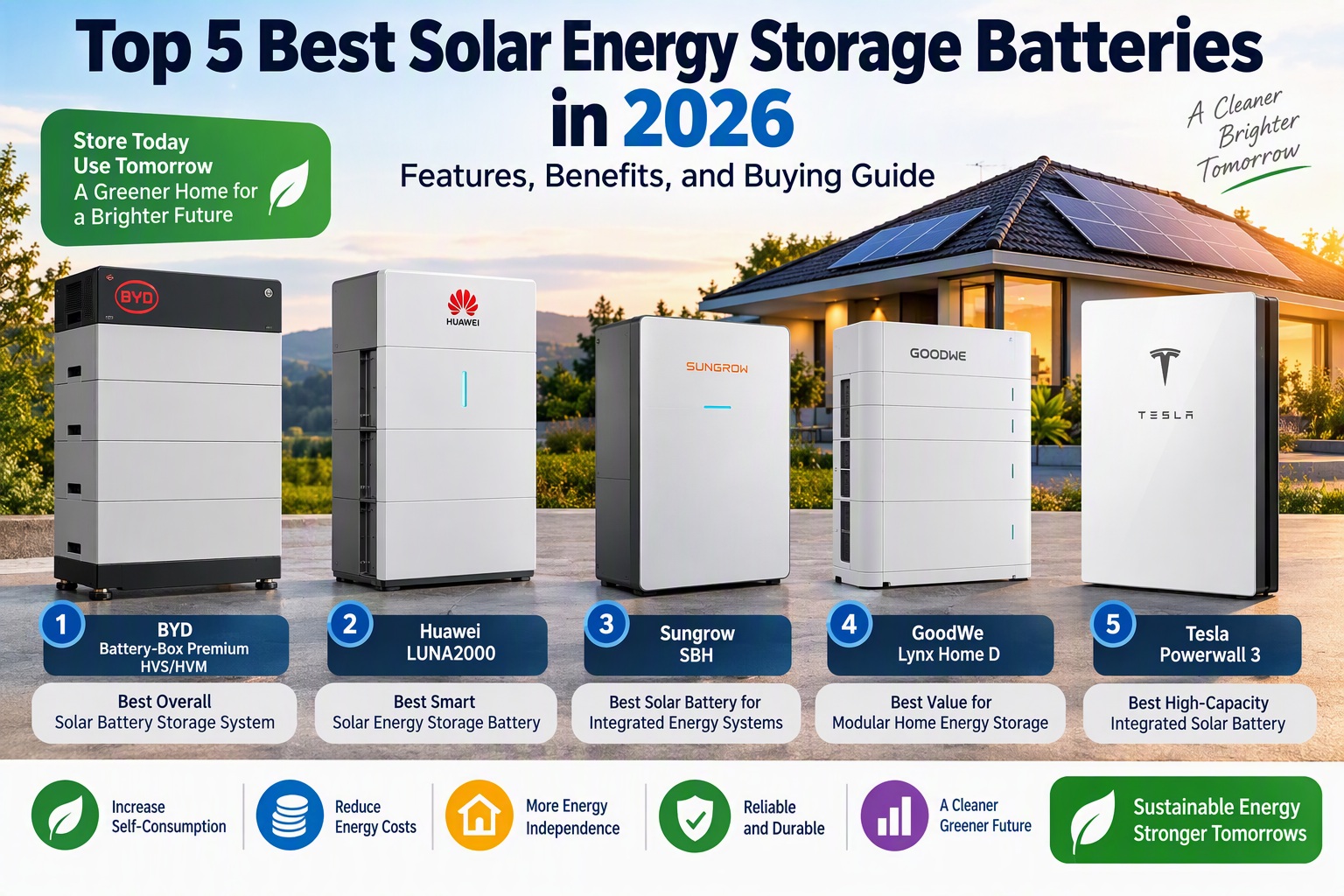
Top 5 Best Solar Energy Storage Batteries in 2026: Features, Benefits, and Buying Guide
Introduction
Solar energy storage batteries are becoming an essential part of modern residential solar power systems. They allow homeowners to store excess electricity generated by solar panels during the day and use it later in the evening or during periods of low sunlight. Choosing the best solar battery can help increase energy independence, improve solar energy utilization, and reduce reliance on electricity from the grid.
In 2026, several manufacturers offer advanced home battery storage solutions featuring lithium iron phosphate (LiFePO4 or LFP) technology, modular designs, intelligent battery management systems, and compatibility with modern solar inverters. Popular options include the BYD Battery-Box Premium, Huawei LUNA2000, Sungrow SBH, GoodWe Lynx Home D, and Tesla Powerwall 3. Each system has different advantages depending on household energy consumption, solar installation size, available space, and budget.
This guide explores five of the best solar energy storage batteries in 2026, highlighting their features, benefits, and important considerations to help homeowners make an informed purchasing decision.
1. BYD Battery-Box Premium HVS/HVM: Best Overall Solar Battery Storage System
The BYD Battery-Box Premium HVS and HVM series are popular modular energy storage solutions designed for residential and small commercial solar installations. Their flexible configurations allow homeowners to choose a storage capacity suited to their electricity consumption and expand their systems when their energy requirements increase.
One of the main advantages of the BYD Battery-Box Premium range is its use of lithium iron phosphate battery technology. LFP batteries are known for their thermal stability, long service life, and suitability for frequent charging and discharging. These characteristics make them an attractive option for households seeking dependable long-term energy storage.
The HVS and HVM models differ in their electrical configurations and available capacities. This distinction is important because the two series are not interchangeable in every installation. Buyers should check the specific model’s capacity, inverter compatibility, and installation requirements before choosing a system.
Key benefits include modular expansion, efficient energy storage, and compatibility with selected hybrid inverters from established manufacturers. Depending on the configuration, a BYD Battery-Box system can support a range of household energy requirements, from moderate evening electricity consumption to larger solar installations.
The BYD Battery-Box Premium is particularly suitable for homeowners who want a flexible battery system that can grow alongside their solar installation.
Best for: Homeowners looking for a modular solar battery with flexible capacity options and broad compatibility with supported inverter systems.
Amazon Germany purchase link: Search for BYD Battery-Box on Amazon Germany
Amazon Europe purchase link: Search for BYD Battery-Box on Amazon Europe
2. Huawei LUNA2000: Best Smart Solar Energy Storage Battery
The Huawei LUNA2000 series is designed to work with compatible solar energy systems, offering intelligent battery management and modular storage configurations. It is an appealing option for homeowners who want to combine solar panels, energy storage, and digital monitoring within an integrated energy ecosystem.
A major feature of the LUNA2000 range is its modular architecture. Depending on the model and generation, users can select different battery module configurations to match their energy requirements. Certain versions also support flexible expansion, making it easier to adapt the system as household electricity consumption changes.
Huawei’s battery systems use lithium iron phosphate technology, providing a combination of thermal stability and durability. Intelligent monitoring features help users track energy production, battery charging, and electricity consumption through compatible energy management applications.
Another advantage is the integration of battery management and safety monitoring functions. These systems are designed to monitor operating conditions and help protect the battery during normal operation. Actual protection features and available storage capacity vary by model, so checking the manufacturer’s current technical documentation is essential.
The Huawei LUNA2000 is best considered as part of a compatible solar energy ecosystem rather than as a standalone battery. Buyers should verify inverter compatibility, supported battery modules, and whether the selected installation requires additional equipment.
Best for: Homeowners who want intelligent energy monitoring, modular storage, and integration with compatible Huawei solar equipment.
Amazon Germany purchase link: Search for Huawei LUNA2000 on Amazon Germany
Amazon Europe purchase link: Search for Huawei LUNA2000 on Amazon Europe
3. Sungrow SBH: Best Solar Battery for Integrated Energy Systems
The Sungrow SBH is a high-voltage residential battery storage system designed for homeowners who want to improve the efficiency of their solar installations. Sungrow offers a range of solar energy products, including inverters and battery storage solutions, allowing users to build an integrated home energy system.
One of the main features of the Sungrow SBH is its modular design. The system uses lithium iron phosphate battery technology and supports expandable storage configurations, depending on the selected model. This flexibility makes it suitable for households with different electricity consumption patterns.
The battery is designed to work with compatible Sungrow hybrid inverters, helping coordinate solar electricity generation, battery charging, and energy consumption. By storing surplus solar electricity during the day, homeowners can use more of their own generated power during the evening and other periods when solar production is limited.
Another important advantage is the potential for centralized energy monitoring. When connected to compatible Sungrow equipment, users can monitor important aspects of their solar installation and battery operation through the manufacturer’s monitoring platform.
However, compatibility should be checked carefully before purchasing. Battery voltage, inverter models, communication protocols, and installation requirements must match the selected system. The total cost should also include any necessary inverter equipment and professional installation.
The Sungrow SBH is an attractive option for homeowners who prefer an integrated energy system from one manufacturer and want storage that can be adapted to their household’s needs.
Best for: Homeowners planning a compatible Sungrow solar installation with expandable battery storage and centralized monitoring.
Amazon Germany purchase link: Search for Sungrow solar batteries on Amazon Germany
Amazon Europe purchase link: Search for Sungrow solar batteries on Amazon Europe
4. GoodWe Lynx Home D: Best Value for Modular Home Energy Storage
The GoodWe Lynx Home D is a residential battery storage system designed to provide flexible energy storage for modern solar installations. Its modular architecture makes it particularly interesting for homeowners who want to start with a smaller storage capacity and expand their system as their electricity requirements grow.
The Lynx Home D uses lithium iron phosphate battery technology, which is widely used in residential energy storage because of its thermal stability and suitability for repeated charging and discharging. The system is designed to work with compatible GoodWe inverters, helping households manage the electricity generated by their solar panels.
A notable feature of this product family is its modular battery design. According to published product comparisons, the Lynx Home D uses approximately 5 kWh battery blocks, with configurations supporting expansion up to 40 kWh per battery connection under the specified system conditions. Actual capacity depends on the installation configuration and compatible equipment.
The system is designed for homeowners who want to store surplus electricity instead of immediately exporting all excess solar power to the grid. Stored energy can then be used when solar production falls, potentially increasing household self-consumption.
Another advantage is the system’s IP66 protection rating reported for the Lynx Home D range. This rating indicates protection against dust and powerful water jets under standardized testing conditions. However, it does not automatically mean that every installation location is suitable. The manufacturer’s environmental, mounting, and temperature requirements must still be followed.
Before buying, homeowners should confirm the required battery modules, supported inverter models, installation costs, and warranty conditions. Comparing the total installed price rather than the battery price alone can provide a more accurate assessment of value.
The GoodWe Lynx Home D is a compelling option for homeowners seeking expandable battery storage with a focus on flexibility and cost-conscious system planning.
Best for: Homeowners who want modular solar energy storage and the option to expand capacity in the future.
Amazon Germany purchase link: Search for GoodWe Lynx Home D on Amazon Germany
Amazon Europe purchase link: Search for GoodWe Lynx Home D on Amazon Europe
5. Tesla Powerwall 3: Best High-Capacity Integrated Solar Battery
The Tesla Powerwall 3 is an integrated residential energy storage system designed to store electricity for use when solar production is insufficient or when grid electricity is unavailable, subject to the installation’s configuration.
Unlike battery-only products that require a separate compatible inverter, the Powerwall 3 incorporates an integrated solar inverter. This design can simplify system planning for suitable new solar installations by combining important energy conversion and storage functions in one product.
The Powerwall 3 has a nominal energy storage capacity of approximately 13.5 kWh and is designed to support residential energy management. Its integrated architecture makes it an option for homeowners seeking a coordinated solution for solar generation and battery storage.
The system can store excess solar electricity during the day and make that energy available later. Depending on household consumption, solar production, system configuration, and local electricity tariffs, this can help reduce reliance on grid electricity.
Another advantage is the Tesla energy monitoring ecosystem, which allows users to monitor relevant energy flows through compatible software. Available functions depend on the system configuration and regional support.
The Powerwall 3 uses lithium iron phosphate battery technology. As with any home energy storage system, its real-world performance depends on installation quality, operating conditions, inverter configuration, and the household’s energy consumption.
Potential buyers should consider its overall installed cost, warranty conditions, installer availability, and compatibility with their existing solar equipment. Those who already own a solar inverter should also determine whether replacing or retaining their existing equipment is the most appropriate option.
The Tesla Powerwall 3 is particularly attractive for homeowners who want a high-capacity residential battery with integrated solar conversion and a connected energy management platform.
Best for: Homeowners planning an integrated solar and battery installation with substantial household energy storage requirements.
Amazon Germany purchase link: Search for Tesla Powerwall 3 on Amazon Germany
Amazon Europe purchase link: Search for Tesla Powerwall 3 on Amazon Europe
How to Choose the Best Solar Energy Storage Battery in 2026
Choosing the best solar energy storage battery requires more than comparing brand names. The right system should match the household’s electricity consumption, solar panel capacity, inverter configuration, installation environment, and budget.
1. Choose the Right Battery Capacity
Battery capacity, measured in kilowatt-hours (kWh), indicates how much energy a battery can store. A larger battery can store more electricity, but it may not provide better value if the household cannot regularly charge and discharge it.
For example, a household that consumes a significant amount of electricity in the evening may benefit from a larger battery than a household that uses most of its electricity during daylight hours.
When comparing products, distinguish between nominal capacity and usable capacity. Usable capacity represents the amount of energy available for consumption under the manufacturer’s specified operating conditions.
The best approach is to examine historical electricity consumption and estimate how much excess solar energy is available for storage throughout the year.
2. Compare Battery Chemistry
Lithium iron phosphate batteries, commonly called LiFePO4 or LFP batteries, are widely used in modern residential energy storage systems. They offer good thermal stability and can support many charge and discharge cycles when operated within their specified limits.
Other lithium-ion chemistries are also available. Their performance, energy density, operating requirements, and warranty conditions can differ.
For homeowners comparing solar batteries, the battery chemistry should be evaluated alongside usable capacity, safety features, operating temperature, and the manufacturer’s warranty.
3. Check Inverter Compatibility
Inverter compatibility is one of the most important considerations when purchasing a solar battery.
Some storage systems require a compatible hybrid inverter, while others incorporate inverter functionality. A battery designed for one electrical configuration may not work with a different inverter model.
Before purchasing, check the manufacturer’s approved compatibility list and confirm whether the installation requires additional equipment.
For existing solar installations, compatibility can influence the total cost more significantly than small differences in battery capacity.
4. Evaluate Round-Trip Efficiency
Round-trip efficiency describes how much energy can be recovered from a battery after accounting for charging and discharging losses.
For example, a battery system with a 95% round-trip efficiency would return approximately 9.5 kWh of energy after receiving 10 kWh under the conditions used for that efficiency measurement.
Higher efficiency can reduce energy losses, but published figures may be measured under different conditions. Buyers should compare figures using the manufacturer’s technical documentation and consider the efficiency of the complete storage system.
5. Consider Warranty and Expected Lifespan
A solar battery is a long-term investment, so its warranty is an important factor.
Check the warranty period, permitted energy throughput, cycle limits, minimum guaranteed remaining capacity, and any conditions affecting coverage. A warranty of ten years, for example, does not necessarily guarantee that the battery will retain its original capacity throughout that period.
Also consider the availability of replacement components, local technical support, and the manufacturer’s long-term presence in the European market.
6. Compare the Total Installation Cost
The price of a battery alone does not represent the total cost of a residential energy storage system.
Depending on the product and installation, additional expenses may include an inverter, electrical protection equipment, mounting components, communication equipment, installation labor, and system commissioning.
Homeowners in Germany and other European countries should compare complete installed quotations and check applicable taxes, local regulations, and any available incentives.
Amazon listings may be useful for identifying products and checking availability, but high-voltage home storage systems often require specialist suppliers and professional installation. Always confirm that a seller offers the exact model, a valid manufacturer’s warranty, and appropriate after-sales support.
Benefits of Installing a Solar Energy Storage Battery
A solar energy storage battery can improve the usefulness of a residential solar installation by making surplus electricity available when the sun is not producing enough power.
One of the main benefits is increased self-consumption. Instead of using solar electricity only when it is generated, homeowners can store some of that energy for later use. This can be especially useful in households where electricity demand increases during the evening.
Another benefit is reduced dependence on grid electricity. The amount of reduction depends on battery capacity, household consumption, solar panel output, and seasonal weather conditions. A battery cannot eliminate grid dependence in every situation, particularly during prolonged periods of low solar production.
Energy storage can also improve the flexibility of household energy management. Some compatible systems support scheduled charging, time-of-use optimization, or integration with other energy devices. The availability of these features depends on the battery, inverter, software, and local electricity arrangements.
For homeowners interested in backup power, it is important to distinguish between ordinary energy storage and a system configured to provide electricity during a grid outage. Not every solar battery automatically supplies backup power. Appropriate backup hardware, electrical configuration, and professional installation may be required.
Finally, a well-sized battery can help homeowners make better use of the solar electricity they generate. However, the financial benefits depend on local electricity prices, export compensation, installation costs, system efficiency, and battery lifespan.
Frequently Asked Questions About Solar Energy Storage Batteries
What Is the Best Solar Energy Storage Battery in 2026?
There is no single best battery for every household. The BYD Battery-Box Premium is worth considering for modular storage, Huawei LUNA2000 for integration with compatible Huawei equipment, Sungrow SBH for an integrated Sungrow system, GoodWe Lynx Home D for expandable storage, and Tesla Powerwall 3 for an integrated battery and inverter solution.
The most suitable option depends on the solar installation, required capacity, compatibility, budget, and local installer support.
How Many Kilowatt-Hours Does a Home Solar Battery Need?
The required capacity depends on how much electricity the household consumes when solar production is low and how much surplus energy the solar panels generate during the day.
A practical starting point is to review daily electricity consumption and identify the portion that occurs in the evening and overnight. The installer can then estimate an appropriate usable battery capacity based on the solar system’s expected production and seasonal conditions.
Are LiFePO4 Solar Batteries a Good Choice?
LiFePO4 batteries are widely used in residential energy storage because of their thermal stability, cycle-life potential, and suitability for regular charging and discharging.
However, overall battery quality also depends on the battery management system, cell quality, product design, installation conditions, and warranty support.
Can a Solar Battery Power a House at Night?
Yes. A suitably sized and configured battery can supply stored electricity to household circuits at night. The available runtime depends on the battery’s usable capacity and the electrical loads being powered.
For example, a battery supplying an average load of 1 kW for five hours would deliver approximately 5 kWh of energy, excluding additional system losses and other operating considerations.
Can a Solar Battery Work Without an Electricity Grid Connection?
Some solar battery systems can operate in off-grid installations, but not every residential battery is designed for independent off-grid operation. The system must have compatible solar equipment, appropriate controls, sufficient storage, and the ability to manage power generation and consumption without the grid.
Homeowners planning an off-grid installation should verify that every major component is suitable for this purpose.
Are Solar Energy Storage Batteries Available on Amazon Germany?
Some solar batteries and related energy storage products are listed on Amazon Germany. However, availability varies by manufacturer, model, seller, and delivery location.
For larger residential systems, specialist solar equipment suppliers and authorized installers may offer a wider range of models, installation services, and technical support. Buyers should compare the complete system and confirm compatibility before placing an order.
Conclusion
The best solar energy storage batteries in 2026 offer homeowners a practical way to store surplus solar electricity, increase self-consumption, and reduce dependence on grid power. The BYD Battery-Box Premium, Huawei LUNA2000, Sungrow SBH, GoodWe Lynx Home D, and Tesla Powerwall 3 each offer distinct advantages for different residential energy requirements.
For flexible modular storage, the BYD Battery-Box Premium is a strong option. Huawei LUNA2000 is worth considering for homeowners using compatible Huawei equipment, while Sungrow SBH offers an integrated approach within the Sungrow ecosystem. GoodWe Lynx Home D is an attractive choice for expandable storage, and Tesla Powerwall 3 combines battery storage with integrated solar inverter functionality.
Before choosing a system, compare usable capacity, battery chemistry, inverter compatibility, efficiency, warranty conditions, and total installation costs. Selecting a battery that matches your household’s actual energy consumption and solar production is more important than simply buying the largest or most expensive model.
With careful planning and a compatible installation, a solar energy storage battery can help households make better use of renewable electricity and build a more flexible, efficient, and energy-conscious home.


