
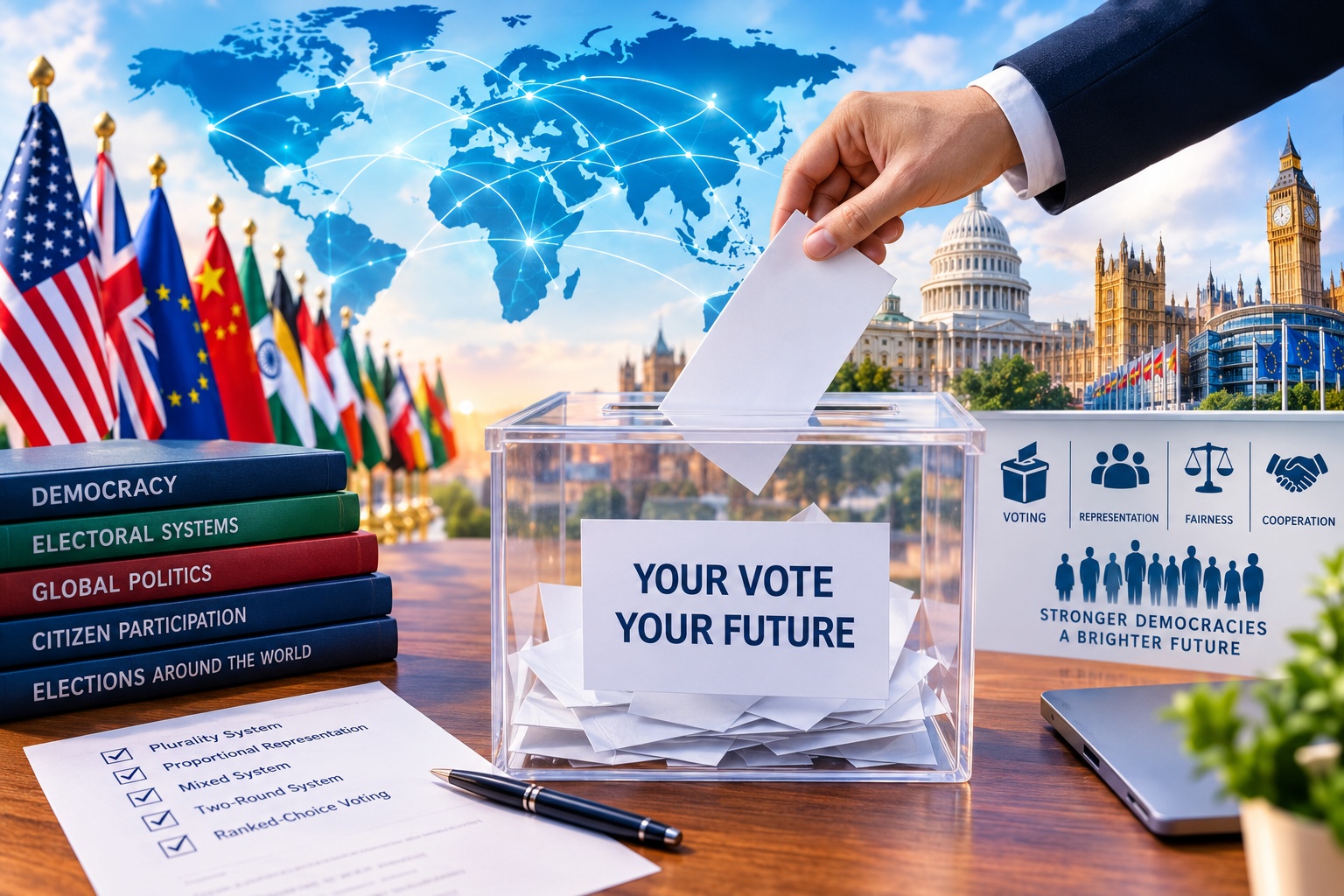
Elections and Electoral Systems Around the World: Types, Rules, and Democratic Representation
Introduction
Elections are an important mechanism through which citizens choose political representatives, influence public policy, and participate in the governance of their countries. Across the world, electoral systems differ in how votes are cast, counted, and translated into political power. Some countries elect individual candidates in local constituencies, while others allocate legislative seats to political parties according to their share of the vote. Many use a combination of different methods.
Understanding elections and electoral systems around the world helps explain why countries with similar voting participation can produce very different political outcomes. Electoral rules influence party competition, representation, government formation, and the relationship between voters and elected officials. However, election procedures alone do not determine whether a political system is democratic. The wider institutional environment, protection of civil liberties, political competition, and public accountability also matter.
The International IDEA Electoral System Design Database provides comparative information about electoral systems in countries and territories worldwide, making it a useful starting point for understanding how national voting rules differ.
What Is an Electoral System?
An electoral system is the set of rules used to determine how votes are converted into elected positions. These rules establish whether voters choose individual candidates or political parties, how electoral districts are organized, what proportion of votes is needed to win, and how seats are allocated in a legislature.
Two countries may hold elections using secret ballots and similar voter registration procedures but produce different outcomes because they use different electoral formulas. In one country, the candidate with the highest number of votes in a district may win the seat. In another, several seats may be distributed among parties according to their share of the vote.
Electoral systems can also include rules about electoral thresholds, candidate eligibility, reserved seats, independent candidates, and the number of voting rounds. These details influence how parties organize campaigns and how voters decide which candidates or lists to support.
The ACE Electoral Knowledge Network offers an extensive explanation of electoral system design, including voting formulas, district boundaries, ballot structures, and the possible consequences of different arrangements.
The Main Types of Electoral Systems
Electoral systems are commonly grouped into three broad families: plurality or majority systems, proportional representation systems, and mixed systems. Each family contains several variations, and countries may apply different rules to presidential elections, parliamentary elections, upper houses, and local government.
Plurality and majority systems generally focus on selecting winning candidates in particular constituencies. Proportional representation seeks to allocate legislative seats in relation to the votes received by parties or candidates. Mixed systems combine elements of both approaches, although the precise relationship between their components varies.
There is no single electoral formula that automatically guarantees effective representation or stable government. The results depend on the rules themselves, the structure of political parties, the distribution of voters, and the broader constitutional system.
The International IDEA Electoral System Design Handbook explains these major system families and examines their possible effects on representation, political competition, and governance.
First-Past-the-Post Elections
First-past-the-post is a plurality voting system in which the candidate who receives more votes than any other candidate wins the seat. The winner does not necessarily need to receive more than half of all valid votes. For example, a candidate who receives 40 percent of the vote can win if every other candidate receives a smaller share.
This system is used in elections for the United Kingdom’s House of Commons and the United States House of Representatives. In both cases, voters elect representatives from individual districts, although the broader political and constitutional systems differ.
One advantage of first-past-the-post is its relative simplicity. Voters can identify their local representative, and counting the votes is generally straightforward. The system may also encourage parties to concentrate on constituency-level issues.
However, the relationship between national vote share and the number of seats won can be disproportionate. A party may receive a substantial share of votes across the country without winning a comparable share of legislative seats. Smaller parties whose support is geographically dispersed may be particularly disadvantaged.
The UK Parliament’s explanation of general elections provides information about constituency elections and how representatives are elected to the House of Commons.
Proportional Representation
Proportional representation is designed to allocate seats in a legislature broadly in proportion to the votes received by political parties or candidate lists. The exact outcome depends on the electoral formula, district size, thresholds, and other national rules.
In a party-list proportional system, parties present lists of candidates, and voters cast ballots for a party or, in some systems, express preferences for individual candidates. Seats are then distributed according to the applicable allocation formula. Open-list systems allow voters to influence which candidates from a party list are elected, while closed-list systems generally follow the party’s predetermined candidate order.
Proportional representation can allow smaller parties to gain legislative representation and may better reflect the diversity of political preferences across the electorate. However, it can also result in a legislature with several parties, making coalition negotiations necessary to form a government. The degree of fragmentation depends on the specific rules and the political environment.
Countries use different proportional systems, so the term does not describe one identical arrangement everywhere. District magnitude, thresholds, list rules, and seat-allocation formulas can produce significantly different results.
The International IDEA electoral system database enables readers to compare proportional representation arrangements and other electoral models across countries.
Mixed Electoral Systems
Mixed electoral systems combine two methods of electing representatives, usually combining constituency elections with proportional or party-list representation. The objective is to bring together the benefits of local representation and a closer relationship between party vote shares and legislative seats.
In a mixed-member proportional system, party-list seats are used to compensate for disproportional results from constituency elections, subject to the country’s detailed rules. Germany is a well-known example of a country using a mixed-member proportional arrangement for its federal parliament.
A parallel system also combines constituency and list elections, but the results from one component do not generally compensate for disproportionality in the other. Consequently, a party’s total share of seats may differ substantially from its overall share of votes.
Mixed systems can offer voters more than one route to representation, but they can also make electoral rules more complicated. Understanding how the different components interact is essential when evaluating their fairness and political consequences.
The German Bundestag’s official website provides information about Germany’s parliament and federal elections, while International IDEA offers comparative descriptions of mixed electoral systems.
Two-Round Elections and Runoff Voting
In a two-round electoral system, a second round is held when the initial election does not meet a specified winning requirement. In many presidential elections, a candidate must receive an absolute majority of valid votes to win in the first round. If no candidate reaches that threshold, a runoff is held according to the applicable rules.
Runoff elections can allow voters to reconsider their choices after seeing the first-round results. They may also encourage candidates to seek broader support during the second round. However, holding another election requires additional administrative work, funding, campaign time, and voter participation.
The rules differ across countries. Some systems allow only the leading candidates to participate in the runoff, while others use different eligibility thresholds or procedures. The same country may also apply different electoral formulas to presidential and parliamentary elections.
France provides a prominent example of a two-round system in presidential elections. The details of the electoral procedure, including the requirements for winning, are established by French law.
The French Constitutional Council provides official information about constitutional responsibilities and presidential election oversight in France.
Ranked-Choice and Preferential Voting
Ranked-choice voting allows voters to express an order of preference among candidates rather than selecting only one candidate. Depending on the specific method, ballots may be counted in multiple rounds, with candidates eliminated and votes transferred according to voters’ next available preferences.
One form is the alternative vote, used in single-member constituencies. If no candidate reaches the required majority of first preferences, the lowest-ranked candidate is eliminated and ballots are transferred according to the next available preference. This process continues until a candidate meets the winning requirement.
The single transferable vote is a different preferential method used in multi-member constituencies. It allows voters to rank candidates, and votes are transferred according to the rules to help determine which candidates fill several available seats.
These systems can provide voters with more expressive choices than a single-mark ballot. However, they require clear ballot instructions, reliable counting procedures, and voter education. Different preferential systems also have different mathematical properties and should not be treated as interchangeable.
The ACE Electoral Knowledge Network explains alternative vote, single transferable vote, and other electoral methods, including their administrative requirements and potential effects.
Presidential and Parliamentary Elections
Presidential and parliamentary elections serve different constitutional purposes. In a presidential system, the president is elected separately from the legislature, either directly by voters or through an electoral mechanism established by the constitution. The president’s powers depend on the country’s constitutional framework.
In a parliamentary system, voters elect members of parliament, and the government is generally formed by the party or coalition able to command legislative confidence. The head of government is usually a prime minister, although constitutional arrangements differ across countries.
Some countries use semi-presidential arrangements that combine a directly elected president with a prime minister and government responsible to parliament. The distribution of authority between these offices varies according to national law and political practice.
These distinctions matter because presidential and parliamentary elections can use different voting formulas within the same country. A country may elect its president through a majority runoff while choosing its legislature through proportional representation or a mixed system.
The International IDEA electoral system resources provide information on electoral arrangements for both legislatures and presidents in different national contexts.
How Electoral Districts Influence Election Results
Electoral districts define the geographic areas or constituencies used to elect representatives. Some countries divide their territory into single-member districts, while others use larger districts that elect several representatives. Some systems use national or regional party lists alongside constituency elections.
The number of representatives elected from each district can influence proportionality. Larger multi-member districts often make it easier for parties with smaller shares of the vote to win seats under proportional formulas, although thresholds and allocation rules also matter.
District boundaries can also affect electoral competition. If boundaries are drawn unfairly to advantage a political party or disadvantage particular groups, the resulting representation may not reflect voters’ preferences equitably. Transparent boundary-setting procedures and clear legal standards can help reduce this risk.
Electoral districts also need to account for changes in population. Where constituencies vary greatly in population, the voting power associated with each representative may become unequal unless the system provides appropriate safeguards.
The ACE Electoral Knowledge Network provides educational resources on boundary delimitation and related aspects of electoral administration.
Voter Registration and Eligibility
Voter registration establishes who is eligible to participate in an election and helps election administrators prepare accurate voter lists. Depending on national law, registration may be automatic, based on an application by the voter, or managed through a combination of administrative records and individual registration.
Eligibility rules can cover citizenship, age, residency, and other legally defined requirements. These rules vary between countries, and some systems provide special arrangements for citizens living abroad, people with disabilities, or voters who cannot easily reach polling stations.
Reliable voter lists can reduce administrative errors and help prevent duplicate registrations. However, registration procedures should also be accessible and transparent. Complicated documentation requirements, outdated records, limited registration facilities, or insufficient public information can prevent eligible people from voting.
Election authorities therefore need clear procedures for updating records, correcting errors, protecting personal information, and informing citizens about registration deadlines and requirements.
The United Nations’ electoral assistance resources provide information about electoral support, institutional capacity, and processes intended to help countries conduct credible elections.
Secret Ballots and the Integrity of Elections
A secret ballot protects voters’ ability to make political choices without revealing their selections to other people. It helps reduce the risk of intimidation, coercion, retaliation, and improper pressure from employers, political organizations, or other individuals.
Election integrity depends on several additional safeguards. These may include impartial election administration, clear laws, transparent counting procedures, secure handling of ballots, accessible complaint mechanisms, and independent observation where provided for by national law.
The rules must also be applied consistently. Voters need confidence that their ballots will be counted according to the law, that complaints can be reviewed fairly, and that the results will be reported accurately. Transparency can help build trust, particularly when election outcomes are closely contested.
No single procedure can guarantee a flawless election. Credible electoral administration requires effective planning, trained personnel, adequate resources, reliable technology where used, and mechanisms for identifying and correcting errors.
The Organization for Security and Co-operation in Europe (OSCE) publishes election observation reports and guidance on electoral standards, transparency, and the conduct of elections in participating states.
Electronic Voting and Digital Election Technology
Technology is increasingly used in different stages of electoral administration. Electronic voter registration, digital transmission of results, biometric identification, electronic voting machines, and online information services may be used in some countries, although their availability and scope vary widely.
Digital systems can improve administrative efficiency and make some services more accessible. For example, electronic systems may help election officials manage large voter lists or publish preliminary results more quickly. Their effectiveness depends on system design, staff training, infrastructure, and the availability of reliable backup procedures.
Technology also introduces risks. Cyberattacks, software errors, inadequate security controls, technical failures, and limited public understanding can undermine trust if systems are not properly designed and audited. Electronic voting does not automatically make an election more secure or more transparent than a well-managed paper-based process.
Before adopting new technology, election authorities should assess security, accessibility, auditability, privacy, cost, and the ability to recover from failures. Independent testing and clear public explanations can help voters understand how the system works and how results are verified.
The International Foundation for Electoral Systems (IFES) provides resources on electoral administration, election technology, integrity, and the practical challenges of conducting elections.
Voter Turnout and Political Participation
Voter turnout refers to the proportion of eligible or registered voters who participate in an election, depending on how turnout is calculated and reported. It is often used as an indicator of electoral participation, but it does not explain every aspect of political engagement.
Turnout can be influenced by the competitiveness of the election, trust in institutions, the accessibility of polling stations, registration rules, voting procedures, public confidence, and the perceived importance of the outcome. Weather, transportation, work schedules, and other practical barriers can also affect participation.
Some countries require eligible citizens to vote, while others treat voting as voluntary. Compulsory voting laws differ in their enforcement and in the consequences for non-participation. High turnout alone does not prove that an election is free or fair, just as low turnout does not by itself establish that an election lacks legitimacy.
Election authorities and policymakers can encourage participation by providing clear information, making voting accessible, protecting ballot secrecy, and ensuring that voters understand the rules and deadlines.
The International IDEA Voter Turnout Database allows users to compare participation levels across countries and elections, while also providing context for interpreting turnout figures.
Women and Minority Representation in Elections
Electoral systems influence how easily different groups can gain political representation. Women, ethnic and linguistic minorities, and smaller political communities may face barriers related to candidate selection, campaign financing, discrimination, party structures, or the geographic distribution of voters.
Some countries use electoral quotas, reserved seats, or candidate-placement rules to increase the representation of groups that have historically been underrepresented. Other countries rely on party policies, electoral competition, and broader legal protections. The design and impact of these arrangements differ across political systems.
Representation cannot be assessed only by counting elected officials. It is also important to consider whether representatives can participate meaningfully in legislative work, influence policy, and respond to the needs of their constituencies.
Electoral rules can contribute to inclusion, but their effectiveness depends on implementation and the broader political environment. Access to political education, campaign resources, fair media coverage, and protection from harassment can also influence who is able to compete successfully.
The Inter-Parliamentary Union (IPU) publishes data on women’s representation in national parliaments, enabling comparisons across countries and over time.
Political Parties, Campaigns, and Election Financing
Political parties connect voters with candidates, organize campaigns, develop policy proposals, and help coordinate legislative activity. The electoral system can influence how parties compete. Single-member constituencies may encourage parties to concentrate on local races, while proportional systems can provide opportunities for parties with support spread across a wider geographic area.
Election campaigns also depend on financing. Candidates and parties may need funds for staff, travel, advertising, communication, and public events. Campaign finance rules differ among countries and may include contribution limits, spending restrictions, disclosure requirements, or public funding.
Transparent campaign financing can help voters understand who supports political candidates and may reduce opportunities for corruption or improper influence. Enforcement matters, however: rules are less effective when financial disclosures are incomplete, oversight is weak, or violations are not investigated fairly.
Campaign communication has also changed with the growth of digital platforms. Online advertising and social media can help candidates reach voters, but they can also accelerate the spread of misleading claims or make it difficult to identify the source of political messages. Public access to reliable information is therefore important throughout an election campaign.
The International IDEA Political Finance Database provides comparative information on political finance regulations and public funding arrangements around the world.
Election Observation and International Standards
Election observation involves examining different aspects of an electoral process, such as the legal framework, voter registration, campaigning, media access, voting procedures, counting, and the resolution of complaints. Observers may be domestic or international and operate under different mandates.
Observation can help identify administrative weaknesses, assess whether procedures comply with applicable standards, and provide recommendations for future improvements. Reports may examine whether voters can participate freely, whether candidates have fair opportunities to compete, and whether results are handled transparently.
Election observation does not replace the responsibility of national institutions to administer elections or resolve legal disputes. Its value depends on the independence and methodology of observers, the scope of their access, and the quality of the evidence collected.
International standards emphasize meaningful participation, freedom of expression and association, equal treatment under the law, and genuine opportunities for voters to influence public affairs. The way these principles are implemented depends on national law and relevant international commitments.
The OSCE Office for Democratic Institutions and Human Rights publishes observation reports and methodologies, while the United Nations electoral assistance programme supports electoral processes in eligible contexts at the request of member states.
The Challenges Facing Elections in the Modern World
Modern elections face challenges that extend beyond ballot counting. These include misinformation, unequal access to campaign resources, political intimidation, cyber risks, administrative capacity, disputes over electoral rules, and declining public trust in institutions.
Social media can make political communication faster and more accessible, but false or misleading content may spread before it can be corrected. Election officials, media organizations, civil society groups, and technology platforms each have different roles in helping people access accurate information without unnecessarily restricting lawful political expression.
Other challenges are more structural. In some settings, weak institutions, restrictions on political competition, unequal access to media, or limited independence of oversight bodies can reduce the ability of voters to choose among genuine alternatives. A well-organized polling process alone cannot resolve these wider problems.
Addressing election-related challenges requires clear laws, professional administration, independent oversight where appropriate, effective complaint mechanisms, voter education, and access to reliable public information. Trust is strengthened when institutions explain their procedures and respond transparently to credible concerns.
The United Nations’ electoral assistance programme and International IDEA provide resources on electoral processes, institutional development, and the challenges associated with democratic participation.
How Electoral Systems Affect Government Formation
Electoral systems influence how legislative seats are distributed, which can affect whether a single party wins a majority or several parties must negotiate to form a government. These outcomes can shape the speed of decision-making, the composition of governing coalitions, and the relationship between the executive and legislature.
In systems that frequently produce single-party majorities, governments may find it easier to pass legislation, although the level of political stability also depends on party discipline, constitutional constraints, and other institutions. In proportional systems, coalition governments may require negotiation among several parties, potentially encouraging compromise but also making government formation more complex.
These patterns are not universal. A proportional system does not always produce fragmented legislatures, and a plurality system does not always produce stable government. Regional divisions, party organization, constitutional arrangements, and political culture can be equally important.
When evaluating an electoral system, it is therefore useful to consider several objectives together: fair representation, accountable government, inclusion, clear voter choice, workable administration, and respect for fundamental rights. No single measure captures every aspect of electoral performance.
The International IDEA handbook on electoral system design discusses the relationship between electoral rules, representation, political parties, and government formation.
The Future of Elections Around the World
The future of elections will be shaped by changes in technology, demographics, political communication, public expectations, and institutional design. Some countries may expand digital services for voter registration and election information, while others may prioritize improving traditional polling systems, voter access, and public confidence.
Electoral reform is most effective when it addresses clearly identified problems and is based on transparent consultation, reliable evidence, and careful evaluation. Changing a voting formula can affect political competition in ways that may not be immediately obvious, so reform proposals should consider their likely effects on representation, administration, and accountability.
International comparisons can help policymakers learn from other countries, but electoral arrangements cannot simply be copied without considering national circumstances. Population distribution, party structures, constitutional rules, political history, and administrative resources all influence whether a particular system is suitable.
Ultimately, credible elections depend on more than technology or the formal voting formula. They require clear and consistently applied rules, informed participation, competent administration, genuine competition, transparent counting, and institutions capable of addressing complaints fairly.
The International IDEA Electoral System Design Database offers a practical resource for comparing existing systems and understanding the range of electoral arrangements used around the world.
Conclusion
Elections and electoral systems are central to understanding how political representation works around the world. First-past-the-post, proportional representation, mixed systems, runoff elections, and preferential voting each use different rules to translate citizens’ choices into elected positions.
Every system involves trade-offs. Some emphasize a direct relationship between voters and local representatives, while others seek a closer relationship between the share of votes received and the number of legislative seats won. Mixed and preferential systems offer additional ways to organize representation, but they also require rules that voters and election officials can understand and apply consistently.
The quality of an election depends on much more than the electoral formula. Fair access to participation, ballot secrecy, transparent administration, political competition, accurate information, and credible mechanisms for resolving disputes all contribute to public confidence.
Understanding these differences helps citizens, researchers, journalists, and policymakers compare elections more accurately. Rather than assuming that one system is universally best, meaningful analysis considers how electoral rules operate within each country’s constitutional, political, and social context.


