
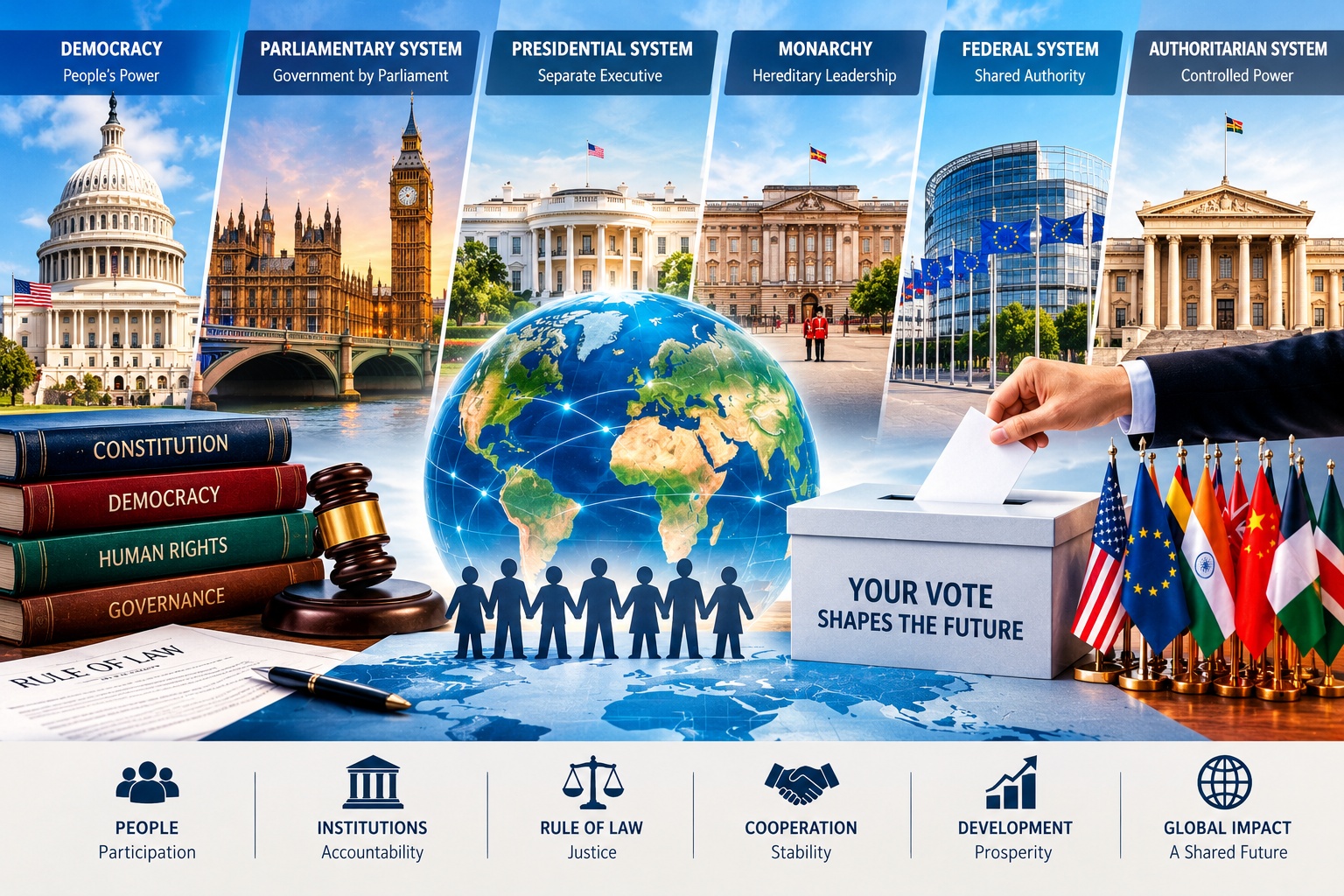
Political Systems Compared: Democracy, Authoritarianism, Monarchy, and Different Models of Government
Introduction
Political systems shape how countries are governed, how leaders are selected, how laws are made, and how public power is controlled. Around the world, governments operate under different constitutional structures, political traditions, and institutional arrangements. Understanding these differences helps readers evaluate how political institutions function, why countries follow different governing models, and how these systems influence representation, accountability, stability, and public participation.
Political systems cannot be compared accurately by their names alone. A country may have a constitution, a parliament, and regular elections, yet the actual distribution of power may differ significantly from that of another country with similar institutions. A meaningful comparison therefore considers both the formal rules and how they operate in practice. Source: International IDEA — Constitution-Building Resources
What Is a Political System?
A political system is the collection of institutions, rules, and processes through which a society exercises public authority and makes collective decisions. It includes the executive branch, the legislature, the judiciary, political parties, electoral institutions, and the legal protections governing political participation.
Political systems are classified in several ways. One classification examines whether political competition is open or restricted. Another focuses on the relationship between the executive and legislature, while a third considers how authority is distributed between national and regional governments. These classifications describe different dimensions of governance, so a single country can simultaneously be a federal state, a parliamentary democracy, and a constitutional monarchy. Source: OECD — Constitutions in OECD Countries: A Comparative Study
Democracy: Political Competition and Public Participation
Democracy is a system in which citizens have meaningful opportunities to participate in political decision-making, particularly through elections and other legally protected forms of participation. In a representative democracy, voters choose representatives who exercise public authority within constitutional and legal limits.
Democratic systems generally rely on political competition, freedom of expression, access to information, and mechanisms for holding public officials accountable. The strength of these protections varies between countries. Elections alone do not necessarily establish that a political system is fully democratic: the fairness of competition, the protection of civil liberties, and the ability of institutions to constrain government power are also important.
A potential advantage of democratic government is that peaceful elections can provide a mechanism for changing leadership and responding to public preferences. However, democratic systems may face political polarization, slow decision-making, misinformation, or difficulty building legislative majorities. Their performance depends partly on institutional design, public trust, and the effectiveness of the rule of law. Source: V-Dem Institute — Democracy Reports
Authoritarian Systems: Concentrated Political Power
Authoritarian systems concentrate political authority in one leader, a small group, a dominant party, or another institution, while limiting meaningful political competition. The extent of these restrictions varies. Some systems permit elections but place substantial limits on opposition parties, independent media, or political organization; others restrict electoral competition much more severely.
Concentrated authority can allow leaders to make decisions without the same level of public or legislative negotiation found in competitive democratic systems. Nevertheless, rapid decision-making does not automatically produce effective policies, economic growth, or political stability. When independent oversight is weak, it can be more difficult to expose corruption, correct policy failures, or hold decision-makers accountable.
Authoritarianism should not be treated as one uniform model. Countries differ in their governing institutions, economic policies, administrative capacity, and degree of political restriction. Comparative assessments therefore need to examine how power is exercised in practice rather than relying only on a country’s official constitutional description. Source: V-Dem Institute — Democracy Reports
Parliamentary Systems: Government Based on Legislative Confidence
In a parliamentary system, the government is formed through the legislature and must retain its confidence to remain in office. The head of government is usually a prime minister, while the head of state may be a monarch or a president with primarily ceremonial responsibilities, depending on the country’s constitution.
A key characteristic of parliamentary government is the relationship between the executive and the legislative majority. When one party or a stable coalition controls parliament, the government may be able to pass legislation efficiently. If the governing party loses its majority or a confidence vote, the government may need to resign, seek new support, or trigger an election under the applicable constitutional rules.
Parliamentary systems can offer regular legislative scrutiny and a mechanism for replacing a government without waiting for the end of a fixed presidential term. However, coalition negotiations and fragmented legislatures can make government formation difficult. Outcomes depend on party structures, electoral rules, constitutional conventions, and the strength of parliamentary oversight. Source: International IDEA — Government Formation and Removal Mechanisms
Presidential Systems: A Separately Elected Executive
In a presidential system, the president serves as the chief executive and normally holds office for a constitutionally defined term. The executive and legislature have separate institutional mandates, and each operates under rules that define its powers and limits.
This separation can make the responsibilities of the president and legislature more distinct. A president may be able to provide continuity in executive leadership during a legislative dispute, while an independent legislature can examine government proposals, approve budgets, and exercise oversight. Courts and other constitutional institutions may provide additional checks on executive authority.
However, separation of powers can also produce deadlock when the president and legislature disagree, particularly when they are controlled by opposing political parties. The degree of presidential authority varies considerably across countries, and constitutional safeguards are essential to prevent the excessive concentration of power. A presidential system is therefore not automatically more stable or more accountable than a parliamentary one. Source: International IDEA — Making Presidentialism Work
Semi-Presidential Systems: Shared Executive Authority
Semi-presidential systems combine a directly elected president with a prime minister and cabinet that are responsible to the legislature. The president typically has meaningful executive responsibilities, although the exact division of power differs between constitutions.
One potential strength of this arrangement is that executive authority can be shared between institutions with different sources of political legitimacy. The president may play a role in national strategy or foreign affairs, while the prime minister manages government policy and maintains legislative support, depending on the constitutional framework.
The main challenge is defining the boundaries between the president and prime minister. If their political priorities conflict, disagreements can complicate decision-making or create uncertainty over responsibility. The practical balance of power depends on constitutional provisions, party control of parliament, political conventions, and how institutions behave during periods of disagreement. Source: International IDEA — Transitions to Parliamentary Systems
Monarchy: Constitutional and Absolute Models
A monarchy is a political system in which the head of state is a monarch, usually a king or queen, whose position is generally inherited. Monarchies differ substantially in the powers given to the monarch and the institutions that govern the country.
In a constitutional monarchy, the monarch’s powers are limited by constitutional rules and established political arrangements. In parliamentary constitutional monarchies, elected representatives and the government generally exercise political decision-making, while the monarch performs primarily formal and ceremonial duties. The precise constitutional arrangements vary by country.
In an absolute monarchy, the monarch retains extensive governing authority. The existence of a monarchy by itself does not reveal how much political power citizens, legislatures, courts, or other institutions exercise. A proper comparison must examine the monarch’s actual powers, legal constraints, and the opportunities available for public participation. Source: International IDEA — Constitutional Monarchs in Parliamentary Democracies
Federal and Unitary States: Where Political Authority Is Located
Federalism concerns how governing powers are divided between national and regional governments. In a federal state, the constitution generally protects a division of authority between the federal government and constituent units, such as states or provinces. Both levels exercise powers within their respective legal responsibilities.
Federal systems can allow regional governments to address local priorities while preserving a common national framework. They may also create opportunities for policy experimentation across regions. At the same time, overlapping responsibilities, disputes over funding, and differences between regional policies can make coordination more complex.
In a unitary state, ultimate constitutional authority rests with the central state, although regional and local governments may still have substantial delegated responsibilities. Unitary systems can make nationwide policy coordination more straightforward, but their degree of decentralization varies widely. Federal and unitary arrangements should not be confused with democracy and authoritarianism: either territorial structure can exist under different political conditions. Source: International IDEA — Constitution-Building Primers
One-Party Systems and Dominant-Party Systems
A one-party system is one in which a single political party holds the legally recognized position of governing party, and meaningful competition for national power through rival parties is prohibited or severely restricted. A dominant-party system, by contrast, may legally permit several parties while one party repeatedly wins elections and maintains a long period of political control.
The distinction matters because legal opposition and actual political competition are not the same thing. A country may permit opposition parties to exist but impose barriers that prevent them from competing on equal terms. Alternatively, a dominant party may repeatedly win genuinely competitive elections while opposition parties retain meaningful rights and opportunities to replace it.
Assessing these systems requires examining electoral fairness, access to media, freedom of association, campaign conditions, and the independence of institutions responsible for enforcing political rules. The number of registered parties alone is not a reliable measure of political pluralism. Source: V-Dem Institute — Democracy Reports
Comparing Political Systems: Main Differences
Political systems are best compared across several dimensions rather than ranked according to a single label. The following table summarizes common institutional characteristics. Actual arrangements can differ between countries, and some political systems combine features from more than one model.
| Political model | How executive leadership is organized | Key institutional feature | Common challenge |
|---|---|---|---|
| Parliamentary | Government led by a prime minister supported by parliament | Government depends on legislative confidence | Coalition instability or loss of majority |
| Presidential | President serves as chief executive for a defined term | Executive and legislature have separate mandates | Deadlock between branches |
| Semi-presidential | President and prime minister share executive responsibilities | Dual executive leadership | Disputes over authority |
| Constitutional monarchy | Monarch is head of state under constitutional limits | Elected institutions usually govern in parliamentary models | Depends on the constitutional distribution of powers |
| Absolute monarchy | Monarch holds extensive governing authority | Political power is concentrated in the monarch | Limited institutional checks, depending on the system |
| Federal state | Authority is divided between national and regional governments | Constitutionally protected regional powers | Intergovernmental disputes |
| Unitary state | National institutions retain ultimate constitutional authority | Regional powers are delegated or established by national law | Excessive centralization if local accountability is weak |
These categories are not all mutually exclusive. For example, a country may be a federal parliamentary republic or a unitary constitutional monarchy. The comparison draws on the institutional distinctions described in International IDEA’s constitution-building resources and the OECD’s comparative study of constitutions. Source: International IDEA · Source: OECD
Accountability and the Rule of Law
Accountability refers to the ability to question public decisions, investigate misconduct, and impose consequences when officials violate their legal responsibilities. Depending on the political system, accountability can operate through elections, parliamentary committees, independent courts, audit institutions, freedom-of-information rules, and independent media.
The rule of law means that public authority is exercised under publicly established laws and that those laws are applied through institutions capable of constraining arbitrary action. Written constitutional protections are important, but their practical value depends on enforcement, judicial independence, access to remedies, and compliance by government institutions.
A comparison of political systems should therefore consider whether public officials are subject to effective oversight, whether courts can act independently, and whether people can exercise their legal rights. Formal institutions may appear similar on paper while producing very different outcomes in practice. Source: OECD — Constitution-Building and Governance Research
Political Stability and Government Effectiveness
Political stability is often discussed as an advantage of certain governing arrangements, but it has several meanings. It may refer to continuity in government, peaceful transfers of power, the absence of political violence, or the ability of institutions to function during crises. These outcomes should be measured separately rather than treated as interchangeable.
A government that remains in office for a long period is not necessarily effective, just as frequent changes of government do not automatically indicate institutional failure. The quality of public administration, economic conditions, social trust, the independence of oversight bodies, and the peaceful resolution of political disputes all influence performance.
Comparative analysis should distinguish between stability achieved through public consent and stability maintained by restricting political competition. It should also examine whether institutions can correct policy mistakes and respond to changing public needs without undermining legal protections. Source: International IDEA — Annual Review of Constitution-Building
Citizen Participation and Political Representation
Political participation includes voting, joining political parties, contacting elected representatives, taking part in public consultations, and engaging in lawful civic activity. The extent to which citizens can use these channels depends on legal protections, institutional access, and the political environment.
Electoral systems also influence representation. Some electoral rules make it easier for larger parties to win legislative majorities, while proportional systems generally aim to distribute seats more closely in line with parties’ shares of the vote. These are distinct choices from whether a government is presidential or parliamentary, although the rules can interact and affect how governments are formed.
Effective representation involves more than the act of voting. It also depends on whether people can obtain reliable information, organize peacefully, express criticism, and seek remedies when their rights are violated. Differences in these conditions help explain why countries with similar formal institutions can experience different political outcomes. Source: International IDEA — Electoral System Design
Economic Policy and Political Institutions
Political institutions influence how economic decisions are made, but they do not determine economic performance on their own. Taxation, public spending, regulation, investment, trade, and social protection are shaped by political priorities as well as economic conditions, administrative capacity, and global developments.
Different systems may use different processes to approve budgets, negotiate reforms, and distribute resources. Parliamentary governments may coordinate policy through a legislative majority, while presidential systems may require negotiation between independently elected branches. Federal systems add another dimension because spending and taxation responsibilities can be shared across levels of government.
It would be misleading to claim that one political model automatically produces greater prosperity. Economic outcomes also depend on education, infrastructure, institutions, market conditions, public-sector competence, and international circumstances. A careful comparison looks at actual policies and measurable results instead of assuming that a political label guarantees success. Source: OECD — Governance
How to Evaluate a Political System Fairly
A balanced assessment should begin with clear criteria. Relevant questions include how leaders are selected, how political competition operates, how powers are divided, whether courts are independent, and whether citizens can exercise their rights. The analysis should also examine how government decisions are implemented and whether public institutions can respond to errors.
Researchers should distinguish constitutional design from political practice. A constitution may formally separate powers, for example, while political realities weaken legislative scrutiny. Conversely, a system’s institutions may develop conventions and accountability mechanisms that are not fully apparent from its formal structure alone.
Reliable comparisons should use transparent definitions, country-specific constitutional documents, credible comparative research, and clearly dated evidence. Political classifications can change over time, and research organizations may use different indicators or methodologies. Where rankings or indices are used, their definitions and limitations should be explained rather than treated as absolute judgments. Source: V-Dem Institute — Democracy Reports · Source: International IDEA — Constitution-Building Resources
Conclusion
Political systems differ in how they select leaders, distribute authority, organize legislatures, and provide accountability. Parliamentary, presidential, and semi-presidential systems describe different relationships between executive and legislative institutions, while monarchies describe arrangements for the head of state. Federal and unitary systems explain how authority is distributed territorially, and democracy and authoritarianism describe important differences in political competition and public participation.
No single label is sufficient to explain how a country functions. The most useful comparison examines constitutional rules, political rights, institutional independence, administrative capacity, and real-world outcomes together. By applying consistent criteria and relying on credible evidence, readers can develop a clearer understanding of political systems around the world without reducing complex countries to simplistic rankings.


