
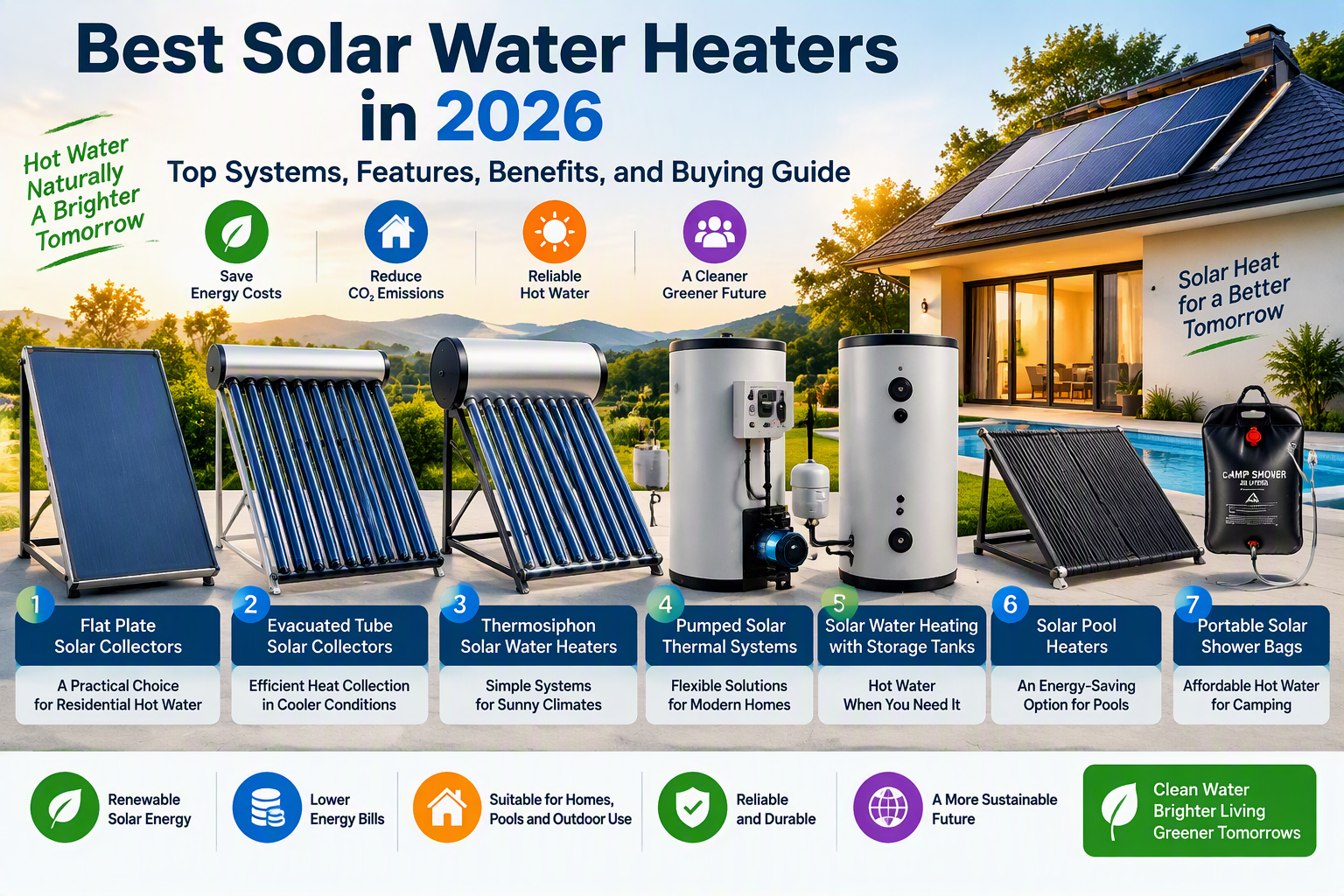
Best Solar Water Heaters in 2026: Top Systems, Features, Benefits, and Buying Guide
Why Choose the Best Solar Water Heaters in 2026?
Solar water heaters are an increasingly attractive solution for households that want to reduce conventional water-heating costs and make better use of renewable energy. These systems capture heat from sunlight and transfer it to water for everyday activities such as showering, bathing, washing dishes, and cleaning.
Unlike photovoltaic solar panels, which generate electricity, solar thermal collectors directly capture solar energy and convert it into heat. The collected heat can be stored in an insulated water tank and used when hot water is needed. Depending on the system design, solar water heating can also support swimming pools and certain heating applications.
The best solar water heaters in 2026 offer a combination of efficient heat collection, suitable storage capacity, reliable construction, and convenient installation. The right option depends on household water consumption, available roof space, local sunlight conditions, climate, and budget.
This guide explores several types of solar water heating systems, including flat plate collectors, evacuated tube collectors, thermosiphon systems, pumped solar thermal systems, and solar pool heaters. It also covers portable solar shower bags for camping and outdoor activities.
For homeowners in Germany and other European countries, choosing an appropriate solar water heating system can help reduce dependence on conventional energy sources. However, the amount of energy saved depends on the installation, weather conditions, hot water demand, and the performance of any supplementary heating system.
1. Flat Plate Solar Collectors: A Practical Choice for Residential Hot Water
Flat plate solar collectors are among the most established technologies used in residential solar water heating systems. They typically consist of a dark absorber plate inside an insulated enclosure covered with transparent glass. The absorber captures sunlight and transfers the resulting heat to a fluid circulating through internal pipes.
The heated fluid then transfers energy to domestic water through a heat exchanger, usually connected to an insulated storage tank. This arrangement allows households to use solar energy for showers, baths, kitchen sinks, and other hot water needs.
Flat plate collectors are commonly used in temperate and sunny climates because they offer a relatively straightforward design and can provide good performance when properly installed.
Key Features and Benefits
One of the main advantages of flat plate collectors is their durable construction. Their enclosed design protects the absorber and internal components from many outdoor conditions, while insulation helps reduce heat loss.
These collectors can be integrated into different residential solar thermal configurations, including systems with a supplementary boiler or another water-heating source. This makes them suitable for households that want to reduce conventional water-heating consumption without relying entirely on sunlight.
Flat plate systems can be a practical option when roof space is available and the primary objective is domestic hot water production. They are generally less complex than some specialized collector arrangements, although the complete installation still requires appropriate piping, storage, controls, and safety components.
Performance depends on collector area, orientation, tilt, outdoor temperature, and water demand. Buyers should compare certified efficiency figures and installation requirements rather than relying on a single advertised performance number.
Best For: Homeowners who want a conventional solar thermal system for daily hot water in temperate or sunny climates.
Amazon Germany and EU Purchase Links:
Amazon Germany: https://www.amazon.de/s?k=flat+plate+solar+thermal+collector
Amazon France: https://www.amazon.fr/s?k=capteur+solaire+thermique+plan
Amazon Italy: https://www.amazon.it/s?k=collettore+solare+termico+piano
Amazon Spain: https://www.amazon.es/s?k=colector+solar+termico+plano
2. Evacuated Tube Solar Collectors: Efficient Heat Collection in Cooler Conditions
Evacuated tube solar collectors use a series of glass tubes designed to reduce heat loss. Many models contain an absorber inside each tube, with a vacuum between the glass layers that limits heat transfer to the surrounding air.
The collected heat is transferred to a circulating fluid or a heat-transfer mechanism, depending on the collector design. The heat is then delivered to a water storage system.
Evacuated tube collectors are particularly worth considering when available roof space is limited or when the system needs to operate with a relatively high temperature difference between the collector and the outdoor environment.
Key Features and Benefits
A major benefit of evacuated tube technology is its ability to reduce heat losses under suitable operating conditions. This can help the system collect useful heat during cooler weather compared with some conventional flat plate designs.
Many evacuated tube collectors use modular arrangements, allowing multiple tubes to contribute to the system’s total heat output. Depending on the design, individual tubes may also be replaceable, which can simplify certain maintenance tasks.
These systems can be suitable for domestic hot water production and, when correctly designed, for supporting other heating applications. However, winter performance still depends on sunlight availability, collector orientation, storage temperature, and system design.
Evacuated tube collectors may cost more than flat plate alternatives and can be more sensitive to certain types of physical damage. Before purchasing, compare the manufacturer’s technical documentation, warranty, replacement tube availability, and compatibility with the intended storage tank.
Best For: Homes with limited collector space or installations where reduced heat loss during cooler conditions is an important consideration.
Amazon Germany and EU Purchase Links:
Amazon Germany: https://www.amazon.de/s?k=evacuated+tube+solar+collector
Amazon France: https://www.amazon.fr/s?k=capteur+solaire+thermique+tubes+evacues
Amazon Italy: https://www.amazon.it/s?k=collettore+solare+termico+tubi+sottovuoto
Amazon Spain: https://www.amazon.es/s?k=colector+solar+termico+tubos+vacio
3. Thermosiphon Solar Water Heaters: Simple Systems for Sunny Climates
Thermosiphon solar water heaters combine a solar collector with a water storage tank, often mounted above the collector. They use natural circulation rather than a conventional circulation pump.
As the water or heat-transfer fluid warms, its density changes. This creates natural movement through the system, allowing heat to transfer toward the storage tank. Cooler fluid then returns toward the collector, creating a circulation cycle under suitable conditions.
Because thermosiphon systems can operate without an electrically powered circulation pump, they offer a relatively simple solution for some residential and outdoor installations.
Key Features and Benefits
Thermosiphon systems are available in several designs, including flat plate and evacuated tube configurations. Some models integrate the tank and collector into a single assembly, while others use separate components.
Their main advantage is mechanical simplicity. A system without a circulation pump may require fewer electrical components and can be attractive for locations with abundant sunshine and straightforward installation requirements.
However, the tank can be heavy when filled with water, so the roof or supporting structure must be suitable for the load. The installation must also be designed to handle local temperatures, water pressure, and plumbing requirements.
In freezing climates, exposed water lines and collector components require appropriate protection. A system intended for a warm climate should not automatically be assumed suitable for year-round operation in areas where freezing temperatures occur.
Best For: Homes, cabins, and other properties in sunny climates where a simple solar water heating arrangement is appropriate.
Amazon Germany and EU Purchase Links:
Amazon Germany: https://www.amazon.de/s?k=thermosiphon+solar+water+heater
Amazon France: https://www.amazon.fr/s?k=chauffe+eau+solaire+thermosiphon
Amazon Italy: https://www.amazon.it/s?k=scaldacqua+solare+termosifone
Amazon Spain: https://www.amazon.es/s?k=calentador+solar+de+agua+termosifon
4. Pumped Solar Thermal Systems: Flexible Solutions for Modern Homes
Pumped solar thermal systems use a circulation pump to move heat-transfer fluid between the solar collectors and a storage tank. A controller typically monitors temperatures and activates the pump when the collectors can provide useful heat.
In many installations, a heat exchanger transfers energy from the solar circuit to domestic hot water. The solar circuit may contain a suitable heat-transfer fluid to help protect components from freezing, depending on the design.
This configuration provides greater flexibility in positioning the collectors and storage tank compared with many integrated thermosiphon arrangements.
Key Features and Benefits
Pumped systems can support larger residential installations and can be integrated with existing heating equipment. Depending on the system design, they may provide domestic hot water and contribute to space heating.
An electronic controller can manage circulation according to temperature differences, helping the system transfer heat when conditions are suitable. Insulated pipes and a correctly sized storage tank help reduce heat losses and improve overall operation.
The main consideration is installation complexity. A pumped system requires suitable plumbing, electrical connections, controls, expansion and pressure protection where applicable, and proper commissioning.
Maintenance requirements can also include checking the heat-transfer fluid, pump operation, sensors, valves, and safety components. Professional installation is recommended for permanent domestic hot water systems.
Best For: Households that want a flexible solar thermal installation integrated with an existing hot water or heating system.
Amazon Germany and EU Purchase Links:
Amazon Germany: https://www.amazon.de/s?k=solar+thermal+hot+water+system+with+pump
Amazon France: https://www.amazon.fr/s?k=systeme+solaire+thermique+eau+chaude+pompe
Amazon Italy: https://www.amazon.it/s?k=impianto+solare+termico+acqua+calda+con+pompa
Amazon Spain: https://www.amazon.es/s?k=sistema+solar+termico+agua+caliente+bomba
5. Solar Water Heating Systems with Storage Tanks: Hot Water When You Need It
A storage tank is an essential component of many residential solar water heating systems. Solar collectors produce heat when sunlight is available, but household demand does not always occur at the same time. An insulated tank allows the system to store some of that heat for later use.
The required tank capacity depends on the number of occupants, daily hot water consumption, collector size, available sunlight, and the type of supplementary heating system.
Some tanks include internal heat exchangers for transferring energy from the solar circuit. Others can support multiple heat sources, allowing solar thermal energy to work alongside a boiler, heat pump, or another compatible heating system.
Key Features and Benefits
A well-insulated storage tank helps retain heat for use after sunset or during periods of reduced sunlight. Suitable tank capacity can also help balance the amount of heat collected during the day with household demand.
For households installing a new system, it is important to compare tank volume, insulation quality, heat exchanger configuration, operating pressure, and compatibility with the intended collectors.
A tank that is too small may not store enough energy during sunny periods, while an unnecessarily large tank can increase installation costs and heat losses. Proper system sizing is therefore essential.
Buyers should also distinguish between a domestic hot water tank and a buffer tank designed primarily for heating-system water. These products are not automatically interchangeable.
Best For: Homeowners planning a complete solar thermal system for regular domestic hot water use.
Amazon Germany and EU Purchase Links:
Amazon Germany: https://www.amazon.de/s?k=solar+thermal+hot+water+storage+tank
Amazon France: https://www.amazon.fr/s?k=ballon+stockage+eau+chaude+solaire+thermique
Amazon Italy: https://www.amazon.it/s?k=serbatoio+accumulo+acqua+calda+solare+termico
Amazon Spain: https://www.amazon.es/s?k=deposito+acumulacion+agua+caliente+solar+termica
6. Solar Pool Heaters: An Energy-Saving Option for Swimming Pools
Solar pool heaters are designed to warm swimming pool water using solar energy. Unlike domestic hot water systems, which commonly use an insulated storage tank, many pool heating systems circulate pool water directly through solar collectors.
These collectors may consist of polymer panels, flexible mats, or other heat-absorbing arrangements. Pool water passes through the collectors, absorbs heat, and returns to the pool.
The system may use the existing pool circulation pump or a dedicated pump, depending on its design and the required flow rate.
Key Features and Benefits
Solar pool heaters can help extend the swimming season when sunlight and outdoor temperatures are suitable. They can also reduce the need for conventional pool heating equipment, although the actual savings depend on the pool size, local climate, collector area, and desired water temperature.
Some compact systems are designed for above-ground pools and can be relatively simple to connect. Larger in-ground pools may require a more substantial collector installation and professional planning.
When comparing products, consider the collector surface area, hose compatibility, recommended flow rate, pressure limits, and suitability for your pool type.
Pool covers can also help reduce heat loss, particularly overnight. Combining suitable solar collectors with a pool cover may improve the overall performance of a solar pool heating system.
Best For: Swimming pool owners who want to use solar energy to increase water temperature and reduce conventional heating requirements.
Amazon Germany and EU Purchase Links:
Amazon Germany: https://www.amazon.de/s?k=solar+pool+heater
Amazon France: https://www.amazon.fr/s?k=rechauffeur+solaire+piscine
Amazon Italy: https://www.amazon.it/s?k=riscaldatore+solare+piscina
Amazon Spain: https://www.amazon.es/s?k=calentador+solar+piscina
7. Portable Solar Shower Bags: Affordable Water Heating for Camping
Portable solar shower bags offer a simple alternative to permanent solar water heating systems. They are designed primarily for camping, hiking, outdoor activities, and temporary washing facilities.
These products generally consist of a dark water container that absorbs sunlight and warms the water inside. Many models include a hose, showerhead, hanging handle, and a valve for controlling water flow.
Unlike roof-mounted solar thermal systems, portable shower bags usually do not require a pump, storage tank installation, or permanent plumbing.
Key Features and Benefits
The main advantages are portability, low equipment complexity, and ease of use. Some models can hold around 10 to 20 liters of water, although capacities vary considerably.
A larger bag can provide more water for washing, but it will also be heavier when filled. Buyers should therefore consider capacity, material strength, handle design, and ease of carrying.
Solar shower bags usually work best when placed in direct sunlight for several hours. Actual water temperature depends on starting temperature, sunlight intensity, outdoor conditions, water volume, and exposure time.
Water heated in a portable solar shower can become unexpectedly hot. Always test the temperature carefully before use, and mix with cooler water when necessary to reduce the risk of burns.
These products are not equivalent to certified domestic hot water systems and should not be treated as a replacement for properly designed household plumbing.
Best For: Campers, travelers, outdoor enthusiasts, and people who need temporary hot water without permanent installation.
Amazon Germany and EU Purchase Links:
Amazon Germany: https://www.amazon.de/s?k=portable+solar+shower+bag
Amazon France: https://www.amazon.fr/s?k=douche+solaire+portable+camping
Amazon Italy: https://www.amazon.it/s?k=doccia+solare+portatile+campeggio
Amazon Spain: https://www.amazon.es/s?k=ducha+solar+portatil+camping
8. How to Choose the Best Solar Water Heater for Your Home
Choosing the best solar water heater starts with understanding your household’s hot water consumption. A small household may require less storage capacity than a family with several people who regularly take showers or baths.
The next step is to assess the available installation space. Roof orientation, tilt, shading, structural capacity, and local weather all influence how much heat the system can collect.
You should also decide whether you want a system dedicated to domestic hot water or one that can contribute to space heating. These applications have different design requirements, and a system intended for hot water alone may not be suitable for supporting an entire heating system.
Flat plate collectors can be a practical option for many residential installations, particularly when the main objective is hot water production in sunny or temperate conditions. Evacuated tube collectors may be worth considering when roof space is limited or reduced heat loss in cooler conditions is important.
A thermosiphon system may suit some sunny locations, while a pumped system can provide greater flexibility for installations with a separate storage tank and existing heating equipment.
Finally, consider the complete cost, including collectors, tank, plumbing, mounting equipment, controls, installation, maintenance, and supplementary heating. Comparing the total system rather than the price of an individual component will help you make a more informed decision.
9. Solar Water Heater Efficiency: What Should You Compare?
Solar thermal efficiency describes how effectively a collector converts incoming solar energy into useful heat. However, the performance of a complete solar water heating system depends on more than the collector’s efficiency rating.
Heat losses from pipes and storage tanks, the operating temperature, water consumption, and the amount of sunlight available all affect the quantity of useful heat delivered to the household.
When comparing collectors, review certified performance data, including optical efficiency and heat-loss coefficients where available. These measurements help explain how a collector performs under different operating conditions.
It is also useful to compare the expected annual heat output for the intended location. A collector that performs well under one set of weather conditions may produce different results in another climate.
Storage insulation is equally important because heat collected during the day must remain available when the household needs it. A highly efficient collector paired with an inadequately insulated tank may not deliver the expected overall performance.
Buyers should avoid choosing a system solely because it advertises the highest peak efficiency. Proper sizing, suitable installation, and good thermal insulation are all important for achieving useful energy savings.
10. Can Solar Water Heaters Work During Winter?
Solar water heaters can collect heat during winter, but their output generally decreases when daylight hours are shorter and sunlight is less intense.
Cloud cover, low outdoor temperatures, snow, shading, and the angle of the sun can all reduce the amount of useful energy available. Evacuated tube collectors can reduce certain heat losses, but they cannot eliminate the effects of limited sunlight.
In colder climates, many domestic solar thermal systems use a supplementary heat source to ensure that hot water remains available when solar energy is insufficient.
Depending on the installation, supplementary heating may come from a boiler, heat pump, or compatible electric heating element. The exact arrangement depends on the storage tank and system design.
For installations exposed to freezing temperatures, the collector circuit and pipes must be protected against frost using an appropriate design. Some systems use a suitable antifreeze heat-transfer fluid, while others use alternative freeze-protection arrangements.
Before purchasing, verify the manufacturer’s recommended operating temperature range, frost protection requirements, and maintenance procedures. A system designed for a warm climate may not be suitable for year-round operation in a freezing environment.
11. Installation and Maintenance: How to Improve Long-Term Performance
Correct installation is essential for the safety, efficiency, and durability of a solar water heating system. Collectors should be positioned to receive sufficient sunlight, and the roof or supporting structure must be capable of carrying the system’s weight.
The storage tank should be appropriately sized and insulated, while the piping should be designed to minimize heat loss. Controllers, pumps, valves, and pressure protection components must be installed according to the manufacturer’s specifications.
Maintenance requirements vary by system type. Some installations may require periodic inspection of the heat-transfer fluid, pump, expansion vessel, valves, sensors, and collector connections.
Collectors should be checked for damage, leaks, and obstructions. Any cleaning should follow the manufacturer’s recommendations to avoid damaging glass surfaces, seals, or protective coatings.
In regions with hard water, mineral deposits may affect certain components, particularly in systems where domestic water passes directly through parts of the heating arrangement. The system design should account for local water quality.
Because solar thermal systems can involve hot pressurized fluids and water, permanent domestic installations should be designed and commissioned by qualified professionals. Follow applicable plumbing and building regulations, and ensure that the system includes appropriate temperature and pressure protection.
12. Are Solar Water Heaters Available on Amazon Germany and Across the EU?
Amazon Germany, France, Italy, and Spain provide search results for various solar water heating products, including portable shower bags, pool heaters, solar thermal collectors, and selected system components.
The links included in this guide are marketplace search links, not guarantees that a particular model is currently available or suitable for every installation. Stock, seller information, prices, and delivery options may vary between countries.
Portable solar shower bags and some pool heating accessories are generally easier to compare and purchase online because they often require fewer installation components.
Complete domestic solar thermal systems are more complex. Collectors, storage tanks, controllers, pumps, mounting equipment, and plumbing components must be compatible with one another. Some products may also require professional installation or may be available primarily through specialist distributors.
Before buying, check the exact model, capacity, technical specifications, warranty, seller information, and compatibility with your existing equipment. For permanent residential systems, obtaining advice from a qualified installer can help prevent costly sizing and installation errors.
Conclusion: Which Solar Water Heater Is Best in 2026?
The best solar water heater in 2026 depends on your hot water requirements, climate, installation space, and budget. Flat plate solar collectors are a practical option for many residential hot water systems, while evacuated tube collectors can offer advantages when reduced heat loss and efficient use of limited roof space are important.
Thermosiphon systems may suit sunny locations where a relatively simple installation is appropriate. Pumped solar thermal systems offer greater flexibility for homes that need a separate storage tank or integration with existing heating equipment.
For swimming pool owners, solar pool heaters can provide a useful way to increase water temperature using renewable energy. Portable solar shower bags offer a simpler and more affordable solution for camping and temporary outdoor washing.
Before making a purchase, compare collector performance, storage capacity, installation requirements, frost protection, warranty coverage, and total system cost. Use the Amazon Germany and EU marketplace links to explore available products, but verify the specifications and compatibility of each item before ordering.
By choosing a solar water heating solution that matches your household’s needs and local climate, you can make better use of renewable heat, reduce conventional water-heating consumption, and improve the long-term efficiency of your hot water system.


