
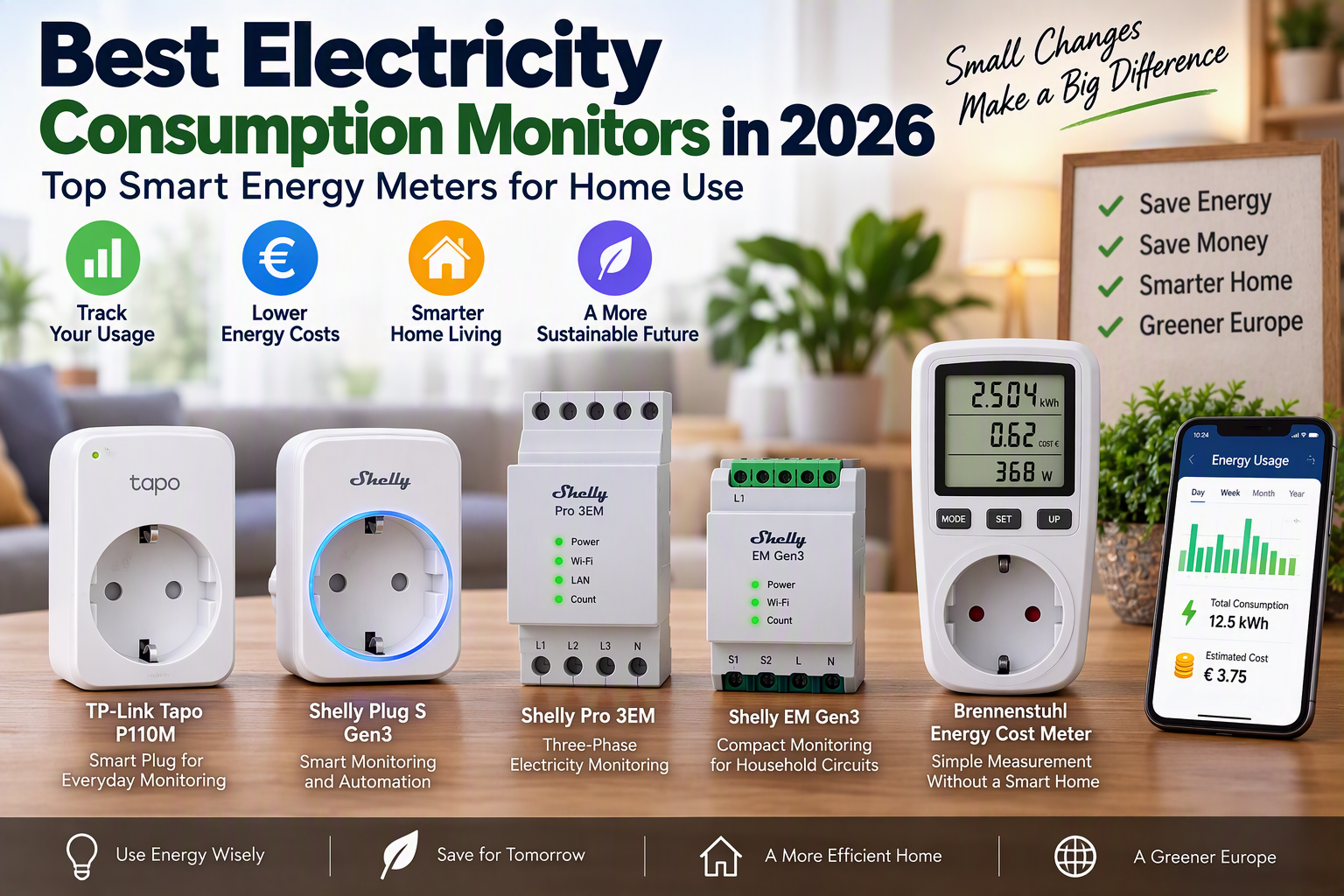
Best Electricity Consumption Monitors in 2026: Top Smart Energy Meters for Home Use
Why Use an Electricity Consumption Monitor in 2026?
Electricity consumption monitors are useful devices for homeowners, renters, and businesses that want to understand how much electricity their appliances consume. By measuring electricity usage and displaying the results through a screen or smartphone application, these devices help users identify energy-intensive equipment, track consumption patterns, and make more informed decisions about electricity use.
The best electricity consumption monitors in 2026 range from simple plug-in power meters to advanced smart meters that monitor several electrical circuits or an entire property. Some models provide real-time power readings, while others store historical data, calculate estimated electricity costs, and integrate with smart home systems.
Choosing the right device depends on whether you want to monitor a single appliance, compare the consumption of several devices, or measure electricity usage across your entire home. Compatibility, measurement accuracy, installation requirements, and data privacy are also important considerations.
This guide explores five electricity monitoring solutions worth considering in Germany and the wider European market. It covers their main features, practical benefits, ideal applications, and Amazon search links to help buyers compare available models.
1. TP-Link Tapo P110M: Best Smart Plug for Everyday Electricity Monitoring
The TP-Link Tapo P110M is a smart plug designed to monitor the electricity consumption of an individual appliance. It is a practical option for people who want to understand how much electricity devices such as televisions, computers, lamps, and selected household appliances use without installing equipment inside their electrical distribution panel.
One of its main features is energy consumption monitoring through the Tapo application. Depending on the supported app functions and configuration, users can review electricity usage, examine historical consumption, and use the information to estimate the running costs of connected equipment.
The P110M also supports Matter, a smart home interoperability standard that can simplify integration with compatible smart home platforms. Its remote switching and scheduling functions allow users to control supported appliances through compatible systems.
The main advantage of this device is its straightforward installation. It plugs into a compatible wall socket, allowing users to begin monitoring a connected appliance without modifying household wiring. Its compact design also makes it suitable for apartments, rented properties, and small home offices.
However, the P110M measures the electricity passing through the plug rather than the consumption of the entire property. Users who want to monitor several appliances separately may need multiple units.
Before purchasing, check the maximum supported electrical load, local socket compatibility, and the manufacturer’s instructions. High-power appliances should only be connected when their electrical requirements are within the device’s specified limits.
Key features and benefits:
- Measures the electricity consumption of connected appliances.
- Provides consumption information through a compatible smartphone application.
- Supports Matter for compatible smart home integrations.
- Offers remote switching and scheduling functions.
- Requires no permanent electrical installation.
- Suitable for identifying the electricity consumption of individual devices.
Best for: Beginners, renters, and households looking for an affordable way to monitor individual appliances.
Purchase links:
- Amazon Germany: https://www.amazon.de/s?k=TP-Link+Tapo+P110M
- Amazon EU search: https://www.amazon.de/s?k=Tapo+P110M+energy+monitor
- Official product information: https://www.tapo.com/
2. Shelly Plug S Gen3: Smart Electricity Monitoring and Automation
The Shelly Plug S Gen3 is a smart plug that combines electricity monitoring with remote appliance control. It is worth considering for users who want more than a basic power meter and prefer to integrate energy monitoring into a connected home.
Depending on the supported configuration, the device can report electrical measurements and consumption data through Shelly’s software tools. This allows users to observe how connected equipment behaves during normal operation and compare consumption over time.
One of its practical advantages is its smart home integration. Shelly products are designed to work with a range of automation tools, and compatibility with supported systems can allow energy readings to trigger automations or notifications.
For example, users may monitor the power consumption of a computer workstation, entertainment system, or other compatible appliance. Reviewing the resulting data can help identify equipment that consumes electricity while idle or remains switched on unnecessarily.
The Shelly Plug S Gen3 is also useful for people who want to combine energy monitoring with scheduled switching. However, its maximum supported load must be checked carefully. This model has a lower rated maximum power than some 16-amp smart plugs, so it is important to verify the current manufacturer’s specifications before connecting an appliance.
As with other plug-in monitors, the device measures the equipment connected through it rather than providing a complete picture of household electricity consumption.
Key features and benefits:
- Monitors the electricity consumption of connected equipment.
- Supports smart home automation features.
- Provides remote switching through compatible software.
- Can help users identify unnecessary electricity consumption.
- Offers a compact design for everyday home use.
- Suitable for users interested in flexible automation and monitoring.
Best for: Smart home enthusiasts who want appliance-level energy monitoring and automation.
Purchase links:
- Amazon Germany: https://www.amazon.de/s?k=Shelly+Plug+S+Gen3
- Amazon EU search: https://www.amazon.de/s?k=Shelly+smart+plug+energy+monitor
- Official product information: https://www.shelly.com/
3. Shelly Pro 3EM: Advanced Three-Phase Electricity Monitoring
The Shelly Pro 3EM is an advanced electricity monitoring device designed for measuring power consumption across electrical phases. It is particularly relevant to homes with three-phase electrical supplies, small businesses, workshops, and properties with more complex electrical installations.
Unlike a smart plug, this type of monitor can measure electricity at the electrical distribution level using compatible current transformers. This makes it possible to monitor a much larger portion of a property’s electrical consumption rather than focusing on one appliance.
Depending on the installation and configuration, the device can provide information about active power, voltage, current, and accumulated energy. Certain configurations also support monitoring energy flows in both directions, which can be useful for properties with solar photovoltaic systems.
Connectivity options may include Wi-Fi, Ethernet, and Bluetooth, depending on the exact model. The monitoring data can be used with compatible applications and automation platforms to help users understand when their electricity demand is highest.
One of its main advantages is its suitability for more detailed energy analysis. Homeowners may use it to compare overall consumption with solar production, while businesses may use it to observe changing electrical demand throughout the working day.
However, the Shelly Pro 3EM is not a simple plug-in device. Installation involves electrical distribution equipment and current transformers, and the appropriate setup depends on the property’s electrical configuration. A qualified electrician should carry out installation where required by local regulations or when the user is not competent to work safely with the equipment.
Key features and benefits:
- Supports monitoring of three-phase electrical installations.
- Measures electrical parameters and accumulated energy.
- Can help analyse electricity consumption across a property.
- Offers connectivity options for supported monitoring systems.
- May support bidirectional energy monitoring, depending on configuration.
- Useful for properties with solar panels and more complex electrical systems.
Best for: Homeowners, solar energy users, workshops, and small businesses requiring advanced electricity monitoring.
Purchase links:
- Amazon Germany: https://www.amazon.de/s?k=Shelly+Pro+3EM
- Amazon EU search: https://www.amazon.de/s?k=Shelly+Pro+3EM+energy+meter
- Official product information: https://www.shelly.com/
4. Shelly EM Gen3: Compact Monitoring for Household Circuits
The Shelly EM Gen3 is a compact energy monitoring solution designed for measuring electricity consumption through compatible current transformers. It is worth considering for users who need more detailed information than a conventional plug-in meter can provide but do not necessarily require a full three-phase monitoring system.
Depending on the installation, a compatible configuration can monitor selected electrical circuits or loads. This can help users understand how much electricity a particular section of the home consumes and identify opportunities to improve energy efficiency.
For example, monitoring a dedicated circuit can provide a clearer picture of the electricity required by selected household equipment. The resulting data can support decisions about appliance usage, operating schedules, and energy management.
The Shelly EM Gen3 can also be useful in smart home environments where electricity measurements are combined with compatible automation tools. Depending on the configuration, users may be able to view consumption information remotely or use the measurements in broader energy management workflows.
Its compact design can make it suitable for installations where space is limited. However, the supported measurement channels, current transformer requirements, electrical limits, and monitoring capabilities should be checked against the exact model specifications.
Like other electrical panel monitoring equipment, it requires appropriate installation and should not be treated as a plug-and-play consumer device.
Key features and benefits:
- Monitors electricity consumption through compatible current transformers.
- Provides information about electrical usage over time.
- Can help identify energy-intensive circuits or loads.
- Supports integration with compatible monitoring and automation systems.
- Offers a compact alternative for selected monitoring applications.
- Suitable for users who want more detailed information than a smart plug provides.
Best for: Homeowners and smart home users who want to monitor selected electrical circuits.
Purchase links:
- Amazon Germany: https://www.amazon.de/s?k=Shelly+EM+Gen3
- Amazon EU search: https://www.amazon.de/s?k=Shelly+EM+Gen3+energy+monitor
- Official product information: https://www.shelly.com/
5. Brennenstuhl Energy Cost Meter: Simple Electricity Measurement Without a Smart Home
The Brennenstuhl energy cost meter is a practical option for users who prefer a traditional electricity measuring device rather than a connected smart plug. Depending on the model, these meters display electrical consumption and other measurements directly on an integrated screen.
A plug-in energy meter is useful when you want to measure the electricity consumed by an appliance over a particular period. Examples include desktop computers, televisions, refrigerators, and other compatible equipment that can safely operate within the meter’s rated electrical limits.
The displayed consumption data can help users estimate the running cost of an appliance. By entering the relevant electricity tariff when the model supports this function, users can compare the estimated costs of different devices.
One of the main benefits is simplicity. A conventional energy meter can often be used without configuring a smartphone application, creating an account, or connecting the device to a home network.
This can also be useful for people who prefer to keep household energy monitoring separate from cloud-based services. However, the available readings and calculation features differ by model, so buyers should check the specifications before ordering.
The meter only measures the appliance connected through it. It cannot replace a whole-house energy monitor or provide detailed information about every circuit in a property.
Key features and benefits:
- Displays electricity consumption directly on a screen.
- Can help estimate appliance running costs on supported models.
- Does not necessarily require Wi-Fi or a smartphone application.
- Offers a simple way to compare the consumption of household equipment.
- Suitable for occasional measurements and energy audits.
- Available in different configurations, depending on the model.
Best for: Users who want a straightforward electricity meter without smart home features.
Purchase links:
- Amazon Germany: https://www.amazon.de/s?k=Brennenstuhl+energy+cost+meter
- Amazon EU search: https://www.amazon.de/s?k=Brennenstuhl+Strommessger%C3%A4t
- Official product information: https://www.brennenstuhl.com/
How to Choose the Best Electricity Consumption Monitor
The best electricity consumption monitor depends on what you want to measure, how much detail you need, and whether you prefer a simple measuring device or a connected energy management system.
1. Decide Between Appliance-Level and Whole-Home Monitoring
Appliance-level monitors measure the electricity passing through a particular plug or connected device. They are generally suitable for renters, students, and homeowners who want to investigate the consumption of specific appliances.
Whole-home monitors measure electricity at a suitable point in the property’s electrical installation. Depending on the model, they may provide information about the overall consumption of a home or selected circuits.
If your main goal is to identify which appliance consumes the most electricity, a smart plug or plug-in energy meter may be sufficient. If you want to understand your property’s overall electricity demand, a dedicated energy monitor may be more appropriate.
2. Check Measurement Accuracy
Measurement accuracy is important when comparing appliances or estimating electricity costs. Manufacturers may specify accuracy under particular operating conditions, but actual results can depend on the device, electrical load, and installation.
Low-power devices and equipment with changing electrical loads can be more challenging to measure accurately than steady loads. For important financial or technical applications, review the manufacturer’s accuracy specifications and the conditions under which they apply.
A consumer energy monitor is useful for understanding everyday electricity use, but it should not automatically be treated as a certified billing meter.
3. Look for Real-Time and Historical Data
Real-time readings help users understand how much power an appliance is consuming at a particular moment. Historical records show how energy consumption changes over hours, days, or months.
Devices with historical data can help users compare operating patterns and identify changes in electricity use. Some applications also support electricity tariff settings and estimated cost calculations.
Before purchasing, check how long the device retains its records, whether historical information requires a subscription, and whether data remains available if the internet connection is interrupted.
4. Consider Smart Home Compatibility
Smart energy monitors may work with systems such as Apple Home, Google Home, Amazon Alexa, or other compatible automation platforms. Matter support can improve interoperability between supported devices, but not every feature is necessarily available through every platform.
If you already use a smart home system, verify that the exact monitor supports your preferred platform and the functions you need.
Users who prefer greater control over their data may also wish to investigate local network access, local APIs, and whether the device requires an external cloud service for its main monitoring functions.
5. Check Electrical Ratings and Socket Compatibility
For plug-in meters and smart plugs, verify the maximum current and power ratings, socket type, voltage requirements, and any restrictions on particular appliance categories.
A device’s maximum rated load should not be interpreted as a guarantee that every appliance below that wattage is suitable. Motor loads, heating equipment, and devices with high starting currents may have additional requirements.
For distribution-panel monitors, confirm compatibility with the electrical supply, current transformers, phase arrangement, and installation environment. Professional installation may be required.
6. Compare Installation Requirements
Plug-in energy meters are generally easier to set up because they do not require permanent wiring. They are suitable for temporary measurements and straightforward appliance monitoring.
Smart plugs usually require an application or compatible smart home platform for their connected features. Whole-home monitors and current-transformer systems require a more careful installation process.
Choosing a device that matches your technical skills and installation environment can help avoid unnecessary costs and complications.
7. Evaluate Data Privacy and Security
Smart energy monitors can collect information about household electricity use. Detailed consumption patterns may reveal when appliances operate and how a household uses electricity.
Before buying, review the manufacturer’s privacy policy, account requirements, data retention practices, and available security settings. Keep device firmware updated and use secure network credentials.
If cloud connectivity is unnecessary for your needs, consider a conventional display-based meter or a monitor that supports suitable local monitoring options.
Benefits of Using Electricity Consumption Monitors
Identify Energy-Intensive Appliances
Electricity monitors help users identify appliances that consume substantial amounts of energy. Measuring consumption over a representative period can reveal which devices contribute most to the electricity bill.
The results can help households decide whether to change operating habits, replace inefficient equipment, or use appliances at different times.
Understand Standby Electricity Consumption
Many electronic devices continue to draw some electricity while in standby mode. Monitoring their consumption can help users identify equipment that remains powered unnecessarily.
The amount of standby consumption varies by device, age, settings, and operating mode. Measuring actual usage provides a more reliable basis for deciding whether switching off or unplugging a device is worthwhile.
Estimate Electricity Costs
A monitor that records energy consumption in kilowatt-hours can help users estimate how much an appliance costs to operate.
To calculate the approximate cost, multiply the energy consumed in kilowatt-hours by the electricity price per kilowatt-hour. For example, an appliance consuming 2 kWh at a tariff of €0.30 per kWh would cost approximately €0.60 to operate over the measured period.
This is a simplified estimate and may not include fixed charges, time-dependent tariffs, taxes, or other elements of an electricity bill.
Improve Household Energy Management
Historical readings help users compare consumption before and after changing their habits. This can make it easier to evaluate the effects of shorter appliance operating times, improved settings, or the replacement of inefficient equipment.
Energy monitors provide information rather than automatically guaranteeing savings. The financial benefit depends on how users act on the data.
Support Solar Energy Monitoring
Some advanced monitors can measure electricity flows associated with solar photovoltaic systems. Depending on the device and configuration, this information can help users understand solar production, household consumption, grid imports, and energy exports.
Compatibility is essential because not every monitor measures bidirectional energy flows or communicates with every inverter.
Electricity Consumption Monitor vs. Smart Electricity Meter
Although the terms are sometimes used interchangeably, an electricity consumption monitor and a smart electricity meter serve different purposes.
An electricity consumption monitor is generally intended to help users understand how much electricity their appliances, circuits, or property consume. It may display real-time measurements, historical records, or estimated energy costs.
A smart electricity meter is part of an electricity metering system used to record consumption for utility or billing purposes, depending on the local arrangement. Its capabilities and regulatory requirements differ from those of ordinary consumer monitoring devices.
A consumer monitor should not automatically be assumed to replace the electricity meter installed or recognised by the utility provider. Anyone who needs official billing measurements should consult their electricity supplier or the relevant local authority.
Where to Buy Electricity Consumption Monitors in Germany and the European Union
Amazon Germany is a convenient starting point for comparing smart plugs, plug-in electricity meters, current-transformer monitors, and smart energy management equipment.
The purchase links in this guide lead to Amazon search results rather than guaranteeing the availability of a particular product. Listings, prices, sellers, and delivery conditions can change over time.
For purchases elsewhere in the European Union, check whether the seller delivers to your country and whether the product has the correct electrical specifications, socket compatibility, warranty coverage, and technical support arrangements.
For equipment installed inside an electrical distribution panel, consult the manufacturer’s documentation and a qualified electrician where necessary. Buying the correct device is only one part of ensuring a safe and reliable installation.
The descriptions in this article are original explanatory text. Product names are used only to identify the manufacturers and devices discussed, and readers should consult the official product documentation for the latest technical specifications.
Frequently Asked Questions About Electricity Consumption Monitors
What Is the Best Electricity Consumption Monitor for Home Use?
The best option depends on your requirements. The TP-Link Tapo P110M and Shelly Plug S Gen3 are suitable options for monitoring individual appliances, while the Shelly Pro 3EM and Shelly EM Gen3 are designed for more advanced electrical monitoring. A Brennenstuhl energy cost meter is worth considering if you prefer a conventional display.
Can an Electricity Consumption Monitor Reduce My Electricity Bill?
A monitor does not automatically reduce electricity consumption. It provides information that can help users identify waste, adjust appliance usage, and make better decisions about energy efficiency.
The actual savings depend on the devices being monitored and the actions taken after reviewing the results.
Can I Monitor My Entire House With a Smart Plug?
No. A conventional smart plug measures the electricity passing through that particular device. Monitoring an entire property generally requires a suitable whole-home energy monitor or a system installed at an appropriate point in the electrical distribution system.
Do Electricity Consumption Monitors Work Without Wi-Fi?
Some conventional energy meters display readings directly on a screen and do not require Wi-Fi. Smart plugs and connected monitors may require a network connection for remote monitoring or app-based functions.
The exact requirements depend on the device and which features you want to use.
Are Smart Electricity Monitors Accurate?
Many consumer monitors provide useful measurements for everyday energy management. However, accuracy varies by model, operating conditions, and electrical load.
Check the manufacturer’s published accuracy specifications and remember that a consumer monitor is not necessarily a certified billing meter.
How Can I Calculate the Cost of Running an Appliance?
Measure the energy consumed in kilowatt-hours and multiply it by your electricity tariff.
For example, if a device uses 5 kWh and your electricity costs €0.30 per kWh, the estimated energy cost is €1.50. Actual bills may include additional charges, and time-dependent tariffs can change the result.
Conclusion
The best electricity consumption monitors in 2026 help households understand their energy usage, identify inefficient appliances, and make better decisions about electricity consumption. The TP-Link Tapo P110M is a practical choice for everyday appliance monitoring, while the Shelly Plug S Gen3 offers additional smart home possibilities. For more advanced installations, the Shelly Pro 3EM and Shelly EM Gen3 provide options for monitoring electrical consumption at the distribution level. A Brennenstuhl energy cost meter remains a useful alternative for users who prefer a simple display-based device.
Before purchasing, compare measurement accuracy, supported electrical loads, historical data features, smart home compatibility, privacy options, and installation requirements. Choosing a monitor that matches your household’s needs can make electricity consumption easier to understand and help you identify practical opportunities to improve energy efficiency.


