
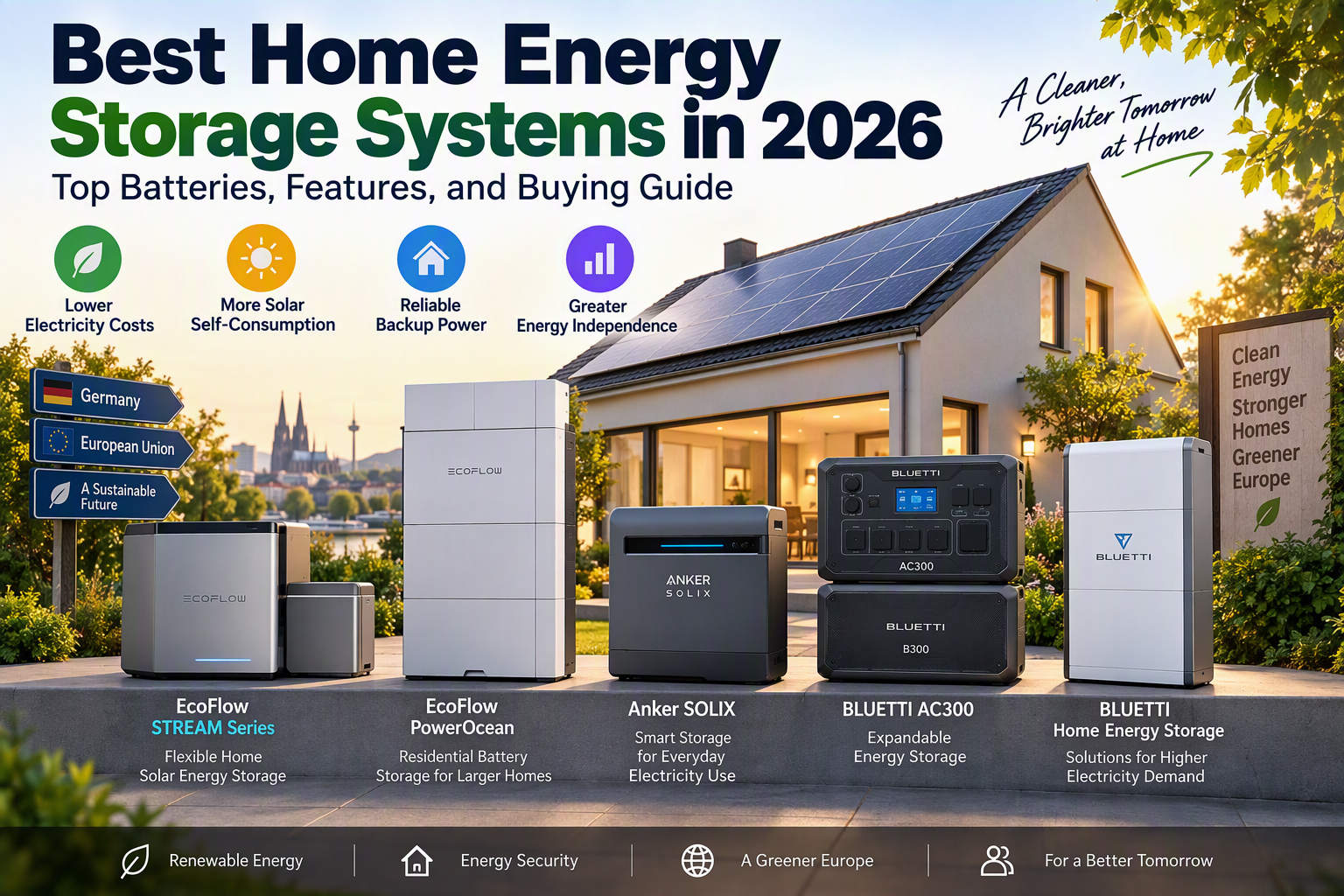
Best Home Energy Storage Systems in 2026: Top Batteries, Features, and Buying Guide
Why Choose a Home Energy Storage System in 2026?
Home energy storage systems are becoming increasingly popular among homeowners who want to make better use of renewable energy, reduce their dependence on the electricity grid, and maintain access to power during certain outages. These systems store electricity generated by solar panels or supplied by the grid, allowing households to use stored energy when it is most convenient.
The best home energy storage systems in 2026 offer different combinations of battery capacity, power output, intelligent energy management, solar compatibility, and backup capabilities. Some are designed for apartments and small solar installations, while others support larger homes with higher electricity consumption.
Choosing the right system depends on your household’s energy requirements, existing solar equipment, installation space, budget, and desired level of energy independence. Popular manufacturers include EcoFlow, Anker SOLIX, and BLUETTI, which offer solutions ranging from compact solar batteries to expandable residential energy storage systems.
1. EcoFlow STREAM Series: Flexible Home Solar Energy Storage
The EcoFlow STREAM series is worth considering for households looking for a flexible way to store solar energy and increase the amount of self-generated electricity they use. Depending on the model, the system can work with compatible solar panels, smart meters, and additional batteries to help households manage their electricity consumption more efficiently.
One of the main advantages of the STREAM family is its modular approach. Homeowners can choose a configuration suited to their available solar generation and expand their storage capacity when their energy needs increase. The range includes different models, so buyers should compare the specifications of each version before purchasing.
Key features include intelligent energy management, app-based monitoring, solar charging support, and compatibility with selected expansion batteries. Certain models offer multiple maximum power point tracking inputs, helping the system manage energy from different solar panel configurations.
The benefits include better use of daytime solar production, greater flexibility when designing a home energy setup, and improved visibility into electricity generation and consumption. Depending on the selected model and installation, a compatible system may also supply electricity to supported household loads when required.
For homeowners with a balcony solar installation or a small photovoltaic system, the STREAM range may provide a practical entry point into home battery storage. Larger configurations may suit households seeking more substantial solar storage capacity.
Best for: Households seeking flexible solar energy storage with modular expansion options.
Purchase links:
- Amazon Germany: https://www.amazon.de/s?k=EcoFlow+STREAM+home+battery
- Amazon EU search: https://www.amazon.de/s?k=EcoFlow+solar+battery+storage
- Official product information: https://www.ecoflow.com/de/series/home-energy-solutions
2. EcoFlow PowerOcean: Residential Battery Storage for Larger Homes
EcoFlow PowerOcean is a residential energy storage family designed for homeowners who want to integrate solar generation, battery storage, and energy management into a more comprehensive home energy system.
Unlike small portable power stations, PowerOcean systems are designed for permanent residential energy applications. Depending on the configuration, they can combine compatible batteries, inverters, and energy management components to store electricity produced by a photovoltaic installation.
A key feature is the ability to configure the system around the property’s electricity requirements. Available configurations differ in capacity, output power, and electrical arrangement. Certain versions support three-phase installations, making them relevant to homes with more demanding electrical requirements.
The principal benefits include increased solar self-consumption, the ability to use stored electricity after sunset, and improved control over household energy flows. A properly configured system can help households reduce the amount of electricity they purchase from the grid, although the actual savings depend on local electricity prices, solar generation, system efficiency, and consumption patterns.
PowerOcean may also be suitable for homeowners who want a more integrated approach to energy management rather than assembling a system from several independent components. Installation requirements and compatibility should be checked carefully before purchase.
Because these systems involve residential electrical equipment, professional assessment and installation may be necessary. Buyers should verify local electrical requirements and confirm that the selected configuration supports their intended backup applications.
Best for: Homeowners planning a permanent solar battery installation for a larger property.
Purchase links:
- Amazon Germany: https://www.amazon.de/s?k=EcoFlow+PowerOcean
- Amazon EU search: https://www.amazon.de/s?k=EcoFlow+home+energy+storage
- Official product information: https://www.ecoflow.com/de/series/home-battery
3. Anker SOLIX Solar Batteries: Smart Storage for Everyday Electricity Use
Anker SOLIX offers solar energy storage products designed to help households capture and use more of their own electricity. Its product family includes solutions for smaller solar installations and larger portable or expandable battery systems.
When comparing Anker SOLIX products, it is important to distinguish between a residential solar battery designed to work with a photovoltaic installation and a portable power station intended to power selected appliances. These product categories can serve different purposes and should not be treated as interchangeable.
Depending on the model, relevant features may include lithium iron phosphate battery chemistry, app-based monitoring, solar charging, multiple output connections, and support for additional battery capacity. Some products are particularly suitable for storing surplus electricity from a compatible balcony solar system, while higher-capacity power stations can provide electricity to selected appliances during an outage.
Lithium iron phosphate, commonly abbreviated as LFP, is valued for its thermal stability and suitability for repeated charging and discharging. Battery lifespan nevertheless depends on operating conditions, temperature, charging practices, and the manufacturer’s specifications.
The main advantages of an Anker SOLIX solution are flexibility, convenient monitoring, and the availability of products for different household requirements. A smaller setup may suit someone who wants to increase solar self-consumption, whereas a larger system may provide more substantial backup power.
Before buying, check the exact model number, usable battery capacity, maximum continuous output, solar input limits, expansion compatibility, and whether the system can operate during a grid outage. Not every product provides automatic household backup or direct integration with a home’s electrical panel.
Best for: Households looking for flexible solar storage or battery backup for selected appliances.
Purchase links:
- Amazon Germany: https://www.amazon.de/s?k=Anker+SOLIX+solar+battery
- Amazon EU search: https://www.amazon.de/s?k=Anker+SOLIX+home+energy+storage
- Official product information: https://www.anker.com/eu-en
4. BLUETTI AC300 and Compatible Battery Systems: Expandable Energy Storage
The BLUETTI AC300 is a modular power system designed to operate with compatible external battery modules. It is worth considering for users who want a configurable energy storage setup rather than a single fixed-capacity portable battery.
Its modular design allows users to select compatible battery capacity according to their requirements. Depending on the configuration, the system can support solar charging and supply electricity to selected appliances through its available outputs.
One of its main advantages is flexibility. Users can plan a system around essential household devices, workshop equipment, or selected backup loads, provided the combined battery capacity and power output meet those devices’ requirements.
Another benefit is the ability to separate the power unit from the battery modules. This design can make it easier to configure a storage system for different use cases, although the equipment still requires suitable space, ventilation, and protection from inappropriate environmental conditions.
The BLUETTI AC300 should not automatically be considered a complete grid-connected home battery system. Buyers need to check the precise compatibility of the power unit and batteries, regional electrical specifications, and the installation requirements for any planned household integration.
For consumers who want substantial storage capacity without immediately committing to a permanently installed whole-home battery, this modular approach may offer useful flexibility.
Best for: Users seeking expandable battery capacity for selected household loads and solar-powered backup.
Purchase links:
- Amazon Germany: https://www.amazon.de/s?k=BLUETTI+AC300
- Amazon EU search: https://www.amazon.de/s?k=BLUETTI+AC300+B300+battery
- Official product information: https://www.bluettipower.eu/
5. BLUETTI Home Energy Storage Systems: Solutions for Higher Electricity Demand
BLUETTI also offers products specifically designed for more substantial energy storage applications. Its home energy range includes systems intended for residential energy management, with configurations that can differ considerably from portable power stations.
For homeowners with larger photovoltaic installations, a dedicated residential system may provide a more suitable way to store surplus solar electricity and supply energy when generation falls. Depending on the model, these systems may include integrated energy management, compatible inverters, expandable battery capacity, and support for grid-connected or off-grid operation.
A major advantage of a dedicated residential solution is the opportunity to design the system around a household’s daily consumption and required backup loads. This can be particularly useful when a home uses electricity for several high-demand appliances or when the owner wants to reduce dependence on grid electricity.
However, capacity alone does not determine whether a system can power an entire home. Continuous output, peak output, phase compatibility, inverter configuration, and the home’s electrical installation all influence what can operate simultaneously.
Potential buyers should also compare warranty conditions, expected battery life, operating temperature limits, maintenance requirements, and the availability of local technical support. These factors can be just as important as the initial purchase price.
Best for: Homeowners evaluating dedicated residential battery systems for larger solar installations.
Purchase links:
- Amazon Germany: https://www.amazon.de/s?k=BLUETTI+home+energy+storage
- Amazon EU search: https://www.amazon.de/s?k=BLUETTI+home+battery+system
- Official product information: https://www.bluettipower.eu/
How to Choose the Best Home Energy Storage System
Selecting the best home energy storage system in 2026 starts with understanding how much electricity your household uses and when you use it. A household that consumes most of its electricity in the evening may benefit from a different battery capacity than a home that uses substantial power during daylight hours.
Battery Capacity and Usable Energy
Battery capacity is usually expressed in kilowatt-hours (kWh). It indicates how much energy a battery can store, although the usable amount may be lower than its nominal capacity.
For example, a battery with 5 kWh of usable energy could theoretically supply a device consuming 500 watts for around 10 hours. Actual runtime will be lower or higher depending on conversion losses, changing power consumption, battery reserve settings, and operating conditions.
A small household with modest backup requirements may be able to use a compact battery, while a larger property may require several battery modules. Reviewing electricity bills and monitoring daily consumption can help establish a suitable starting point.
Continuous Output Power
Continuous output power, measured in watts or kilowatts, determines how much electrical power a system can deliver at a given time.
A battery with high capacity but limited output may run small appliances for many hours without being able to start or operate a powerful appliance. Refrigerators, pumps, kettles, washing machines, and other equipment have different power requirements.
Before buying, calculate the combined power demand of the devices you intend to operate simultaneously. Also check surge ratings where appliances require additional power when starting.
Battery Chemistry and Expected Lifespan
Lithium iron phosphate batteries are widely used in modern solar storage systems because of their thermal stability and suitability for repeated cycling.
Battery manufacturers may specify an expected number of charge cycles or a warranty period. These figures are not identical: actual performance depends on the depth of discharge, temperature, charging practices, and other operating conditions.
Compare the warranty’s coverage, capacity-retention conditions, and any limits on usage. A longer advertised cycle life does not automatically guarantee a particular number of years of service.
Solar Panel Compatibility
If you already own solar panels, confirm that the battery system supports their electrical specifications. Important details include maximum photovoltaic input power, voltage range, current limits, connector types, and the number of supported solar inputs.
A battery designed for an existing home photovoltaic installation may require a compatible inverter or energy management system. Some portable power stations support direct solar charging but cannot automatically integrate with the home’s existing solar inverter.
Compatibility should be confirmed before ordering to avoid purchasing equipment that cannot operate with your current setup.
Expandability and Future Requirements
Expandable systems allow users to add compatible battery modules as their energy needs grow. This can be useful if you plan to install additional solar panels, purchase an electric vehicle, or increase electricity consumption in the future.
However, expansion limits vary by model. Check the maximum supported battery capacity, compatibility requirements, and whether additional equipment is needed to expand the system.
Planning for future requirements can help avoid replacing an entire system when a larger capacity becomes necessary.
Smart Monitoring and Energy Management
Smart monitoring can display battery charge levels, solar production, household consumption, and charging or discharging activity. Some systems also support schedules or automated energy management based on configured preferences.
These features help users understand how electricity flows through their homes and identify opportunities to use more self-generated energy.
App features vary by manufacturer and model, so check which functions are included, whether internet access is required, and whether remote monitoring depends on an ongoing service.
Backup Power During Outages
Not every home battery provides backup power when the grid fails. Some systems stop exporting or supplying electricity during an outage unless they include a compatible backup function and the necessary electrical equipment.
If emergency power is important, confirm whether the system supports islanded operation, automatic transfer, or a dedicated backup output. Also determine which circuits will remain powered.
A portable power station can operate compatible appliances directly from its outlets, but that does not mean it can safely power an entire house through an ordinary wall socket. Household integration must use an appropriate, professionally designed arrangement.
Benefits of Installing a Home Energy Storage System
Lower Electricity Costs
A home battery can store surplus solar electricity for use later, reducing the amount of power purchased from the grid. The potential savings depend on the relationship between electricity prices, solar generation, export compensation, battery efficiency, and household consumption.
A battery does not automatically guarantee lower bills. Before investing, compare the installed cost with realistic annual savings and account for future maintenance and battery degradation.
Better Use of Renewable Energy
Solar panels typically generate electricity during daylight hours, while many households use significant amounts of energy in the evening. A battery helps bridge this difference by storing some daytime production for later consumption.
This can increase the share of household electricity supplied by the home’s own solar installation.
Greater Energy Flexibility
Stored electricity can provide additional flexibility when household demand changes or solar production temporarily falls. Depending on the system’s design, users may be able to operate selected appliances from stored energy during certain interruptions.
The actual level of independence depends on battery capacity, inverter output, solar availability, and household consumption.
Emergency Power for Essential Devices
A suitably configured battery system can help keep selected essential devices running during an electricity outage. Examples may include communication equipment, lighting, refrigeration, and certain medical devices, provided the system meets their electrical requirements.
Users who depend on critical medical equipment should confirm that the backup arrangement meets the equipment manufacturer’s requirements and should maintain an appropriate contingency plan.
Improved Energy Management
Monitoring and automation features can help households schedule electricity use more effectively. Depending on the system, users may be able to prioritise solar charging, control battery discharge, or respond to electricity tariffs.
These functions can make energy consumption easier to understand and help homeowners make informed decisions about their electricity usage.
Home Energy Storage Costs and Value for Money
The cost of a home energy storage system varies according to battery capacity, inverter requirements, installation complexity, backup functionality, and the number of additional components required.
Portable power stations are often simpler to purchase and use for selected appliances, while permanently installed residential batteries can involve additional equipment and professional installation costs.
When comparing offers, consider the complete system cost rather than the battery price alone. A residential installation may require electrical protection, compatible inverters, a smart meter, wiring, commissioning, and other components.
It is also important to compare the usable capacity and continuous output rather than relying only on the manufacturer’s headline figures. Two systems with similar battery capacity can offer substantially different performance.
To estimate the potential financial benefit, calculate how much solar electricity you currently export or fail to use, how much of that energy a battery could realistically store, and how much grid electricity it could replace later. Include conversion losses and the difference between the cost of imported electricity and any compensation received for exported energy.
For homeowners in Germany and other European countries, local electricity tariffs, grid rules, installation requirements, and available incentives can significantly influence the financial case.
Where to Buy Home Energy Storage Systems in Germany and the European Union
Amazon Germany provides a convenient starting point for comparing home batteries, solar storage accessories, portable power stations, and compatible expansion batteries. Its search results can include different sellers and configurations, so product descriptions should be reviewed carefully.
For the wider European market, availability and delivery conditions may vary by country. A product listed on Amazon Germany may not be deliverable to every EU destination, and some systems may have country-specific electrical configurations or warranty conditions.
Before purchasing, verify the seller’s identity, the exact model number, the included accessories, the applicable warranty, and the availability of local technical support. For permanently installed residential systems, a manufacturer’s official website or authorised installer may be a better source for a complete installation package.
The Amazon links in this guide are search links rather than guarantees that a specific model is in stock. They allow readers to compare current listings without relying on copied product photographs or copyrighted marketing material.
Frequently Asked Questions About Home Energy Storage
What Is the Best Home Energy Storage System in 2026?
The best option depends on the intended application. EcoFlow STREAM may suit households seeking flexible solar storage, EcoFlow PowerOcean is worth considering for permanent residential installations, Anker SOLIX offers options for different storage needs, and BLUETTI provides both modular power systems and dedicated home energy products.
Compare individual models according to capacity, output, solar compatibility, backup functionality, installation requirements, and total cost.
How Many Kilowatt-Hours Does a Home Battery Need?
The appropriate capacity depends on household electricity consumption, the amount of surplus solar energy available, and how much electricity you want to use after sunset or during an outage.
Reviewing your daily consumption and identifying the appliances that need backup is a useful first step. A qualified installer can help determine a suitable capacity for a permanently installed system.
Can a Home Battery Power an Entire House?
Some residential systems can support substantial household loads when correctly sized and installed. However, not every battery can supply an entire property.
The battery capacity, inverter output, electrical configuration, backup equipment, and simultaneous power demand determine what can be operated.
Are Home Energy Storage Systems Compatible With Existing Solar Panels?
Many systems can work with existing solar installations, but compatibility depends on the battery’s charging inputs, inverter design, voltage limits, and energy management equipment.
Check the manufacturer’s compatibility documentation before purchasing, particularly if you intend to retain an existing photovoltaic inverter.
Is a Home Battery Worth the Investment?
A home battery may be worthwhile if you regularly generate surplus solar electricity and can use that stored energy when electricity would otherwise be purchased from the grid.
The financial return depends on installation cost, electricity prices, export compensation, efficiency, battery lifespan, and consumption patterns. A detailed estimate is preferable to assuming that every installation will pay for itself within a particular period.
Conclusion
The best home energy storage systems in 2026 provide practical ways to store electricity, increase solar self-consumption, and improve household energy flexibility. EcoFlow STREAM is worth exploring for modular solar storage, while EcoFlow PowerOcean targets more comprehensive residential installations. Anker SOLIX offers flexible products for different household requirements, and BLUETTI provides modular power stations alongside dedicated home energy storage solutions.
Before making a purchase, compare usable battery capacity, continuous output, solar compatibility, expansion options, warranty conditions, and backup capabilities. For permanent residential installations, confirm the electrical requirements and seek qualified installation advice where necessary.
With careful planning, the right home battery can help a household use more renewable electricity, manage energy consumption more effectively, and prepare for certain power interruptions while making the most of its existing solar investment.


