
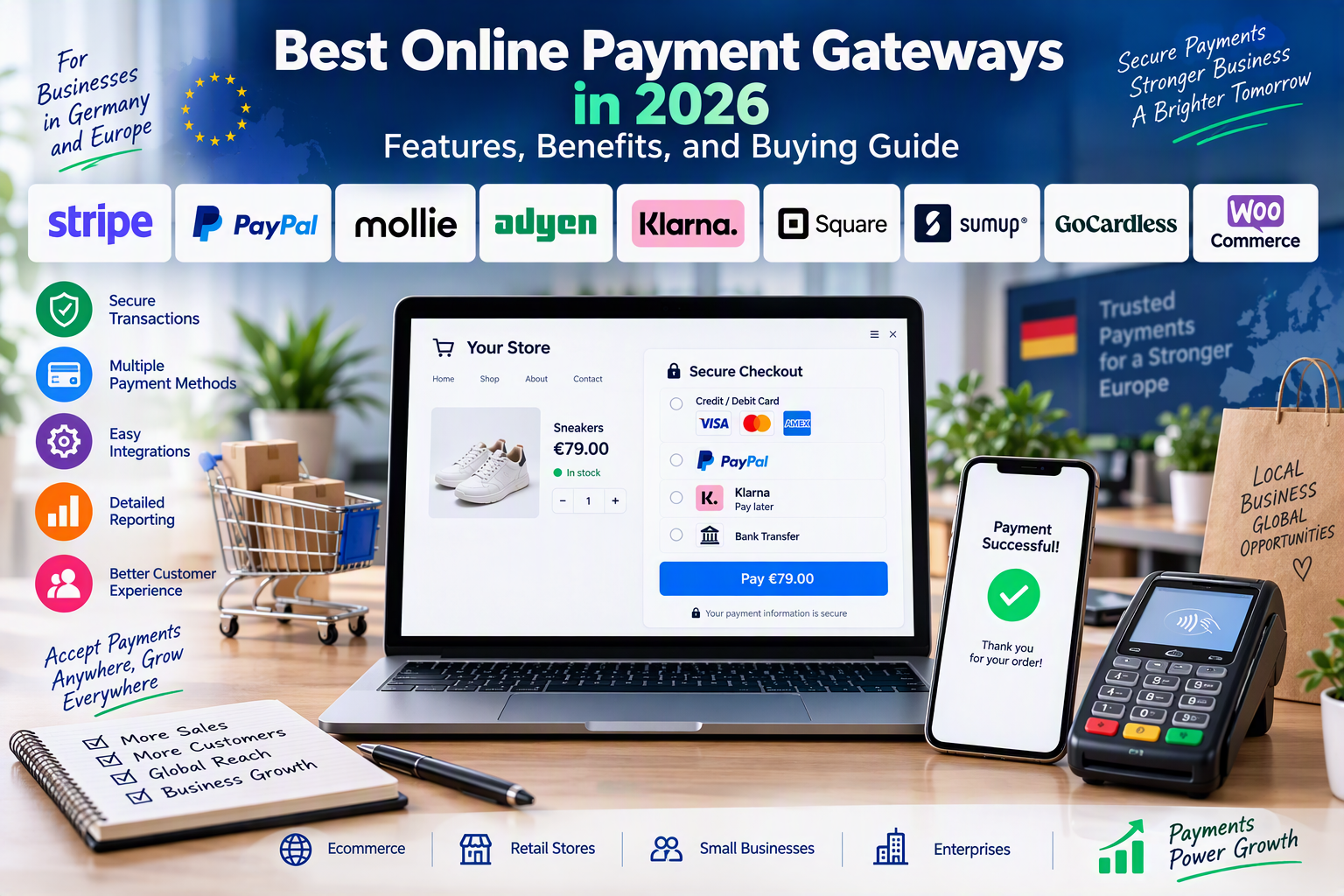
Best Online Payment Gateways in 2026: Features, Benefits, and Buying Guide
to Online Payment Gateways
Online payment gateways have become essential tools for ecommerce stores, subscription services, digital businesses, and companies that accept payments through websites or mobile applications. They help businesses process electronic transactions and provide customers with convenient ways to pay for products and services.
The best online payment gateways in 2026 offer a combination of secure transaction processing, flexible payment methods, integration with ecommerce platforms, transaction reporting, and tools for managing refunds. Choosing the right provider can help businesses simplify checkout, organize payment operations, and provide a smoother customer experience.
For businesses operating in Germany and the European Union, payment preferences can differ between countries. Customers may prefer credit cards, debit cards, digital wallets, bank transfers, direct debits, or local payment services. Offering suitable payment options can help businesses serve different customer groups more effectively.
This guide explores popular online payment gateways, their main features, advantages, and potential limitations. It also explains how to choose a suitable provider and identifies payment hardware that businesses may need for in-person transactions.
1. Stripe: Flexible Online Payment Processing
Stripe is a payment technology platform designed to help businesses accept and manage online payments. It is suitable for ecommerce stores, software companies, subscription services, marketplaces, and businesses that require customizable payment workflows.
Stripe offers payment tools that can be integrated into websites, mobile applications, and compatible ecommerce platforms. Businesses can use hosted payment pages or build customized checkout experiences depending on their technical requirements.
Main Features and Benefits
Stripe supports payment processing for eligible cards and various additional payment methods, depending on the merchant’s country, account configuration, and customer location. It also provides tools for managing refunds, monitoring transactions, and handling recurring payments.
One important advantage is its developer infrastructure. Businesses with technical resources can use APIs and software development tools to customize payment experiences and connect transactions with their internal systems.
Stripe also offers tools for subscription billing, invoicing, and fraud prevention. These capabilities can be valuable for businesses selling digital services, memberships, or products through recurring payment plans.
For European merchants, the availability of supported local payment methods can help businesses adapt their checkout process to different markets.
However, transaction fees, supported payment methods, and service availability vary. Businesses should review the current pricing structure and integration requirements before choosing Stripe.
Best for: Ecommerce stores, software businesses, subscription services, and companies that need flexible payment integrations.
Official website: https://stripe.com/
2. PayPal: A Recognized Payment Option for Online Stores
PayPal is a widely recognized online payment service that allows eligible businesses to receive payments through supported online checkout options. It can be particularly useful for merchants who want to offer customers an alternative to entering card details directly into a checkout form.
Many ecommerce platforms support PayPal through built-in integrations or third-party extensions.
Main Features and Benefits
PayPal provides online payment acceptance, transaction records, refunds, and business account tools. Depending on the merchant’s location and eligibility, customers may be able to pay using their PayPal balance, linked bank accounts, or supported payment cards.
A major advantage is customer familiarity. Some shoppers prefer using a payment service they already know rather than entering payment details into an unfamiliar website.
PayPal can also be integrated with compatible ecommerce platforms to help merchants manage checkout without building an entirely custom payment system.
For businesses serving German customers, offering PayPal alongside other suitable payment methods may provide additional flexibility.
Nevertheless, merchants should review transaction fees, currency conversion costs, dispute procedures, account restrictions, and the availability of specific services in their country.
Best for: Small businesses, online retailers, freelancers, and merchants who want to offer a familiar digital payment option.
Official website: https://www.paypal.com/
3. Mollie: Payment Solutions for European Businesses
Mollie is a payment service provider focused on helping businesses accept online payments through a range of supported payment methods. It is particularly relevant to European ecommerce businesses that want to offer customers different ways to complete purchases.
The platform provides payment integrations for supported online stores and business applications.
Main Features and Benefits
Mollie supports various payment methods, which may include cards, bank-related payments, and selected local payment options depending on the merchant’s country and account configuration.
Its integrations can simplify the process of adding payment options to compatible ecommerce platforms. Businesses can also use transaction reporting and payment management features to organize their operations.
One advantage is the ability to manage multiple supported payment methods through a single provider rather than creating a separate integration for every method.
This can be helpful for businesses selling to customers in different European markets, where payment preferences and commonly used services may vary.
However, not every payment method is available in every country. Merchants should confirm eligibility, integration compatibility, settlement arrangements, and current transaction fees before signing up.
Best for: European online retailers, small and medium-sized businesses, and merchants that need several regional payment methods.
Official website: https://www.mollie.com/
4. Adyen: Payment Infrastructure for Growing and Large Businesses
Adyen is a payment platform designed to support businesses that need to manage payments across multiple channels and markets. It can be suitable for larger retailers, international ecommerce companies, and businesses operating both online and in physical stores.
The platform offers payment processing and related tools for managing transactions across supported business environments.
Main Features and Benefits
Adyen supports online and in-person payment processing, with payment methods and services depending on the merchant’s region and configuration.
Businesses can use its payment infrastructure to coordinate transactions across different channels and access reporting tools for monitoring payment activity.
For retailers operating internationally, a unified payment platform can help simplify payment operations and provide more centralized oversight.
Adyen also offers integrations and technical tools for businesses that require customized payment experiences.
Its suitability depends on transaction volumes, business requirements, implementation resources, and commercial terms. Pricing may be tailored to the merchant, so businesses should request a detailed proposal before making a decision.
Best for: Large retailers, international businesses, and companies seeking integrated online and in-store payment processing.
Official website: https://www.adyen.com/
5. Klarna: Flexible Payment Options for Online Shopping
Klarna provides payment services that can include options such as paying later or paying in installments, depending on the country, merchant agreement, and customer eligibility.
These services may be relevant to online retailers whose customers want alternatives to paying the entire purchase amount immediately.
Main Features and Benefits
Klarna’s available payment options vary by market. Depending on the arrangement, customers may be offered immediate payment, invoice-based payment, or installment plans.
For merchants, integration with a supported checkout system can make eligible Klarna options available during the purchasing process.
Flexible payment options may appeal to some customers, particularly for eligible purchases where the payment provider supports the selected arrangement.
However, businesses should clearly explain the available payment terms and ensure that customers understand any applicable repayment obligations.
Merchants should also evaluate transaction fees, settlement conditions, customer eligibility rules, returns procedures, and integration requirements.
Best for: Eligible ecommerce retailers that want to offer supported pay-later or installment options.
Official website: https://www.klarna.com/
6. Square: Payment Processing for In-Person and Online Sales
Square offers payment services and business tools for merchants that sell through physical locations, online stores, or a combination of both. Its products can help eligible businesses manage transactions and organize selected retail operations.
Square’s availability, payment services, and hardware options depend on the country in which the business operates.
Main Features and Benefits
Square provides payment processing and compatible payment hardware in supported markets. Depending on the service and configuration, businesses may also access sales reporting, product management, and point-of-sale features.
For retailers, the ability to connect payment acceptance with sales records can simplify some daily administrative tasks.
Businesses may also use compatible card readers or terminals to accept supported card and contactless payments in person.
However, merchants in Germany or other European countries should verify local availability before purchasing Square-related equipment. A payment device may require an eligible account and a compatible service, so hardware should not be purchased without checking these requirements.
Best for: Eligible small retailers, service businesses, and merchants that need payment processing for in-person transactions.
Official website: https://squareup.com/
7. SumUp: Payment Terminals for Small Businesses
SumUp offers payment products designed to help small businesses accept electronic payments. Its services can be relevant to independent retailers, market sellers, cafes, mobile service providers, and other businesses that accept payments in person.
Depending on the product and region, SumUp provides portable card readers, payment terminals, and additional business tools.
Main Features and Benefits
SumUp payment devices can support selected card and contactless payment methods. Certain products are designed to operate independently, while others may connect to a compatible smartphone or tablet.
Portable equipment can be useful for businesses that need to accept payments away from a fixed checkout counter.
Some SumUp services also provide transaction records and business management features, although the available functionality depends on the selected product and account.
Before purchasing a device, merchants should check supported payment methods, connectivity, battery life, transaction fees, and any subscription or service charges.
It is also important to confirm whether the device is available for use in the merchant’s country and whether an eligible SumUp account is required.
Best for: Small retailers, independent service providers, mobile sellers, and businesses accepting payments in person.
Official website: https://www.sumup.com/
8. GoCardless: Bank Payments and Recurring Collections
GoCardless specializes in bank payment services, including supported direct debit and related payment solutions. It can be useful for businesses that collect recurring payments or regularly invoice customers.
The service is particularly relevant to subscription companies, membership organizations, and businesses that charge customers on a recurring schedule.
Main Features and Benefits
GoCardless supports eligible bank payment methods in its available markets. Depending on the service and configuration, businesses can organize recurring collections and monitor payment statuses.
Automated collection workflows can reduce the need to request payment manually every billing period.
For businesses with regular customer payments, this may simplify administration and make payment scheduling easier to manage.
However, bank payment methods have their own authorization, processing, settlement, and return procedures. Merchants should understand the relevant timelines and requirements before using them.
Available countries, currencies, pricing, and integration options should also be checked directly with the provider.
Best for: Subscription businesses, membership services, and companies that collect recurring payments through supported bank methods.
Official website: https://gocardless.com/
9. WooCommerce-Compatible Payment Gateways
WooCommerce is an ecommerce platform for WordPress websites. Businesses using WooCommerce can connect payment gateways through official integrations or compatible extensions.
The most appropriate payment solution depends on the store’s location, customer preferences, technical setup, and required payment methods.
Main Features and Benefits
WooCommerce-compatible payment gateways can allow merchants to accept eligible card payments, digital wallets, bank payments, and other supported methods.
A suitable integration can connect checkout transactions with order management, allowing the store to update order statuses according to the payment provider’s supported workflow.
Some integrations also support refunds, recurring payments, and transaction information within the store’s administration area.
One advantage is flexibility. Store owners can compare providers and select an option that fits their business model rather than relying on a single universal payment service.
However, extensions may differ in quality, maintenance, fees, and compatibility with other plugins. Businesses should choose reputable integrations, keep software updated, and test checkout thoroughly after configuration changes.
Best for: WordPress store owners, independent ecommerce businesses, and merchants who want control over their website and payment integrations.
Official website: https://woocommerce.com/
10. How to Choose the Best Online Payment Gateway
Choosing the best online payment gateway requires careful evaluation of business needs, customer preferences, technical requirements, and total operating costs.
A suitable provider should support the payment methods your customers use, integrate with your ecommerce platform, and offer reliable tools for managing transactions.
Supported Payment Methods
Payment methods are among the most important factors to consider.
Depending on the target market, customers may expect credit cards, debit cards, digital wallets, bank transfers, direct debit, or local payment services.
For businesses serving customers across Europe, it is important to investigate payment preferences in each country rather than assuming that one method will suit every market.
Offering a suitable range of payment options can make checkout more convenient, but every additional method should be evaluated against its cost and operational requirements.
Transaction Fees and Additional Costs
Payment providers may charge transaction fees, fixed fees, currency conversion charges, dispute-related fees, or other costs.
Some providers also offer paid subscriptions or additional services.
Businesses should calculate the total cost using realistic estimates of transaction values, sales volumes, currencies, and payment methods.
For example, a provider with a low percentage fee may still be expensive for small transactions if a fixed fee applies to each payment.
Always review the provider’s current official pricing page because fees and commercial terms can change.
Ecommerce Integration
A payment gateway should work with the store’s ecommerce platform, shopping cart, accounting software, and other relevant systems.
Businesses using Shopify, WooCommerce, Shopware, or PrestaShop should verify that the selected provider supports their platform and required features.
A reliable integration can reduce manual administration and help keep transaction and order records consistent.
Before launch, test successful payments, declined transactions, cancellations, refunds, and order status updates.
Security and Fraud Prevention
Security is essential because payment processing involves sensitive financial information.
Look for providers that explain their security controls, payment data handling, fraud monitoring, and support for applicable payment industry standards.
Where applicable, businesses should understand requirements relating to Strong Customer Authentication and secure customer verification.
Using a recognized payment gateway can help with payment security, but it does not eliminate every risk or automatically make the entire website secure.
Merchants must also maintain secure websites, restrict administrative access, update software, and protect customer information.
International Payments and Multiple Currencies
Businesses selling internationally may need to accept payments in different currencies or support payment methods used in specific countries.
Check whether the provider supports the countries in which you intend to sell, the currencies you need, and the settlement options available for your business.
Currency conversion may involve additional costs, so the exchange rate and associated fees should be reviewed before choosing a provider.
Refunds and Customer Support
Refund handling is another important consideration.
Businesses should understand how to issue full or partial refunds, how quickly funds are returned, and whether any processing fees are refundable.
Accessible customer support can also be valuable when a transaction fails or a technical issue affects checkout.
Review support channels, service availability, documentation, and dispute handling procedures before committing to a provider.
11. Essential Features of a Reliable Payment Gateway
A reliable payment gateway should provide more than a way to collect money. The following features can help businesses manage payment operations effectively.
Secure Transaction Processing
Secure processing helps protect payment information during transactions. Merchants should check the provider’s security documentation and understand which security responsibilities remain with the business.
Fraud Monitoring
Fraud prevention tools may identify suspicious transaction patterns, help apply risk rules, and support review of potentially fraudulent activity.
No fraud detection system is perfect. Businesses should evaluate available controls and develop procedures for handling suspicious orders.
Payment Reporting
Payment reports can help merchants reconcile transactions, review settlement activity, identify failed payments, and prepare financial records.
Useful reports may include transaction amounts, fees, refunds, payment statuses, and settlement details.
Recurring Billing
Subscription businesses may benefit from tools that schedule repeat payments and manage billing cycles.
The provider should support the business’s intended subscription model and provide clear information about failed payments, cancellations, and customer authorization.
Refund and Dispute Management
Businesses should be able to understand how refunds and disputes are handled.
Clear records, accurate product descriptions, transparent policies, and timely customer communication can help businesses manage payment disputes more effectively.
Integration and Customization
APIs, plugins, hosted checkout pages, and other integration options allow businesses to connect payment processing with their existing systems.
The right level of customization depends on the business’s technical resources and operational needs.
12. Payment Hardware for Businesses in Germany and Europe
Online payment gateways process electronic transactions, but businesses that also sell in physical locations may need compatible payment hardware.
Payment terminals and card readers allow eligible merchants to accept supported card and contactless payments in person. Hardware must be compatible with the selected payment provider and merchant account.
Amazon marketplaces can be useful for researching payment-related accessories, but a device purchased through Amazon is not automatically authorized to process payments. Many payment terminals require a specific provider account, activation, or service contract.
Card Readers
Card readers can be useful for small businesses that need a compact way to accept eligible in-person payments.
Important features include support for chip cards, contactless payments, connection options, battery life, device security, and compatibility with the payment service.
Before purchasing, confirm that the device is supported by your provider and available for activation in your country.
Amazon Germany: https://www.amazon.de/s?k=card+reader+payment+terminal
Amazon France: https://www.amazon.fr/s?k=lecteur+carte+paiement
Amazon Italy: https://www.amazon.it/s?k=lettore+carte+pagamento
Contactless Payment Terminals
Contactless payment terminals can allow customers to pay using supported contactless cards and digital wallets.
Businesses should check which payment methods are supported, how the terminal connects to the payment service, and whether it requires a separate merchant account.
Other considerations include screen readability, durability, connectivity, battery life, and receipt options.
Amazon Germany: https://www.amazon.de/s?k=contactless+payment+terminal
Amazon Spain: https://www.amazon.es/s?k=terminal+de+pago+contactless
POS Systems and Payment Accessories
Retailers may also need compatible point-of-sale hardware, such as touchscreen terminals, receipt printers, barcode scanners, or cash drawers.
These accessories can help organize checkout and sales administration, but compatibility should be checked before buying.
A payment terminal and a POS system are not necessarily the same product. Some terminals only process payments, while a POS system may also manage product catalogs, stock, orders, and sales reports.
Amazon Germany: https://www.amazon.de/s?k=POS+system+retail
Amazon France: https://www.amazon.fr/s?k=systeme+caisse+enregistreuse
Amazon Italy: https://www.amazon.it/s?k=sistema+POS+negozio
These links lead to product search results. Product availability, prices, seller information, delivery options, and compatibility may change. Verify the specifications and payment provider requirements before purchasing any hardware.
13. Payment Gateway Considerations for Germany and the European Union
Businesses serving customers in Germany and other EU countries should evaluate regional payment preferences, supported currencies, and applicable legal obligations.
Offer Suitable Regional Payment Methods
Different European markets use different combinations of cards, bank payments, digital wallets, and local services.
A business selling in Germany may prioritize one combination of payment methods, while a store targeting customers in the Netherlands, Belgium, or other countries may need different options.
Research the payment preferences of your target audience and confirm that your provider supports the relevant methods.
Understand Strong Customer Authentication
Applicable European payment rules may require Strong Customer Authentication for certain electronic transactions, subject to relevant exemptions and conditions.
Businesses should check how their payment provider supports the authentication requirements that apply to their transactions.
The provider’s available tools can help with implementation, but merchants should not assume that every transaction follows the same authentication process.
Protect Personal Data
Payment processing may involve customer names, contact details, order information, and transaction records.
Businesses serving EU customers should assess their responsibilities under the General Data Protection Regulation and review how their payment providers handle personal information.
Relevant considerations may include privacy notices, data retention, access controls, and the responsibilities of the merchant and service provider.
Maintain Transparent Checkout Information
Customers should be able to understand the total price, available payment methods, delivery costs, and relevant purchase conditions before completing an order.
Businesses should also provide clear information about refunds, cancellations, and customer support.
Payment integration does not replace the need for appropriate consumer information and legally compliant business policies.
Verify Local Requirements
Legal and tax obligations can depend on the country, business model, products sold, and payment arrangement.
Businesses should review the requirements that apply to their operations and seek qualified professional advice where necessary. No payment gateway can guarantee compliance with every legal obligation for every merchant.
14. Common Payment Gateway Mistakes to Avoid
Choosing a payment provider without evaluating its suitability can create unnecessary costs and technical problems.
One common mistake is selecting a gateway based only on transaction fees. Other factors, such as supported payment methods, settlement timing, currency conversion, refunds, and integration costs, can affect the total cost of operating a store.
Another mistake is failing to check whether the provider supports the business’s country, product category, and intended business model. Approval and eligibility requirements can differ between providers.
Businesses should also avoid installing unmaintained plugins or making checkout changes without testing them. A payment integration that works incorrectly can prevent customers from completing purchases or create inconsistent order records.
Ignoring fraud prevention and account security is another serious risk. Merchants should use strong authentication, restrict administrative access, keep software updated, and follow the payment provider’s security recommendations.
Finally, businesses should not purchase payment hardware before verifying compatibility. A terminal advertised online may require an account or activation process that is unavailable to the buyer.
Careful planning and regular reviews can help businesses avoid these problems and maintain a more reliable payment experience.
15. How Payment Gateways Can Support Ecommerce Growth
Payment gateways can contribute to ecommerce growth by making checkout more convenient and connecting transactions with business operations.
Offering payment methods that suit customers can help reduce unnecessary friction during checkout. However, the impact on sales depends on many factors, including pricing, product quality, website usability, delivery options, and customer trust.
Automated transaction records can reduce manual administrative work and help merchants reconcile payments with orders.
Payment reporting can also help businesses understand transaction outcomes, monitor refunds, and identify recurring payment problems.
For subscription businesses, recurring billing tools may simplify scheduled collections and reduce the need for manual invoicing.
For international retailers, supported local payment methods and currencies can make it easier to serve customers in additional markets.
The most effective payment setup is one that matches the business’s customer base, technical environment, and operational requirements without introducing unnecessary complexity.
Conclusion
The best online payment gateways in 2026 help businesses accept electronic payments, manage transactions, integrate checkout systems, and provide convenient payment options for customers.
Stripe offers flexible integration tools for ecommerce and subscription businesses. PayPal provides a familiar online payment option, while Mollie is worth considering for European retailers that need multiple supported payment methods. Adyen can suit larger businesses with complex payment operations, and Klarna may be relevant to eligible merchants offering supported pay-later or installment options. Square and SumUp provide payment solutions for in-person transactions in supported markets, while GoCardless specializes in bank payment services, including recurring collections.
Before choosing a provider, compare payment methods, transaction fees, integration compatibility, security features, settlement arrangements, and regional availability. Businesses operating in Germany and the European Union should also consider applicable payment authentication, data protection, and consumer information requirements.
For retailers that accept in-person payments, compatible card readers and payment terminals can complement an online payment setup. Always confirm that the hardware works with the chosen provider and merchant account before purchasing it.
By selecting a payment gateway that matches their business needs and maintaining a secure, transparent checkout process, businesses can build a more convenient payment experience and establish a stronger foundation for sustainable ecommerce growth.


