
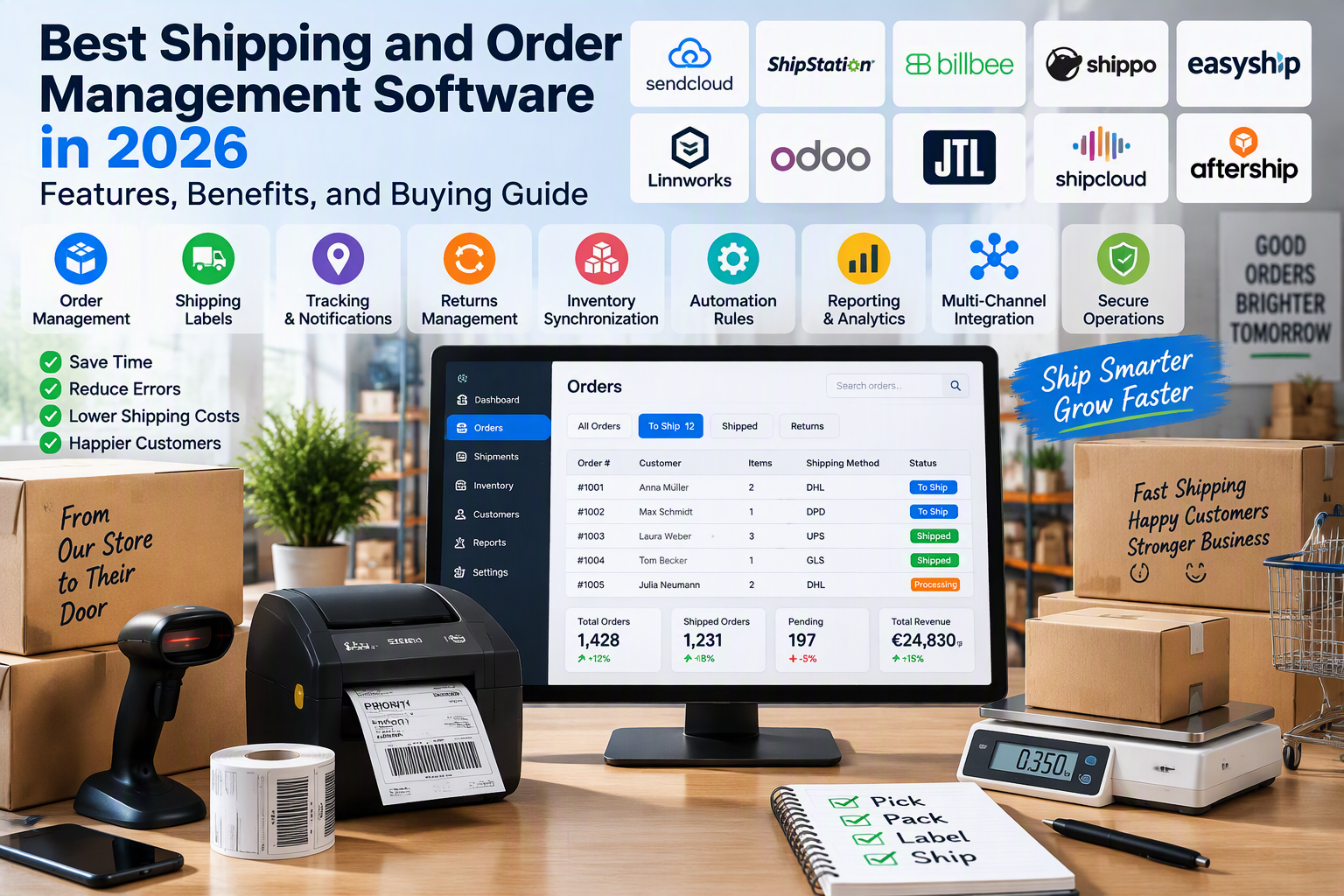
Best Shipping and Order Management Software in 2026: Features, Benefits, and Buying Guide
to Shipping and Order Management Software
Shipping and order management software has become essential for ecommerce businesses, online retailers, wholesalers, and companies that sell products through multiple channels. These tools help businesses organize customer orders, prepare shipments, generate shipping labels, track deliveries, manage returns, and coordinate fulfillment operations.
As online shopping continues to develop, managing orders manually can become time-consuming. Businesses may receive orders from online stores, marketplaces, and social commerce platforms, making it difficult to maintain accurate records and process every shipment efficiently. The best shipping and order management software helps centralize these activities and automate repetitive tasks.
In 2026, businesses can choose from a wide range of solutions, including European shipping platforms, multichannel order management systems, warehouse management software, and integrated ecommerce tools. Some platforms focus primarily on shipping labels and carrier connections, while others combine order processing, inventory synchronization, invoicing, and fulfillment management.
This guide explores the best shipping and order management software for 2026, highlighting its main features, advantages, limitations, and suitable business uses. It also explains how to select the right solution and identifies useful shipping equipment available through Amazon Germany and other European Amazon marketplaces.
1. Sendcloud: Shipping Management for European Ecommerce
Sendcloud is a shipping management platform designed to help online retailers simplify shipping operations and connect their stores with supported delivery carriers. It is particularly relevant to ecommerce businesses operating in Germany and other European markets.
The platform helps merchants manage shipping workflows from a centralized environment instead of handling every shipment separately through individual carrier websites.
Main Features and Benefits
Sendcloud provides shipping automation features that may include shipping label generation, carrier integrations, shipping rules, tracking notifications, and returns management. Available features depend on the selected plan, country, and connected carrier services.
One of its main advantages is the ability to connect ecommerce stores with multiple supported shipping providers. This can help businesses compare available services and organize shipments without repeatedly entering order information.
Shipping rules can also help automate repetitive tasks. For example, a retailer may configure rules to select a preferred carrier based on destination, package characteristics, or shipping method, provided the relevant conditions are supported.
Tracking tools can help customers follow their deliveries and reduce the need to contact customer support for routine shipping updates.
Sendcloud may be particularly useful for businesses selling across European borders because delivery requirements and carrier options can vary between countries.
However, carrier availability, shipping rates, label limits, and automation features vary by market and subscription plan. Businesses should confirm that the platform supports their preferred carriers and ecommerce systems before choosing a subscription.
Best for: European ecommerce stores, multichannel retailers, and businesses that need centralized shipping automation.
Official website: https://www.sendcloud.com/
2. ShipStation: Multichannel Order and Shipping Management
ShipStation is a shipping and fulfillment platform designed to help businesses process orders from supported ecommerce stores and marketplaces. It can be useful for retailers that receive orders through multiple sales channels and want to organize fulfillment in one place.
Instead of manually transferring information between platforms, businesses can use supported integrations to bring orders into a centralized workflow.
Main Features and Benefits
ShipStation offers order importing, shipping label creation, shipment tracking, automation rules, and integrations with supported carriers and sales channels. Specific integrations and features depend on the user’s region, subscription, and configuration.
One of its main advantages is its focus on reducing repetitive shipping tasks. Businesses can organize orders, apply shipping preferences, and prepare labels through a connected workflow.
Automation rules can help assign shipping services or organize orders according to predefined conditions. This can be especially useful for retailers processing many similar shipments each day.
ShipStation also supports workflows for printing shipping labels and sharing tracking information with connected sales channels where the integration allows it.
However, businesses should verify its current carrier coverage in Germany and other European countries. Some sellers may need separate inventory management software if they require more advanced stock control or purchasing features.
Best for: Online retailers, marketplace sellers, and businesses handling orders from several supported sales channels.
Official website: https://www.shipstation.com/
3. Billbee: Order Management for German and European Online Retailers
Billbee is an order management platform designed for online retailers that need to coordinate orders, inventory, shipping, and administrative workflows.
It is particularly relevant to small and medium-sized ecommerce businesses selling through multiple online stores and marketplaces.
Main Features and Benefits
Billbee can centralize orders from supported ecommerce platforms and marketplaces. Depending on the integration and configuration, it can also support automated invoice creation, shipping label workflows, inventory synchronization, and customer communication.
One major advantage is its ability to connect different stages of order processing. Instead of handling orders, invoices, and shipping information separately, businesses can manage many of these tasks through a connected workflow.
Inventory synchronization can help retailers maintain more consistent stock information across supported sales channels. This is important for businesses selling the same products through several marketplaces or online stores.
Automation rules can reduce repetitive administrative work by applying predefined actions to eligible orders.
Billbee may also be useful for businesses that need structured order documentation and accounting-related integrations.
Before selecting the platform, merchants should review supported sales channels, carrier connections, pricing, order-volume limits, and compatibility with their existing systems.
Best for: German online retailers, small and medium-sized ecommerce businesses, and multichannel sellers seeking combined order and shipping management.
Official website: https://www.billbee.io/
4. Shippo: Shipping Tools for Online Stores and Developers
Shippo provides shipping software and shipping-related technology for ecommerce businesses, developers, and companies that want to connect their order workflows with supported delivery services.
It can be useful for smaller businesses seeking a shipping platform as well as technical teams building custom shipping processes.
Main Features and Benefits
Depending on the plan and integration, Shippo can provide shipping label creation, shipment tracking, carrier connections, address validation, and shipping-related APIs.
The ability to connect shipping operations with an online store or custom application can help reduce manual data entry and simplify fulfillment.
For developers, API access can make it possible to integrate shipping functions into an existing ecommerce platform or business application. The level of customization depends on the available API features and the company’s technical resources.
Shipping tools can also help businesses compare eligible shipping services and organize delivery information.
However, carrier coverage, pricing, and available features vary by country. European retailers should confirm support for their preferred local carriers and destinations before relying on Shippo for daily operations.
Best for: Small ecommerce businesses, developers, and retailers looking for flexible shipping integrations.
Official website: https://goshippo.com/
5. Easyship: International Shipping and Cross-Border Fulfillment
Easyship is a shipping platform designed to help ecommerce businesses manage domestic and international deliveries. It can be useful for merchants that sell to customers in multiple countries and need tools for cross-border shipping.
International orders can involve additional requirements, including customs declarations, duties, taxes, and different delivery services. A suitable shipping platform can help organize these processes.
Main Features and Benefits
Easyship offers shipping tools that may include carrier comparisons, shipping labels, tracking, customs documentation, and integrations with supported ecommerce platforms.
Its international shipping features can help merchants prepare the information required for eligible cross-border shipments.
Depending on the available services, businesses may also be able to review shipping options and estimated delivery costs before selecting a carrier.
Another advantage is the ability to manage shipping information in a centralized system, which can help reduce the need to enter the same details repeatedly.
However, customs procedures and tax responsibilities depend on the destination, products, shipment value, and transaction structure. Software assistance does not guarantee that every shipment complies with all applicable rules.
Businesses should also confirm supported countries, carrier availability, pricing, and integration requirements before choosing a plan.
Best for: International ecommerce sellers, cross-border retailers, and businesses shipping to customers outside their domestic market.
Official website: https://www.easyship.com/
6. Linnworks: Multichannel Order and Inventory Management
Linnworks provides commerce operations software designed to help businesses coordinate orders, inventory, and fulfillment across supported sales channels.
It can be suitable for retailers that have outgrown basic shipping tools and need a more comprehensive approach to managing multiple marketplaces and online stores.
Main Features and Benefits
Depending on the selected configuration, Linnworks can support centralized order management, inventory synchronization, warehouse workflows, shipping integrations, and order routing.
Centralizing orders can help teams view sales from supported channels without switching between multiple dashboards.
Inventory synchronization can also reduce the risk of selling products that are no longer available, provided updates are configured correctly and connected systems synchronize reliably.
Order routing features can help businesses direct orders to suitable warehouses or fulfillment processes according to predefined rules.
For companies with established operations, connecting inventory and order information can improve visibility and help teams manage larger order volumes.
However, Linnworks may be more complex than necessary for a small store with only a few orders per day. Businesses should review implementation requirements, supported marketplaces, carrier integrations, and total costs before adopting the platform.
Best for: Growing multichannel retailers, established ecommerce businesses, and companies managing inventory across several sales channels.
Official website: https://www.linnworks.com/
7. Odoo: Integrated Sales, Inventory, and Shipping Management
Odoo is a business management platform that offers applications for sales, inventory, purchasing, accounting, and related business operations.
Its modular approach can help businesses connect order management and shipping with other operational activities.
Main Features and Benefits
Odoo can support sales order processing, inventory management, warehouse operations, delivery orders, and shipping-related integrations, depending on the installed applications and configuration.
Connecting sales and inventory can help businesses maintain more consistent product availability information as orders are processed.
Warehouse features can support stock movements and the preparation of outgoing shipments. Shipping integrations may allow businesses to connect selected delivery services, although availability depends on the carrier, country, and installed modules.
Another advantage is the platform’s flexibility. Businesses can add relevant applications as their needs develop rather than relying on separate systems for every operational task.
However, implementation and customization can require technical expertise. Hosting, subscriptions, third-party integrations, training, and support can also affect the total cost.
Businesses should verify that Odoo supports their required shipping providers and ecommerce platforms before committing to a particular configuration.
Best for: Businesses seeking integrated order, inventory, sales, and shipping workflows.
Official website: https://www.odoo.com/
8. JTL-Wawi: Order and Warehouse Management for German Retailers
JTL-Wawi is a merchandise management system used by online retailers to organize product data, orders, inventory, and related business processes.
It is particularly relevant to businesses operating in Germany that need structured order and warehouse workflows.
Main Features and Benefits
Depending on the configuration and connected services, JTL-Wawi can support product management, order processing, stock control, warehouse operations, and integrations with supported ecommerce channels.
Centralized product and order information can help businesses reduce duplicated data entry and coordinate fulfillment more consistently.
Warehouse functions can assist with organizing stock movements and preparing outgoing orders. Connected shipping solutions may also help businesses create shipping labels and process shipments.
Its broader merchandise management approach can be useful for retailers who need more than a simple shipping label application.
However, the appropriate setup depends on the business’s sales channels, technical requirements, hosting preferences, and connected applications.
Businesses should review current licensing, service availability, supported integrations, and implementation costs before choosing JTL-Wawi.
Best for: German online retailers and businesses seeking structured merchandise, inventory, and order management.
Official website: https://www.jtl-software.com/
9. Shipcloud: Shipping Integration for Ecommerce and Business Systems
Shipcloud provides shipping technology designed to connect businesses with supported parcel carriers and shipping services.
It can be useful for ecommerce businesses and technical teams that want to integrate shipping functions into existing applications or operational systems.
Main Features and Benefits
Depending on the service and integration, Shipcloud can provide shipping label creation, carrier connectivity, tracking information, and shipping APIs.
An API-based approach can help businesses connect shipping operations with their own order management systems, ecommerce platforms, or warehouse applications.
This flexibility may be particularly valuable for companies that have established software and want to add shipping capabilities without replacing their entire system.
Businesses can use connected shipping workflows to reduce manual data entry and organize delivery information more consistently.
However, API integration may require technical knowledge, and not every feature is available through every carrier or service arrangement.
Before selecting Shipcloud, businesses should confirm supported carriers, pricing, API capabilities, regional availability, and compatibility with their existing systems.
Best for: German and European businesses that need shipping integrations or customized shipping workflows.
Official website: https://www.shipcloud.io/
10. AfterShip: Shipment Tracking and Post-Purchase Management
AfterShip provides shipment tracking and post-purchase tools designed to help ecommerce businesses communicate with customers after an order has been dispatched.
It can be particularly useful for retailers that want to improve delivery visibility and reduce the effort involved in responding to routine shipping questions.
Main Features and Benefits
Depending on the selected product and plan, AfterShip can offer shipment tracking, delivery notifications, branded tracking pages, and related post-purchase tools.
Tracking information from supported carriers can help customers monitor their deliveries without repeatedly contacting the retailer.
Branded tracking pages can provide a more consistent customer experience by presenting shipment updates within a business’s own visual identity.
Automated notifications may also help reduce the need for staff to send routine delivery updates manually.
Some AfterShip products focus on tracking and customer communication rather than full order management or shipping label creation. Businesses should therefore confirm which products they need and whether they must integrate AfterShip with a separate shipping platform.
Best for: Ecommerce retailers that want better shipment visibility, automated delivery updates, and post-purchase communication.
Official website: https://www.aftership.com/
11. How to Choose the Best Shipping and Order Management Software
The best shipping and order management software depends on the business’s size, order volume, sales channels, shipping destinations, and operational requirements.
A small online store may need only shipping labels and tracking. A growing retailer may require multichannel order management, inventory synchronization, and automated fulfillment rules.
Identify Your Business Requirements
Begin by reviewing the current order processing workflow and identifying the tasks that consume the most time.
These may include importing orders, checking stock availability, printing labels, preparing invoices, sending tracking notifications, and handling returns.
List the functions that are essential and distinguish them from features that would simply be convenient.
This approach can help prevent businesses from paying for a complicated platform that does not solve their most important problems.
Check Ecommerce and Marketplace Integrations
If you sell through multiple channels, verify that the software supports your online store and marketplaces.
Relevant integrations may include Shopify, WooCommerce, Shopware, Amazon, eBay, and other supported sales platforms.
Integration quality is important because businesses need accurate order details, product information, and shipping statuses.
Check whether synchronization is automatic, which data fields are transferred, and whether any additional applications or fees are required.
Evaluate Carrier Coverage
Choose a shipping platform that supports the carriers you actually use.
For businesses operating in Germany and Europe, relevant carriers may include DHL, DPD, GLS, UPS, and other providers serving the required destinations.
Carrier availability can differ by country, service type, account arrangement, and software plan.
Before subscribing, confirm that the platform supports your preferred shipping services and any existing carrier contracts you want to retain.
Compare Automation Features
Automation can reduce repetitive work and help standardize fulfillment processes.
Useful features may include automatic carrier selection, shipping label generation, order tagging, shipment notifications, and rules for routing orders to particular warehouses.
The right automation level depends on order volume and workflow complexity.
Businesses should test automation rules carefully to ensure that orders are assigned the correct services and that exceptions can be reviewed by staff.
Review Pricing and Total Cost
Shipping software costs may include monthly subscriptions, per-label fees, additional user charges, integration costs, and optional services.
Shipping charges themselves are usually separate from software subscription costs and depend on the carrier, parcel dimensions, weight, destination, and selected service.
Compare total expected costs using realistic shipment volumes rather than relying only on an advertised starting price.
Also consider whether the software requires paid extensions, external inventory systems, or technical support.
Consider Ease of Use and Support
Employees need to learn how to process orders, generate labels, handle errors, and manage returns.
A clear interface and suitable documentation can help reduce training time.
Before choosing a platform, investigate available customer support, onboarding resources, technical documentation, and options for resolving urgent shipping problems.
Plan for Business Growth
Choose software that can accommodate realistic changes in order volume, sales channels, and warehouse operations.
If you expect to expand into additional European countries or marketplaces, check whether the platform can support those destinations and integrations.
A scalable solution can reduce the disruption of migrating to another system as the business grows.
12. Essential Features of Shipping and Order Management Software
Different platforms provide different capabilities, but several features are particularly useful for ecommerce businesses.
Centralized Order Processing
Centralized order processing brings orders from supported sales channels into a single interface.
This can help employees review orders, identify fulfillment priorities, and avoid repeatedly checking separate platforms.
The benefits depend on the quality of the integrations and the speed at which new orders are synchronized.
Shipping Label Generation
Shipping label tools allow businesses to create labels using order and delivery information.
Depending on the platform, users may be able to generate labels individually or in batches.
Batch processing can be especially useful during busy periods when many orders must be prepared at once.
Carrier Comparison and Selection
Some platforms allow businesses to compare eligible shipping services according to cost, delivery estimates, or service requirements.
This can help retailers choose appropriate shipping options for different destinations and package types.
Businesses should compare the final available rates and conditions rather than assuming that every carrier or service is available for every shipment.
Shipment Tracking
Tracking features provide information about shipment progress and delivery status.
Automated tracking updates can help customers understand when a parcel has been dispatched, is in transit, or has been delivered.
Accurate tracking depends on the carrier providing status updates and the shipping platform processing that information correctly.
Returns Management
Returns are an important part of ecommerce operations.
Suitable software may help businesses create return labels, organize return requests, and communicate return instructions.
More advanced systems may support return portals and automated workflows, depending on the plan and integration.
Businesses should ensure that their software supports the returns policies and destinations relevant to their operations.
Inventory Synchronization
Inventory synchronization helps keep product availability consistent across connected sales channels.
This can reduce the risk of accepting orders for products that are out of stock.
However, synchronization depends on accurate inventory records, correct configuration, and reliable connections between systems.
Reporting and Performance Monitoring
Reporting features can help businesses review shipping activity, order volumes, delivery statuses, and fulfillment performance.
Useful reports may identify recurring shipping delays, high-cost destinations, or operational bottlenecks.
Businesses can use this information to improve workflows and make more informed decisions about carriers and fulfillment processes.
13. Benefits of Shipping and Order Management Software
Shipping and order management software can help businesses improve efficiency by centralizing tasks that would otherwise require several separate systems.
One major benefit is reduced manual data entry. When orders and shipping information are transferred automatically through supported integrations, employees may spend less time copying addresses, product details, and tracking numbers between applications.
Another advantage is faster order processing. Batch label creation, predefined shipping rules, and centralized order queues can help businesses prepare shipments more consistently.
Improved tracking communication can also benefit customers. When delivery information is available through tracking pages or automated notifications, customers can check shipment progress without contacting support for every update.
Inventory integration can help businesses maintain more accurate stock information across supported sales channels. This is especially valuable for retailers that sell the same products through online stores and marketplaces.
Shipping software can also improve visibility into fulfillment operations. Reports and status information can help teams identify delayed orders, investigate failed shipments, and monitor performance.
For international sellers, supported customs and carrier integrations can help organize cross-border shipping documentation.
The actual benefits depend on the software configuration, carrier services, data accuracy, employee training, and the business’s existing processes.
14. Shipping Hardware Available Through Amazon Germany and Europe
Shipping software can be combined with compatible hardware to improve order preparation, package identification, and warehouse organization.
Amazon Germany and other European Amazon marketplaces provide product search pages for equipment such as thermal label printers, barcode scanners, and parcel scales. These links are useful for comparing products, but individual listings and delivery options can change.
Thermal Shipping Label Printers
Thermal shipping label printers are commonly used by ecommerce businesses to print parcel labels, barcode labels, and warehouse stickers.
Many direct thermal printers operate without ink or toner, which can make them convenient for routine shipping operations.
Important features include label width, printing resolution, printing speed, connection options, supported operating systems, and compatibility with the shipping software.
Businesses should also check whether the printer supports the label dimensions required by their carriers.
Amazon Germany: https://www.amazon.de/s?k=thermal+shipping+label+printer
Amazon France: https://www.amazon.fr/s?k=imprimante+etiquettes+expedition+thermique
Amazon Italy: https://www.amazon.it/s?k=stampante+etichette+spedizione+termica
Amazon Spain: https://www.amazon.es/s?k=impresora+etiquetas+envio+termica
Barcode Scanners
Barcode scanners help warehouse employees identify products, verify order items, and record inventory movements.
They can be useful when receiving deliveries, picking products, checking packed orders, and organizing warehouse stock.
USB scanners may be suitable for fixed workstations, while wireless models can provide more flexibility in larger storage areas.
Before purchasing a scanner, verify its supported barcode formats, connection options, scanning range, durability, and compatibility with the software and devices used by the business.
Amazon Germany: https://www.amazon.de/s?k=barcode+scanner+warehouse
Amazon France: https://www.amazon.fr/s?k=scanner+code+barres+entrepot
Amazon Italy: https://www.amazon.it/s?k=lettore+codici+a+barre+magazzino
Amazon Spain: https://www.amazon.es/s?k=lector+codigo+barras+almacen
Digital Parcel Scales
Digital parcel scales help businesses measure package weight before shipping.
Accurate weight information is important because shipping prices may depend on weight, package dimensions, destination, and the selected carrier service.
Useful features include maximum capacity, measurement precision, display readability, platform size, and measurement units.
Businesses shipping large or heavy products should choose a scale that can safely handle their typical packages.
Amazon Germany: https://www.amazon.de/s?k=digital+parcel+scale
Amazon France: https://www.amazon.fr/s?k=balance+colis+numerique
Amazon Italy: https://www.amazon.it/s?k=bilancia+pesa+pacchi+digitale
Amazon Spain: https://www.amazon.es/s?k=bascula+digital+paquetes
Shipping Supplies and Packing Equipment
Shipping supplies can help businesses protect products and prepare orders for dispatch.
Common items include cardboard boxes, padded envelopes, packing tape, protective wrapping, and label holders.
The appropriate materials depend on product fragility, package dimensions, weight, shipping distance, and carrier requirements.
Businesses should select packaging that protects the goods while avoiding unnecessary size and weight, which may affect shipping costs.
Amazon Germany: https://www.amazon.de/s?k=ecommerce+shipping+supplies
Amazon France: https://www.amazon.fr/s?k=fournitures+emballage+expedition
Amazon Italy: https://www.amazon.it/s?k=materiale+imballaggio+spedizioni
Amazon Spain: https://www.amazon.es/s?k=material+embalaje+envios
These Amazon links lead to product search results rather than guaranteed listings for specific products. Prices, stock, sellers, shipping destinations, and product specifications may change. Verify compatibility and product details before purchasing.
15. Shipping and Order Management for Germany and the European Union
Businesses operating in Germany and other EU countries should evaluate regional shipping requirements when selecting software.
Support for Local and International Carriers
A platform should support the delivery services required by the business’s main destinations.
A retailer shipping mainly within Germany may prioritize domestic parcel services, while a business selling throughout Europe may need broader cross-border carrier coverage.
Check whether the software supports the required services, label formats, pickup arrangements, and tracking information.
Cross-Border Shipping
Shipping products between EU countries can involve different delivery services, languages, return arrangements, and customer expectations.
Shipping outside the EU may introduce customs declarations, import duties, taxes, and additional documentation.
Some platforms can help prepare shipping information, but businesses remain responsible for verifying that the documentation and shipping arrangements are appropriate for their products and destinations.
Data Protection
Order management systems may process customer names, addresses, email addresses, telephone numbers, and purchase information.
Businesses handling personal data in the European Union should review their obligations under the General Data Protection Regulation and examine how software providers handle customer information.
Relevant considerations may include user permissions, access controls, data retention, security practices, and the terms governing data processing.
Consumer Information and Returns
Businesses selling to consumers should provide clear information about delivery, shipping charges, returns, and applicable cancellation rights.
The exact obligations depend on the business model, products, destination, and applicable law.
Order management software can help organize records and workflows, but using a particular platform does not automatically guarantee legal compliance.
Packaging and Environmental Requirements
Businesses shipping physical products may also need to consider packaging-related obligations in the countries where they sell.
For example, German packaging rules may apply to certain businesses placing packaged goods on the German market.
Retailers should determine which requirements apply to their activities and maintain appropriate records. Shipping software may support parts of the workflow, but it does not replace registration or other obligations where required.
16. Common Mistakes to Avoid When Choosing Shipping Software
One common mistake is selecting software based only on the advertised subscription price. Additional fees for labels, integrations, users, or advanced functions may affect the total cost.
Another mistake is failing to confirm carrier coverage. A platform may support the business’s preferred carrier in one country but offer different services or functionality elsewhere.
Businesses should also avoid assuming that shipping software automatically includes complete inventory management. Some tools focus on labels and tracking, while others provide broader order and stock management features.
Ignoring integration quality can cause additional problems. Orders may fail to import correctly, tracking details may not synchronize, or inventory records may become inconsistent.
Another frequent mistake is purchasing hardware before checking compatibility. A thermal printer may not support the label size required by the shipping provider, and a barcode scanner may not work with the chosen application.
Finally, businesses should avoid automating every process without testing exceptions. Incorrect shipping rules can assign unsuitable services or send orders through the wrong fulfillment workflow.
Careful evaluation, testing, and employee training can help businesses avoid these problems and build a more reliable shipping process.
17. How to Improve Order Fulfillment Efficiency
Improving order fulfillment begins with understanding the steps between receiving an order and handing the parcel to the carrier.
Businesses should review how orders enter the system, how stock is checked, how products are picked, how packages are prepared, and how shipping information is recorded.
Centralizing orders from supported sales channels can help employees identify which shipments require attention.
Barcode scanning can improve product identification during picking and packing. Shipping label automation can reduce repetitive entry, while predefined rules can help assign appropriate delivery services.
Businesses should also establish a clear process for handling exceptions such as missing products, incorrect addresses, damaged goods, and failed label creation.
Regularly reviewing shipping performance can reveal opportunities for improvement. For example, repeated delays may indicate that a particular carrier, warehouse location, or packaging workflow needs attention.
Inventory accuracy is equally important. A shipping platform cannot fulfill an order correctly if the stock information supplied by the inventory system is inaccurate.
Combining suitable software, clear procedures, compatible equipment, and regular performance reviews can help businesses create a more efficient fulfillment operation.
Conclusion
The best shipping and order management software in 2026 can help ecommerce businesses centralize orders, generate shipping labels, coordinate carriers, track deliveries, manage returns, and improve fulfillment efficiency.
Sendcloud is worth considering for European retailers seeking shipping automation, while ShipStation can suit multichannel sellers that need centralized order processing and label creation. Billbee is particularly relevant to German online retailers looking for connected order, inventory, and shipping workflows. Shippo and Easyship offer useful shipping tools for different domestic and international shipping needs, while Linnworks provides broader multichannel order and inventory management. Odoo and JTL-Wawi can suit businesses seeking integrated merchandise and warehouse processes, Shipcloud offers shipping integration options, and AfterShip focuses on tracking and post-purchase communication.
Before choosing a platform, compare carrier coverage, ecommerce integrations, automation features, pricing, ease of use, and scalability. Businesses operating in Germany and the European Union should also consider applicable data protection, packaging, consumer information, and cross-border shipping requirements.
Compatible equipment, including thermal label printers, barcode scanners, parcel scales, and packing supplies, can further improve shipping operations. Always check product specifications and software compatibility before purchasing hardware through Amazon Germany or other European marketplaces.
By selecting suitable shipping and order management software and maintaining accurate operational records, businesses can reduce repetitive work, organize fulfillment more effectively, and provide customers with a more reliable delivery experience.


