
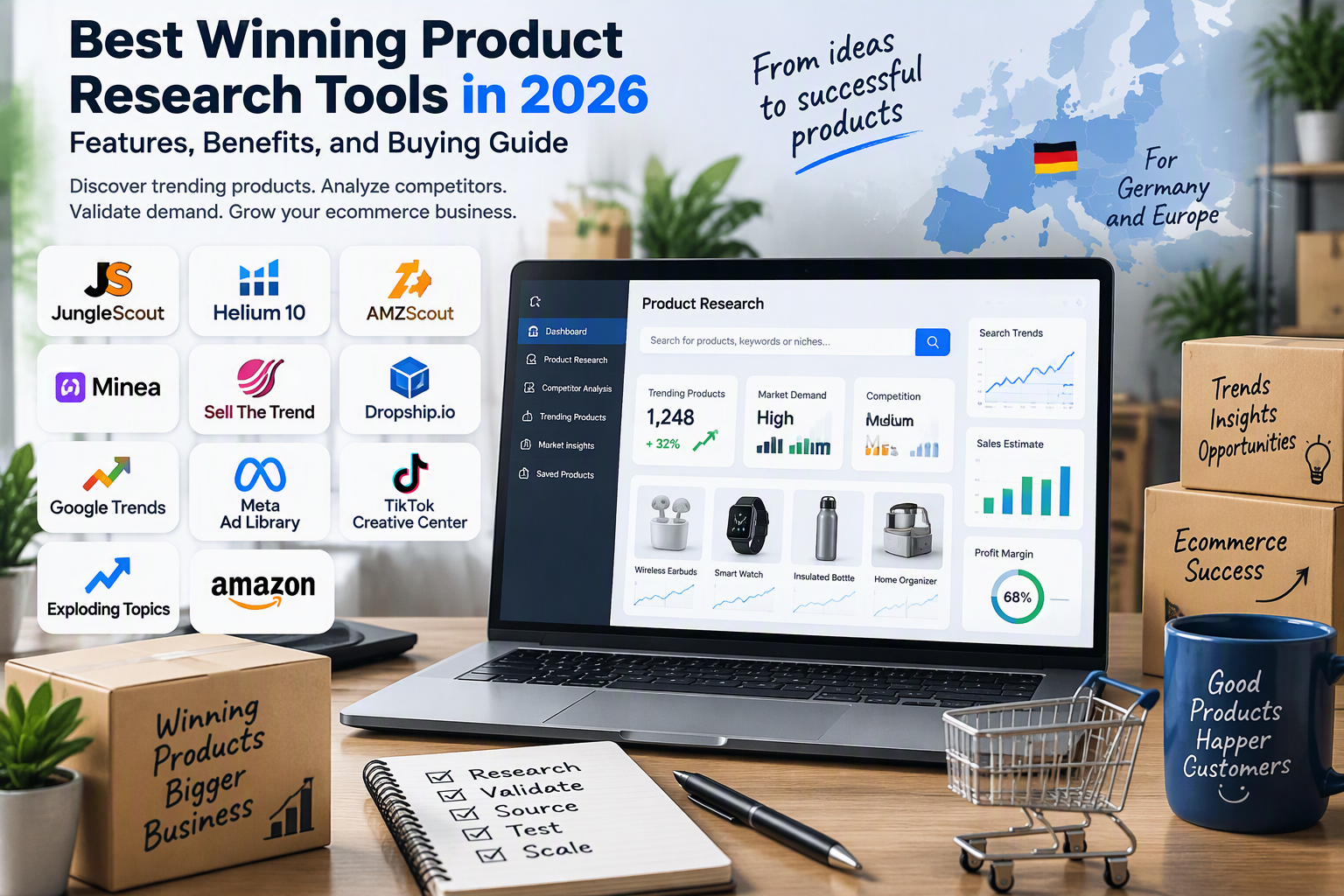
Best Winning Product Research Tools in 2026: Features, Benefits, and Buying Guide
to Winning Product Research Tools
Finding winning products is one of the most important steps in building a successful ecommerce business. Whether you sell through Shopify, Amazon, eBay, TikTok Shop, or your own online store, choosing products with genuine customer demand can help you make better business decisions and reduce unnecessary expenses.
The best winning product research tools in 2026 help sellers discover trending products, analyze competitors, evaluate market demand, monitor advertising activity, and estimate potential profitability. Instead of relying entirely on guesswork, entrepreneurs can use market data and consumer trends to identify promising opportunities.
However, a popular product is not automatically a profitable one. Competition, supplier prices, shipping costs, advertising expenses, product quality, and customer expectations all influence business results. Effective product research combines several sources of information rather than relying on a single tool or sales estimate.
This guide explores the best product research tools for ecommerce and dropshipping in 2026, including their features, advantages, limitations, and ideal uses. It also explains how to validate product ideas, estimate profit margins, and choose appropriate tools for businesses targeting Germany and other European markets.
1. Jungle Scout: Product Research for Amazon Sellers
Jungle Scout is a product research and business analytics platform designed primarily for Amazon sellers. It helps entrepreneurs investigate product opportunities, evaluate competition, and understand potential demand within the Amazon marketplace.
For sellers planning to launch products through Amazon Germany or other supported Amazon marketplaces, Jungle Scout can provide useful research capabilities before they invest in inventory.
Main Features and Benefits
Jungle Scout offers product research tools, keyword research, competitor analysis, sales estimates, and other features that can help sellers evaluate marketplace opportunities. Available functions depend on the selected subscription and current product offering.
Product research tools can help users identify items that appear to have demand and compare opportunities across different product categories. Keyword research can also help sellers understand what shoppers search for when looking for particular products.
Competitor analysis can provide additional context about product listings, pricing, and market positioning. This information may help businesses identify opportunities to improve product descriptions, differentiate their offers, or serve a specific customer segment.
One major advantage of Jungle Scout is its focus on the Amazon selling ecosystem. Sellers can concentrate on marketplace-specific research instead of combining several unrelated tools for every task.
However, sales figures and demand indicators should be treated as estimates rather than guaranteed results. Sellers should also account for Amazon fees, advertising, returns, storage, shipping, and product sourcing costs.
Best for: Amazon FBA sellers, private-label businesses, and entrepreneurs researching products for Amazon marketplaces.
Official website: https://www.junglescout.com/
2. Helium 10: Product Discovery and Amazon Business Analytics
Helium 10 is an ecommerce software suite primarily associated with Amazon selling. It provides tools for product research, keyword analysis, listing optimization, and other aspects of marketplace operations.
It can be useful for sellers who want to combine product discovery with research into how customers search for and evaluate products.
Main Features and Benefits
Depending on the selected plan, Helium 10 provides product research tools, keyword discovery, listing analysis, competitor research, and business analytics.
Product research features can help users explore marketplace categories and identify potential opportunities based on available sales and competition indicators.
Keyword research can help sellers discover relevant search terms and understand how shoppers describe their needs. This information can support product selection and the development of informative product listings.
Listing analysis tools can also help sellers evaluate their own content and identify areas for improvement.
One advantage is that several research and optimization functions are available within the same ecosystem. This can reduce the need to switch between multiple applications during product evaluation.
However, the range of available features may be more than a beginner needs. Users should compare subscription plans and confirm which tools are included before paying.
Best for: Amazon sellers who want product research, keyword analysis, listing optimization, and business management tools in one platform.
Official website: https://www.helium10.com/
3. AMZScout: Product Research for Beginners and Growing Sellers
AMZScout offers product research tools designed to help Amazon sellers evaluate product opportunities and understand marketplace competition.
Its tools can be useful for entrepreneurs who want to investigate potential products before purchasing stock or developing a private-label brand.
Main Features and Benefits
AMZScout provides product research and analysis features that may include product databases, sales estimates, competition indicators, keyword research, and product-related browser tools.
These features can help sellers compare products, investigate demand, and identify categories that deserve further research.
Browser-based research tools can also make it more convenient to evaluate product information while browsing supported marketplace pages.
For beginners, a structured product research process can make it easier to compare several ideas instead of choosing the first product that looks attractive.
Another benefit is the ability to investigate potential opportunities without immediately committing to inventory purchases.
However, product estimates are not guarantees of future sales. Sellers should compare the available data with actual marketplace conditions, supplier quotations, competition, and total operating costs.
Best for: Beginner Amazon sellers, small ecommerce businesses, and entrepreneurs who want structured product research.
Official website: https://amzscout.net/
4. Minea: Discovering Products Through Advertising Trends
Minea is a product research platform that focuses on advertising intelligence and ecommerce product discovery. It can help sellers investigate products promoted through supported advertising channels and identify marketing approaches worth studying.
This approach is especially relevant to dropshipping businesses and online retailers that discover product ideas through social media advertising.
Main Features and Benefits
Minea offers advertising research and product discovery features, with coverage and functionality depending on the subscription and supported platforms.
Users can investigate advertisements, explore products being promoted, and study different creative approaches used by ecommerce businesses.
Advertising research can provide clues about how sellers present a product, which benefits they emphasize, and what types of promotional messages appear repeatedly.
For example, if multiple advertisers promote products that solve a similar household problem, a seller may investigate whether the category has broader customer demand.
Minea can also help users organize product research around particular niches or advertising channels.
However, the presence of an advertisement does not prove that the product is profitable. Advertisers may be testing an idea, losing money, or targeting a market that differs from yours.
Best for: Dropshippers, social commerce sellers, and entrepreneurs researching products through online advertisements.
Official website: https://www.minea.com/
5. Sell The Trend: Product Discovery for Dropshipping
Sell The Trend is an ecommerce research platform designed to help entrepreneurs explore product ideas and investigate opportunities for dropshipping businesses.
It can be useful for sellers who want to combine product discovery with selected ecommerce research and store-related features.
Main Features and Benefits
Sell The Trend offers product discovery and market research functions, with available capabilities depending on the current plan.
Its research workflow can help users explore product ideas, investigate supplier-related information, and review indicators that may suggest customer interest.
The platform is designed to support entrepreneurs looking for products to test in an online store rather than relying entirely on manual browsing.
A structured research process can help sellers compare product ideas according to their audience, price, competition, and potential sales channels.
Some available plans may also include additional ecommerce tools that support the wider selling process.
However, suggested products should be treated as candidates for further investigation, not guaranteed winners. Before launching a product, sellers should confirm supplier reliability, delivery times, product quality, and the actual costs of fulfilling orders.
Best for: Dropshipping beginners, Shopify entrepreneurs, and online retailers who want product discovery tools in a connected workflow.
Official website: https://www.sellthetrend.com/
6. Dropship.io: Competitor and Product Research
Dropship.io is a product research platform designed for ecommerce sellers who want to investigate products and analyze information about online stores.
It can help entrepreneurs explore what other sellers offer and identify product ideas that may deserve further testing.
Main Features and Benefits
Dropship.io provides research tools that can include product discovery, competitor store analysis, and product-related tracking features. The precise capabilities depend on the current subscription.
Competitor research can help sellers understand how products are presented, which categories appear frequently, and how stores organize their product ranges.
This information can support market positioning. For example, a seller may discover that a product category has many similar offers but few listings that clearly address a particular customer need.
Research tools can also help users create a shortlist of products for additional validation.
However, third-party store analytics may rely on estimates or indirect signals. Estimated revenue should never be treated as verified financial information unless supported by reliable evidence.
Best for: Dropshippers, Shopify store owners, and sellers researching competitor products and store strategies.
Official website: https://www.dropship.io/
7. Google Trends: Free Product Demand Research
Google Trends is a free research tool that helps users explore how search interest changes over time for selected terms and topics.
It is especially useful for determining whether interest in a product category appears to be increasing, declining, seasonal, or relatively stable.
Main Features and Benefits
Google Trends allows users to compare search terms, examine interest over different periods, and explore geographic patterns where data is available.
For example, a seller researching reusable water bottles could compare related search terms and investigate whether interest changes around particular seasons.
Geographic filtering can help businesses compare search interest in Germany, France, Italy, Spain, and other markets.
This is particularly valuable for entrepreneurs planning to sell across Europe, because a product that attracts attention in one country may receive less interest in another.
Google Trends is also useful for distinguishing temporary spikes from longer-term patterns. A brief increase in interest does not necessarily indicate sustainable demand.
One of its greatest advantages is accessibility. Entrepreneurs can begin researching ideas without paying for a specialized product research subscription.
However, Google Trends uses normalized search-interest data rather than providing a direct count of product sales. It should be combined with marketplace research, competitor analysis, and supplier information.
Best for: Beginners, budget-conscious sellers, content-driven ecommerce businesses, and anyone who wants to validate demand before investing.
Official website: https://trends.google.com/trends/
8. Meta Ad Library: Researching Competitor Advertisements
Meta Ad Library is a searchable advertising resource that allows users to explore advertisements running across supported Meta platforms.
It can help ecommerce entrepreneurs understand how businesses promote products and which marketing messages appear in their advertising.
Main Features and Benefits
Users can search for advertisements and investigate available information about advertisers, creative formats, and campaign activity.
For product research, the library can help identify brands promoting products within a particular category. Sellers can examine how advertisements demonstrate product benefits, explain common problems, or communicate offers.
This research may also reveal different ways to position a product for a specific audience.
For example, a seller investigating home organization products could study how advertisers demonstrate storage solutions in small apartments or family homes.
The library is useful because it allows entrepreneurs to conduct advertising research without purchasing an expensive advertising intelligence subscription.
However, public advertising information does not normally establish an advertiser’s actual profit, conversion rate, or return on advertising spend. Some advertising data may also be unavailable or limited depending on the platform, country, and advertisement type.
Use the library to study market activity and creative ideas, not to assume that a product is profitable simply because an advertisement is visible.
Best for: Dropshippers, social media marketers, ecommerce entrepreneurs, and businesses researching product positioning.
Official website: https://www.facebook.com/ads/library/
9. TikTok Creative Center: Discovering Products and Marketing Trends
TikTok Creative Center provides resources for exploring advertising creative, popular content, and marketing trends across supported regions and categories.
It can be useful for sellers who rely on short-form video to introduce products and demonstrate how they work.
Main Features and Benefits
Available features may include advertising examples, creative insights, trending content information, and category-related inspiration.
Product researchers can use these resources to identify recurring themes in advertisements and understand how businesses present products visually.
For example, an entrepreneur researching kitchen accessories might study how video advertisements demonstrate a product’s function within a few seconds.
Creative research can also help sellers recognize common approaches to storytelling, demonstrations, and calls to action.
Another benefit is the opportunity to study marketing formats before investing in original advertising production.
However, popularity on a social platform does not necessarily translate into consistent purchases. A video may receive significant engagement without producing profitable sales.
Trends can also change quickly, so sellers should confirm that a product solves a real customer problem and remains commercially viable beyond a short-lived social media trend.
Best for: TikTok-focused ecommerce businesses, video advertisers, and entrepreneurs researching social commerce trends.
Official website: https://ads.tiktok.com/business/creativecenter/
10. Exploding Topics: Identifying Emerging Market Trends
Exploding Topics is a trend research platform designed to help users discover topics, products, and market interests that may be gaining attention.
It can be useful for businesses looking for emerging categories rather than focusing only on products that are already widely advertised.
Main Features and Benefits
The platform provides trend discovery and analysis features that help users investigate how interest in selected topics develops over time.
Trend information can support early-stage market research by highlighting subjects that may deserve further investigation.
For example, an entrepreneur interested in sustainable household products might use trend research to explore emerging consumer interests and then investigate specific product categories within that market.
This approach can help sellers develop a broader list of product ideas rather than copying products that are already common across ecommerce stores.
The platform may also be useful for content planning and identifying subjects that could support a long-term product range.
However, an emerging trend is not necessarily a viable business opportunity. The size of the addressable market, willingness to pay, competition, supplier availability, and operating costs still need to be evaluated.
Best for: Entrepreneurs exploring emerging niches, ecommerce brands planning new product categories, and businesses conducting long-term market research.
Official website: https://explodingtopics.com/
11. Amazon Best Sellers and Movers & Shakers: Marketplace-Based Product Research
Amazon provides several marketplace sections that can help sellers observe product popularity and changes in category rankings.
These resources are particularly relevant to entrepreneurs researching products for Amazon or looking for ideas based on visible marketplace activity.
Main Features and Benefits
Amazon Best Sellers lists popular products within supported categories, while Movers & Shakers highlights products experiencing significant changes in sales rank over a specified period.
These pages can help researchers identify product categories attracting attention and explore how products are positioned in the marketplace.
Product pages also provide useful information about prices, specifications, customer reviews, and competing offers.
Reviews can reveal recurring complaints or unmet customer needs. For example, shoppers may repeatedly mention that a product is difficult to clean, too small, or poorly packaged. These observations can help a seller identify opportunities to improve a product or select a better supplier.
However, ranking changes do not guarantee that a product will remain popular. Rankings can fluctuate because of promotions, seasonal demand, price changes, or other factors.
Amazon research should therefore be combined with demand analysis, competition assessment, and a realistic calculation of profitability.
Best for: Amazon sellers, private-label entrepreneurs, and ecommerce businesses researching existing marketplace demand.
Official website: https://www.amazon.de/
12. How to Choose the Best Winning Product Research Tool
The best product research tool depends on your selling model, target marketplace, budget, and level of experience.
An Amazon FBA seller may benefit more from marketplace-specific research software, while a dropshipper may prioritize advertising intelligence and competitor store analysis. A beginner with a limited budget can often start with free research tools before subscribing to a paid platform.
Identify Your Selling Model
Start by determining where and how you intend to sell products.
If you plan to sell through Amazon, prioritize tools that provide useful marketplace data, keyword research, and competitor analysis.
If you operate a Shopify store or a dropshipping business, you may benefit more from product discovery, advertising research, and supplier evaluation tools.
For a business selling through multiple channels, choose tools that help you compare opportunities across the marketplaces relevant to your customers.
Check the Quality of Available Data
Research tools use different data sources and estimation methods.
Some focus on search interest, others analyze advertisements, and some estimate marketplace sales or competitor store activity.
Understand what each tool actually measures. Search popularity, advertisement activity, estimated sales, and actual profit are different indicators.
Prefer tools that explain their data sources and limitations clearly.
Compare Pricing and Subscription Terms
Paid tools may charge monthly or annual subscriptions, with different usage limits and feature levels.
Before subscribing, compare the functions included in each plan and determine whether you genuinely need them.
A free tool may be sufficient for early research, while a paid platform may become worthwhile once you investigate many products regularly.
Check trial periods, automatic renewal terms, cancellation procedures, and refund policies before entering payment details.
Evaluate Ease of Use
An effective research tool should make it easier to answer practical questions.
Can you identify potential demand? Can you compare competitors? Can you estimate costs? Can you investigate supplier quality? Can you determine whether the product suits your target market?
If a tool produces large amounts of data but does not help you make clearer decisions, it may not be the best option for your business.
Consider European Market Coverage
If you plan to sell in Germany or other European countries, make sure the research process reflects those markets.
Check local search interest, competitor pricing, shipping costs, customer expectations, language requirements, and relevant product regulations.
A product that performs well in the United States may not have the same demand or competitive conditions in Germany.
13. How to Identify a Potentially Winning Product
Finding a promising product requires more than discovering a popular advertisement or a highly ranked marketplace listing. A structured process can help you evaluate opportunities more carefully.
Step 1: Find a Product That Solves a Real Problem
Start by identifying products that address a clear need, simplify a task, improve convenience, or serve a specific customer group.
Products that are easy to explain and demonstrate may be easier to market, although success still depends on demand, price, quality, and competition.
Consider whether the product offers a meaningful advantage over existing alternatives.
Step 2: Validate Demand
Use Google Trends, marketplace rankings, keyword research, and relevant advertising resources to investigate whether customers are showing interest in the category.
Look for consistent signals across multiple sources rather than relying on one sudden increase in attention.
Investigate demand in the countries you intend to target. Compare Germany with other relevant European markets where appropriate.
Step 3: Analyze Competition
Search for similar products and examine how competing sellers position their offers.
Compare prices, product specifications, delivery times, customer reviews, product photography, and the quality of product descriptions.
A crowded market is not automatically a bad opportunity, but it may require stronger differentiation or more competitive costs.
Look for genuine customer needs that existing offers do not adequately address.
Step 4: Verify Supplier Reliability
Before selecting a supplier, investigate product quality, communication, shipping times, minimum order quantities, return arrangements, and available documentation.
Request samples when appropriate, particularly if product quality cannot be assessed reliably through online information alone.
For European sales, consider whether the supplier can provide dependable delivery and the documentation required for the product category and destination.
Do not rely solely on promotional claims or supplier-provided sales estimates.
Step 5: Calculate the Real Profit Margin
A product’s selling price is not the same as its profit.
Calculate the expected revenue per order and subtract the relevant costs, including the product purchase price, shipping, packaging, marketplace fees, payment processing, advertising, expected returns, and other applicable expenses.
For example, if a product sells for €40 and the combined variable costs are €28, the contribution before fixed business expenses and taxes is €12 per sale.
That figure may change if advertising costs increase, customers return products, or shipping charges are higher than expected.
Use conservative assumptions and test whether the product remains viable under less favorable conditions.
Step 6: Test Before Scaling
Once you have validated the basic opportunity, consider a small and controlled test before investing heavily.
Depending on your business model, this may involve ordering samples, launching a limited inventory quantity, or testing a small advertising campaign.
Define what success means before the test begins. Relevant measures may include conversion rate, cost per acquisition, contribution margin, return rate, and customer feedback.
Avoid expanding an advertising budget simply because a product receives clicks or views. Evaluate whether the resulting sales are financially sustainable.
14. Important Metrics for Product Research
Understanding key metrics can help entrepreneurs distinguish an interesting product from a commercially viable opportunity.
Search Interest
Search interest indicates whether people are looking for a product or related topic.
Tools such as Google Trends can help compare search patterns, although they do not directly measure sales or guarantee purchase intent.
Competition Level
Competition analysis examines how many sellers offer similar products and how effectively they serve customers.
Consider not only the number of competitors but also their pricing, product quality, brand recognition, delivery options, and customer reviews.
Estimated Sales
Some research platforms estimate sales volumes or revenue for marketplace products and online stores.
These figures can help compare opportunities, but the accuracy varies by data source and methodology. Treat estimates as directional indicators rather than verified financial results.
Conversion Rate
Conversion rate measures the proportion of relevant visitors who complete a desired action, such as purchasing a product.
Actual conversion rates depend on traffic quality, product presentation, pricing, checkout experience, shipping, and customer trust.
Customer Acquisition Cost
Customer acquisition cost represents the cost of acquiring a customer through the relevant marketing activities.
For paid advertising, compare acquisition costs with the contribution margin generated by the order. A product can attract many sales while remaining unprofitable if advertising costs are too high.
Contribution Margin
Contribution margin is the amount remaining from revenue after subtracting the relevant variable costs.
It is an important measure because it helps determine how much a business has available to cover fixed expenses and generate profit.
Return Rate
Returns can reduce profitability through refund costs, shipping expenses, damaged goods, and additional customer service work.
Products with unclear specifications, inconsistent quality, or unrealistic advertising claims may generate more customer dissatisfaction.
Research customer reviews and supplier quality before choosing a product.
15. Product Research for Germany and the European Union
Businesses targeting Germany and other EU countries should evaluate market demand alongside delivery, customer expectations, and applicable legal requirements.
Local Demand and Language
Search terms, product preferences, and customer expectations can vary by country.
A product that attracts interest in Germany may require different positioning in France, Italy, or Spain.
Use local-language keyword research and review competing offers in the markets you plan to serve.
Accurate translations and clear product descriptions can help customers understand what they are buying.
Shipping and Fulfillment Costs
Shipping expenses can significantly affect product profitability.
Compare delivery costs, expected delivery times, packaging requirements, and return arrangements before selecting a supplier.
If you sell to several European countries, investigate whether the same product can be delivered economically across your target markets.
Product Safety and Compliance
Some product categories are subject to specific safety, labeling, documentation, or conformity requirements.
Depending on the product, relevant obligations may include CE marking, restrictions on certain materials, electrical safety rules, or other applicable European requirements.
Do not assume that a product is legally suitable for sale simply because it is available from a supplier or advertised on a marketplace.
Verify the requirements that apply to the specific product and your role in placing it on the market.
Consumer Rights and Returns
Businesses selling to European consumers may have obligations relating to product information, delivery, warranties, and cancellation rights.
The exact requirements depend on the product, transaction, destination, and applicable law.
Product research should therefore include the potential cost and operational impact of returns, customer support, and consumer protection obligations.
Intellectual Property
Avoid selecting products that depend on unauthorized use of protected brand names, logos, copyrighted designs, patented inventions, or other intellectual property.
A product that resembles a popular branded item may still create legal risks if it infringes protected rights.
Choose legitimate suppliers and verify relevant permissions and product documentation where necessary.
For product photography and marketing content, use original materials, properly licensed assets, or content you have permission to use. Do not copy competitors’ photographs, descriptions, or advertisements without authorization.
16. Amazon Germany and European Resources for Product Research
Although most specialized product research tools are software subscriptions rather than physical products, Amazon marketplaces can help entrepreneurs investigate product categories, compare equipment, and find educational resources.
The following links lead to search pages that can be used to explore relevant books and learning materials. They are not endorsements of individual products, and availability may vary by country.
Ecommerce and Product Research Books
Books about ecommerce, market research, consumer behavior, and business planning can help beginners develop a more structured approach to product selection.
Look for recent editions with practical guidance on demand validation, competitor analysis, pricing, supplier evaluation, and financial planning.
Amazon Germany: https://www.amazon.de/s?k=ecommerce+product+research+books
Amazon France: https://www.amazon.fr/s?k=livres+etude+de+marche+ecommerce
Amazon Italy: https://www.amazon.it/s?k=libri+ricerca+di+mercato+ecommerce
Amazon Spain: https://www.amazon.es/s?k=libros+investigacion+de+mercado+ecommerce
Market Research and Business Planning Books
Market research books can help entrepreneurs understand customer needs, assess competitors, and evaluate whether a business idea has a realistic target audience.
Choose educational materials that explain research methods and financial evaluation rather than promising guaranteed profits.
Amazon Germany: https://www.amazon.de/s?k=market+research+business+books
Amazon France: https://www.amazon.fr/s?k=livres+etude+de+marche
Amazon Italy: https://www.amazon.it/s?k=libri+ricerca+di+mercato
Amazon Spain: https://www.amazon.es/s?k=libros+investigacion+de+mercados
These links lead to Amazon search results, not guaranteed listings for specific books or products. Prices, availability, sellers, and delivery options can change. Check product details before purchasing.
17. Common Product Research Mistakes to Avoid
One of the most common mistakes is choosing a product because it is popular on social media. Views and engagement do not necessarily indicate strong buying intent or profitable sales.
Another mistake is relying on one research tool. Different platforms measure different signals, and no single source provides a complete picture of customer demand, competition, supplier quality, and profit.
Ignoring total costs can also lead to poor decisions. Product prices must be evaluated alongside shipping, marketplace fees, payment processing, advertising, returns, and other relevant expenses.
Some sellers also underestimate competition. A product may have high demand but already be offered by many established businesses with better prices, stronger brands, or faster delivery.
Copying another seller’s product page, images, videos, or branding can create copyright or intellectual property problems. Research competitors to understand the market, but create original product descriptions and marketing materials.
Finally, avoid investing heavily before validating product quality and customer demand. Small tests, supplier checks, and realistic financial calculations can help reduce unnecessary risk.
18. How to Build a Repeatable Product Research Strategy
A repeatable product research strategy helps businesses evaluate opportunities consistently instead of chasing every new trend.
Start by selecting a small number of product categories that match your budget, knowledge, and target customers. Define the type of product you are looking for and the commercial requirements it must meet.
Use free research tools to generate initial ideas. Google Trends can help evaluate search interest, marketplace pages can reveal competing products, and advertising libraries can show how businesses present similar offers.
Next, use a specialized research platform if it provides information that meaningfully improves your decisions. Amazon-focused sellers may prioritize Jungle Scout, Helium 10, or AMZScout, while dropshippers may investigate Minea, Sell The Trend, or Dropship.io.
Create a shortlist and compare each candidate using consistent criteria, including demand, competition, supplier reliability, delivery costs, differentiation, and estimated contribution margin.
Verify supplier claims and examine the product’s legal and regulatory requirements before placing a substantial order.
Finally, run controlled tests and record the results. Keep track of product costs, advertising expenses, customer feedback, sales, returns, and operational problems.
Over time, this process can help you identify which product characteristics work best for your business and reduce dependence on unverified claims about winning products.
Conclusion
The best winning product research tools in 2026 help ecommerce entrepreneurs investigate demand, analyze competitors, discover trends, and evaluate product opportunities before making significant investments.
Jungle Scout, Helium 10, and AMZScout are particularly relevant to Amazon sellers who need marketplace research and product analysis. Minea, Sell The Trend, and Dropship.io can help dropshippers explore products and competitor activity. Google Trends, Meta Ad Library, TikTok Creative Center, Exploding Topics, and Amazon marketplace resources provide additional ways to research customer interests and commercial opportunities.
The right choice depends on your selling model, budget, target market, and research needs. Beginners can start with free resources and add paid software when the additional information justifies the cost.
Most importantly, no research tool can guarantee a winning product. Successful product selection requires validating demand, examining competition, checking supplier quality, calculating realistic profit margins, and testing products before scaling.
For businesses targeting Germany and other European markets, local demand, shipping costs, product safety, consumer protection, and intellectual property requirements should all be part of the evaluation process.
By combining reliable research tools with original marketing content, careful financial analysis, and controlled testing, ecommerce businesses can make more informed product decisions and build a stronger foundation for sustainable growth.


