
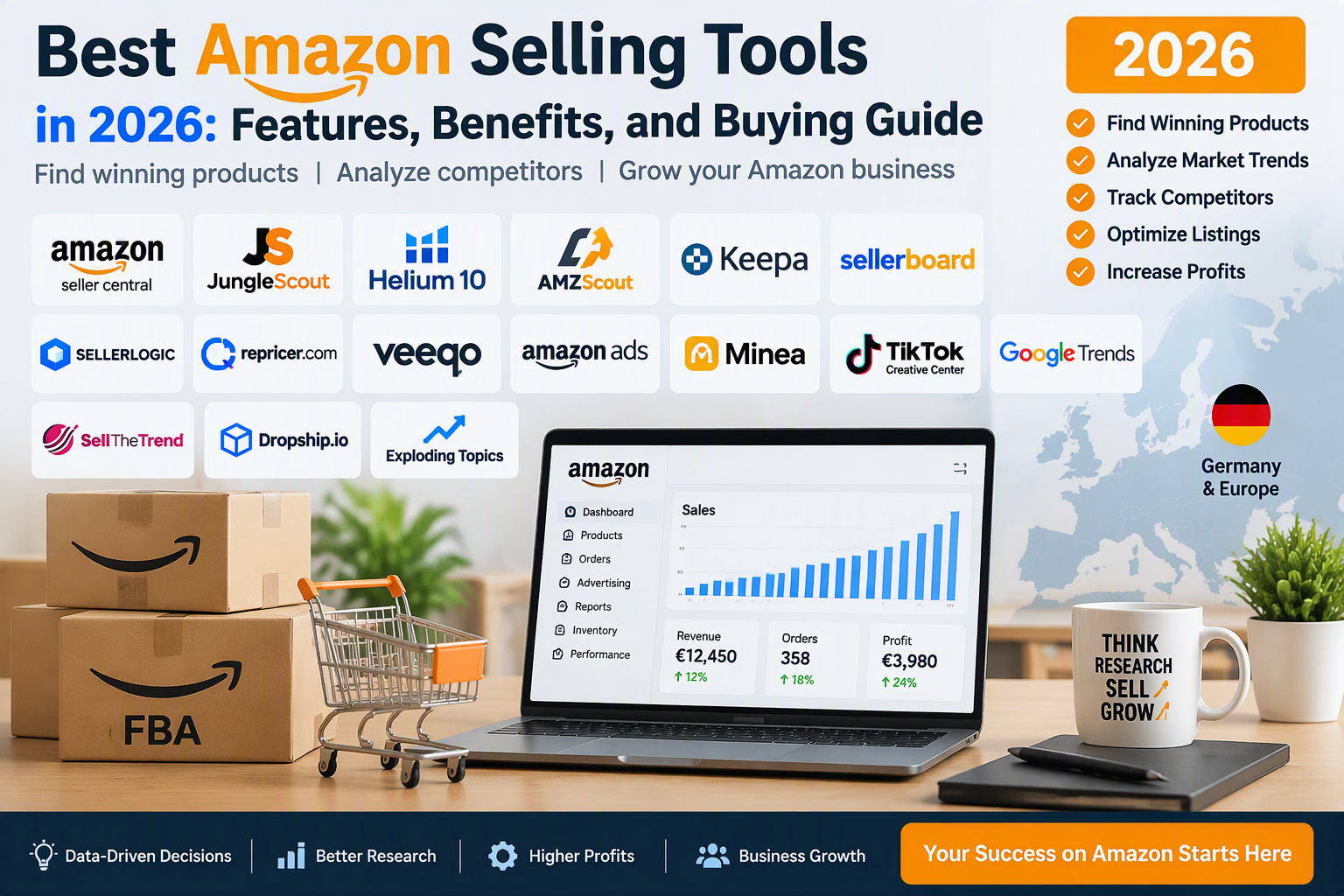
Best Amazon Selling Tools in 2026: Features, Benefits, and Buying Guide
to the Best Amazon Selling Tools
Selling on Amazon can be an effective way to reach customers in Germany and other European markets, but managing a successful Amazon business requires more than listing products. Sellers need to research product demand, optimize listings, monitor competitors, manage inventory, calculate profits, advertise products, and process orders efficiently.
The best Amazon selling tools in 2026 help sellers simplify these tasks, make data-informed decisions, and organize their businesses more effectively. Some tools focus on product research and keyword analysis, while others specialize in pricing, advertising, inventory management, financial reporting, and order fulfillment.
Choosing the right tools depends on your business model, budget, experience, and target marketplace. A beginner selling a few products may need only Amazon’s free seller tools and a basic profit calculator. A growing business with hundreds of listings may benefit from specialized software that automates repetitive tasks and provides more detailed analytics.
This guide explores some of the best Amazon selling tools, their main features, benefits, limitations, and suitable uses. It also includes useful Amazon Germany and European marketplace links for researching business equipment and educational resources.
1. Amazon Seller Central: Essential Tools for Every Seller
Amazon Seller Central is the main platform sellers use to manage their Amazon businesses. It provides access to product listings, orders, inventory, advertising, performance information, and other seller services available for their accounts.
For anyone starting an Amazon business, Seller Central should be the first tool to learn before purchasing additional software.
Main Features and Benefits
Seller Central allows sellers to create and manage product listings, update prices, monitor orders, review inventory information, and access business reports. Available features depend on the seller’s account, marketplace, selling plan, and product category.
The platform also provides access to advertising services and other tools that can help sellers promote products and manage their marketplace operations.
One important advantage is that Seller Central connects sellers directly to Amazon’s own systems. This can help reduce the need to rely on third-party applications for basic tasks.
Sellers can also explore Amazon’s official Selling Partner Appstore to discover compatible third-party tools for product research, pricing, inventory management, analytics, and other business functions.
However, the platform has a learning curve, especially for sellers managing several marketplaces or a large product catalog. New sellers should become familiar with the available reports, policies, fees, and account performance requirements.
Best for: All Amazon sellers, including beginners, private-label businesses, wholesale sellers, and established ecommerce companies.
Official website: https://sellercentral.amazon.de/
2. Amazon Seller App: Managing Your Business on a Smartphone
The Amazon Seller App is a mobile application that helps eligible sellers monitor and manage parts of their Amazon business while away from a computer.
It can be useful for entrepreneurs who need quick access to sales information, product research, inventory details, and listing management.
Main Features and Benefits
Depending on the marketplace and account configuration, the app can help sellers review sales data, monitor orders, check product information, manage listings, and receive account notifications.
Product research functions may allow users to scan barcodes, search product identifiers, and investigate existing Amazon listings. These features can help sellers evaluate potential products while sourcing inventory or visiting suppliers.
The app can also provide convenient access to important business information without requiring sellers to sign in through a desktop browser for every routine check.
Another advantage is that it complements Seller Central rather than replacing it. Sellers can use the mobile app for quick tasks and return to the full web interface when they need more detailed reports or advanced settings.
Before relying on a particular feature, confirm that it is available for your marketplace and account.
Best for: Sellers who want mobile access to sales information, product research, notifications, and routine account management.
Official website: https://sell.amazon.de/programme/amazon-seller-app
3. Jungle Scout: Product Research and Market Analysis
Jungle Scout is a product research platform designed primarily for Amazon sellers. It helps entrepreneurs investigate product opportunities, estimate demand, analyze competition, and plan potential product launches.
It can be especially useful for sellers who want to research the market before investing money in inventory.
Main Features and Benefits
Jungle Scout offers product research tools, keyword research, competitor analysis, and business-related features. Available functions depend on the subscription and current product offering.
Product research tools can help users compare potential products and identify categories that may deserve further investigation. Keyword research can reveal search terms associated with customer demand, while competitor analysis can provide context about competing offers.
These features can help sellers evaluate whether a product category appears suitable for their business model and target audience.
Another advantage is its focus on Amazon-specific research. Sellers can investigate marketplace opportunities without assembling every research function from separate applications.
However, estimated sales figures and other analytical indicators are not guarantees of future performance. Before choosing a product, sellers should calculate the total cost of sourcing, shipping, storage, advertising, returns, and Amazon selling fees.
Best for: Amazon FBA sellers, private-label businesses, and entrepreneurs researching new products.
Official website: https://www.junglescout.com/
4. Helium 10: Product Research, Keywords, and Listing Optimization
Helium 10 is an Amazon selling software suite that combines several research and optimization functions. It can help sellers investigate product opportunities, discover keywords, improve listings, and monitor aspects of their business.
It is particularly relevant to sellers who want several Amazon-focused tools within one platform.
Main Features and Benefits
Depending on the subscription, Helium 10 may provide product research, keyword discovery, listing optimization, competitor analysis, and business analytics.
Keyword research tools help sellers identify search terms relevant to their products. This information can support the creation of informative titles, bullet points, descriptions, and other listing content.
Product research functions can help sellers compare potential opportunities, while listing analysis tools can highlight areas that may need improvement.
Using a connected suite can make research more organized because sellers can move between product discovery, keyword analysis, and listing optimization within the same software environment.
However, the number of available features can make the platform more complicated than necessary for beginners. Compare plans carefully and choose a subscription that matches your actual requirements.
Best for: Amazon sellers who need product research, keyword analysis, listing optimization, and business analytics.
Official website: https://www.helium10.com/
5. AMZScout: Product Research for New and Growing Sellers
AMZScout provides product research tools designed to help Amazon sellers evaluate market opportunities and investigate competing products.
It can be useful for entrepreneurs who want a structured process for comparing potential products before buying inventory.
Main Features and Benefits
AMZScout offers product research and analysis functions that may include product databases, sales estimates, keyword research, competition indicators, and browser-based research tools.
These features can help sellers compare products and investigate whether a category appears to have sufficient demand for further evaluation.
For beginners, product comparison tools can make it easier to organize research rather than relying on personal impressions or social media trends alone.
AMZScout can also support a more disciplined approach to product selection by encouraging sellers to compare multiple opportunities before committing to one.
Nevertheless, research estimates should be treated as indicators, not verified sales figures or promises of profitability. Sellers still need to evaluate supplier reliability, product quality, market competition, and all relevant costs.
Best for: Beginner Amazon sellers, small businesses, and entrepreneurs researching potential products.
Official website: https://amzscout.net/
6. Keepa: Price History and Product Tracking
Keepa is a product research and tracking service widely used by Amazon sellers and shoppers to examine historical product information.
It can be particularly useful for understanding how prices and other available product indicators change over time.
Main Features and Benefits
Keepa provides historical price charts and tracking features for supported Amazon products. Depending on the product and available data, users may be able to examine price changes, marketplace offers, and historical sales-rank information.
Price history can help sellers avoid making decisions based on a single temporary price. For example, a product may appear attractive during a short promotion but normally sell at a different price.
Historical information can also help sellers investigate seasonal patterns and evaluate whether a product’s price has remained relatively stable.
One important benefit is that sellers can use historical data to support more informed sourcing and pricing decisions.
However, historical performance does not guarantee future sales or profitability. The available information may also vary by marketplace, product, and subscription level.
Best for: Amazon sellers, online arbitrage researchers, wholesale sellers, and businesses monitoring product prices.
Official website: https://keepa.com/
7. Sellerboard: Profit Analytics and Financial Monitoring
Sellerboard is an Amazon seller analytics platform designed to help businesses understand profitability and monitor financial performance.
It can be useful for sellers who want to look beyond sales revenue and understand how different expenses affect their actual business results.
Main Features and Benefits
Depending on the selected plan, Sellerboard offers profit analytics, financial reporting, inventory-related tools, and other seller management features.
Profit dashboards can help users review sales and account for relevant expenses, including marketplace fees, advertising costs, refunds, and product costs when the information is configured correctly.
This can help sellers identify products that generate revenue but contribute less profit than expected.
Financial monitoring can also support decisions about pricing, advertising budgets, and inventory investment.
One major advantage is the focus on profitability rather than sales volume alone. A product with high revenue is not necessarily the most financially attractive product.
However, the quality of the results depends on accurate cost data and correct settings. Sellers should verify reports against Amazon settlement statements, invoices, and other financial records.
Best for: Amazon sellers who need detailed profit tracking, financial reporting, and business performance analysis.
Official website: https://sellerboard.com/
8. SELLERLOGIC: Repricing and FBA Business Tools
SELLERLOGIC provides software for Amazon sellers, including tools associated with automated pricing, financial analysis, and fulfillment-related business processes.
It can be useful for sellers who want to reduce repetitive work and monitor parts of their Amazon operations more efficiently.
Main Features and Benefits
SELLERLOGIC offers tools such as repricing software and FBA-related analytics, with availability depending on the product and subscription.
Repricing tools can adjust product prices according to configured rules and market conditions. This may help sellers respond more efficiently to competitor price changes.
Its FBA-related tools can help sellers investigate certain fulfillment and financial issues, depending on the selected service.
Automation can be valuable for businesses managing many listings, where changing every price manually would consume significant time.
However, repricing should not be based on the lowest available price alone. Sellers need minimum-price rules that account for product costs, marketplace fees, shipping, and desired profit margins.
Before subscribing, compare supported marketplaces, pricing, feature limitations, and integration requirements.
Best for: Amazon sellers who want repricing automation and selected FBA business management tools.
Official website: https://www.sellerlogic.com/
9. Veeqo: Shipping, Inventory, and Order Management
Veeqo provides ecommerce operations tools designed to help eligible businesses manage shipping, orders, and inventory across supported sales channels.
It can be useful for sellers who operate on Amazon alongside other online stores or marketplaces.
Main Features and Benefits
Depending on the available service and configuration, Veeqo can support order management, shipping workflows, inventory-related operations, and integrations with supported ecommerce platforms.
Centralized order processing can help sellers organize incoming orders and reduce the need to switch between several systems.
Shipping tools can also help streamline the preparation of orders and tracking information, while inventory features can support more consistent stock management across connected channels.
For businesses that sell the same products on Amazon and other platforms, inventory synchronization can help reduce the risk of accepting orders for unavailable stock when configured correctly.
However, sellers should verify current service availability, carrier coverage, supported integrations, and pricing conditions for their business location.
Best for: Multichannel sellers who need shipping and order management alongside their Amazon operations.
Official website: https://www.veeqo.com/
10. Repricer.com: Automated Price Management
Repricer.com provides pricing automation software designed to help online sellers manage product prices according to configured strategies and marketplace conditions.
It can be useful for businesses operating in competitive product categories where prices change frequently.
Main Features and Benefits
Repricer.com offers repricing functions intended to automate price adjustments across supported marketplaces and sales channels.
Sellers can configure pricing rules to help respond to competitor offers and marketplace conditions without manually editing every listing.
Automated pricing may save time for sellers managing large catalogs and help them respond more consistently to market changes.
However, changing prices too aggressively can reduce profit margins. A product may win more orders while generating less profit if its price falls below a sustainable level.
Set appropriate minimum and maximum prices, consider all relevant costs, and regularly review the results of any automated pricing strategy.
Before choosing a subscription, check supported marketplaces, integrations, rule options, and current pricing.
Best for: Sellers managing many products in competitive categories who need automated pricing controls.
Official website: https://www.repricer.com/
11. Amazon Advertising Console: Promoting Products on Amazon
Amazon Advertising Console provides access to advertising tools for eligible sellers and other advertisers. It helps businesses create and manage campaigns designed to increase product visibility within supported Amazon environments.
Advertising can be an important part of launching products and reaching customers, but campaign performance depends on product quality, pricing, competition, and campaign management.
Main Features and Benefits
Available advertising options may include Sponsored Products and other campaign types, depending on the advertiser’s eligibility and marketplace.
Sponsored Products campaigns can help promote eligible listings in Amazon shopping results and product pages.
Advertising reports can provide information about impressions, clicks, spend, attributed sales, and other campaign metrics.
These reports can help sellers evaluate which keywords or targeting approaches may deserve further testing.
However, advertising results should be assessed against profit margins rather than sales alone. A campaign may generate attributed revenue while still losing money after advertising costs and other expenses.
Start with a defined budget, monitor campaign performance, and adjust targeting based on meaningful results. Ensure that your advertised listings have accurate information, competitive offers, and suitable inventory availability.
Best for: Sellers who want to promote eligible products and measure advertising performance on Amazon.
Official website: https://advertising.amazon.com/
12. Amazon Selling Partner Appstore: Finding Compatible Third-Party Tools
The Amazon Selling Partner Appstore is an official directory where sellers can discover software that integrates with supported Amazon selling services.
It includes applications covering different business functions, allowing sellers to compare options rather than relying on a single software provider.
Main Features and Benefits
The Appstore includes categories such as product research, listing management, automated pricing, inventory and shipping, advertising optimization, financial reporting, accounting, and ecommerce management.
This makes it useful for businesses looking for a tool that addresses a specific operational problem.
For example, a seller who needs better profit reporting can focus on analytics applications, while a seller struggling with stock synchronization can investigate inventory management tools.
Using the directory can also help sellers identify applications designed to work with Amazon’s selling ecosystem.
However, the presence of an application in the directory does not mean it is the best choice for every business. Review pricing, permissions, marketplace coverage, customer feedback, data access, and cancellation terms before connecting an application to your account.
Best for: Sellers looking for compatible third-party software for specific Amazon business tasks.
Official website: https://sellercentral.amazon.de/apps/store/
13. How to Choose the Best Amazon Selling Tools
The best Amazon selling tools depend on your business model, current challenges, product range, and available budget. Instead of subscribing to several platforms immediately, identify the tasks that need the most improvement.
Product Research and Market Validation
If you are still deciding what to sell, prioritize product research tools that help you evaluate demand, competition, pricing history, and relevant keywords.
Jungle Scout, Helium 10, AMZScout, and Keepa provide different types of marketplace research information. Compare their capabilities and decide which data is most useful for your intended business model.
Use more than one source when validating an opportunity, and remember that sales estimates and historical information cannot guarantee future results.
Listing Optimization
If you already have products but struggle to attract relevant shoppers, investigate keyword research and listing optimization tools.
Accurate titles, clear descriptions, relevant search terms, and useful product information can help customers understand your offer.
Avoid keyword stuffing or making unsupported claims. Listing content should accurately represent the product and follow the requirements that apply to the relevant category and marketplace.
Pricing and Profitability
If your products sell but profits remain unclear, prioritize financial analytics and pricing tools.
Profit software can help organize business data, while repricing applications can automate selected price changes.
Before using automated pricing, calculate your minimum sustainable price and account for all relevant fees and operating costs.
Inventory and Shipping
If you process many orders or sell across several channels, inventory and shipping software may provide more value than additional product research subscriptions.
Look for reliable integrations, accurate inventory synchronization, shipping automation, and reporting features that fit your workflow.
Confirm that the service supports your carriers, sales channels, and target countries.
Advertising Management
If you run paid campaigns, use Amazon’s advertising reports and consider additional software only when it provides useful capabilities beyond the built-in tools.
Track advertising spend alongside attributed sales and product-level profitability. Avoid increasing budgets solely because impressions, clicks, or revenue are rising.
Budget and Ease of Use
Compare subscription prices, feature limits, training requirements, and cancellation terms.
A low-cost or free tool may be sufficient when your catalog is small. More advanced software may become worthwhile as order volumes, advertising activity, or inventory complexity increase.
Choose tools that solve specific problems and regularly review whether they provide enough value to justify their cost.
14. Important Metrics Every Amazon Seller Should Monitor
Amazon sellers should track several key metrics to understand business performance and make informed decisions.
Revenue and Units Sold
Revenue shows the value of sales over a selected period, while units sold indicate the quantity of products purchased.
These measures help sellers monitor activity, but neither reveals profitability on its own.
Net Profit and Contribution Margin
Profit calculations should include the relevant product costs, Amazon fees, shipping, advertising, refunds, storage, and other business expenses.
Contribution margin helps show how much remains after relevant variable costs are deducted from revenue.
Use accurate cost records and verify analytics reports against actual financial statements.
Conversion Rate
Conversion rate measures how often shoppers complete a purchase after viewing a listing or visiting a relevant page, according to the metric being measured.
Product presentation, price, availability, delivery expectations, reviews, and customer trust can all influence conversion.
Interpret the metric within its context rather than assuming one universal conversion rate is appropriate for every product.
Advertising Cost of Sales
Advertising cost of sales, commonly called ACoS, compares advertising spend with attributed advertising sales.
A lower ACoS is not automatically better in every situation, because campaign goals, profit margins, and the role of advertising in the customer journey vary.
Evaluate ACoS alongside contribution margin and other business objectives.
Inventory Turnover
Inventory turnover helps sellers understand how quickly stock moves through the business over a selected period.
Slow-moving stock can tie up capital and may create additional storage costs. Insufficient stock can also cause missed sales opportunities.
Use inventory reports and realistic demand forecasts to plan replenishment.
Return and Refund Rates
Returns and refunds can reduce profit and create additional operational work.
Monitor return patterns and investigate recurring complaints. Product quality, inaccurate descriptions, packaging, sizing information, and delivery problems may all contribute to customer dissatisfaction.
15. Selling on Amazon Germany and Other European Marketplaces
Sellers targeting Germany and the European Union should consider marketplace differences, fulfillment costs, language requirements, and applicable legal obligations when planning their businesses.
Localize Product Listings
Customers in different European countries may use different languages, search terms, and product descriptions.
When expanding to another marketplace, prepare accurate localized content and review the terminology customers use in that country.
Do not simply translate a listing without checking whether the wording is natural, accurate, and appropriate for the product.
Calculate Marketplace-Specific Costs
Selling costs may vary according to product category, fulfillment method, destination, storage requirements, and other factors.
Calculate profitability for each marketplace rather than assuming that a product with a healthy margin in Germany will generate the same result in France, Italy, or Spain.
Review the applicable Amazon fee schedules and fulfillment charges before setting prices.
Understand Fulfillment Options
Eligible sellers may choose between fulfilling orders themselves and using Amazon fulfillment services, subject to the requirements of the relevant program.
Self-fulfillment provides more direct control over storage and shipping, while fulfillment services can handle certain logistics activities in exchange for applicable fees.
Compare the operational requirements and total costs of each approach before deciding.
Check Product Compliance
Certain products require specific safety information, labeling, documentation, or conformity procedures before they can be sold in European markets.
Requirements depend on the product category, country, and the seller’s role in the supply chain.
Verify applicable obligations before sourcing inventory or publishing a listing. Do not assume that a product is compliant simply because it is available from a supplier or already appears on a marketplace.
Protect Intellectual Property
Sellers should avoid unauthorized use of protected trademarks, logos, copyrighted photographs, product descriptions, patented inventions, or protected designs.
Use original listing content, properly licensed images, and product information you have permission to publish.
When sourcing branded goods, investigate authenticity and supplier documentation. Do not assume that a product is safe to list simply because a supplier offers it.
Amazon’s listing rules and intellectual property procedures should be reviewed before launching products that could raise ownership or authenticity concerns.
Consider Tax and Data Protection Requirements
Selling across European borders can create tax, reporting, and administrative obligations depending on the business structure and fulfillment arrangements.
Businesses may also process customer information through seller software and connected applications. Review the relevant privacy and data protection responsibilities, including applicable GDPR requirements.
Software tools can help organize records, but they do not automatically guarantee legal or tax compliance.
16. Amazon Germany and EU Links for Seller Equipment and Learning Resources
Amazon selling tools are primarily software services, so they are generally purchased through the provider’s official website rather than as physical products on Amazon. However, Amazon Germany and other European marketplaces can be useful for finding equipment that supports product preparation, inventory management, and shipping.
The following links lead to Amazon search results, not guaranteed listings for specific products. Availability, prices, sellers, and delivery options may change.
Barcode Scanners for Inventory Management
Barcode scanners can help sellers identify products, record stock movements, and verify items during picking and packing.
When comparing scanners, consider supported barcode types, connection options, scanning range, durability, and compatibility with your inventory software.
Amazon Germany: https://www.amazon.de/s?k=barcode+scanner+inventory
Amazon France: https://www.amazon.fr/s?k=scanner+code+barres+inventaire
Amazon Italy: https://www.amazon.it/s?k=lettore+codici+a+barre+inventario
Amazon Spain: https://www.amazon.es/s?k=lector+codigo+barras+inventario
Thermal Shipping Label Printers
Thermal label printers can help sellers print shipping labels and product labels efficiently. Many direct thermal models operate without ink or toner, although label type and printer compatibility should be checked.
Important specifications include supported label sizes, resolution, printing speed, connectivity, operating system compatibility, and software support.
Amazon Germany: https://www.amazon.de/s?k=thermal+shipping+label+printer
Amazon France: https://www.amazon.fr/s?k=imprimante+etiquettes+expedition+thermique
Amazon Italy: https://www.amazon.it/s?k=stampante+etichette+spedizione+termica
Amazon Spain: https://www.amazon.es/s?k=impresora+etiquetas+envio+termica
Digital Parcel Scales
Digital parcel scales help sellers measure package weight before dispatch. Accurate measurements are important when shipping costs depend on parcel weight and dimensions.
Consider maximum capacity, measurement precision, display readability, platform size, and measurement units before buying.
Amazon Germany: https://www.amazon.de/s?k=digital+parcel+scale
Amazon France: https://www.amazon.fr/s?k=balance+colis+numerique
Amazon Italy: https://www.amazon.it/s?k=bilancia+pesa+pacchi+digitale
Amazon Spain: https://www.amazon.es/s?k=bascula+digital+paquetes
Books About Amazon Selling and Ecommerce
Educational books can help new sellers understand product research, marketplace operations, pricing, inventory, and business planning.
Choose resources that provide realistic guidance about costs, competition, and operational requirements instead of promising guaranteed income.
Amazon Germany: https://www.amazon.de/s?k=Amazon+FBA+business+books
Amazon France: https://www.amazon.fr/s?k=livres+business+Amazon+FBA
Amazon Italy: https://www.amazon.it/s?k=libri+business+Amazon+FBA
Amazon Spain: https://www.amazon.es/s?k=libros+negocio+Amazon+FBA
Always check product specifications, software compatibility, current prices, and seller information before purchasing equipment or educational materials.
17. Common Mistakes to Avoid When Using Amazon Selling Tools
One common mistake is paying for several tools that perform nearly identical functions. This can increase costs without significantly improving decision-making. Begin with essential tools and add subscriptions only when they solve a clear problem.
Another mistake is treating estimated sales, keyword volumes, or competitor data as exact facts. Research tools use different methods and may not reflect every aspect of the marketplace. Compare multiple sources and validate assumptions before investing.
Ignoring total costs is also a frequent problem. Revenue does not equal profit, and sellers must account for marketplace fees, advertising, shipping, storage, returns, and other expenses.
Some sellers automate pricing without establishing minimum profit limits. This can lead to price reductions that increase sales volume while damaging profitability.
Other businesses connect third-party applications without reviewing their permissions or data access. Before authorizing a tool, investigate its provider, security practices, subscription terms, and access requirements.
Finally, avoid copying competitors’ photographs, descriptions, logos, or other protected materials. Use original content or assets you are legally permitted to use, and verify that products and listings meet the relevant marketplace requirements.
18. How to Build an Effective Amazon Selling Workflow
A practical Amazon selling workflow begins with product research and continues through sourcing, listing creation, fulfillment, advertising, and financial review.
First, investigate product demand and competition using suitable research tools. Compare product ideas and estimate their likely costs before committing to inventory.
Next, verify suppliers and product documentation. Request samples when appropriate, check quality, and investigate any relevant safety or compliance requirements.
Prepare accurate listings with clear titles, useful product information, appropriate keywords, and original or authorized images. Review the rules that apply to the relevant category and marketplace.
After launch, monitor sales, advertising activity, inventory levels, customer feedback, and profitability. Use Seller Central reports and compatible analytics tools to identify problems that require attention.
Automate repetitive tasks gradually. Repricing, inventory synchronization, shipping, and reporting tools can help as operations become more complex, but each automation should be configured and tested carefully.
Review software subscriptions regularly to confirm that they still provide value. As your business grows, your needs may change from basic product research to more advanced financial analysis, advertising management, and multichannel fulfillment.
By following a consistent process and using tools for specific purposes, sellers can make better-informed decisions and manage their Amazon businesses more efficiently.
Conclusion
The best Amazon selling tools in 2026 help sellers research products, optimize listings, monitor prices, manage inventory, analyze profits, and promote products more efficiently.
Amazon Seller Central and the Amazon Seller App provide essential tools for everyday account management. Jungle Scout, Helium 10, and AMZScout support product and keyword research, while Keepa helps users investigate price history and Sellerboard provides financial analytics. SELLERLOGIC and Repricer.com offer pricing-related automation, Veeqo supports shipping and order workflows, and Amazon Advertising Console helps eligible sellers manage campaigns. The Amazon Selling Partner Appstore provides an official place to discover additional compatible applications.
The right combination depends on your business model, budget, product catalog, and target marketplaces. Beginners can start with Amazon’s own tools and add specialized software when its benefits justify the cost.
For sellers targeting Germany and other European countries, product compliance, localized listings, fulfillment costs, tax responsibilities, data protection, and intellectual property requirements should be considered from the beginning.
By combining reliable tools with accurate product information, realistic profit calculations, original marketing content, and careful business planning, Amazon sellers can improve their operations and build a stronger foundation for sustainable growth.


