
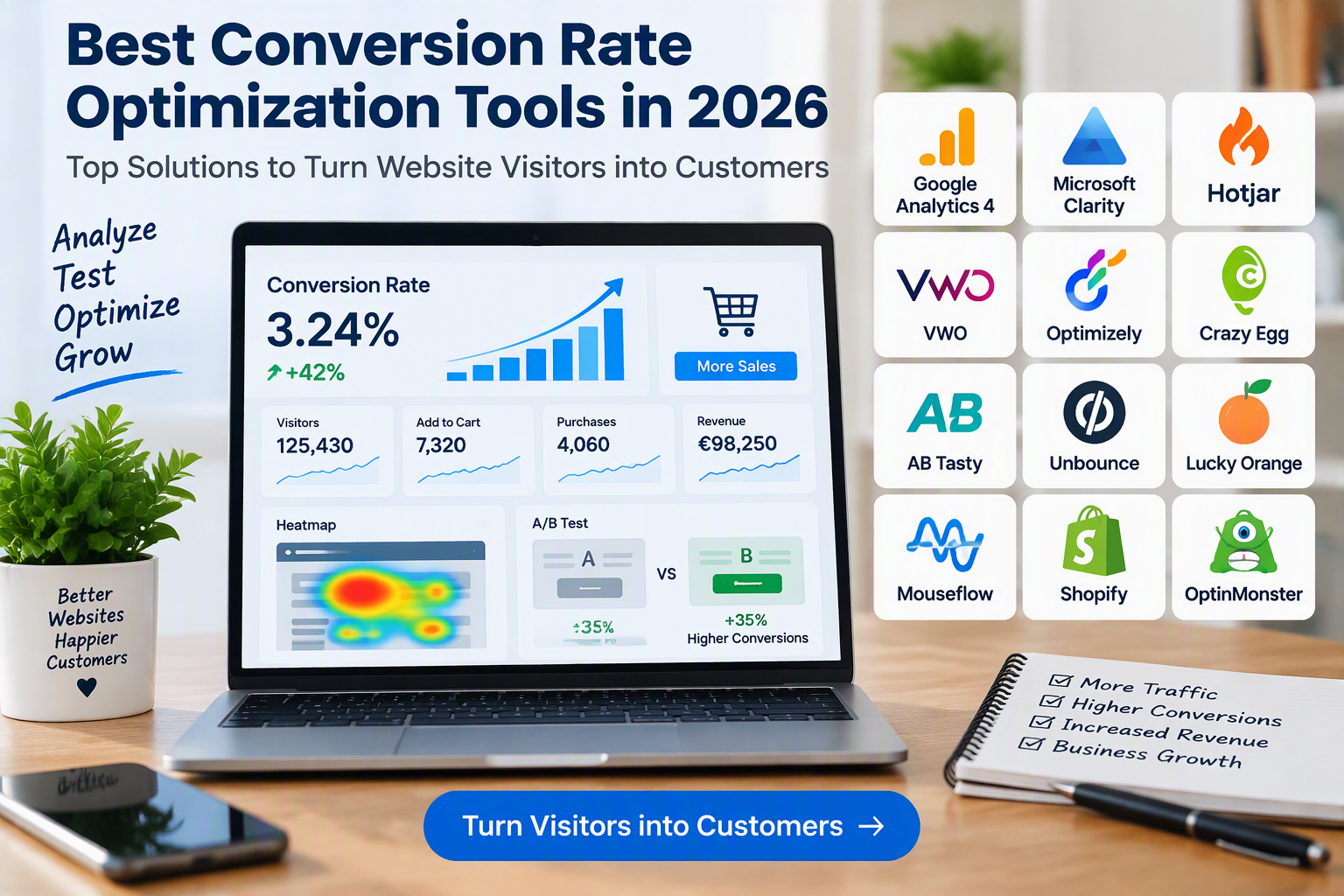
Best Conversion Rate Optimization Tools in 2026: Top Solutions to Turn Website Visitors into Customers
Choosing the best conversion rate optimization tools is essential for businesses that want to turn more website visitors into paying customers. Attracting traffic through search engines, social media, email marketing, and paid advertising is only one part of building a successful online business. An effective website must also help visitors find the right products, understand their benefits, trust the seller, and complete purchases without unnecessary obstacles.
Conversion rate optimization, commonly known as CRO, is the process of improving a website or online store to increase the percentage of visitors who complete a desired action. This action may include purchasing a product, submitting a contact form, subscribing to a newsletter, requesting a quotation, or creating an account.
Modern CRO tools help businesses understand visitor behavior, identify problems in the shopping journey, test website changes, and measure the results. Some platforms specialize in heatmaps and session recordings, while others focus on A/B testing, website analytics, customer feedback, landing pages, and personalized product recommendations.
In 2026, ecommerce businesses can choose from a wide range of free and paid solutions. The right combination depends on website traffic, business goals, technical resources, budget, and privacy requirements. This guide explores some of the best conversion rate optimization tools, their main features, advantages, limitations, and practical uses for online stores and digital businesses.
1. Google Analytics 4: Best for Measuring Website Conversions
Google Analytics 4, also known as GA4, is a website and app analytics platform that helps businesses understand how visitors interact with their digital properties. It is a useful starting point for conversion rate optimization because it provides data about traffic sources, user engagement, and configured conversion events.
For ecommerce stores, GA4 can measure activities such as product views, add-to-cart actions, checkout starts, and completed purchases when the appropriate tracking has been implemented. These reports help business owners identify which marketing channels attract visitors and which pages contribute to important customer actions.
One of its main advantages is the ability to examine the customer journey across different stages. For example, a store may receive substantial traffic to a product page but generate relatively few purchases. This finding can encourage further investigation into pricing, product information, delivery costs, payment options, or checkout usability.
GA4 can also help businesses evaluate marketing campaigns and compare performance across different acquisition channels. However, its usefulness depends on accurate event configuration and appropriate data collection practices.
Key Features and Benefits:
- Website and app traffic analysis.
- Conversion and ecommerce event tracking.
- Traffic source and campaign reports.
- Audience and engagement analysis.
- Customer journey reporting.
- Integration with selected Google marketing products.
- Custom events and reporting options.
- Core analytics features available without a standard subscription fee.
Potential Limitation: Accurate reporting requires proper configuration, and privacy settings can affect the data available. GA4 does not replace a dedicated A/B testing platform.
Official Website: https://analytics.google.com/
2. Microsoft Clarity: Best Free Tool for Understanding Visitor Behavior
Microsoft Clarity is a behavior analytics tool that helps website owners understand how people interact with their pages. It offers heatmaps and session recordings that can reveal usability problems that may not be obvious from standard traffic reports.
Heatmaps show where visitors click, how far they scroll, and which areas of a page attract attention. Session recordings provide visual replays of browsing sessions, allowing businesses to investigate interactions with navigation menus, product images, forms, buttons, and checkout pages.
Clarity can also identify behavioral signals such as repeated clicks on the same element or clicks on areas that do not respond as expected. These patterns may indicate confusing layouts, broken interactions, or unclear calls to action.
For small businesses and new ecommerce stores, Microsoft Clarity is an accessible way to begin investigating conversion problems without purchasing an expensive analytics package. It can complement quantitative analytics by showing what visitors appear to experience while navigating a website.
Key Features and Benefits:
- Website heatmaps.
- Session recordings.
- Click and scroll behavior analysis.
- Identification of selected interaction problems.
- Filters for investigating relevant sessions.
- Visual insights into page usability.
- Integration options for supported website platforms.
- Free access to core features.
Potential Limitation: Clarity is primarily a behavioral analysis tool rather than a complete experimentation platform. Businesses should also configure analytics and controlled testing when they need to measure the impact of specific changes.
Official Website: https://clarity.microsoft.com/
3. Hotjar: Best for Heatmaps, Recordings, and Customer Feedback
Hotjar is a website behavior analytics and user feedback platform that helps businesses understand how visitors experience their websites. Its tools can reveal where users interact with a page, where they stop scrolling, and which elements may cause confusion.
Heatmaps provide a visual overview of clicks and scrolling behavior, while session recordings allow teams to inspect selected browsing sessions. Feedback tools and surveys can help businesses collect direct opinions from visitors about their experience, concerns, and expectations.
For ecommerce websites, these features can help investigate questions such as why shoppers leave product pages, whether important delivery information is easy to find, or why visitors abandon a form before completing it.
For example, a retailer may notice that shoppers repeatedly scroll past a product’s purchase button without clicking it. Combining this observation with customer feedback and sales analytics may reveal that the button is poorly positioned or that visitors need more information before buying.
Key Features and Benefits:
- Click and scroll heatmaps.
- Session recordings.
- On-site surveys and feedback collection.
- User experience research tools.
- Insights into page interaction patterns.
- Support for investigating potential usability problems.
- Integrations with selected analytics and website platforms.
- Plans and features suited to different business needs.
Potential Limitation: Available features and usage limits depend on the current subscription. Session recordings and surveys should be configured carefully to avoid collecting unnecessary personal or sensitive information.
Official Website: https://www.hotjar.com/
4. VWO: Best for A/B Testing and Website Experiments
VWO, formerly known as Visual Website Optimizer, is a conversion optimization platform that helps businesses test website changes and evaluate their impact. It is particularly useful for companies that want to move beyond identifying problems and begin testing specific solutions.
A/B testing allows businesses to compare two versions of a page or element. For example, an ecommerce store might compare two product page layouts, different calls to action, or alternative presentations of delivery information.
Depending on the selected product and subscription, VWO offers experimentation features alongside tools for understanding user behavior. Businesses can use these capabilities to develop hypotheses, run controlled experiments, and analyze whether a change improves a chosen metric.
VWO can be useful for online retailers with sufficient traffic to run meaningful experiments. It may help teams evaluate product page designs, checkout improvements, promotional messaging, and landing page layouts before applying changes more broadly.
Key Features and Benefits:
- A/B testing.
- Multivariate testing in eligible plans.
- Website experimentation tools.
- Conversion performance reporting.
- Behavioral analysis features in supported products.
- Audience targeting and segmentation options.
- Testing workflows for marketing and product teams.
- Tools for evaluating alternative website experiences.
Potential Limitation: Pricing and feature availability depend on the product and subscription. Smaller stores should confirm the available plan options and ensure they have enough traffic to produce useful test results.
Official Website: https://vwo.com/
5. Optimizely: Best for Enterprise Conversion Optimization
Optimizely is a digital experience and experimentation platform designed for businesses that need structured testing and optimization across websites and other digital experiences.
Its experimentation capabilities can help organizations compare alternative experiences and measure how changes affect selected business outcomes. Depending on the product and implementation, businesses can test page layouts, content variations, user journeys, and other digital experiences.
For large ecommerce companies, experimentation can become part of a continuous optimization process. Teams can develop hypotheses, design tests, analyze results, and use the findings to guide future improvements.
Optimizely may be particularly suitable for organizations with dedicated marketing, product, analytics, or engineering teams. Its advanced capabilities can support more complex testing programs, but the platform may be more than a small online store needs.
Key Features and Benefits:
- Website and digital experience experimentation.
- A/B testing and supported advanced testing methods.
- Experiment management and reporting.
- Testing capabilities for complex digital environments.
- Personalization features in eligible products.
- Tools for teams running multiple experiments.
- Integration options for supported business systems.
- Enterprise-oriented configuration and governance.
Potential Limitation: Pricing is generally tailored to business requirements, and advanced implementations may require technical resources. Smaller retailers should compare its capabilities with simpler alternatives before committing.
Official Website: https://www.optimizely.com/
6. Crazy Egg: Best for Simple Website Optimization
Crazy Egg is a website optimization platform that helps businesses understand how visitors interact with individual pages. Its tools include heatmaps, session recordings, and other features designed to reveal usability issues and potential conversion opportunities.
Businesses can use Crazy Egg to investigate whether visitors notice important content, click on intended buttons, or reach key sections of a page. These insights can be useful when improving landing pages, product pages, promotional pages, and lead generation forms.
Some available plans also include testing and experimentation capabilities. This can help teams compare selected page variations and investigate whether a proposed change improves performance.
Crazy Egg may be suitable for businesses that want a straightforward interface for understanding user behavior without immediately adopting a more complex enterprise platform.
Key Features and Benefits:
- Website heatmaps.
- Session recordings.
- Click and scrolling analysis.
- Page-level behavior insights.
- Conversion optimization features.
- A/B testing in eligible plans.
- Tools for evaluating landing page usability.
- Reporting to support website improvement decisions.
Potential Limitation: Available features depend on the subscription, and complex experimentation programs may require a more advanced platform. Confirm current usage limits and pricing before signing up.
Official Website: https://www.crazyegg.com/
7. AB Tasty: Best for Ecommerce Personalization and Testing
AB Tasty is an experimentation and personalization platform designed to help businesses improve digital experiences. It is relevant to ecommerce retailers that want to test changes and deliver different experiences to suitable audience segments.
Depending on the selected solution and implementation, businesses can use experimentation features to compare page variations and personalization tools to adapt selected elements of the customer journey. These approaches can help retailers investigate whether product discovery, promotional messaging, navigation, or content presentation works better for particular audiences.
For example, a retailer could test different arrangements of category pages or compare alternative promotional messages. Results can help the team decide which version better supports its objectives, provided the experiment is designed and measured correctly.
AB Tasty may be particularly useful for medium-sized and large ecommerce businesses with defined optimization goals and the resources to implement experiments consistently.
Key Features and Benefits:
- A/B testing.
- Supported multivariate experiments.
- Website personalization.
- Audience segmentation.
- Experiment performance reporting.
- Tools for improving digital customer experiences.
- Testing workflows for marketing teams.
- Integration options for supported platforms.
Potential Limitation: Pricing and implementation requirements depend on business needs. Small stores should evaluate whether their traffic volume and available resources justify a dedicated experimentation platform.
Official Website: https://www.abtasty.com/
8. Unbounce: Best for High-Converting Landing Pages
Unbounce is a landing page platform designed to help marketers create, publish, and optimize pages for advertising campaigns and other marketing activities.
For businesses that rely on paid search, social media advertising, or email campaigns, landing pages provide a focused destination for visitors. A well-designed page can explain an offer, highlight key benefits, answer common questions, and guide users toward a specific action.
Unbounce provides page-building features, templates, and conversion-focused design options. Depending on the subscription, businesses may also access testing and optimization features to compare different landing page versions.
An ecommerce company could use landing pages for a product launch, seasonal promotion, special offer, or targeted advertising campaign. Instead of sending every visitor to a general homepage, the business can present information tailored to the campaign’s objective.
Key Features and Benefits:
- Landing page creation.
- Customizable templates.
- Page design and publishing tools.
- Campaign-specific page layouts.
- Conversion-focused page elements.
- A/B testing in eligible plans.
- Integration options for marketing platforms.
- Tools for creating focused lead generation or sales pages.
Potential Limitation: Unbounce is primarily focused on landing pages rather than full ecommerce store management. Businesses should verify the available integrations and testing limits for their chosen plan.
Official Website: https://unbounce.com/
9. Lucky Orange: Best for Live Visitor Insights
Lucky Orange is a website optimization platform that offers tools for understanding visitor behavior and identifying potential usability problems. Its capabilities include heatmaps, session recordings, visitor insights, and selected engagement features.
For online stores, these tools can help reveal where shoppers struggle with navigation, product information, forms, or checkout steps. Session recordings may show repeated attempts to use a control, while heatmaps can highlight whether important buttons and content receive attention.
Depending on the subscription and configuration, Lucky Orange also offers features such as surveys, live chat, and conversion funnel analysis. These functions can help businesses combine behavioral observation with direct customer feedback.
Lucky Orange may be suitable for smaller and medium-sized ecommerce businesses that want several customer behavior tools in one platform. As with any analytics product, its value depends on the quality of the questions the business investigates and the actions taken in response to the findings.
Key Features and Benefits:
- Heatmaps and click analysis.
- Session recordings.
- Visitor behavior insights.
- Conversion funnel analysis in supported plans.
- Survey and feedback tools.
- Live chat features in eligible plans.
- Website usability investigation.
- Integration options for supported ecommerce platforms.
Potential Limitation: Available tools and usage allowances vary by plan. Review pricing, integrations, and privacy controls before installing the tracking code.
Official Website: https://www.luckyorange.com/
10. Mouseflow: Best for Form and Funnel Analysis
Mouseflow is a behavior analytics platform that helps businesses understand how visitors navigate websites and where they encounter difficulties. Its tools include session replays, heatmaps, funnel analysis, and form analytics, depending on the selected plan.
Form analytics can be useful for businesses that rely on contact forms, account registration, quote requests, or checkout forms. If visitors repeatedly abandon a particular field, the business can investigate whether the field is confusing, unnecessary, or difficult to complete on mobile devices.
Funnel analysis helps teams examine the steps visitors take before completing an important action. For example, an online store can investigate the transition from product page to cart, checkout, and purchase when the relevant events are configured.
Mouseflow is particularly useful for teams that want to investigate the causes of form abandonment and friction across multi-step user journeys.
Key Features and Benefits:
- Session recordings.
- Click and scroll heatmaps.
- Conversion funnel analysis.
- Form analytics in supported plans.
- Tools for investigating user friction.
- Behavior filtering and session analysis.
- Reporting for website optimization.
- Integration options for supported platforms.
Potential Limitation: Some advanced reports and higher recording volumes may require paid plans. Configure data masking and privacy settings carefully, especially on checkout and account pages.
Official Website: https://mouseflow.com/
11. Shopify Search & Discovery: Best for Shopify Product Discovery
Shopify Search & Discovery is a tool for merchants using Shopify who want to improve how customers find products within their online stores.
Product discovery plays an important role in conversion optimization. Visitors may leave a store when search results are irrelevant, filters are difficult to use, or category pages make it hard to locate suitable products.
Depending on the current functionality and store configuration, Shopify Search & Discovery allows merchants to customize search behavior, manage product filters, and improve product recommendations. These capabilities can help shoppers narrow down large product catalogs and find relevant items more efficiently.
For stores with many products or variations, better search and filtering can reduce frustration and make product comparisons easier. Merchants should monitor search activity and sales data to determine whether changes improve the shopping experience.
Key Features and Benefits:
- Customization of store search.
- Product filtering options.
- Product discovery improvements.
- Search merchandising controls.
- Product recommendation features.
- Integration with the Shopify ecosystem.
- Tools for organizing product discovery.
- Useful starting point for Shopify merchants.
Potential Limitation: The tool is designed for Shopify stores and does not replace a complete analytics or A/B testing platform. Available functions may depend on the store setup and Shopify’s current product capabilities.
Official Website: https://www.shopify.com/
12. OptinMonster: Best for Lead Capture and Email Signups
OptinMonster is a lead generation and conversion optimization platform that helps businesses create campaigns designed to encourage visitors to take specific actions.
These campaigns may include newsletter signup forms, promotional messages, and targeted offers displayed according to configured rules. For ecommerce stores, lead capture can help build an audience of people who have chosen to receive future marketing communications.
For example, a store might invite interested visitors to subscribe to product updates or receive information about an upcoming collection. Campaigns should provide clear value and avoid interrupting the shopping experience unnecessarily.
OptinMonster can be useful for businesses that want to increase newsletter registrations or capture leads from relevant landing pages. However, signup rates should not be treated as the only measure of success. Businesses should also evaluate subscriber quality, engagement, and eventual sales.
Key Features and Benefits:
- Lead capture forms.
- Popups and other supported campaign formats.
- Campaign targeting and display rules.
- Customizable templates.
- Signup and conversion reporting.
- Integration options for email marketing services.
- Tools for building subscriber lists.
- Campaigns designed around specific visitor actions.
Potential Limitation: Features and campaign limits depend on the subscription. Businesses should avoid intrusive popups and ensure that email marketing follows applicable consent and privacy requirements.
Official Website: https://optinmonster.com/
Best Conversion Rate Optimization Tools: Comparison Guide
The best conversion rate optimization tools serve different purposes, so businesses should select platforms according to their main challenges.
Google Analytics 4 is useful for measuring traffic, ecommerce events, and conversion performance. Microsoft Clarity offers a free way to inspect heatmaps and session recordings, while Hotjar combines behavioral analysis with visitor feedback features.
VWO, Optimizely, and AB Tasty are suitable for businesses that want to run structured experiments. Crazy Egg provides visual behavior analysis and selected testing features, while Unbounce focuses on creating and optimizing landing pages.
Lucky Orange and Mouseflow help businesses investigate visitor behavior, funnels, and potential usability problems. Shopify Search & Discovery can improve product discovery for Shopify merchants, while OptinMonster focuses on lead capture and signup campaigns.
A small ecommerce store may begin with analytics and a behavior analysis tool before investing in a paid testing platform. A larger retailer with significant traffic and dedicated optimization staff may benefit from more advanced experimentation and personalization features.
How to Choose the Best Conversion Rate Optimization Software
1. Define Your Conversion Goals
Before choosing software, determine what you want visitors to do. Ecommerce stores may focus on completed purchases, add-to-cart actions, checkout completion, or average order value. Other businesses may prioritize lead generation, appointment bookings, or newsletter subscriptions.
Choose a clear primary metric and a small number of supporting indicators. This makes it easier to evaluate whether an optimization effort delivers meaningful results.
2. Understand Your Website Traffic
Some tools help diagnose usability issues even when traffic is relatively low. However, A/B tests usually require enough visitors and conversions to distinguish meaningful differences from random variation.
If your website receives limited traffic, begin by fixing obvious problems such as broken links, unclear product descriptions, slow pages, confusing navigation, and missing delivery information. Run controlled experiments when your traffic and conversion volume can support useful comparisons.
3. Choose Tools That Match Your Technical Skills
Some CRO platforms are designed for marketers who prefer visual interfaces and minimal coding. Others offer more advanced experimentation capabilities that may require developers, analysts, or technical implementation.
Consider who will configure tracking, design experiments, interpret results, and implement changes. A powerful tool is not necessarily the best choice if your team cannot use it effectively.
4. Compare Total Costs
Pricing may depend on monthly sessions, recorded visits, tracked users, experiments, team members, or additional features. Some platforms use custom enterprise pricing rather than publishing standard rates.
Review the current pricing page and calculate the expected cost based on your website’s traffic and requirements. Include setup, training, integration, and ongoing maintenance in your budget.
5. Check Ecommerce Integrations
Make sure the selected platform works with your website technology and ecommerce system. Depending on your business, you may need integrations with Shopify, WooCommerce, a content management system, an analytics platform, or an email marketing service.
Confirm whether the integration is native or requires a third-party application. Check what information is shared and whether additional subscription fees apply.
6. Review Privacy and Data Protection
CRO tools may collect information about visitor interactions, browsing behavior, and website usage. Some may record sessions or collect feedback, making it important to understand what data is captured and how it is processed.
Businesses operating in Germany and the European Union should review GDPR responsibilities, consent requirements for applicable tracking technologies, data retention policies, access controls, and data transfer arrangements. Recording tools should be configured to mask sensitive information, especially payment details, passwords, and personal data.
Installing a tool does not automatically make a website compliant with privacy laws. Businesses should assess their own configuration and obtain qualified advice when necessary.
7. Measure Business Outcomes, Not Just Clicks
A change that increases button clicks does not necessarily increase completed purchases or profit. For ecommerce stores, important metrics may include conversion rate, revenue per visitor, average order value, checkout completion, refund rates, and contribution margin.
Select metrics that match your business goals. Monitor possible negative effects as well as improvements, and avoid declaring a test successful based on a small or unreliable difference.
Practical Strategies to Improve Ecommerce Conversion Rates
Improve Product Pages
Product pages should provide clear descriptions, accurate specifications, useful images, pricing, availability, and delivery information. Visitors should be able to understand what they are buying without searching across multiple pages.
Make purchase buttons easy to identify and ensure that important information is accessible on mobile devices. Use genuine product images and accurate customer reviews where available.
Simplify the Checkout Process
A complicated checkout can discourage shoppers from completing their purchases. Review whether the process asks for unnecessary information, displays unexpected costs, or makes payment options difficult to understand.
Show delivery fees, estimated delivery times, return policies, and available payment methods clearly. Test the checkout on different devices and browsers to identify technical problems.
Improve Website Speed and Mobile Usability
Slow loading pages and difficult mobile navigation can create friction. Check page performance, image sizes, layout behavior, and interactive elements across common screen sizes.
Prioritize changes that affect important customer journeys, such as product discovery, adding items to the cart, and completing checkout.
Build Trust With Clear Information
Customers are more likely to feel confident when a store provides transparent business information, secure payment options, clear policies, and accessible customer support.
Display accurate shipping, return, warranty, and contact information. Avoid exaggerated claims, fake urgency, fabricated reviews, or misleading discounts, as these practices can damage trust and create legal risks.
Use Customer Feedback
Analytics can show where visitors leave, but direct feedback can help explain why. Surveys and feedback forms may reveal concerns about pricing, product suitability, delivery, payment options, or missing information.
Ask focused questions and use responses to identify patterns rather than assuming that a single comment represents every visitor.
Run Controlled A/B Tests
Once you identify a potential problem, create a clear hypothesis and test one meaningful change at a time where practical. For example, you could compare two product page layouts or test whether clearer delivery information improves checkout completion.
Define the primary metric before starting the experiment. Allow the test to run long enough to collect sufficient data, and consider factors such as seasonality, traffic sources, and changes in promotions.
Do not assume that a result will apply equally to every audience or device. Verify important findings and monitor the impact after implementation.
Common Mistakes to Avoid When Using CRO Tools
One common mistake is installing multiple tracking platforms without a clear plan. Overlapping scripts can increase complexity and potentially affect website performance. Start with a small set of tools that addresses your most important questions.
Another mistake is making decisions from incomplete data. A heatmap may suggest that visitors ignore a button, but it does not necessarily explain why. Combine behavioral evidence with analytics, customer feedback, and controlled testing.
Businesses should also avoid running too many experiments without defining clear goals. Testing several unrelated changes simultaneously can make results difficult to interpret, particularly when traffic is limited.
Ignoring mobile visitors is another frequent problem. A page that works well on a desktop may be difficult to use on a smartphone. Review the complete customer journey across devices.
Finally, do not treat a higher conversion rate as the only measure of success. Discounts or aggressive promotional messages may increase purchases while reducing profit or customer trust. Evaluate conversion performance alongside revenue, margin, customer satisfaction, and long-term business outcomes.
Where to Find Conversion Optimization Tools and Related Equipment in Germany and Europe
Most conversion rate optimization platforms are digital services purchased directly from their providers. Their official websites are the most reliable places to review current plans, available features, integrations, trial options, and subscription terms.
The following official websites provide information about the tools covered in this guide:
- Google Analytics: https://analytics.google.com/
- Microsoft Clarity: https://clarity.microsoft.com/
- Hotjar: https://www.hotjar.com/
- VWO: https://vwo.com/
- Optimizely: https://www.optimizely.com/
- Crazy Egg: https://www.crazyegg.com/
- AB Tasty: https://www.abtasty.com/
- Unbounce: https://unbounce.com/
- Lucky Orange: https://www.luckyorange.com/
- Mouseflow: https://mouseflow.com/
- Shopify: https://www.shopify.com/
- OptinMonster: https://optinmonster.com/
For businesses that also need physical equipment for website analysis, marketing, or remote usability testing, Amazon’s European marketplaces offer products such as computer monitors, webcams, headsets, microphones, and office accessories.
Amazon Germany: https://www.amazon.de/s?k=website+optimization+equipment
Amazon France: https://www.amazon.fr/s?k=website+optimization+equipment
Amazon Italy: https://www.amazon.it/s?k=website+optimization+equipment
Amazon Spain: https://www.amazon.es/s?k=website+optimization+equipment
These links lead to marketplace search results rather than guaranteed product listings. Check product specifications, compatibility, seller details, shipping costs, and return conditions before ordering. Software subscriptions should be reviewed separately on the relevant provider’s official website.
Conclusion
The best conversion rate optimization tools in 2026 help businesses understand visitor behavior, identify obstacles, test improvements, and measure meaningful results. Google Analytics 4 provides a foundation for conversion measurement, while Microsoft Clarity and Hotjar help reveal how visitors interact with website pages.
VWO, Optimizely, and AB Tasty offer experimentation capabilities for businesses that want to compare different website experiences. Crazy Egg, Lucky Orange, and Mouseflow help investigate usability and visitor behavior, while Unbounce supports landing page creation and testing. Shopify Search & Discovery helps eligible Shopify merchants improve product discovery, and OptinMonster focuses on lead capture and signup campaigns.
There is no single tool that is ideal for every business. The best choice depends on website traffic, budget, technical resources, privacy responsibilities, and the specific conversion problems that need to be solved.
By combining accurate analytics, useful customer feedback, clear website content, reliable checkout processes, and carefully designed experiments, ecommerce businesses can make informed improvements to the shopping experience and create better opportunities to turn visitors into customers.


