
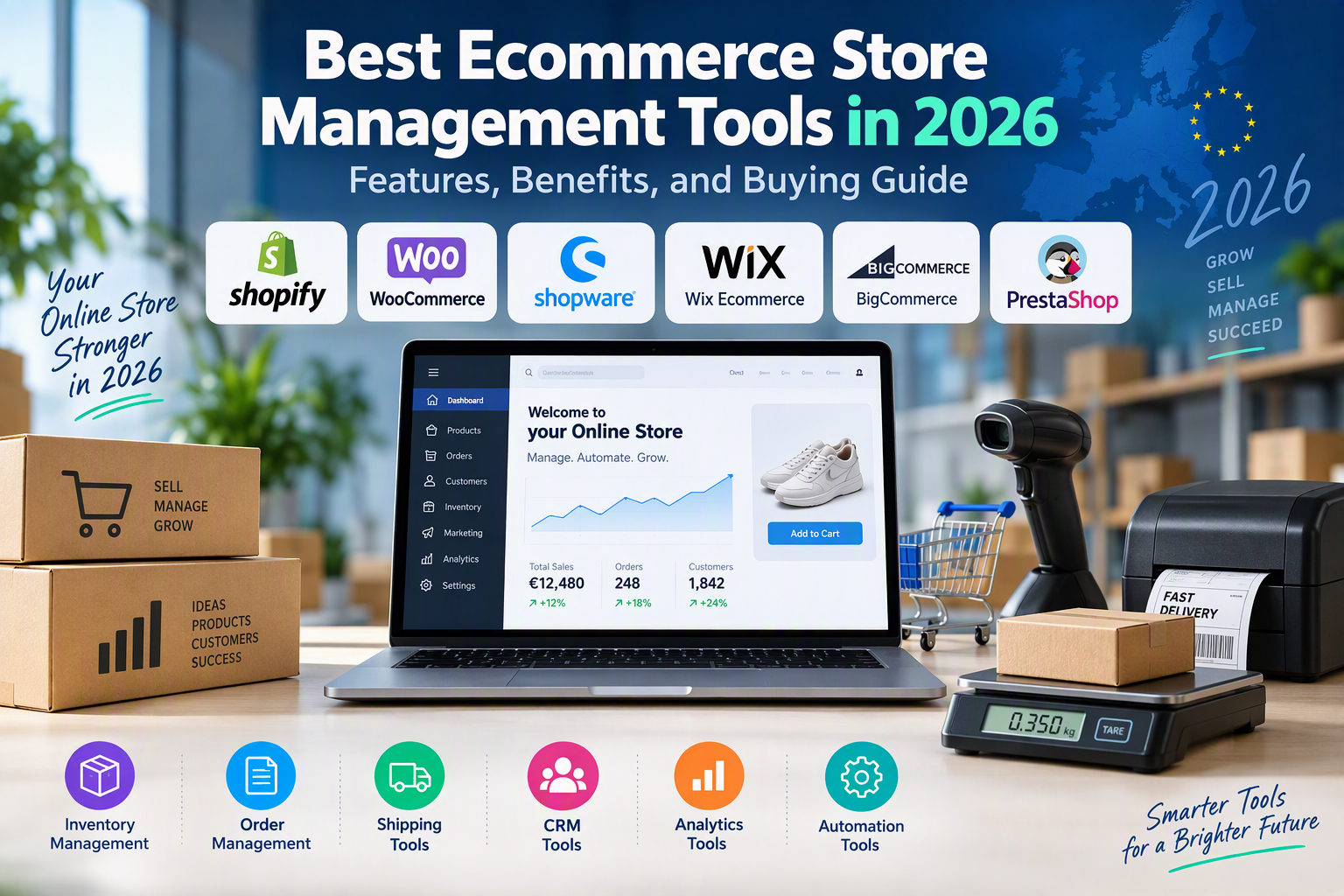
Best Ecommerce Store Management Tools in 2026: Features, Benefits, and Buying Guide
Running a successful online store requires more than offering attractive products. Ecommerce businesses must manage product listings, inventory, customer orders, payments, shipping, marketing, customer support, and financial records. Handling these tasks manually can consume valuable time, increase operational costs, and create unnecessary errors.
The best ecommerce store management tools help business owners organize daily operations, automate repetitive tasks, improve customer experiences, and monitor business performance. Whether you operate a small online shop, sell through multiple marketplaces, or manage a growing ecommerce company, choosing the right software can make your business more efficient.
In 2026, popular solutions include ecommerce platforms, inventory management systems, order processing applications, shipping tools, customer relationship management software, and analytics platforms. Some provide an all-in-one solution, while others specialize in specific business processes.
For businesses operating in Germany and the European Union, additional considerations include VAT management, consumer protection requirements, data privacy, payment preferences, shipping integrations, and multilingual storefronts.
This guide explores the best ecommerce store management tools, their main features, advantages, and practical applications.
1. Shopify: An All-in-One Ecommerce Management Platform
Shopify is one of the most recognizable ecommerce platforms for entrepreneurs who want to create and manage an online store without building an entire website from scratch.
Its integrated environment brings together product management, order processing, payment integrations, storefront customization, and sales reporting. Users can manage many important business activities through a centralized dashboard.
Main Features and Benefits
Shopify provides customizable website themes, product catalogs, inventory tracking, order management, discount creation, and integrations with numerous business applications. Depending on the selected plan and available integrations, merchants can also connect additional sales channels and marketing tools.
One of its biggest advantages is ease of use. Beginners can launch a store without extensive programming knowledge, while growing businesses can add applications and integrations as their needs become more complex.
Shopify also provides tools for managing product variations, organizing collections, tracking orders, and reviewing sales performance. These features help businesses maintain a more organized workflow.
Another advantage is its ecosystem of third-party applications. Store owners can extend functionality with tools for email marketing, customer support, accounting, shipping, and product reviews.
However, subscription fees, paid applications, and payment processing costs should be included in the total budget. Merchants should also review the platform’s available customization options before committing to a long-term setup.
Best for: Beginners, small businesses, direct-to-consumer brands, and growing ecommerce companies.
Official platform: https://www.shopify.com/
2. WooCommerce: Flexible Ecommerce Management for WordPress
WooCommerce is an ecommerce plugin for WordPress that allows businesses to transform a website into an online store. It is particularly suitable for entrepreneurs who want greater control over their website, content, design, and technical configuration.
Unlike fully hosted ecommerce platforms, WooCommerce can be installed on compatible WordPress hosting. This gives store owners considerable flexibility, although they must take responsibility for hosting, security, backups, and maintenance or arrange these services through a provider.
Main Features and Benefits
WooCommerce supports product catalogs, shopping carts, checkout processes, order management, coupons, and inventory-related functions. Additional plugins can provide advanced shipping options, payment gateways, subscription products, reporting, and automated workflows.
Its integration with WordPress makes it attractive for businesses that rely on content marketing and search engine optimization. Store owners can publish informative articles, product guides, landing pages, and other content alongside their products.
Another important advantage is extensibility. Businesses can select plugins that match their specific requirements instead of paying for features they do not need.
WooCommerce can also support different product types, including physical products, digital downloads, and certain subscription-based offerings through suitable extensions.
The main challenge is maintenance. Too many poorly selected plugins can create compatibility issues, affect website performance, or increase security risks. Regular updates, reliable hosting, and appropriate backups are essential.
Best for: WordPress users, content-focused businesses, and merchants who want extensive customization.
Official platform: https://woocommerce.com/
3. Shopware: Ecommerce Management for European Businesses
Shopware is an ecommerce platform with a strong presence in the German-speaking market. It offers tools for creating online stores and managing product catalogs, customer experiences, and sales processes.
The platform is particularly relevant to businesses that need flexibility, advanced storefront customization, and integrations with other commercial systems.
Main Features and Benefits
Shopware provides product management, shopping experiences, customer account functionality, and integrations with payment, shipping, and business applications. Depending on the edition and configuration, merchants can access additional features for B2B commerce, automation, and complex sales processes.
Its flexible architecture can help businesses build customized shopping experiences for different customer groups and markets.
For example, a retailer selling in Germany, Austria, and other European countries may need different languages, product information, shipping methods, and tax configurations. Shopware can form part of a solution designed around these requirements.
Businesses can also connect the platform to external inventory systems, accounting software, enterprise resource planning systems, and marketing applications.
However, implementation complexity and operating costs vary considerably according to the selected edition and the level of customization required.
Best for: German and European retailers, established online businesses, and merchants with specialized requirements.
Official platform: https://www.shopware.com/
4. Wix Ecommerce: Simple Store Management for Small Businesses
Wix Ecommerce combines website creation and online selling in a visual platform. It is suitable for entrepreneurs who want to build an attractive storefront without managing a complex technical environment.
The platform offers website templates, visual editing tools, and ecommerce functionality through its available business plans.
Main Features and Benefits
Wix provides product catalog management, order processing, storefront customization, promotional tools, and integrations with supported payment services.
Its visual editor allows business owners to customize pages without advanced coding knowledge. This can be useful for businesses that depend on distinctive product photography, branding, and presentation.
The platform also offers tools for organizing product categories, creating promotional campaigns, and monitoring store performance.
Another benefit is the integration of website creation and commerce management within a single environment. Beginners can manage much of their online presence without assembling numerous separate services.
Nevertheless, businesses should review the available integrations, plan limitations, payment options, and migration requirements before choosing Wix for a store expected to grow significantly.
Best for: Small retailers, creative businesses, independent sellers, and entrepreneurs launching their first online shop.
Official platform: https://www.wix.com/
5. BigCommerce: Scalable Management for Growing Online Stores
BigCommerce is an ecommerce platform designed to support businesses that require a broad range of selling features and opportunities for expansion.
It can be useful for retailers managing larger product catalogs, multiple customer segments, and more advanced ecommerce operations.
Main Features and Benefits
BigCommerce offers product catalog management, order processing, storefront customization, sales-channel integrations, and reporting capabilities. Available features depend on the plan, configuration, and connected applications.
Its flexible integrations can help businesses connect their storefronts with external systems for inventory, marketing, customer management, and fulfillment.
The platform also supports different ecommerce business models, making it relevant to merchants selling directly to consumers or serving business customers.
For growing companies, the ability to connect external applications can reduce the need to replace the entire store whenever operational requirements change.
However, businesses should carefully compare plan limits, integration costs, regional payment support, and the technical requirements of their intended setup.
Best for: Growing retailers, established online stores, and businesses with expanding product catalogs.
Official platform: https://www.bigcommerce.com/
6. PrestaShop: Flexible Ecommerce Software for Independent Retailers
PrestaShop is an ecommerce platform that provides merchants with tools to create and operate online stores. Its flexible approach makes it an option for businesses that want control over store configuration and the ability to add specialized functionality.
Depending on the hosting arrangement and selected services, merchants can manage their technical environment themselves or work with a hosting provider or development partner.
Main Features and Benefits
PrestaShop supports product catalogs, customer accounts, order processing, promotions, and integrations with payment and shipping providers.
Its modular ecosystem allows businesses to add functions such as advanced product filters, marketing tools, additional payment methods, and connections to external business systems.
For European retailers, localization features and compatible modules can help configure different languages, currencies, and market-specific selling processes.
Another advantage is the ability to customize the storefront and operational workflow according to business requirements.
However, merchants should account for hosting, extensions, technical support, security updates, and development costs when calculating the total cost of ownership.
Best for: Independent retailers and businesses seeking a customizable ecommerce solution.
Official platform: https://prestashop.com/
7. Inventory Management Software: Keeping Stock Under Control
Inventory management tools are essential for ecommerce businesses that sell physical products. They help merchants understand how much stock is available, identify products that need replenishment, and reduce the risk of overselling.
When a store operates through several sales channels, inventory management becomes especially important because stock levels must remain consistent across the website and connected marketplaces.
Main Features and Benefits
Depending on the software, inventory management systems can provide real-time or regularly synchronized stock quantities, product variation tracking, purchase order management, supplier records, and low-stock notifications.
Some solutions also support multiple warehouses, barcode scanning, batch tracking, and demand forecasting.
These capabilities can help retailers reduce manual data entry and improve purchasing decisions. Accurate stock records also make it easier to identify popular products and slow-moving inventory.
Businesses should check whether their chosen system integrates with their ecommerce platform and marketplaces. Synchronization frequency, supported product variations, and inventory update rules can significantly affect daily operations.
Best for: Retailers with physical inventory, growing product catalogs, and multiple sales channels.
8. Order Management Systems: Simplifying the Fulfillment Process
Order management software helps businesses process customer purchases from the moment an order is placed until it is shipped, delivered, canceled, or returned.
Without a centralized system, merchants may need to switch between different dashboards, manually update order statuses, and repeatedly enter customer information.
Main Features and Benefits
Order management systems can collect orders from connected sales channels, organize processing queues, update fulfillment statuses, and coordinate inventory changes.
More advanced solutions may provide return management, automated notifications, warehouse workflows, and integrations with accounting or enterprise resource planning systems.
Centralizing orders makes it easier to identify delayed shipments, resolve fulfillment problems, and provide accurate information to customers.
For businesses selling through an independent website and several marketplaces, a suitable system can reduce repetitive work and improve operational visibility.
Before purchasing a solution, merchants should verify its compatibility with their storefront, marketplaces, shipping providers, and existing inventory software.
Best for: Multichannel sellers, retailers processing large order volumes, and businesses seeking more efficient fulfillment.
9. Shipping Management Tools: Faster and More Organized Deliveries
Shipping management software helps ecommerce businesses prepare orders for dispatch, compare available delivery services, generate shipping labels, and communicate tracking information.
Shipping is an important part of the customer experience because delivery costs, estimated arrival dates, and return procedures can influence purchasing decisions.
Main Features and Benefits
Depending on the provider, shipping tools can offer carrier integrations, shipping label generation, tracking updates, delivery notifications, and return label management.
Some services allow merchants to compare shipping options or establish shipping rules based on order weight, destination, and package dimensions.
European retailers may benefit from connections to carriers operating in Germany and other EU countries. However, available carriers, service levels, and prices depend on the provider and the merchant’s account.
Automating shipping workflows can reduce manual errors and save time when processing numerous orders.
Merchants should compare carrier coverage, international shipping support, return procedures, subscription costs, and compatibility with their ecommerce platform before selecting a service.
Best for: Online retailers shipping physical products regularly, especially businesses serving customers across several European countries.
10. Customer Relationship Management Tools: Improving Customer Retention
Customer relationship management software, commonly known as CRM software, helps businesses organize customer information and manage interactions throughout the purchasing journey.
For ecommerce businesses, CRM tools can support customer segmentation, marketing campaigns, support workflows, and follow-up communications.
Main Features and Benefits
CRM systems may provide customer profiles, communication histories, segmentation tools, sales reports, and integrations with ecommerce platforms.
Some also support automated email sequences, customer service workflows, and personalized marketing campaigns based on permitted customer data.
These functions can help businesses identify repeat customers, improve communication, and develop more relevant promotions.
However, customer data must be handled responsibly. Businesses serving EU customers should assess applicable privacy obligations, consent requirements, data retention practices, and the role of each service provider.
Best for: Businesses seeking better customer communication, repeat purchases, and organized customer support.
11. Ecommerce Analytics Tools: Understanding Store Performance
Analytics tools help store owners measure how visitors discover a website, interact with product pages, and complete purchases.
Without reliable reporting, businesses may struggle to identify which marketing campaigns are effective or where potential customers abandon the shopping process.
Main Features and Benefits
Depending on the tool, analytics software can measure traffic sources, product engagement, conversion rates, revenue, and customer journeys.
These insights help merchants evaluate marketing campaigns, improve product descriptions, and identify opportunities to simplify the checkout process.
Some platforms provide built-in sales reports, while dedicated analytics services offer additional reporting and tracking capabilities.
Accurate measurement requires appropriate configuration, and certain tracking technologies may require consent under applicable European privacy rules.
Businesses should select analytics tools that provide useful reports without collecting unnecessary personal information.
Best for: Online retailers that want to make informed decisions about marketing, website performance, and customer behavior.
12. Essential Hardware for Ecommerce Store Management
Although software handles many administrative tasks, physical equipment can also improve order processing, stock control, and shipping operations.
The right hardware depends on the products being sold, the size of the warehouse, and the number of daily orders.
Barcode Scanners
Barcode scanners help employees identify products quickly and reduce errors when receiving stock, picking orders, and conducting inventory counts.
Important features include barcode compatibility, scanning accuracy, connection options, battery life for wireless models, and compatibility with the inventory software.
USB scanners are often suitable for small packing stations, while wireless scanners can provide greater mobility in warehouses.
Buying options: Explore barcode scanners on Amazon Germany – Barcode Scanners or search the wider European Amazon marketplaces through Amazon France – Barcode Scanners.
Thermal Shipping Label Printers
Thermal label printers are useful for businesses that need to print shipping labels, barcode labels, or product identification stickers.
Direct thermal models generally print without ink or toner, although their labels may be sensitive to heat and light. Thermal transfer models use a ribbon and can be suitable for more durable labels.
Before purchasing a printer, check label dimensions, printing resolution, supported operating systems, connectivity, and compatibility with your shipping provider.
Buying options: Browse thermal shipping label printers on Amazon Germany – Label Printers or Amazon Italy – Label Printers.
Digital Shipping Scales
Digital shipping scales help merchants measure package weight before purchasing postage or preparing shipments.
Useful features include an appropriate weight capacity, readable displays, reliable measurement accuracy, and convenient units of measurement.
For businesses shipping many orders, a suitable scale can reduce incorrect weight entries and make packing workflows more consistent.
Buying options: Browse shipping scales on Amazon Germany – Digital Shipping Scales or Amazon Spain – Digital Shipping Scales.
These links lead to product search results rather than guaranteeing the availability of a particular model. Prices, specifications, seller reliability, delivery options, and compatibility should be verified before purchasing.
13. How to Choose the Best Ecommerce Store Management Tools
Choosing the right ecommerce management system starts with understanding the business’s actual needs. A small store with a limited catalog does not require the same infrastructure as a retailer processing thousands of orders across several marketplaces.
Evaluate Essential Features
Start by identifying the tasks that consume the most time. These may include updating inventory, processing orders, generating shipping labels, answering customer questions, or preparing financial reports.
Prioritize tools that solve these problems directly rather than purchasing software with numerous unnecessary features.
Check Integration Capabilities
Compatibility is essential when selecting ecommerce management software. A tool should work reliably with the existing store, payment providers, inventory system, shipping services, and accounting applications.
Poor integration can create duplicate records, inaccurate stock levels, and unnecessary manual work.
Before subscribing, confirm which integrations are included and which require separate applications or paid plans.
Compare Total Costs
The advertised subscription price is only one part of the overall cost. Businesses should also consider transaction fees, payment processing, premium extensions, hosting, shipping services, support, and implementation.
A free or inexpensive platform may be a good choice, but additional maintenance and development expenses can increase its long-term cost.
Calculate the expected monthly and annual expenses before making a decision.
Prioritize Security and Data Protection
Ecommerce businesses process customer information and financial transactions, making security a fundamental requirement.
Choose reputable providers that offer appropriate security controls, account permissions, regular updates, backups where applicable, and clear information about data handling.
Businesses serving customers in the European Union should also assess GDPR obligations, cookie consent requirements where applicable, and relevant consumer protection and product compliance rules.
No software platform automatically guarantees that a business complies with every legal requirement.
Consider Scalability
Select tools that can support expected growth without creating unnecessary complexity.
A small business may initially need only a storefront and basic inventory tracking. As order volumes increase, it may benefit from automated shipping, centralized order management, additional warehouses, and more advanced reporting.
The goal is to choose a system that meets current requirements while providing a practical upgrade path.
14. Best Ecommerce Store Management Tools for Different Business Types
The most suitable software depends on the business model, technical resources, and operational priorities.
For beginners: Shopify and Wix Ecommerce offer accessible ways to launch and manage an online store. Their hosted environments can reduce the technical work associated with maintaining the underlying infrastructure.
For WordPress websites: WooCommerce is a strong option for merchants who want to combine ecommerce with content publishing and extensive customization.
For German and European retailers: Shopware and PrestaShop are worth evaluating when flexibility, localization, integrations, and control over store configuration are important.
For growing businesses: Shopify, BigCommerce, and appropriately configured Shopware installations can support more demanding ecommerce operations, depending on the selected plans and integrations.
For inventory-heavy businesses: A dedicated inventory or order management system may provide more value than relying exclusively on a storefront’s built-in features.
For businesses shipping large numbers of orders: Shipping software, barcode scanners, thermal label printers, and digital scales can help create a more efficient fulfillment process.
For customer-focused businesses: CRM and marketing automation tools can help organize customer relationships and improve communication when configured responsibly.
15. SEO Best Practices for Ecommerce Store Management
Search engine optimization helps online stores attract relevant visitors through unpaid search results. The best ecommerce management setup should support a clear website structure, useful product information, and technically sound pages.
Optimize Product Pages
Write original product descriptions that explain the product’s features, intended uses, benefits, dimensions, and compatibility where relevant.
Avoid copying manufacturers’ descriptions or other retailers’ text without permission. Instead, prepare original wording based on verified specifications and your own understanding of the product.
Use descriptive page titles, concise meta descriptions, logical headings, and readable URLs.
Improve Website Speed and Mobile Usability
A responsive store should work well on smartphones, tablets, and desktop computers.
Optimize image sizes, limit unnecessary scripts, and review performance regularly. Faster pages and a smoother checkout can improve usability, although they do not guarantee higher search rankings or sales.
Organize Categories and Internal Links
Create logical product categories and use clear navigation so visitors can find products easily.
Internal links between related categories, product pages, and useful articles help customers discover relevant information and help search engines understand the site’s structure.
Avoid creating large numbers of thin or repetitive pages solely to target keywords.
Use Structured Data Carefully
Where appropriate, product structured data can help search engines interpret information such as product names, prices, availability, and ratings.
Ensure that structured data accurately reflects the visible page content and follows the applicable search engine guidelines. Do not publish fabricated reviews, ratings, or product details.
Publish Original and Useful Content
Buying guides, product comparisons, maintenance instructions, and answers to common customer questions can help attract visitors with clear purchasing interests.
Focus on accurate information and practical value rather than repeating the same keywords unnaturally.
Consistent, original content can support a stronger ecommerce SEO strategy over time.
Conclusion
The best ecommerce store management tools in 2026 can help businesses simplify operations, manage products, process orders, control inventory, coordinate shipping, and understand customer behavior.
Shopify and Wix Ecommerce are accessible options for entrepreneurs who want a relatively straightforward store setup. WooCommerce offers flexibility for WordPress users, while Shopware and PrestaShop provide alternatives for businesses seeking more control over their ecommerce environment. BigCommerce is another option for retailers evaluating scalable selling features.
Dedicated inventory management, order processing, shipping, CRM, and analytics tools can provide additional benefits as business operations become more complex. Hardware such as barcode scanners, thermal label printers, and digital shipping scales can also improve everyday fulfillment tasks.
Before choosing a solution, compare its essential features, integration options, total costs, security practices, and ability to support future growth. For businesses operating in Germany and the European Union, regional payment support, shipping coverage, localization, and data protection should also be part of the evaluation.
By selecting tools that match their actual needs and combining them with original content and effective SEO practices, online retailers can build a more organized, efficient, and sustainable ecommerce business.


