
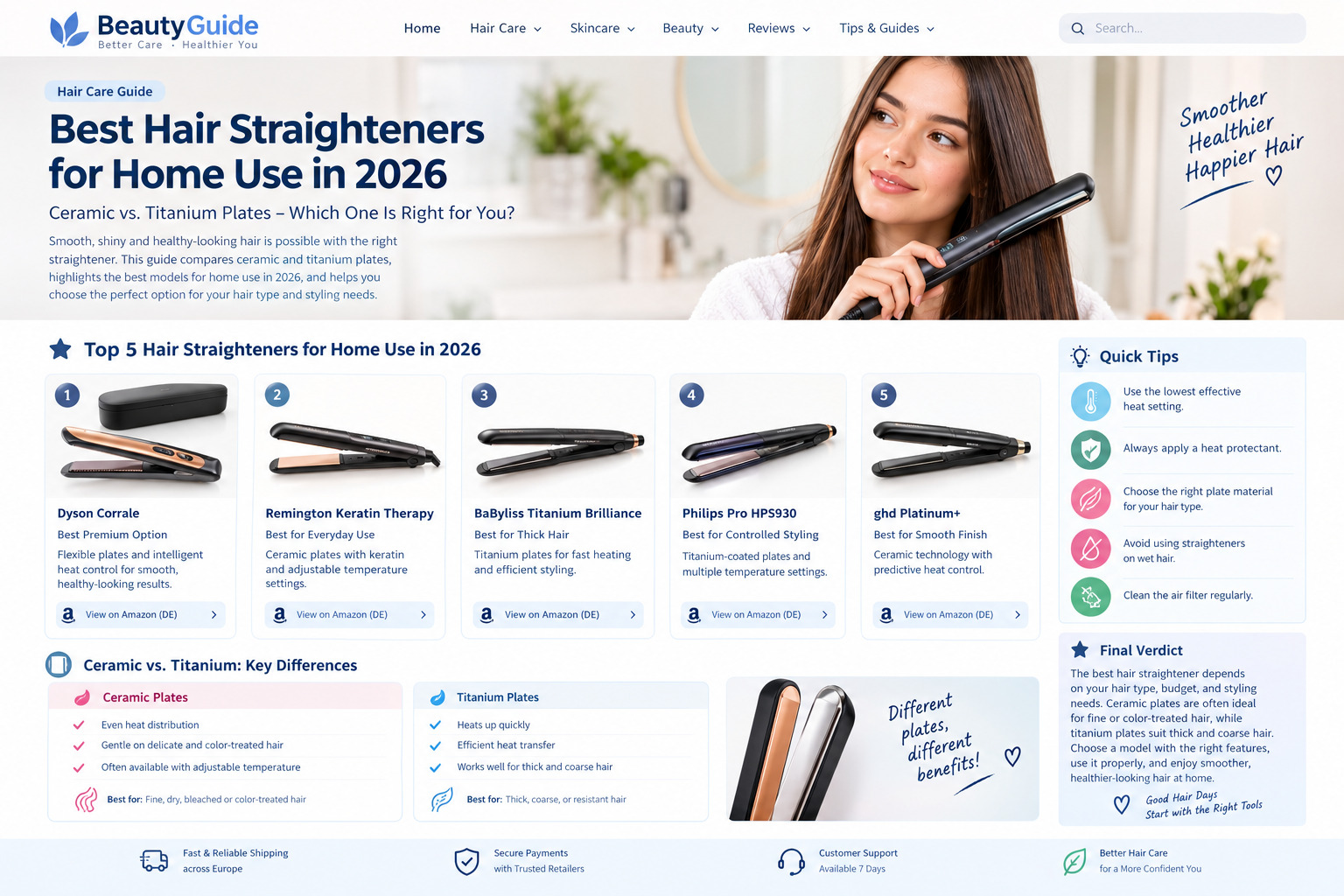
Best Hair Straighteners in 2026: Ceramic vs. Titanium Plates
Choosing the right hair straightener is about more than getting smooth, shiny hair. Plate material, temperature control, plate width, and styling technique all influence how a straightener performs and how much heat stress your hair experiences.
Ceramic and titanium are two common plate options, but neither is the best choice for everyone. Ceramic models are often a practical option for fine, dry, or color-treated hair, while titanium models may suit thick, coarse, or resistant hair. The right choice depends on your hair’s condition and the features of the individual device.
Ceramic vs. Titanium Hair Straighteners: The Main Differences
Ceramic plates are valued for distributing heat across the styling surface and providing controlled, consistent styling. Many ceramic straighteners are available with adjustable temperature settings, making them suitable for people who want flexibility when styling fine, medium, or color-treated hair.
Titanium plates heat up quickly and transfer heat efficiently. This can make them useful for thick or coarse hair that takes longer to straighten. However, their rapid heat transfer makes careful temperature selection particularly important. Neither material prevents heat damage, and the design and quality of the complete appliance matter as much as the plate material.
For a detailed comparison of the two plate types, see this guide from Ulta Beauty: https://www.ulta.com/discover/beauty-education/titanium-vs-ceramic-flat-iron
1. ghd Platinum+ — Best Premium Ceramic Hair Straightener
The ghd Platinum+ is a premium straightener designed for controlled styling with ceramic-based styling plates and a preset operating temperature. Its design may appeal to people who want a polished finish without manually selecting among many temperature levels.
One advantage of a preset-temperature device is simplicity, but it does not mean that heat styling is risk-free. If your hair is very fine, bleached, brittle, or already damaged, consider whether the device’s temperature is appropriate for your needs. Use it only on dry hair and avoid repeatedly passing over the same section.
Amazon Germany: https://www.amazon.de/s?k=ghd+Platinum%2B+hair+straightener
Amazon France: https://www.amazon.fr/s?k=ghd+Platinum%2B+lisseur
Official product information: https://www.ghdhair.com/
2. Remington Shine Therapy S8500 — Best Everyday Ceramic Option
The Remington Shine Therapy S8500 is a ceramic-coated straightener that is worth considering for everyday home styling. Its plate design and styling-focused features make it an accessible option for shoppers who want a straightforward straightener without paying a premium-brand price.
This model is particularly worth comparing if you want a conventional flat iron for smoothing waves and managing frizz. Before buying, check the exact model number, available temperature settings, and condition of the plates. Ceramic coatings can wear over time, so discontinue use if the plates become damaged, rough, or chipped.
Amazon Germany: https://www.amazon.de/s?k=Remington+Shine+Therapy+S8500
Amazon France: https://www.amazon.fr/s?k=Remington+Shine+Therapy+S8500
Official Remington website: https://eu.remington-europe.com/
3. BaByliss Titanium Brilliance — Best Titanium Option to Compare
BaByliss Titanium Brilliance straighteners are worth exploring if you prefer a titanium-focused styling tool. Titanium transfers heat efficiently and may help straighten thick or coarse hair without requiring as many passes as a less suitable device.
The exact specifications depend on the model, so verify whether the plates are titanium or titanium-coated, what temperature range is available, and which safety features are included. For fine, bleached, or fragile hair, a titanium model with a suitably low temperature setting may still be less appropriate than a gentler styling routine.
Amazon Germany: https://www.amazon.de/s?k=BaByliss+Titanium+Brilliance+straightener
Amazon France: https://www.amazon.fr/s?k=BaByliss+Titanium+Brilliance+lisseur
Official BaByliss website: https://www.babyliss.com/
4. Philips Pro Straightener HPS930 — Best for Fast, Controlled Styling
The Philips Pro Straightener HPS930 is a titanium-coated option designed for efficient styling. Its floating plates are intended to move slightly in response to pressure, helping the plates maintain contact with the hair during use.
This model may be worth considering if you have thick hair and prefer a professional-style straightener. Fast heating and efficient heat transfer can be useful, but they do not justify choosing the highest temperature automatically. Select a setting appropriate to your hair, work with small sections, and stop if you notice excessive dryness, a burning smell, or unusual pulling.
Amazon Germany: https://www.amazon.de/s?k=Philips+HPS930+straightener
Amazon France: https://www.amazon.fr/s?k=Philips+HPS930+lisseur
Official Philips product information: https://www.philips.com/
5. Remington PRO-Ceramic Extra S5525 — Best Wide-Plate Ceramic Option
The Remington PRO-Ceramic Extra S5525 is a wide-plate straightener worth comparing for longer or thicker hair. Wider plates can cover more hair per pass, which may make styling large sections more convenient than using a narrow straightener.
However, a wide plate is not automatically the best option for every hairstyle. Narrower plates usually provide better control around short hair, fringes, and detailed styling. Confirm the model’s current specifications, temperature range, plate width, and voltage before ordering, as product details can differ between markets.
Amazon Germany: https://www.amazon.de/s?k=Remington+PRO-Ceramic+Extra+S5525
Amazon France: https://www.amazon.fr/s?k=Remington+PRO-Ceramic+Extra+S5525
Official Remington website: https://eu.remington-europe.com/
Which Plate Material Is Better for Your Hair Type?
Fine or fragile hair: Ceramic is often a sensible starting point because it is widely available in models with adjustable heat. Choose the lowest effective setting and limit how often you straighten your hair.
Dry, bleached, or color-treated hair: Prioritize temperature control and gentle styling rather than relying on plate material alone. Repeated high-heat styling can worsen dryness and breakage, regardless of whether the plates are ceramic or titanium.
Thick or coarse hair: Titanium may be useful because it transfers heat efficiently. A model with reliable temperature control can help you avoid using more heat than necessary.
Curly or coily hair: Both plate types can straighten curly hair, but results depend on the device, temperature, section size, and technique. Make sure your hair is completely dry before using a conventional flat iron.
Short hair or detailed styling: Narrow plates offer more control around roots, fringes, and shorter sections. For long or dense hair, wider plates may save time, provided they are comfortable and manageable to use.
What to Look for Before Buying a Hair Straightener
Plate material is only one part of the decision. Look for clear temperature controls, smooth plates, a comfortable grip, and a design that suits your hair length and styling routine. An automatic shut-off feature can reduce the risk of accidentally leaving the appliance switched on, although it does not replace careful handling.
Check whether the plates are solid ceramic, ceramic-coated, titanium, or titanium-coated. These descriptions are not interchangeable. Also verify the product’s exact model number, European voltage compatibility, plug type, warranty, and return policy.
For an additional overview of straightener features and expert product comparisons, consult NBC Select’s 2026 guide: https://www.nbcnews.com/select/shopping/best-flat-irons-rcna346520
How to Straighten Hair While Reducing Heat Damage
Start with completely dry, gently detangled hair. Apply a heat protectant according to its instructions, divide your hair into manageable sections, and choose the lowest temperature that gives you a satisfactory result.
Move the straightener smoothly rather than holding it in one place. Avoid repeated passes over the same section, and do not use a conventional flat iron on wet hair unless the manufacturer specifically identifies the device as suitable for wet-to-dry styling and explains how to use it safely.
Allow the appliance to cool completely in a safe location after use. Keep it away from water, children, and flammable materials, and unplug it when you finish. Heat protectant can help reduce some styling stress, but it cannot eliminate all heat damage.
Final Verdict: Ceramic or Titanium?
Ceramic straighteners are often the more practical starting point for fine, dry, or color-treated hair, particularly when adjustable temperature control is available. Titanium straighteners may be a better fit for thick, coarse, or resistant hair that needs efficient heat transfer.
For a premium ceramic option, compare the ghd Platinum+. For a more budget-conscious everyday choice, investigate the Remington Shine Therapy S8500. If you prefer titanium, compare the BaByliss Titanium Brilliance range and Philips HPS930. The Remington PRO-Ceramic Extra S5525 is worth considering if wide plates would make styling your hair easier.
There is no universally best straightener. Choose the device that fits your hair type, offers appropriate temperature control, and lets you style with as few passes as possible. A suitable tool combined with careful technique is a more sensible approach than relying on marketing claims about shine or damage prevention.


