
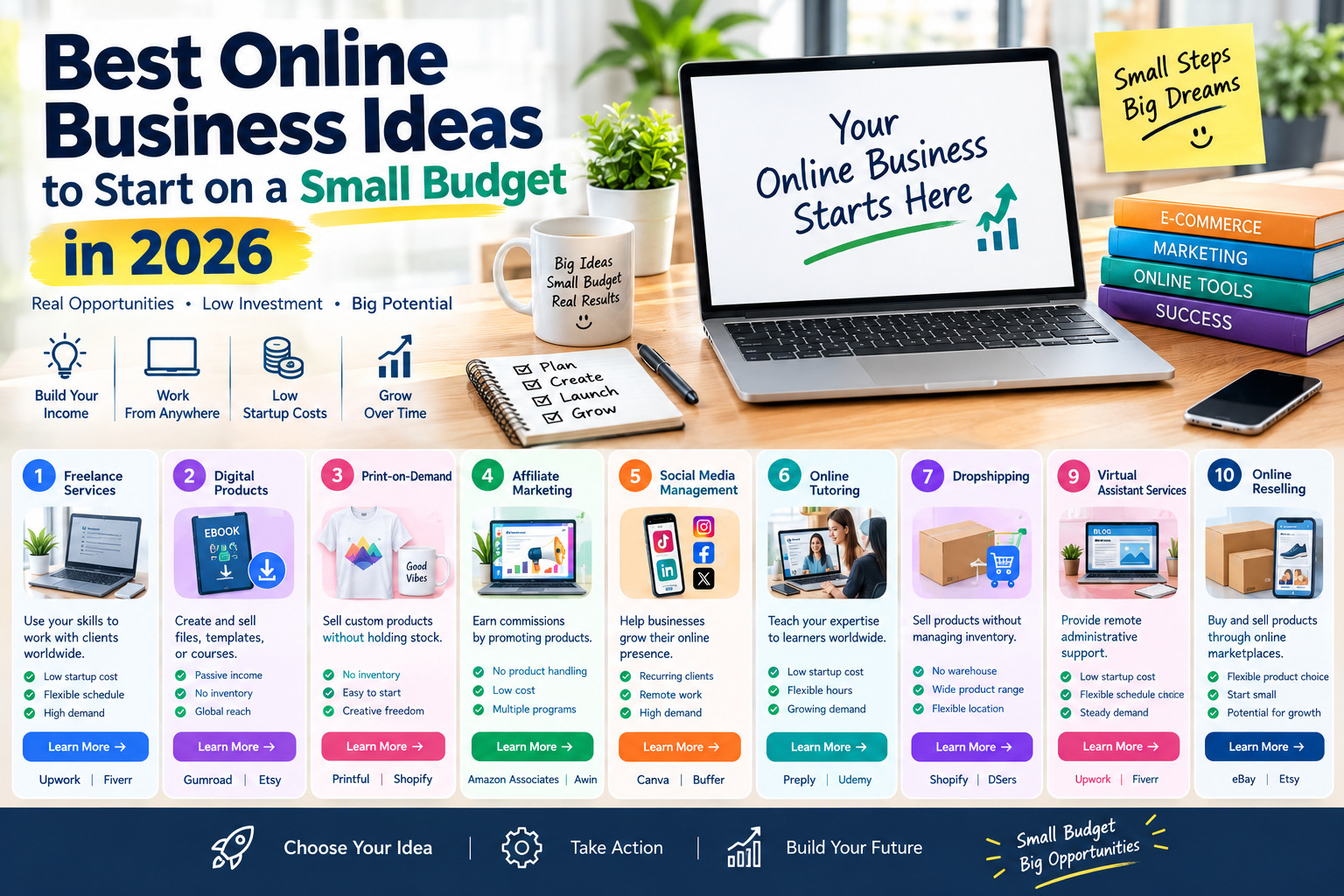
Best Online Business Ideas to Start on a Small Budget in 2026
Starting an online business with a small budget is more achievable when you choose a business model that matches your skills, solves a real customer problem, and does not require expensive equipment or large inventory. From freelance services and digital products to print-on-demand stores and affiliate marketing, there are several ways to build an online income stream without investing heavily at the beginning.
However, a low-cost business is not necessarily an easy business. Every idea requires time, consistent effort, customer research, and a clear marketing strategy. The best approach is to start small, test demand, control expenses, and expand only when you understand what customers are willing to pay for.
This guide explores practical online business ideas for beginners, including their main features, advantages, disadvantages, competition levels, common challenges, and useful platforms for getting started.
1. Freelance Services: Turn Your Skills Into an Online Business
Freelancing is one of the most accessible online business ideas for people who already have a marketable skill. Instead of investing in physical products, you sell services such as graphic design, writing, translation, video editing, website development, bookkeeping, or search engine optimization.
Main Features
A freelance business can operate from home with a computer, an internet connection, and the software needed for your chosen service. You can work with local companies, international clients, startups, or individual customers. You may also specialize in a specific industry, such as ecommerce, real estate, education, or digital marketing.
Strengths
- Very low initial investment when you already have the necessary equipment.
- No inventory, warehouse, or shipping expenses.
- Flexible working hours and the ability to work remotely.
- Opportunities to build recurring income through long-term client contracts.
- Potential to grow into an agency by hiring other freelancers.
Weaknesses
- Income may be unpredictable, especially during the first few months.
- Your earning capacity is initially limited by the time you can work.
- Finding clients can take considerable effort.
- Some customers may request revisions beyond the original agreement.
Competition and Challenges
Freelancing is highly competitive because clients can choose from professionals around the world. Beginners often struggle when they offer general services without a strong portfolio or a clear reason to choose them. Competing only on price can also reduce profits and attract difficult clients.
The most effective strategy is to specialize in a specific service and audience. For example, instead of offering general graphic design, focus on product images for online stores or social media designs for restaurants. Create a small portfolio, define the scope of each service, and collect testimonials as you gain experience.
Useful platforms: Upwork and Fiverr can help freelancers discover clients and present their services.
2. Selling Digital Products: Create Once and Sell Repeatedly
Selling digital products is an attractive option for people who can create useful files, educational resources, or creative assets. Examples include printable planners, budget spreadsheets, website templates, design presets, ebooks, social media templates, and business documents.
Main Features
Digital products can be delivered automatically after purchase, eliminating physical inventory and shipping. You can create different versions of a product, bundle related resources, and sell to customers in different countries. A well-designed product may generate repeat sales without requiring you to recreate it for every buyer.
Strengths
- No physical inventory or shipping requirements.
- Relatively low production costs after the initial creation.
- Easy delivery and the potential to sell internationally.
- Opportunities to create bundles, premium versions, and complementary products.
- Greater ability to scale sales without increasing production time at the same rate.
Weaknesses
- Creating a product that customers actually want takes research and skill.
- Sales are not guaranteed simply because a product is available online.
- Competitors may offer similar products at lower prices.
- Digital files can be copied, shared, or redistributed without permission.
Competition and Challenges
Competition is particularly strong in broad categories such as generic planners, basic ebooks, and simple templates. Poor product presentation, unclear instructions, and weak differentiation can make it difficult to attract buyers.
A stronger approach is to solve a specific problem for a defined audience. For example, create an inventory spreadsheet for small clothing shops instead of a generic spreadsheet. Provide preview images, clear instructions, and practical examples. Test the product with a small audience before investing in a large collection.
Useful platforms: Gumroad supports digital product sales, while Etsy can help eligible sellers list creative and downloadable products. Review each platform’s fees, eligibility, and selling policies before launching. Digital product ideas and examples are also available from Printful’s digital product guide.
3. Print-on-Demand: Sell Custom Products Without Holding Stock
Print-on-demand allows entrepreneurs to sell products such as T-shirts, tote bags, mugs, posters, and phone cases featuring original designs. A production partner prints and ships an item after a customer places an order, so the seller does not need to purchase large quantities in advance.
Main Features
You create designs, publish product listings, and connect your store to a print-on-demand provider. When an order arrives, the provider handles production and fulfillment according to the agreed service terms. You concentrate on product selection, branding, customer acquisition, and design development.
Strengths
- No need to purchase large amounts of inventory upfront.
- Ability to test different designs and product categories.
- Outsourced printing and fulfillment can simplify operations.
- Potential to build a recognizable brand around a specific audience.
- Flexible product development without maintaining a warehouse.
Weaknesses
- Profit margins can be limited by production, shipping, platform, and transaction fees.
- You have less direct control over manufacturing and delivery.
- Product quality and print consistency depend partly on the supplier.
- Returns, refunds, and customer complaints still require attention.
Competition and Challenges
The market is crowded with generic designs, slogans, and common product themes. A design that looks attractive may still fail to sell if it does not appeal to a clearly defined audience. Copyright and trademark violations can also lead to listing removals or legal problems.
To improve your chances, choose a niche you understand, develop original designs, order samples where practical, and calculate the full cost of each sale before setting prices. Avoid using protected characters, logos, or artwork without permission. Build a recognizable visual identity rather than uploading large numbers of similar designs.
Useful platforms: Printful provides print-on-demand production and fulfillment services, while Shopify can be used to build an independent online store. Check integration availability, shipping costs, and seller requirements for your country.
4. Affiliate Marketing: Earn Commissions by Recommending Products
Affiliate marketing involves promoting products or services through tracked links. When a visitor completes a qualifying purchase or another specified action, the affiliate may receive a commission under the program’s terms. This business model works well for people who enjoy writing, creating videos, reviewing products, or building niche communities.
Main Features
Affiliate marketers publish useful content through blogs, social media accounts, newsletters, or video channels. Content may include tutorials, comparisons, product reviews, buying guides, and demonstrations. The business does not normally require the affiliate to handle inventory, shipping, or product manufacturing.
Strengths
- No need to create or store the products being promoted.
- Low startup costs if you already have a website or content channel.
- Ability to promote several relevant products or services.
- Potential for content to attract visitors long after publication.
- Opportunities to build an audience around a specific subject.
Weaknesses
- Earnings depend on traffic, audience trust, conversion rates, and commission terms.
- Search rankings and social media reach can change.
- Affiliate programs may change their rates or eligibility requirements.
- Building a reliable audience often takes months of consistent work.
Competition and Challenges
Broad topics such as general technology, fashion, and fitness can be difficult to enter because established publishers already have strong audiences. Content that merely repeats product descriptions is unlikely to build lasting trust.
A better strategy is to target a narrower audience and publish genuinely useful content. For example, create tutorials about software for small businesses or comparisons of affordable equipment for beginner photographers. Disclose affiliate relationships clearly, check claims before publishing, and recommend products based on relevance rather than commission size.
Useful platforms: Amazon Associates provides information about Amazon’s affiliate program, while Awin connects publishers with participating advertisers. Program availability, approval criteria, and commission rules vary by market and advertiser.
5. Social Media Management: Help Small Businesses Build an Online Presence
Many small businesses need regular social media content but do not have the time or expertise to manage their accounts. A social media management business can provide content planning, post design, scheduling, short-form video editing, community engagement, and basic performance reporting.
Main Features
You can begin with one clearly defined service package and a small number of clients. For example, a monthly package might include a content calendar, a set number of posts, caption writing, and a performance summary. As your skills improve, you can add services such as short-form video production, campaign planning, or paid advertising management.
Strengths
- Low startup costs when using existing equipment and affordable tools.
- Potential for monthly recurring contracts.
- No physical inventory or shipping.
- Opportunity to specialize in a profitable industry or platform.
- Can grow into a content studio or small marketing agency.
Weaknesses
- Clients may expect rapid growth that cannot be guaranteed.
- Content production and revisions can consume significant time.
- Platform changes may affect reach and engagement.
- Managing multiple clients requires strong organization.
Competition and Challenges
Competition is high, especially for basic posting services. Some businesses may expect a large number of posts at very low prices, while others may confuse social media activity with guaranteed sales.
Differentiate your service through industry knowledge, reliable communication, consistent content quality, and measurable goals. Agree in advance on deliverables, revision limits, reporting, and response times. Use clear contracts and never promise specific follower counts or sales without a defensible basis.
Useful platforms: Canva helps with visual content creation, while Buffer offers tools for planning and managing social media publishing. Review available features and plan limits before choosing a workflow.
6. Online Tutoring and Educational Services
Online tutoring is a practical option for people who can teach a subject or skill, including languages, mathematics, science, school subjects, music theory, coding, or professional software. You can offer individual sessions, small group classes, exam preparation, or structured learning programs.
Main Features
Lessons can be delivered through video calls, virtual classrooms, or a learning platform. You can start with individual appointments and later develop group sessions, recorded lessons, downloadable exercises, or paid learning materials. Specializing in a particular age group, exam, or professional skill can help clarify your offer.
Strengths
- Low initial costs if you already have a suitable device and internet connection.
- Opportunity to build repeat bookings with students.
- Ability to serve learners beyond your local area.
- Potential to turn frequently requested lessons into reusable learning materials.
- Flexible scheduling for part-time work.
Weaknesses
- Income depends on teaching hours unless you add scalable products.
- Preparation, marking, and student communication require additional time.
- Reliable internet and clear audio are important.
- Some students need significant individual support.
Competition and Challenges
Tutoring markets can be crowded, and customers may compare tutors mainly by price. Building trust is especially important when parents or learners are choosing someone to support their education.
Focus on a subject where you have demonstrable knowledge, create a clear lesson structure, and explain what students will practice. Use sample lessons or a short introductory session when appropriate. Protect student privacy, set cancellation rules, and follow any local requirements that apply to educational services.
Useful platforms: Preply connects tutors and learners in eligible categories, while Udemy provides information for instructors interested in creating online courses. Their business models differ, so compare fees, approval processes, and control over pricing.
7. Dropshipping: Build an Online Store Without Managing Your Own Warehouse
Dropshipping is an ecommerce model in which a supplier ships products directly to customers after an order is placed. The store owner focuses on selecting products, building the storefront, attracting customers, setting prices, and handling customer service rather than storing every item personally.
Main Features
A dropshipping store can sell products within a focused niche, such as home organization, hobby accessories, or selected pet supplies. Supplier integrations may help synchronize product listings and orders. However, the store owner remains responsible for the overall customer experience and for meeting applicable consumer and business obligations.
Strengths
- Lower inventory requirements than a traditional retail store.
- Ability to test product demand without purchasing large quantities in advance.
- Wide choice of product categories and potential suppliers.
- Opportunity to run the business remotely.
- Easier product testing than models requiring bulk stock purchases.
Weaknesses
- Profit margins may be thin after product costs, shipping, fees, refunds, and advertising.
- Delivery speed and product quality depend heavily on suppliers.
- Stock availability and product information may change unexpectedly.
- The seller has limited control over packaging and fulfillment in many arrangements.
Competition and Challenges
Generic dropshipping stores often compete on price and may sell the same products as many other retailers. Paid advertising can become expensive, while slow shipping or inconsistent quality can damage customer trust.
Before launching, order product samples when possible, verify supplier reliability, calculate the full cost of fulfilling an order, and publish realistic shipping and return policies. Test a small number of products first. A focused store with clear product benefits and dependable service is generally a stronger starting point than a large catalog of unrelated items.
Useful platforms: Shopify offers ecommerce store-building tools, and DSers provides dropshipping-related tools and supplier workflows. Check current integrations, subscription costs, payment availability, and shipping arrangements before committing.
8. Blogging and Niche Content Websites
A niche blog or content website publishes useful information for a specific audience. Topics may include personal finance education, technology tutorials, home improvement, cooking, career development, or specialized hobbies. Revenue can come from advertising, affiliate links, sponsorships, digital products, or relevant services.
Main Features
A content website grows through a library of articles, tutorials, guides, reviews, and other resources. Search engine optimization can help readers discover the content, while email newsletters and social channels provide additional ways to reach an audience. Over time, a focused website can become a valuable source of information within its niche.
Strengths
- Can begin with relatively low costs using a basic website and free research tools.
- Articles may continue attracting readers after publication.
- Multiple monetization methods can be developed over time.
- A strong content library can support related services or digital products.
- Potential to establish expertise and a recognizable brand.
Weaknesses
- Search traffic may take months to grow and is never guaranteed.
- Writing, fact-checking, updating, and editing require consistent effort.
- Revenue can be low before a meaningful audience develops.
- Search algorithm changes can affect visibility.
Competition and Challenges
Broad topics are often dominated by established websites with large editorial teams and strong backlink profiles. Publishing large quantities of shallow content is unlikely to create a durable advantage. Readers need original value, accurate information, clear explanations, and a good user experience.
Choose a specific audience and identify questions that existing resources do not answer well. Publish fewer, more useful articles, organize them into related topic clusters, and update outdated information. Track search impressions, clicks, reader engagement, and conversions instead of judging success only by the number of published posts.
Useful platforms: WordPress provides software for building a content website, while Google Search Console helps website owners monitor search performance and identify technical or indexing issues.
9. Virtual Assistant Services: Provide Remote Administrative Support
A virtual assistant helps entrepreneurs, consultants, online stores, and small companies with administrative tasks. Services may include inbox management, appointment scheduling, data entry, customer support, research, document formatting, order tracking, and basic operations support.
Main Features
The business can start with a small set of tasks you already know how to perform. You can charge hourly, offer fixed-price packages, or provide ongoing monthly support. With experience, you may specialize in ecommerce administration, executive assistance, customer service, or operations coordination.
Strengths
- Very low startup costs when you have a computer and internet access.
- No inventory, manufacturing, or delivery expenses.
- Potential for long-term client relationships.
- Opportunity to develop specialized, higher-value services.
- Can be operated part-time before expanding.
Weaknesses
- Income is often tied to available working hours.
- Clients may expect availability across different time zones.
- Repetitive tasks can become difficult to scale.
- Handling client information requires care and professional boundaries.
Competition and Challenges
General administrative support is competitive, and new assistants may struggle to demonstrate reliability without previous client experience. Clients also vary in how clearly they define tasks, deadlines, and communication expectations.
Start with a defined service package, a simple portfolio, and clear working hours. Use checklists and project management tools to reduce errors. Protect confidential information, agree on access permissions, and define which tasks are included in your rate. Specializing in a particular type of client can make your service easier to market.
Useful platforms: Upwork and Fiverr can help you showcase administrative services and connect with potential clients.
10. Reselling Products Online
Online reselling involves buying or sourcing products and selling them to customers through marketplaces or your own online store. Beginners may focus on secondhand clothing, books, collectibles, refurbished accessories, vintage items, or carefully selected local products.
Main Features
You research demand, source products, inspect their condition, create accurate listings, photograph items, and manage orders. Unlike dropshipping, reselling usually requires access to the products before they are sold, although some arrangements may differ. A small, carefully selected inventory can help you learn pricing and customer preferences without committing to a large stock.
Strengths
- Can start with a small quantity of products.
- Opportunity to specialize in categories you understand.
- Potential to find value in underpriced or overlooked items.
- Customer feedback can help refine sourcing and pricing decisions.
- Successful sellers may expand into a curated store or specialized brand.
Weaknesses
- Inventory requires storage, organization, and upfront spending.
- Product condition and availability may vary.
- Packing, shipping, and returns take time.
- Unsold stock can tie up money that could be used elsewhere.
Competition and Challenges
Popular categories may have many sellers, making price comparison easy for customers. Poor sourcing decisions can leave you with products that are difficult to sell, while inaccurate descriptions may cause disputes and returns.
Research completed sales where available, calculate marketplace fees and delivery costs, and inspect products before listing them. Use clear photographs and honest descriptions, including defects. Begin with a narrow category, keep records of purchase costs and profit, and avoid buying large quantities before you have evidence of demand.
Useful platforms: eBay offers a marketplace for eligible product categories, while Etsy is an option for products that meet its seller and product policies, including qualifying vintage and handmade goods.
Comparing Low-Budget Online Business Ideas
The right business depends on your existing skills, available time, preferred working style, and willingness to manage customers or products. The comparison below describes general operating characteristics rather than guaranteed financial outcomes.
| Business idea | Initial cost tendency | Main advantage | Main challenge |
|---|---|---|---|
| Freelance services | Very low if equipped | Can monetize existing skills | Finding consistent clients |
| Digital products | Low | Repeat sales without physical shipping | Creating a product people want |
| Print-on-demand | Low to moderate | No need to hold bulk inventory | Margins and differentiation |
| Affiliate marketing | Low | No product fulfillment | Building traffic and trust |
| Social media management | Low | Potential recurring contracts | Meeting client expectations |
| Online tutoring | Low if equipped | Direct use of subject expertise | Time-based income |
| Dropshipping | Low to moderate | Reduced inventory requirements | Supplier reliability and margins |
| Blogging | Low | Long-term content asset potential | Slow, uncertain audience growth |
| Virtual assistance | Very low if equipped | Straightforward service model | Time limits and client acquisition |
| Online reselling | Low to moderate | Flexible product selection | Stock, shipping, and unsold inventory |
Actual costs depend on your country, equipment, payment options, platform fees, taxes, shipping arrangements, and marketing choices. A low starting cost should not be confused with a guarantee of profitability.
How to Choose the Right Online Business
Start With Skills You Already Have
Your current skills can reduce the time and money needed to begin. A designer may find it easier to sell templates or offer freelance services, while an experienced teacher may prefer tutoring. Starting with an existing strength can help you deliver value sooner.
Validate Demand Before Spending More
Research customer reviews, competitor offers, marketplace listings, search results, and relevant online communities. Look for recurring problems that people are already trying to solve. When possible, test a small offer or a basic product before building an expensive website or purchasing equipment.
Calculate the Full Cost of Each Sale
Include platform fees, payment processing, advertising, software, supplier charges, shipping, refunds, and taxes where applicable. For service businesses, also account for the time spent finding clients, preparing work, communicating, and making revisions. Revenue alone does not show whether a business is profitable.
Choose a Clear Target Audience
A specific audience makes it easier to create relevant offers and marketing messages. Instead of trying to serve everyone, focus on a group with a shared need, such as independent fitness coaches, small online retailers, beginner photographers, or students preparing for a particular exam.
Build a Simple Marketing System
Use a combination of relevant content, search optimization, social media, direct outreach, partnerships, or email marketing according to your business model. Choose channels you can maintain consistently and measure which activities generate qualified leads or sales.
Keep the First Version Small
Begin with one service package, a few digital products, a limited product range, or a focused group of articles. Track inquiries, conversion rates, costs, customer feedback, and repeat purchases. Improve the offer based on real evidence before expanding.
Check Legal, Payment, and Platform Requirements
Before accepting payments, confirm whether your chosen platform supports sellers in your country. Review applicable registration, tax, consumer protection, privacy, intellectual property, and payment requirements. Marketplace availability and payment methods differ by location, so verify the rules directly with the relevant provider.
Final Thoughts
The best online business ideas to start on a small budget are not necessarily the ones that promise the fastest income. They are the ones that allow you to test real demand, control costs, use your existing strengths, and improve through customer feedback.
Freelancing, virtual assistance, and tutoring can be practical starting points for people who want to sell their skills. Digital products, blogging, and affiliate marketing may suit people who prefer creating reusable resources or building an audience over time. Print-on-demand, dropshipping, and reselling can appeal to entrepreneurs interested in ecommerce, but they require careful attention to margins, product quality, fulfillment, and customer service.
Choose one model, define a specific customer, and test a small offer before committing more money. A focused and well-managed business is a stronger foundation for long-term growth than launching several unrelated ideas at once.


