
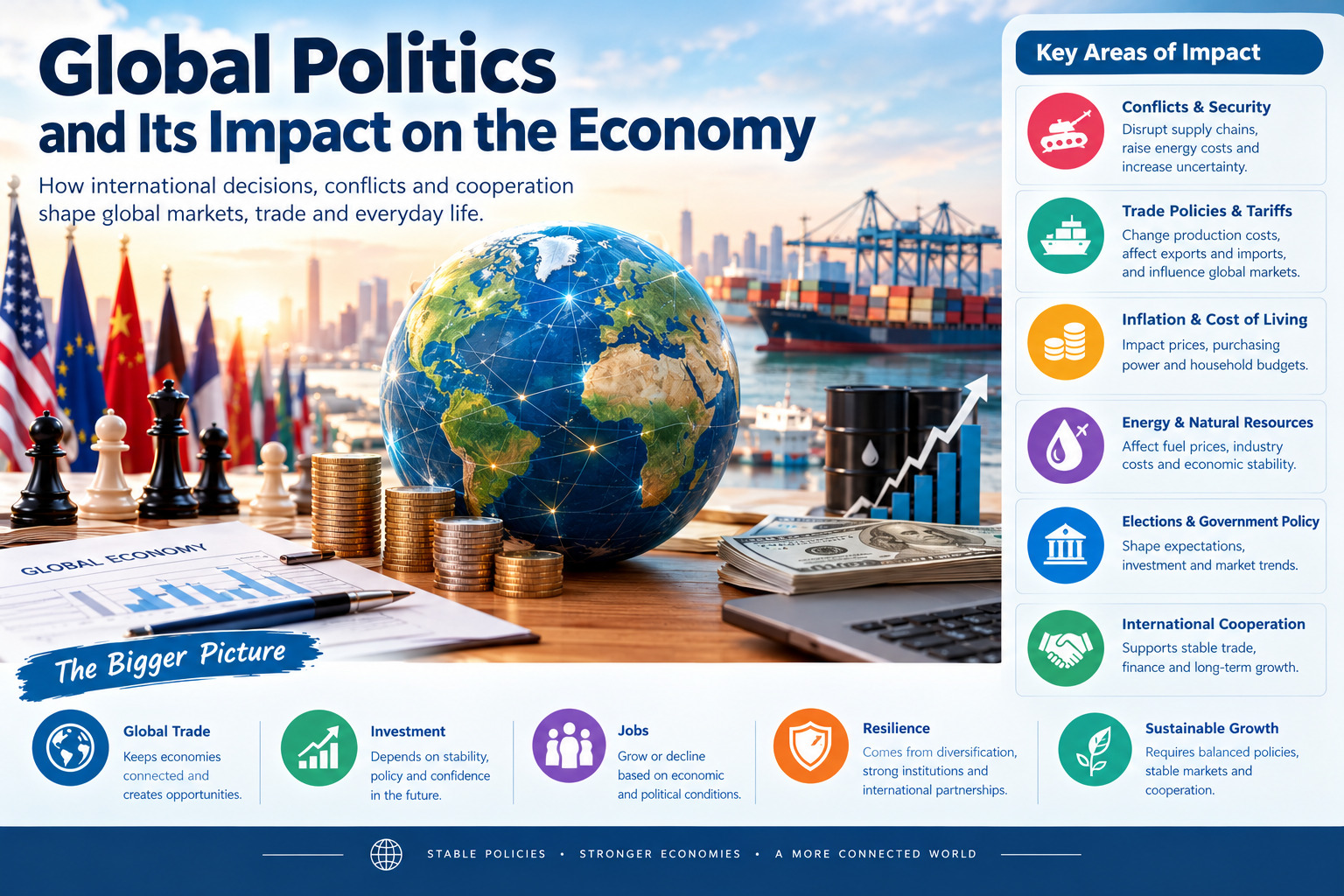
Global Politics and Its Impact on the Economy
Global politics plays a major role in shaping the world economy. Decisions made by governments, international agreements, trade restrictions, military conflicts, and diplomatic negotiations can influence prices, employment, investment, and economic growth across countries. In an interconnected world, a political decision made in one region can affect businesses and households thousands of kilometers away.
Understanding the relationship between politics and economics helps readers interpret changes in international markets, recognize economic risks, and understand why the cost of living can rise even when local economic conditions appear stable. The relationship works in both directions: political decisions influence economic outcomes, while economic pressures can also reshape public opinion and government policy. Source: International Monetary Fund
1. How Political Decisions Shape the Global Economy
Governments influence economic activity through taxation, public spending, trade policy, regulation, industrial strategy, and international agreements. Policies that encourage investment, improve infrastructure, and create predictable business conditions can support economic development. Conversely, sudden policy changes or prolonged political uncertainty may cause companies to delay expansion, reduce investment, or reconsider where they operate.
Political decisions also affect confidence. Businesses are more likely to commit money to factories, technology, and new employees when they can reasonably anticipate future rules and costs. When regulations, tariffs, or diplomatic relationships become unpredictable, companies may postpone decisions even before a policy takes effect. This uncertainty can influence economic growth beyond the country where the political dispute began. Source: World Bank
2. Wars and Geopolitical Conflicts: Economic Consequences
Armed conflicts can damage infrastructure, interrupt production, displace workers, and disrupt the movement of goods. Their economic consequences often extend beyond the countries directly involved because international supply chains depend on stable transportation routes, energy supplies, and cross-border trade.
Conflicts affecting major energy-producing regions or shipping corridors can raise transportation and insurance costs, increase uncertainty, and put upward pressure on the prices of fuel and other essential inputs. Businesses may pass some of these additional costs to consumers, while governments may need to provide assistance to households or industries facing higher expenses.
The scale of the impact depends on the duration of the conflict, the importance of the affected region to global supply chains, and the ability of businesses and governments to adapt. The International Monetary Fund’s April 2026 economic outlook identifies conflict-related disruptions and geopolitical fragmentation as important risks to global growth and inflation. Source: IMF World Economic Outlook, April 2026
3. Trade Wars, Tariffs, and International Business
Trade policy is one of the clearest ways politics affects the economy. Tariffs increase the cost of imported goods, while quotas, export restrictions, and other trade barriers can limit the availability of products and materials. Governments sometimes use these measures to protect domestic industries, respond to unfair trade practices, or pursue national security objectives.
However, tariffs can also increase costs for domestic manufacturers that depend on imported components. Companies may respond by raising prices, changing suppliers, relocating production, or accepting lower profit margins. If trading partners retaliate with their own restrictions, the resulting dispute can affect a much wider range of industries.
The World Trade Organization’s 2026 World Trade Report examines the economic risks of a more fragmented trading system and the benefits of predictable international cooperation. Rules-based trade does not eliminate disputes, but it can provide mechanisms for resolving them and reduce uncertainty for businesses. Source: WTO World Trade Report 2026
4. Political Instability, Inflation, and the Cost of Living
Political instability can contribute to inflation when it disrupts the supply of energy, food, raw materials, or manufactured products. If supply falls while demand remains strong, prices may increase. Currency depreciation can add another source of pressure by making imported goods more expensive in local currency.
The effects vary considerably between countries. An economy that imports most of its fuel and food may be more vulnerable to international price increases than a country with substantial domestic production. Even resource-exporting economies can experience higher transport costs, exchange-rate volatility, or disruptions to other sectors.
Inflation is not caused by politics alone. Monetary policy, domestic demand, productivity, weather conditions, wages, and supply constraints also matter. Political events are best understood as one part of a broader set of forces that determine the prices households pay. Source: World Bank, Global Economic Prospects, June 2026
5. Oil, Natural Gas, and the Politics of Energy
Energy is closely connected to international relations because oil and natural gas production, transport routes, infrastructure, and export agreements cross national borders. Political tensions, sanctions, conflict, and decisions by producing countries can influence the availability and cost of energy.
When energy prices rise, households may spend more on transport, heating, and electricity. Businesses face higher operating costs, especially in transport, manufacturing, agriculture, and other energy-intensive industries. Higher production and distribution costs can then spread through the economy, affecting the prices of goods and services.
Lower energy prices can provide relief to importing countries and businesses, although the benefits may be offset by other economic pressures. Exporting countries can receive more revenue when prices rise, but they may also face greater volatility and uncertainty. Energy policy, diversification of supply, and investment in reliable infrastructure can help countries manage these risks. Source: IMF World Economic Outlook, April 2026
6. Elections and Government Policy: Effects on Markets and Investment
National elections can influence economic expectations because competing political parties often propose different approaches to taxes, public spending, regulation, trade, and industrial development. Investors and businesses may assess how proposed policies could affect future profits, borrowing costs, and demand.
Markets can react before a new government takes office because financial prices reflect expectations about the future. However, a market movement around an election does not prove that a particular candidate or policy is solely responsible. Global interest rates, corporate earnings, commodity prices, and other developments can influence the same markets.
After an election, the actual economic impact depends on which proposals are implemented, how they are financed, the strength of public institutions, and how households and businesses respond. Predictable rules and credible institutions can help reduce uncertainty, while abrupt policy changes may increase it.
7. Sanctions and Their Impact on International Trade
Economic sanctions are restrictions imposed by governments or international bodies to pursue foreign-policy, security, or legal objectives. Depending on their design, they may limit financial transactions, access to technology, exports, imports, or dealings with specified individuals and organizations.
Sanctions can change trade routes, increase compliance costs, and complicate payments and shipping. Businesses may need to find alternative suppliers, verify customers more carefully, or stop transactions that are prohibited by applicable law. These adjustments can affect companies beyond the country directly targeted by the restrictions.
The economic consequences depend on the measures imposed, the countries involved, available alternatives, enforcement, and the length of time restrictions remain in place. Sanctions should therefore be assessed individually rather than assumed to have identical effects in every situation. Businesses involved in international trade should consult current official rules and qualified legal advice before entering potentially restricted transactions.
8. How Global Politics Affects Developing Economies
Developing economies can be particularly exposed to international political and economic shocks when they rely heavily on imported fuel, food, machinery, or external financing. Higher global interest rates can increase the cost of borrowing, while weaker demand in major export markets can reduce revenue and employment.
Countries with limited fiscal resources may find it difficult to support households and businesses during a crisis. Currency pressures can make foreign-currency debt more expensive to service, and disruptions to trade can affect government revenue as well as private-sector activity.
Nevertheless, developing economies are not simply passive victims of global events. Investment in education, infrastructure, trade diversification, reliable institutions, and domestic productive capacity can improve resilience. Regional trade and stronger economic partnerships can also create opportunities, provided that they complement rather than unnecessarily restrict access to wider markets. Source: World Bank, Global Economic Prospects, June 2026
9. Global Politics and Financial Markets
Stock markets, bond markets, currencies, and commodity prices respond to expectations about economic growth, inflation, interest rates, and political risk. A diplomatic agreement may improve confidence if investors expect trade and investment to become more predictable. An escalation in tensions can have the opposite effect, particularly when it threatens energy supplies or major commercial routes.
Financial-market reactions are not always straightforward. Some industries may benefit from higher government spending or changes in trade policy, while others face rising costs or reduced access to markets. Gold, currencies, government bonds, and equities can respond differently depending on interest rates, investor positioning, and the nature of the event.
Short-term price movements are also difficult to interpret. A market can rise during a period of political tension if investors had anticipated worse outcomes, while apparently positive news may have little effect if it was already reflected in prices. Political headlines alone are therefore not a reliable basis for investment decisions.
10. Global Cooperation and the Future of Economic Growth
International cooperation can help countries manage problems that cross borders, including trade disputes, financial instability, climate-related risks, and disruptions to essential supply chains. Institutions such as the International Monetary Fund, World Bank, and World Trade Organization provide platforms for economic analysis, financing, negotiations, and the development of common rules.
Cooperation does not require countries to agree on every political issue. It can involve practical arrangements that reduce uncertainty, preserve essential trade, improve transparency, and support vulnerable economies. Well-designed agreements can help businesses plan ahead and encourage investment that might otherwise be delayed.
The challenge is to balance legitimate national priorities with the economic benefits of international exchange. Excessive fragmentation can make production more expensive and restrict access to technology and markets, while well-designed diversification can reduce dependence on a single supplier or route. The objective is not to eliminate every risk, but to manage it without creating unnecessary barriers to growth. Source: WTO World Trade Report 2026
11. How Businesses and Households Can Respond to Political Uncertainty
Businesses can prepare for international uncertainty by identifying critical suppliers, monitoring transport and energy costs, reviewing currency exposure, and developing alternative sourcing arrangements where practical. They should also follow official trade notices and sanctions guidance relevant to their markets rather than relying only on headlines or social media commentary.
Households can improve their financial resilience by understanding how fuel prices, food costs, borrowing rates, and exchange-rate changes affect their budgets. Keeping essential expenses under review and avoiding decisions based solely on alarming political predictions can help people respond more calmly to changing conditions.
No preparation can eliminate the effects of a major global shock. However, reliable information, careful planning, and a clear understanding of personal or business financial limits can reduce avoidable risks.
Final Thoughts
Global politics and the economy are deeply connected. Conflicts can disrupt energy and trade, tariffs can change production costs, elections can influence expectations, and international cooperation can shape the environment in which businesses invest and households make financial decisions.
These effects are rarely uniform. The same political event can create opportunities for one industry while increasing costs for another, and its consequences depend on the economic conditions of each country. Understanding these connections requires attention to reliable data, the distinction between short-term reactions and long-term changes, and the recognition that political developments are only one part of economic performance.
For readers, businesses, and policymakers, the most useful approach is to follow credible sources, assess the mechanisms through which events affect the economy, and avoid treating uncertain forecasts as guaranteed outcomes.


