
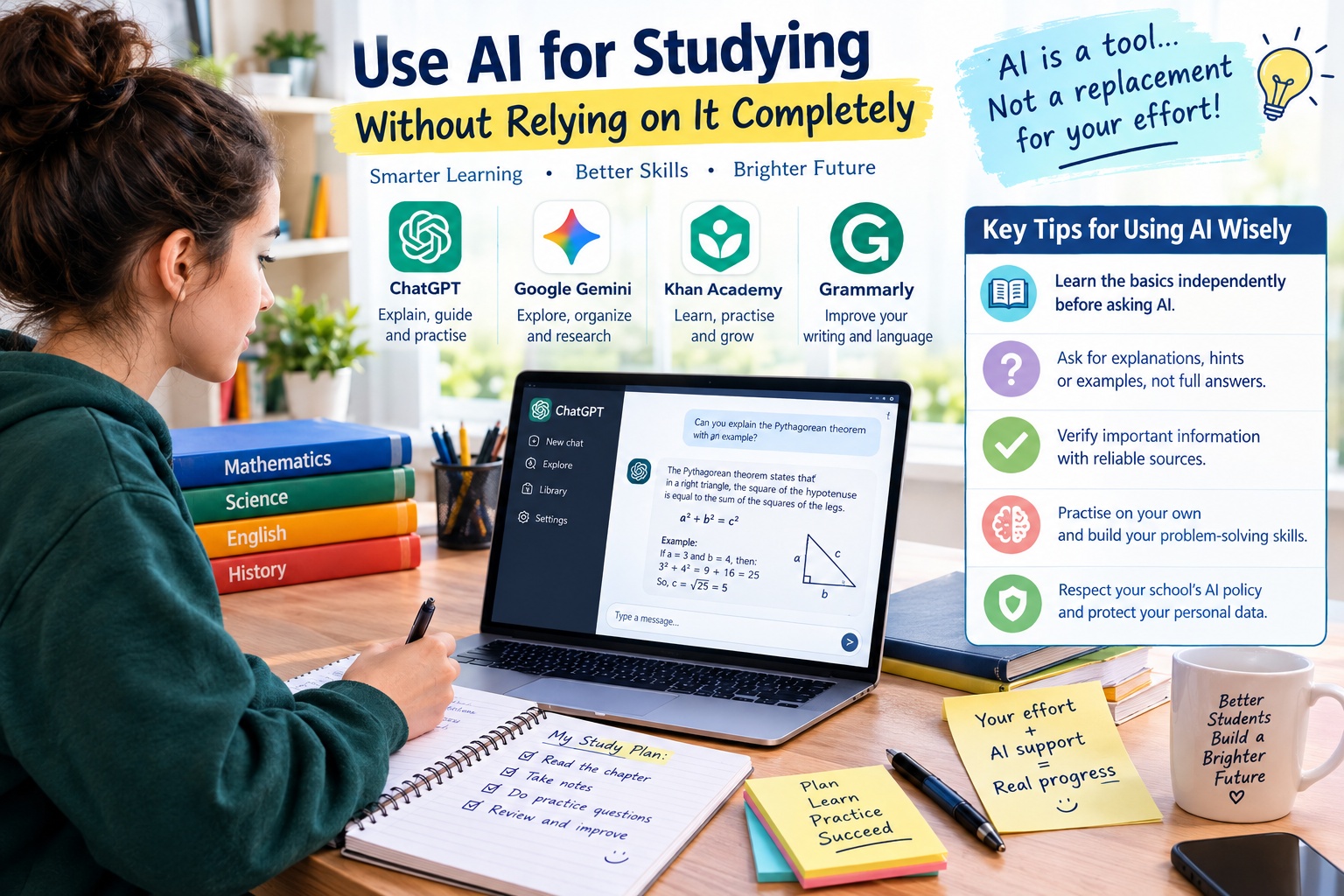
How to Use Artificial Intelligence for Studying Without Depending on It Completely: A Complete Guide for Students in 2026
1. Understand Difficult Subjects with AI-Powered Explanations
One of the most useful applications of artificial intelligence in education is explaining difficult concepts in simpler language. Students can use AI tools to explore topics in mathematics, physics, chemistry, biology, history, and other academic subjects.
For example, if a student struggles to understand a mathematical formula, an AI assistant can explain the underlying concept, demonstrate a similar example, and suggest practice questions. Students can also request explanations suitable for their current knowledge level.
The key is to avoid asking AI to provide answers without understanding the reasoning behind them. Instead, ask it to explain each step, identify the important principles, and provide additional examples that you can solve independently.
Main Features:
- Simplified explanations of difficult concepts.
- Step-by-step learning support.
- Examples adapted to different knowledge levels.
- Follow-up questions for deeper understanding.
- Explanations of unfamiliar terminology.
Advantages:
AI explanations can help students overcome learning difficulties more quickly and explore alternative ways of understanding a subject. They can also make it easier to identify which concepts require further revision.
However, AI-generated explanations are not always accurate. Students should compare important information with textbooks, class notes, and reliable educational resources.
2. Use AI to Create Personalized Study Plans
Time management is an essential part of academic success. Artificial intelligence can help students organize their study schedules, divide large assignments into smaller tasks, and plan revision sessions before examinations.
For example, students can provide their examination dates, subjects, available study periods, and topics that need revision. An AI assistant can then suggest a structured study plan that distributes the workload across several days or weeks.
Students can also use AI to prioritize difficult subjects, schedule practice sessions, and identify areas that deserve additional attention.
Main Features:
- Personalized study schedules.
- Task organization and prioritization.
- Revision plans based on examination dates.
- Suggested study intervals and breaks.
- Progress review and schedule adjustments.
Advantages:
AI-assisted planning can reduce the time spent organizing academic responsibilities and help students develop a more consistent routine.
Nevertheless, students should review the suggested schedules and adapt them to their actual needs. A realistic plan that includes breaks, sleep, and personal responsibilities is more useful than an excessively demanding schedule generated by AI.
3. Practise with AI-Generated Questions and Quizzes
Practising questions is one of the most effective ways to prepare for examinations. AI can generate quizzes, multiple-choice questions, short-answer exercises, and practice problems based on topics that students are studying.
For example, after reading a biology chapter, a student can ask an AI assistant to create ten questions about the main concepts. The student should attempt to answer the questions independently before requesting explanations or checking the answers.
AI can also help students identify weak areas by generating additional exercises on concepts they find difficult.
Main Features:
- Multiple-choice questions.
- Short-answer practice exercises.
- Subject-specific quizzes.
- Explanations of incorrect answers.
- Additional practice on challenging topics.
Advantages:
AI-generated practice materials can make revision more interactive and provide students with additional opportunities to test their knowledge.
However, students should not assume that AI-generated questions perfectly match their actual examinations. They should also practise using official past papers, teacher-provided exercises, and approved course materials whenever available.
4. Improve Note-Taking Without Replacing Your Own Work
AI tools can help students organize notes, summarize long texts, identify key concepts, and transform complicated information into tables or revision outlines.
For instance, students can use AI to reorganize their own notes into a structured summary containing definitions, examples, and important ideas. They can also request a list of key terms to review before an examination.
A useful approach is to read the original material first, write down the main ideas independently, and then use AI to identify missing information or clarify confusing sections.
Main Features:
- Summarization of study materials.
- Organization of notes into clear sections.
- Identification of important concepts.
- Creation of revision outlines.
- Transformation of notes into question-and-answer formats.
Advantages:
AI-assisted note-taking can save time and make large amounts of information easier to review.
However, copying AI-generated summaries without reading the original material may create gaps in understanding. Students should always compare summaries with their course materials and make sure they can explain the concepts in their own words.
5. Use AI to Improve Writing and Language Skills
Artificial intelligence can support students who want to improve their grammar, vocabulary, sentence structure, and writing organization.
For example, students learning English can ask AI to explain grammar rules, provide examples of unfamiliar words, or identify mistakes in a paragraph they have written themselves.
AI can also help students develop essay outlines, brainstorm possible arguments, and understand how introductions, body paragraphs, and conclusions work together.
Main Features:
- Grammar and spelling feedback.
- Vocabulary explanations.
- Writing structure suggestions.
- Examples of sentence construction.
- Language-learning exercises.
- Feedback on clarity and organization.
Advantages:
AI writing assistance can help students recognize recurring mistakes and develop stronger communication skills.
The important distinction is between receiving feedback and allowing AI to complete the entire assignment. Students should write their own work, evaluate the suggestions they receive, and follow their school’s rules regarding AI assistance.
6. Use AI as a Tutor Instead of an Answer Machine
One of the best ways to avoid depending too much on artificial intelligence is to treat it as a tutor that guides your thinking.
Instead of asking AI to solve every problem immediately, request hints, explanations, or questions that help you discover the answer yourself.
For example, when working on a mathematics exercise, you can first attempt the problem independently. If you become stuck, ask AI to explain the relevant formula or provide a small hint without revealing the complete solution.
After understanding the method, solve a similar problem without assistance.
Main Features:
- Guided explanations.
- Progressive hints.
- Follow-up questions.
- Practice problems with increasing difficulty.
- Feedback on your reasoning.
Advantages:
This approach encourages independent thinking and helps students understand how to solve problems rather than simply memorize answers.
The goal is to become increasingly capable of completing academic tasks without AI assistance.
7. Recommended AI Tools for Studying in 2026
Several AI-powered platforms can support different aspects of the learning process. Choosing the right tool depends on the subject, learning objectives, available features, and school policies.
ChatGPT: Best for Explanations and Guided Learning
ChatGPT can explain concepts, help students practise languages, generate revision questions, and suggest different approaches to difficult problems.
Students can ask it to explain a topic at different levels of difficulty or provide hints before revealing a solution.
Its flexibility makes it useful for a wide range of academic subjects. However, students should verify important facts and avoid treating every generated response as correct.
Official website: https://chatgpt.com/
Google Gemini: Best for Exploring Topics and Organizing Information
Google Gemini can help students explore unfamiliar subjects, ask follow-up questions, brainstorm ideas, and organize information for revision.
Depending on the available features and account, it may also support connected Google services and other learning-related workflows.
Students should evaluate its answers critically and compare important claims with trustworthy sources.
Official website: https://gemini.google.com/
Khan Academy: Best for Structured Learning and Practice
Khan Academy offers educational lessons and practice activities across subjects such as mathematics, science, and economics. Its AI-supported learning features, including Khanmigo where available, are designed to support guided learning and encourage students to think through problems.
The platform is particularly useful when students want to combine structured educational content with additional practice.
Availability and access conditions for AI features may vary.
Official website: https://www.khanacademy.org/
Grammarly: Best for Grammar and Writing Feedback
Grammarly provides writing assistance that can help students review grammar, spelling, clarity, and sentence structure. Depending on the plan and available features, it may also offer AI-powered writing support.
Students can use it to review their own drafts, understand language mistakes, and improve readability.
It should support the student’s writing process rather than replace original work or violate academic integrity requirements.
Official website: https://www.grammarly.com/
8. Best Study Accessories on Amazon Germany and the European Union
AI tools can support digital learning, but traditional study materials remain valuable for independent thinking, handwriting practice, and examination preparation.
The following Amazon Germany search links help students explore products that can complement an AI-assisted study routine. These are product search pages rather than specific product recommendations, and availability may vary across European countries.
Study Planners
A study planner helps students record deadlines, examination dates, daily goals, and weekly revision schedules. It is useful for turning an AI-generated plan into a practical routine.
Amazon Germany: https://www.amazon.de/s?k=student+study+planner
Notebooks for Independent Note-Taking
Notebooks allow students to write explanations in their own words, solve exercises manually, and summarize important concepts without relying entirely on digital tools.
Amazon Germany: https://www.amazon.de/s?k=school+notebooks
Flashcards for Active Recall
Flashcards are useful for practising definitions, vocabulary, formulas, scientific terminology, and historical facts. Students can create their own cards from textbooks and class notes or use AI to suggest questions for revision.
Amazon Germany: https://www.amazon.de/s?k=study+flashcards
Whiteboards for Solving Problems
A small whiteboard can provide a reusable space for practising mathematics, drawing diagrams, explaining scientific concepts, and testing knowledge from memory.
Amazon Germany: https://www.amazon.de/s?k=small+whiteboard+for+study
Study Timers
A study timer can help students divide their work into focused sessions and regular breaks. It can complement digital planning tools by providing a simple way to monitor study periods.
Amazon Germany: https://www.amazon.de/s?k=study+timer
Before purchasing any item, compare product specifications, customer reviews, prices, and delivery options for your location.
9. The Risks of Depending Too Much on Artificial Intelligence
Although AI offers many educational benefits, excessive dependence can create several problems.
First, students may develop weaker problem-solving habits if they routinely request complete answers before attempting exercises independently. Learning requires active participation, including making mistakes, reviewing feedback, and trying again.
Second, AI systems can produce inaccurate information or explanations that sound convincing but contain errors. Students who accept these responses without verification may memorize incorrect facts.
Third, relying on AI to write essays or complete assignments can prevent students from developing their own writing, reasoning, and research abilities. Submitting AI-generated work as original work may also violate school or university policies.
Finally, entering personal information, confidential school documents, or sensitive details into AI services can create privacy risks.
To reduce these risks, students should verify important information, follow their institution’s AI policy, protect personal data, and make sure that their submitted work reflects their own understanding.
Responsible use means evaluating AI responses rather than automatically trusting them.
10. A Practical Method for Using AI Without Becoming Dependent
Students can follow a simple process to combine AI assistance with independent learning.
Step 1: Study the Material Independently
Begin by reading your textbook, reviewing class notes, or watching an approved lesson. Identify the main concepts before asking AI for help.
Step 2: Identify What You Do Not Understand
Write down specific questions about confusing definitions, formulas, examples, or arguments. Clear questions help you use AI more effectively.
Step 3: Ask for Guidance
Request an explanation, a hint, or a similar example instead of immediately asking for a complete answer.
Step 4: Practise Without AI
Close the AI tool and attempt to solve a related exercise or explain the concept in your own words. This helps you determine whether you genuinely understand the material.
Step 5: Verify Important Information
Compare AI-generated explanations with your textbooks, teacher’s instructions, and reliable educational sources.
Step 6: Review Your Mistakes
If your answer is incorrect, investigate the reason. Use AI to clarify the relevant concept, then attempt another similar exercise independently.
Step 7: Evaluate Your Progress
At the end of a study session, ask yourself whether you can explain the topic or solve a similar problem without assistance. If you cannot, spend more time practising independently.
This method makes AI a supportive learning resource while keeping the student responsible for the actual learning process.
Conclusion
Artificial intelligence can make studying more flexible, organized, and interactive when students use it with clear learning goals. It can explain difficult subjects, generate practice questions, organize revision schedules, improve writing, and provide guidance when learners encounter problems.
However, the best way to use AI for studying without depending on it completely is to combine digital assistance with independent reading, critical thinking, active recall, and regular practice.
Tools such as ChatGPT, Google Gemini, Khan Academy, and Grammarly can support different learning activities, while traditional study materials such as notebooks, flashcards, and planners encourage students to practise independently.
Ultimately, AI should help students become more capable learners, not make learning unnecessary. By asking thoughtful questions, checking information, following academic integrity rules, and regularly working without AI assistance, students can benefit from modern technology while developing the knowledge and skills they need for long-term academic success.


