
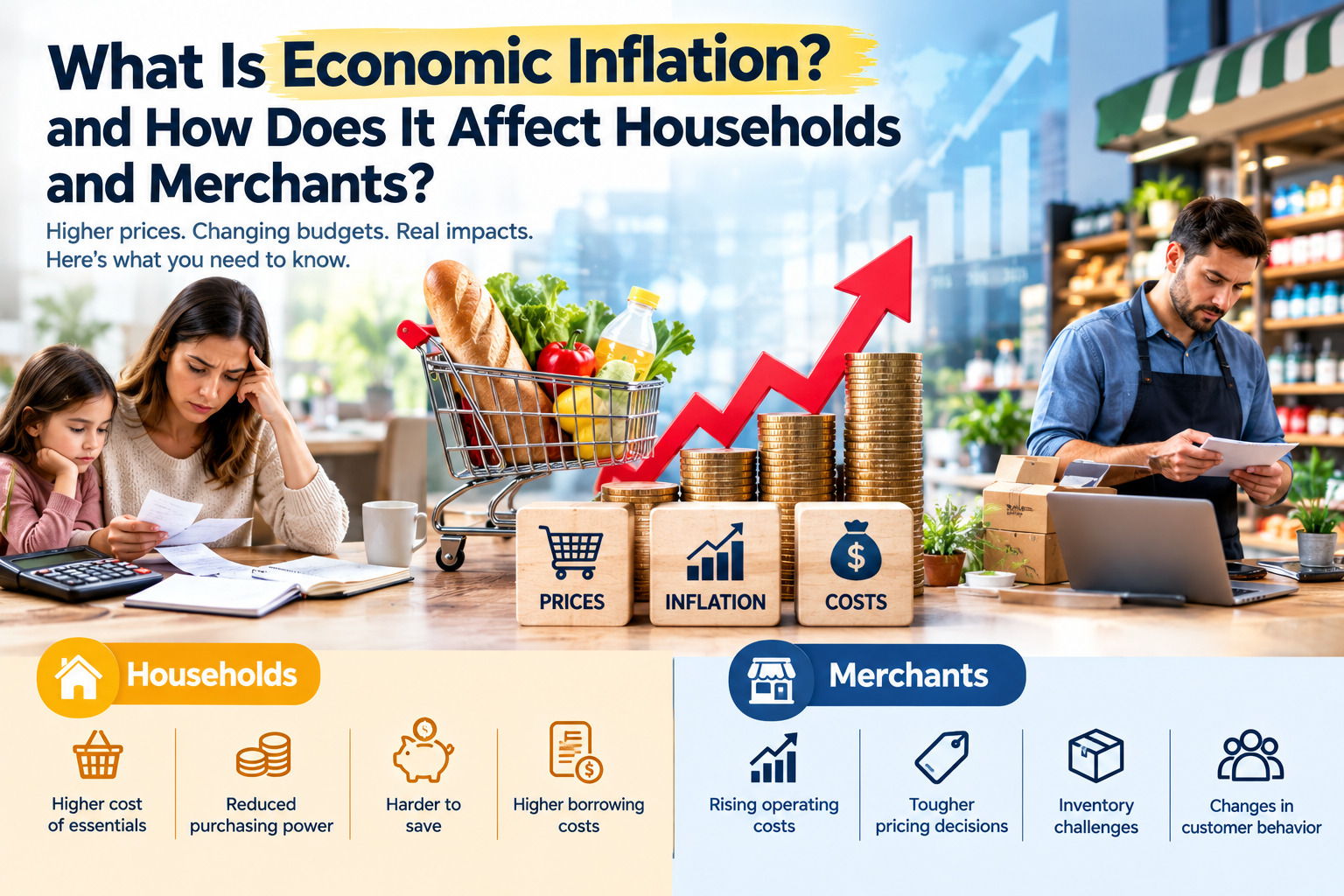
What Is Economic Inflation and How Does It Affect Households and Merchants?
Economic inflation is one of the most important factors affecting the cost of living, household budgets, business expenses, and purchasing decisions. When prices rise across an economy, families may struggle to afford everyday necessities, while merchants face higher operating costs and changing customer demand. Understanding inflation helps individuals manage their money more effectively and enables business owners to make better pricing, purchasing, and financial planning decisions.
Inflation does not affect everyone equally. Its impact depends on income levels, savings, debt, business costs, and how quickly wages and revenues adjust to rising prices. By understanding what causes inflation and how it influences households and merchants, people can make more informed financial decisions and prepare for economic uncertainty.
What Is Economic Inflation?
Economic inflation is a sustained increase in the general price level of goods and services over time. It means that, on average, consumers need more money to purchase the same basket of products and services than they did previously. Inflation is not simply an increase in the price of one product; it reflects a broader rise in prices across the economy.
For example, imagine that a household spends $500 per month on groceries, transportation, electricity, and other essential expenses. If the prices of these goods and services rise by 10% overall, maintaining the same level of consumption would cost approximately $550, assuming the household buys the same quantities and the price increases affect its basket by that amount. The additional $50 represents the effect of inflation on this illustrative monthly budget.
Inflation is generally measured using a price index, such as the Consumer Price Index (CPI). Statistical agencies track the prices of a representative basket of goods and services and compare them over time. However, the inflation rate experienced by an individual household may differ from the official average because people have different spending habits and living costs.
Official information: https://www.imf.org/en/publications/fandd/issues/series/back-to-basics/inflation
What Are the Main Causes of Inflation?
1. Demand-Pull Inflation
Demand-pull inflation occurs when demand for goods and services grows faster than the economy’s ability to supply them. When consumers have more money to spend, businesses receive more orders, and available products may become insufficient to meet demand. Businesses can then raise prices, particularly when production cannot increase quickly.
For example, if many consumers suddenly want to purchase the same household appliances but manufacturers cannot produce enough units, retailers may increase prices. Similar pressure can occur when consumer spending, government expenditure, or investment rises significantly while production capacity remains limited.
This type of inflation can accompany a growing economy, but excessive demand may push prices up faster than household incomes and business productivity. The challenge for policymakers is to support sustainable economic activity without allowing demand to create persistent price instability.
Further reading: https://www.imf.org/en/publications/fandd/issues/series/back-to-basics/inflation
2. Cost-Push Inflation
Cost-push inflation occurs when the cost of producing or delivering goods and services increases. Businesses may face higher prices for raw materials, fuel, electricity, transportation, packaging, wages, or imported components. When these costs rise, companies may increase their selling prices to protect their profit margins.
For example, a bakery may experience higher costs for flour, electricity, fuel, and packaging. If the owner cannot absorb these increases, the price of bread and other products may rise. Similar effects can spread through supply chains, affecting wholesalers, retailers, restaurants, manufacturers, and consumers.
Cost-push inflation can be particularly difficult to manage because higher production costs may reduce business profitability while simultaneously increasing prices for customers. If customers cannot afford the higher prices, businesses may also experience falling sales.
Further reading: https://www.worldbank.org/en/brief/2024/07/15/global-inflation
3. Imported Inflation and Currency Depreciation
Imported inflation occurs when products purchased from other countries become more expensive. This may happen because international prices rise, transportation costs increase, or the domestic currency loses value against the currencies used for international trade.
For example, a merchant who imports electronic equipment may need to pay more in local currency when the exchange rate moves unfavorably. Even if the supplier’s price remains unchanged in foreign currency, the importer’s total cost may increase. Businesses that depend heavily on imported food, machinery, medicine, fuel, or industrial materials can be particularly exposed to this risk.
Importers may respond by raising selling prices, accepting lower profit margins, changing suppliers, or reducing the quantity they purchase. The final effect depends on competition, the availability of alternatives, exchange-rate movements, and how much of the additional cost businesses can absorb.
Further reading: https://www.worldbank.org/en/brief/2024/07/15/global-inflation
4. Inflation Expectations
Inflation expectations refer to what households, businesses, workers, and investors believe will happen to prices in the future. These expectations can influence current economic decisions. Workers may request higher wages, suppliers may increase quotations, and businesses may adjust prices in anticipation of higher future costs.
For example, a merchant who expects wholesale prices to rise next month may order inventory earlier or increase prices before the additional costs arrive. If such behavior becomes widespread, it can contribute to continuing price pressure, especially when combined with supply shortages or strong demand.
Expectations do not automatically cause inflation on their own, but they can influence how existing price pressures develop. Clear communication from central banks and credible policies can help keep inflation expectations more stable.
Further reading: https://www.imf.org/en/publications/fandd/issues/series/back-to-basics/inflation
How Is Inflation Measured?
The Consumer Price Index is one of the most widely used measures of consumer inflation. It tracks changes in the prices of a selected basket of goods and services commonly purchased by households. The basket may include food, housing, transportation, clothing, healthcare, utilities, and other everyday expenses.
The annual inflation rate is generally calculated by comparing the price index with its level in the same period of the previous year. For example, if the CPI rises from 120 to 126 over a year, the increase is 5%. This means that the measured basket has become 5% more expensive on average over that period.
It is important to distinguish between the inflation rate and the overall price level. If inflation falls from 8% to 3%, prices are generally still increasing, but at a slower rate. A decline in inflation does not automatically mean that products have returned to their previous prices.
Official explanation: https://www.ecb.europa.eu/ecb-and-you/explainers/tell-me-more/html/what_is_inflation.tr.html
How Does Inflation Affect Households?
1. It Reduces Purchasing Power
One of the most direct effects of inflation is the reduction in purchasing power when income does not increase as quickly as prices. A salary that previously covered groceries, rent, transportation, and savings may no longer be sufficient to maintain the same standard of living.
For example, if a household’s monthly income remains unchanged while its essential expenses increase, the family must either spend more of its existing income, reduce consumption, use savings, or borrow money. Even moderate price increases can create significant pressure when a large share of income is already committed to essential expenses.
The impact is often more severe for low-income households because food, housing, utilities, and transportation may account for a larger proportion of their budgets. These families usually have less room to reduce spending without affecting their basic needs.
Further reading: https://www.oecd.org/en/topics/inflation-and-cost-of-living.html
2. It Increases the Cost of Everyday Necessities
Inflation can make essential products and services more expensive, including food, electricity, fuel, rent, public transportation, and healthcare. When several categories rise at the same time, families may find it difficult to compensate by cutting only a few nonessential expenses.
For example, a family may reduce restaurant visits and entertainment spending, but still face higher grocery bills and transportation costs. If rent or utility expenses also rise, the amount left for education, clothing, savings, and unexpected emergencies can shrink considerably.
Households can respond by planning meals, comparing prices, reducing avoidable waste, reviewing recurring expenses, and prioritizing essential purchases. These measures cannot eliminate inflation, but they can help families manage their budgets more carefully.
Further reading: https://www.oecd.org/en/topics/inflation-and-cost-of-living.html
3. It Makes Saving More Difficult
When living expenses rise faster than income, households may have less money available to save. Families may need to use emergency savings to cover routine expenses, making them more vulnerable to future financial shocks such as medical bills, job loss, or urgent home repairs.
Inflation also affects the real value of money kept in cash or in an account that earns little or no interest. If prices rise faster than the return on savings, the amount saved loses purchasing power even though the nominal balance remains unchanged.
For this reason, households should consider both their need for accessible emergency savings and the effect of inflation on longer-term financial goals. The appropriate approach depends on individual circumstances, available financial products, fees, and risk tolerance.
Further reading: https://www.consumerfinance.gov/an-essential-guide-to-building-an-emergency-fund/
4. It Changes Borrowing and Debt Repayment Costs
Inflation can influence interest rates, which affect the cost of borrowing. Central banks may raise policy rates to reduce excessive demand and bring inflation under control. These changes can eventually increase the cost of certain loans, including variable-rate mortgages, business credit, and consumer borrowing.
However, the impact depends on the type of debt and the terms of the agreement. A borrower with a fixed-rate loan may continue paying the same scheduled interest rate, while a borrower with a variable-rate loan may face higher payments. Inflation can also reduce the real burden of fixed nominal debt if the borrower’s income rises sufficiently, but this outcome is not guaranteed.
Households should review loan terms, understand whether interest rates are fixed or variable, and avoid taking on debt they cannot comfortably repay. When borrowing costs rise, paying attention to monthly cash flow becomes especially important.
Further reading: https://www.imf.org/en/about/factsheets/sheets/2023/monetary-policy-and-central-banking
5. It Can Increase Financial Stress and Inequality
Rapid price increases can create uncertainty and financial pressure for households that have limited savings or little ability to increase their income. People living on fixed pensions, certain benefits, or wages that adjust slowly may find that their income buys less over time.
The effects also differ between households that own assets, those that rent, people with substantial debt, and those who depend mainly on wages. Some individuals may benefit from particular economic changes, while others experience higher living costs without a corresponding increase in income.
As a result, inflation can widen differences in financial security. Policies that support vulnerable households, alongside measures that restore price stability, can help reduce the burden on those least able to absorb rising costs.
Further reading: https://www.oecd.org/en/topics/inflation-and-cost-of-living.html
How Does Inflation Affect Merchants and Small Businesses?
1. It Increases Operating Costs
Merchants often face higher costs for purchasing inventory, transporting goods, paying rent, running equipment, and maintaining their premises during periods of inflation. Small businesses can be especially vulnerable because they may have limited cash reserves and less bargaining power with suppliers than large companies.
For example, a grocery store may need to pay more for food deliveries, refrigeration, electricity, packaging, and employee wages. Even if the store continues selling the same quantity of products, its operating expenses may rise enough to reduce profitability.
Business owners should monitor cost changes regularly, review supplier agreements, reduce avoidable waste, and improve inventory management. These steps help identify where expenses are increasing and where operational efficiency can be improved without damaging product quality or customer service.
Further reading: https://www.worldbank.org/en/brief/2024/07/15/global-inflation
2. It Creates Difficult Pricing Decisions
When purchasing costs rise, merchants must decide whether to increase selling prices, absorb the additional costs, change suppliers, or adjust their product range. Raising prices too quickly may push customers toward competitors, while keeping prices unchanged can reduce profit margins and threaten the business’s financial stability.
For example, a retailer may purchase a product for 800 monetary units and sell it for 1,000, generating a gross profit of 200 before other business expenses. If the purchase cost rises to 900 but the selling price remains 1,000, gross profit falls to 100. The retailer earns less from each sale unless other costs or pricing decisions change.
A careful pricing strategy should consider replacement costs, competitor prices, customer demand, taxes, operating expenses, and the value customers receive. Instead of applying the same percentage increase to every product, merchants can review individual product margins and make adjustments based on reliable cost information.
Further reading: https://www.sba.gov/business-guide/manage-your-business/manage-your-finances
3. It Changes Customer Purchasing Behavior
As prices rise, customers may become more price-sensitive and focus on essential products. They may switch to cheaper brands, purchase smaller quantities, delay nonessential purchases, or compare prices across several stores before buying.
This change in behavior can affect merchants differently. Businesses selling necessities may continue to attract regular demand, but their margins can still be squeezed by rising costs. Stores selling luxury goods or nonessential products may experience a larger decline in sales if customers decide to postpone purchases.
Merchants can respond by offering different price points, communicating product value clearly, reviewing product combinations, and maintaining reliable service. Understanding which products customers consider essential can help businesses adapt their inventory and marketing decisions.
Further reading: https://www.oecd.org/en/topics/inflation-and-cost-of-living.html
4. It Creates Inventory and Cash Flow Challenges
Inflation makes inventory planning more complicated because replacement costs may change between the time a product is purchased and the time it is sold. Merchants who rely on outdated cost figures may believe they are making a profit while earning too little to replace their stock at current prices.
At the same time, buying too much inventory in anticipation of future price increases can tie up cash, increase storage expenses, and create a risk of unsold goods. Businesses must balance the need to maintain sufficient stock with the need to preserve working capital.
A useful approach is to monitor stock turnover, supplier lead times, actual purchase costs, and expected demand. Regularly updating inventory records and cash flow forecasts helps merchants make purchasing decisions based on current conditions rather than assumptions.
Further reading: https://www.sba.gov/business-guide/manage-your-business/manage-your-finances
5. It Can Increase Financing and Expansion Costs
When central banks raise interest rates to control inflation, borrowing may become more expensive for businesses. Merchants who depend on credit to purchase inventory, open new locations, buy equipment, or cover temporary cash shortages may face higher financing costs.
Higher interest expenses can reduce the money available for hiring, marketing, technology upgrades, and business expansion. Businesses with variable-rate loans may be particularly exposed to changes in borrowing costs, while fixed-rate agreements may provide greater predictability for the duration of their terms.
Before taking on additional debt, merchants should estimate repayments under different scenarios, review their cash flow, and compare available financing terms. Delaying a major investment may sometimes be more prudent than committing to expenses the business cannot support.
Further reading: https://www.imf.org/en/about/factsheets/sheets/2023/monetary-policy-and-central-banking
6. It Can Affect Employee Wages and Business Productivity
When the cost of living rises, employees may seek higher wages to maintain their purchasing power. Businesses that increase wages may improve staff retention and morale, but they also face higher labor costs. Businesses that cannot adjust compensation may struggle to attract or retain experienced workers.
The effect depends on productivity, competition, profit margins, and the ability of a business to adjust prices or reduce other costs. Simply cutting staff or wages may harm service quality and make it harder to generate sales over the long term.
Merchants can examine work processes, reduce unnecessary administrative tasks, improve staff training, and use appropriate technology to increase productivity. Better productivity can help offset some cost pressures without relying exclusively on price increases.
Further reading: https://www.oecd.org/en/topics/inflation-and-cost-of-living.html
How Can Households Protect Themselves From Inflation?
1. Build a Realistic Household Budget
A clear budget helps families understand where their money goes and which expenses are most affected by rising prices. Start by listing monthly income and essential expenses, then record flexible spending, debt payments, and savings. Reviewing the budget regularly makes it easier to identify changes before they create a financial shortfall.
Households should update their budgets when grocery bills, transportation costs, rent, or utility expenses change. A budget based on outdated prices may provide a misleading picture of how much money is actually available.
2. Prioritize Essential Spending and Reduce Waste
When household costs rise, focus first on necessities such as food, housing, utilities, transportation, and required medical expenses. Compare prices, plan meals, reduce food waste, review subscriptions, and avoid purchases that provide little value. Small savings across several categories may create useful breathing room in a tight budget.
The goal is not to eliminate every enjoyable expense. Instead, households should identify changes that reduce costs without undermining health, safety, or essential quality of life.
3. Build an Emergency Fund
An emergency fund can help households manage unexpected expenses without relying immediately on high-cost borrowing. Start with an achievable savings target and contribute regularly, even if the amount is small. Keeping emergency savings accessible can provide greater financial flexibility when prices rise or income becomes uncertain.
The appropriate size of an emergency fund depends on essential expenses, income stability, family responsibilities, and available support. Households that cannot save a large amount immediately can begin by building a small reserve and increasing it gradually as their financial situation allows.
Practical guidance: https://www.consumerfinance.gov/an-essential-guide-to-building-an-emergency-fund/
4. Look for Ways to Strengthen Income
Reducing expenses has limits, particularly when most spending is essential. Where possible, households can also explore opportunities to improve income through training, additional work, freelance services, career development, or a small business that fits their skills and circumstances.
Additional income is not always immediately available, and any new opportunity should be evaluated carefully. However, improving earning capacity can help families respond to rising living costs more sustainably than relying only on spending cuts.
How Can Merchants Manage Inflation More Effectively?
1. Calculate Profit Margins Using Current Costs
Merchants should update the cost of goods sold and review margins regularly, especially when suppliers change their prices frequently. Calculations should include relevant purchase costs, transportation, packaging, and other direct expenses. Looking only at the original purchase price can make a product appear more profitable than it really is.
Reliable cost information helps business owners decide which products need price adjustments, which suppliers offer better value, and where operational savings are possible.
2. Diversify Suppliers and Review Purchasing Terms
Depending on one supplier can expose a business to sudden price increases, stock shortages, or delivery disruptions. Where practical, merchants can compare alternative suppliers, negotiate volume terms, and review delivery schedules.
The cheapest supplier is not always the best option. Product quality, reliability, payment terms, transport costs, and delivery times should all be considered when comparing offers.
3. Monitor Cash Flow and Avoid Unnecessary Stockpiling
A business can appear profitable on paper while running short of cash needed to pay suppliers, employees, rent, and loan installments. Merchants should forecast incoming payments and outgoing expenses, review overdue invoices, and maintain an appropriate working-capital reserve.
Buying excessive inventory simply because prices might rise can create additional risks. Stock decisions should be based on expected sales, storage capacity, product shelf life, available cash, and the likelihood of future supply problems.
4. Use Data to Make Better Decisions
Sales reports, accounting software, inventory tools, and spreadsheets can help merchants track changing costs and identify products with declining margins. Reviewing sales volumes alongside purchase prices and operating expenses allows business owners to distinguish between a temporary fluctuation and a more persistent problem.
Even a simple spreadsheet that records product cost, selling price, quantity sold, and gross profit can improve decision-making. Businesses can expand to more advanced software as their needs grow.
How Do Governments and Central Banks Control Inflation?
Governments and central banks use different policies to address inflation, depending on its causes and the conditions of the economy. Central banks may raise interest rates to make borrowing more expensive, moderate demand, and influence inflation expectations. These measures can help restore price stability, but they may also slow spending, investment, and economic growth.
Monetary policy cannot directly resolve every source of inflation. For example, if prices rise because of a shortage of fuel, food, or imported materials, higher interest rates cannot immediately increase the available supply. Improving production, transportation, competition, and supply-chain resilience may also be important, depending on the circumstances.
Governments may use targeted support to help vulnerable households manage rising living costs. The design of these measures matters because broad subsidies or poorly targeted spending can be expensive and may not address the underlying causes of inflation. Effective policy generally requires balancing price stability, employment, economic growth, and protection for people most affected by higher costs.
Further reading: https://www.imf.org/en/about/factsheets/sheets/2023/monetary-policy-and-central-banking
Inflation in Everyday Life: A Practical Example
Imagine a small neighborhood grocery store that serves families with limited budgets. Over several months, the store experiences increases in wholesale food prices, transportation costs, electricity bills, and packaging expenses. The owner must decide how to adjust selling prices while keeping essential products affordable.
At the same time, customers notice that their salaries do not cover as many groceries as before. They begin comparing prices more carefully, switching brands, and purchasing fewer nonessential items. The store may therefore face both higher operating costs and pressure on sales volumes.
This example shows how inflation can affect households and merchants simultaneously. Families experience reduced purchasing power, while businesses face a more difficult balance between affordability and profitability. Better budgeting, accurate cost calculations, efficient inventory management, and sound economic policies can help reduce the strain, although no single measure can eliminate every effect of inflation.
Final Thoughts
Economic inflation is more than a rise in prices. It affects purchasing power, savings, debt costs, household living standards, business expenses, pricing decisions, and economic confidence. Its consequences depend on how quickly incomes and revenues adjust, which products become more expensive, and how well households and businesses can adapt.
For households, practical budgeting, careful spending, emergency savings, and efforts to strengthen income can improve financial resilience. For merchants, accurate cost tracking, sensible pricing, efficient inventory management, and cash flow planning can help protect business sustainability.
Understanding inflation allows families and business owners to make more informed decisions instead of reacting only after costs have risen. While individuals cannot control the overall inflation rate, they can take practical steps to manage its effects and prepare for changing economic conditions.


