
Best Ecommerce Platforms for Building Online Stores in 2026
Choosing the right ecommerce platform is one of the most important decisions when starting an online business. The right solution can help you build a professional storefront, manage products and inventory, accept online payments, process orders, and attract customers through search engines and digital marketing.
In 2026, online store builders offer more than website design. Many platforms include artificial intelligence tools, automated workflows, sales analytics, mobile-friendly templates, and integrations with shipping providers and marketing services. However, the best option depends on your budget, technical experience, product catalog, and long-term business goals.
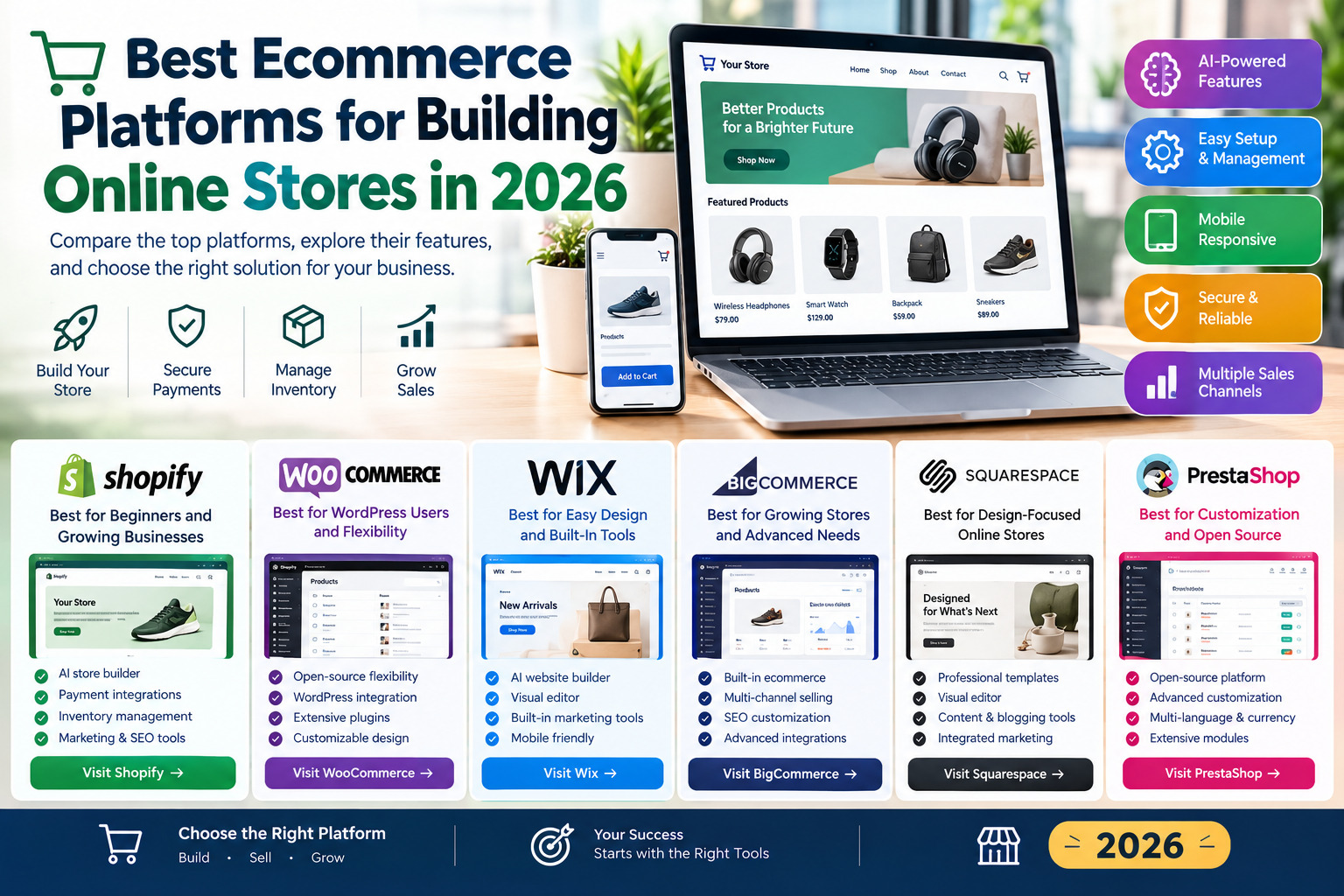
This guide compares six of the best ecommerce platforms for 2026: Shopify, WooCommerce, Wix, BigCommerce, Squarespace, and PrestaShop. Each platform has different strengths, making it easier to choose a solution that matches your business requirements.
1. Shopify: Best Ecommerce Platform for Beginners and Growing Businesses
Shopify is a popular ecommerce platform designed to help entrepreneurs launch, manage, and grow online stores without building an entire website from scratch. It combines storefront design, product management, checkout, order processing, and marketing tools in one hosted environment.
Key Features of Shopify
- Easy online store creation: Choose a professionally designed theme and customize your storefront using visual editing tools without needing advanced coding skills.
- AI-powered store building: Shopify’s AI features can assist with store design, product descriptions, marketing content, and other commerce-related tasks.
- Product and inventory management: Organize product catalogs, manage stock, track orders, and coordinate fulfillment through the store dashboard.
- Secure checkout and payment integrations: Configure supported payment methods and provide customers with a convenient purchasing experience.
- Multichannel selling: Connect supported sales channels, including social commerce and selected online marketplaces, to reach customers beyond your website.
- Marketing and SEO tools: Manage essential search engine settings, product information, promotional campaigns, and customer communications.
- App integrations: Extend store functionality through apps for reviews, shipping, accounting, customer support, and other business operations.
- Business analytics: Review sales performance and customer activity to understand which products and campaigns are performing well.
Why Shopify Is a Good Choice
Shopify is particularly suitable for entrepreneurs who want to concentrate on selling products instead of managing technical infrastructure. It can work well for clothing brands, beauty stores, electronics retailers, dropshipping businesses, and established merchants expanding into new markets.
Another advantage is its hosted structure, which reduces the need to manage server maintenance and core software updates yourself. Businesses should still review payment processing fees, subscription costs, app expenses, and the availability of payment providers in their target countries.
Shopify is an excellent starting point for merchants who value convenience, integrated selling features, and a platform that can grow alongside their business.
Official website: https://www.shopify.com/
2. WooCommerce: Best for WordPress Users and Flexible Store Customization
WooCommerce is an open-source ecommerce solution that adds online selling capabilities to WordPress websites. It gives store owners significant control over their storefront, product catalog, checkout experience, and website functionality.
Unlike fully hosted platforms, WooCommerce requires you to arrange compatible WordPress hosting and manage aspects of your website’s maintenance, depending on your hosting provider and setup.
Key Features of WooCommerce
- Open-source flexibility: Customize your store’s functionality and design according to your business requirements.
- WordPress integration: Combine ecommerce with blogging, landing pages, educational content, and other website features.
- Product management: Create physical and digital product listings, manage variations, configure prices, and organize product categories.
- Extensive plugin ecosystem: Add payment gateways, shipping tools, subscriptions, memberships, product filters, and other capabilities.
- SEO customization: Use WordPress SEO tools, structured content, customizable URLs, and product-page optimization to support organic search visibility.
- Flexible payment options: Integrate supported payment providers according to your location and business requirements.
- Analytics and reporting: Use built-in reports and compatible extensions to monitor sales, orders, and product performance.
- Greater technical control: Select your hosting environment and customize many aspects of your website’s infrastructure.
Why WooCommerce Is a Good Choice
WooCommerce is a strong option for business owners who already use WordPress or want greater control over how their online store operates. It is especially useful for content-driven businesses that rely on search traffic, detailed product guides, tutorials, and educational articles.
For example, a merchant selling computer accessories could publish buying guides, product comparisons, and troubleshooting articles alongside product pages. This creates opportunities to attract visitors through informational searches and direct them toward relevant products.
The main consideration is ongoing management. Hosting, security, backups, updates, premium extensions, and developer support can add to the total cost. WooCommerce is best suited to users who value flexibility and are comfortable managing, or hiring someone to manage, their website.
Official website: https://woocommerce.com/
3. Wix: Best for Easy Store Design and Built-In Business Tools
Wix is a website-building platform that combines visual design tools with ecommerce functionality. It allows entrepreneurs to create branded online stores using customizable templates, drag-and-drop editing, and AI-assisted website creation.
Its integrated business tools make it attractive to small companies that want to manage their storefront, marketing activities, and basic operations within one platform.
Key Features of Wix
- AI website builder: Generate an initial website design from a description of your business and customize the result.
- Visual store editor: Adjust layouts, colors, images, typography, and page elements without requiring advanced programming skills.
- Ecommerce product management: Create product pages, organize catalogs, manage product options, and track orders.
- Payment integrations: Accept payments through supported providers available for your business location and subscription.
- Marketing and SEO tools: Configure page titles, descriptions, URLs, and other SEO elements while managing promotional campaigns.
- Inventory and shipping tools: Monitor stock, organize fulfillment, and connect compatible shipping services.
- Mobile store management: Manage important store operations and review business activity from supported mobile tools.
- Digital products and subscriptions: Sell eligible digital products and offer recurring purchases through supported features and integrations.
Why Wix Is a Good Choice
Wix is suitable for entrepreneurs who prioritize design simplicity and want to launch a professional-looking store without a complicated setup process. It can work particularly well for handmade products, fashion accessories, art, beauty products, and businesses selling a relatively straightforward catalog.
Its visual editor also makes it convenient to build pages that reflect a distinctive brand identity. Business owners can combine product listings with blog content, promotional pages, and other website sections.
However, merchants should compare ecommerce plan requirements, payment availability, product limits, and advanced inventory capabilities before committing. Businesses with highly complex catalogs or specialized selling requirements may prefer a more dedicated ecommerce solution.
Official website: https://www.wix.com/ecommerce/online-store
4. BigCommerce: Best for Growing Stores and Advanced Ecommerce Needs
BigCommerce is an ecommerce platform designed for businesses that need a broad set of selling capabilities and room to expand. It offers hosted store infrastructure, product management, sales integrations, and tools for managing increasingly sophisticated online retail operations.
It can be a good fit for merchants who expect their product catalogs, sales channels, or operational requirements to become more complex over time.
Key Features of BigCommerce
- Built-in ecommerce functionality: Access core selling tools without relying on a separate extension for every business requirement.
- Product catalog management: Organize products, variants, categories, and other catalog information for customer browsing.
- Multichannel commerce: Connect supported marketplaces, social platforms, and other sales channels.
- SEO controls: Customize important page elements, product URLs, metadata, and other search-related settings.
- Payment integrations: Connect supported payment providers and configure checkout options for your target markets.
- Analytics and reporting: Monitor orders, sales, and other business performance indicators.
- Integration capabilities: Connect the store with selected marketing, inventory, shipping, and business management systems.
- Scalability: Support more advanced ecommerce workflows as the business develops, subject to the chosen plan and technical requirements.
Why BigCommerce Is a Good Choice
BigCommerce is worth considering for established retailers and growing businesses that need more than a basic online storefront. It may be especially useful for merchants managing larger product catalogs, selling through multiple channels, or requiring integrations with other business systems.
For example, a distributor selling products to both individual consumers and business customers may need more structured catalog management and integrations than a small single-product store.
Its broader feature set can reduce dependence on third-party extensions for certain functions. Nevertheless, the platform may take more time to configure than simpler website builders, and subscription costs should be evaluated against actual business needs.
Official website: https://www.bigcommerce.com/
5. Squarespace: Best for Design-Focused Online Stores
Squarespace is a website-building platform known for its visually polished templates and integrated content management tools. Its ecommerce capabilities make it suitable for brands that want their online store to look professional while maintaining a strong visual identity.
The platform combines website design, product pages, content publishing, and supported commerce features within one managed environment.
Key Features of Squarespace
- Professional templates: Choose visually consistent designs for fashion, home decor, art, beauty, and other product categories.
- Visual website editing: Customize layouts, images, typography, and page sections to match your brand.
- Product management: Create product listings, configure available options, and organize your catalog.
- Content and blogging tools: Publish articles, announcements, and product-related content alongside your store.
- Marketing integrations: Use supported email marketing, promotional features, and customer engagement tools.
- SEO settings: Edit page titles, descriptions, URLs, image information, and other important website elements.
- Mobile-responsive layouts: Present storefront pages in layouts designed to adapt to different screen sizes.
- Business integrations: Connect supported tools for payments, scheduling, analytics, and other operational requirements.
Why Squarespace Is a Good Choice
Squarespace is particularly appealing to creative entrepreneurs who want design quality to play a major role in their selling strategy. It can work well for boutique brands, photographers selling prints, designers, specialty gift stores, and businesses with relatively focused product collections.
The platform’s integrated design and content tools can also make it easier to maintain a consistent brand experience across product pages and marketing content.
However, merchants with complex inventory workflows, extensive marketplace requirements, or highly specialized commerce operations should compare its capabilities with more ecommerce-focused platforms before making a decision.
Official website: https://www.squarespace.com/ecommerce-website
6. PrestaShop: Best for Merchants Who Want Open-Source Control
PrestaShop is an open-source ecommerce platform that allows merchants to build and customize online stores with substantial control over their shop’s configuration. It is especially relevant to businesses that want to tailor their ecommerce setup rather than depend entirely on a closed hosted platform.
Its ecosystem includes themes, modules, and integrations that can extend the store’s functionality.
Key Features of PrestaShop
- Open-source architecture: Customize the store’s functionality and technical setup according to your requirements.
- Product catalog management: Organize products, categories, variations, pricing, and product information.
- Order management: Handle customer orders and coordinate important stages of the selling process.
- International selling capabilities: Configure supported languages, currencies, and market-specific settings.
- Themes and modules: Extend design and functionality through compatible add-ons.
- SEO customization: Optimize product pages, category pages, URLs, and other elements that contribute to search engine visibility.
- Payment and shipping integrations: Connect compatible providers and modules based on your market and fulfillment needs.
- Business reporting: Use available reporting features and compatible extensions to monitor store activity.
Why PrestaShop Is a Good Choice
PrestaShop can be a suitable option for merchants who want detailed control over their store and are comfortable managing a more technical ecommerce environment. It may appeal to businesses with specific customization requirements or international selling plans.
For example, a retailer serving several markets may need localized storefront content, tailored shipping rules, and a product catalog structured around different customer needs.
The trade-off is that hosting, maintenance, security, updates, module compatibility, and technical support require careful planning. Although the core software is open source, operating a complete store is not necessarily free.
PrestaShop is best suited to merchants who value flexibility and have the technical resources, or professional support, needed to maintain their online store.
Official website: https://prestashop.com/
Comparison of the Best Ecommerce Platforms in 2026
The following comparison highlights the main differences between these platforms and the business needs they are best positioned to serve.
| Platform | Main Advantage | Best For | Technical Management |
|---|---|---|---|
| Shopify | Integrated selling tools and simple setup | Beginners and growing ecommerce brands | Relatively low |
| WooCommerce | Flexibility and WordPress integration | Content-driven stores and customizable websites | Moderate to high |
| Wix | Visual design and ease of use | Small businesses and creative entrepreneurs | Relatively low |
| BigCommerce | Broad ecommerce capabilities | Growing retailers and more complex stores | Relatively low |
| Squarespace | Design-focused storefronts | Boutique and creative brands | Relatively low |
| PrestaShop | Open-source customization | Merchants needing greater technical control | Moderate to high |
How to Choose the Best Ecommerce Platform for Your Business
The best platform is not necessarily the one with the largest number of features. It is the one that meets your current needs without creating unnecessary costs or operational complexity.
Consider Your Starting Budget
Compare subscription fees, hosting, domain registration, payment processing, premium themes, extensions, and maintenance. An apparently inexpensive platform can become more costly when essential services are added.
Evaluate Your Technical Skills
Hosted platforms such as Shopify, Wix, and Squarespace generally reduce the need to manage servers and core software updates. WooCommerce and PrestaShop offer more technical flexibility but may require additional maintenance or professional support.
Check Payment Availability in Your Country
Before selecting a platform, confirm that its payment integrations support your business location, settlement currency, and preferred payment methods. Payment availability can differ between countries and providers.
Think About Product and Inventory Management
A small catalog may work perfectly well with a straightforward website builder. A business with many product variants, multiple warehouses, wholesale customers, or complicated fulfillment rules should examine inventory and integration capabilities more carefully.
Review SEO and Marketing Capabilities
Look for customizable product pages, clean URLs, mobile-friendly designs, redirects, structured data support, and integration with analytics tools. These capabilities can help you build a foundation for organic search traffic, but they do not guarantee high rankings.
Plan for Future Growth
Consider whether you may expand into international markets, sell through multiple channels, introduce subscriptions, or connect your store with accounting and inventory systems. Choosing a platform that can support realistic future requirements may reduce the need for a costly migration.
Final Thoughts
The best ecommerce platform in 2026 depends on your business model, technical skills, budget, and growth plans. Shopify is a strong option for merchants who want an integrated selling environment, while WooCommerce offers extensive customization for WordPress users. Wix prioritizes ease of design, BigCommerce supports more advanced ecommerce requirements, Squarespace stands out for design-focused brands, and PrestaShop offers open-source control.
Before making your final decision, test the available setup options, review the current subscription terms, confirm payment support in your country, and calculate the total cost of operating the store.
A successful online business does not depend on the platform alone. Product quality, customer service, clear product information, reliable fulfillment, trustworthy payment options, and consistent marketing are equally important to building a store that customers want to return to.


