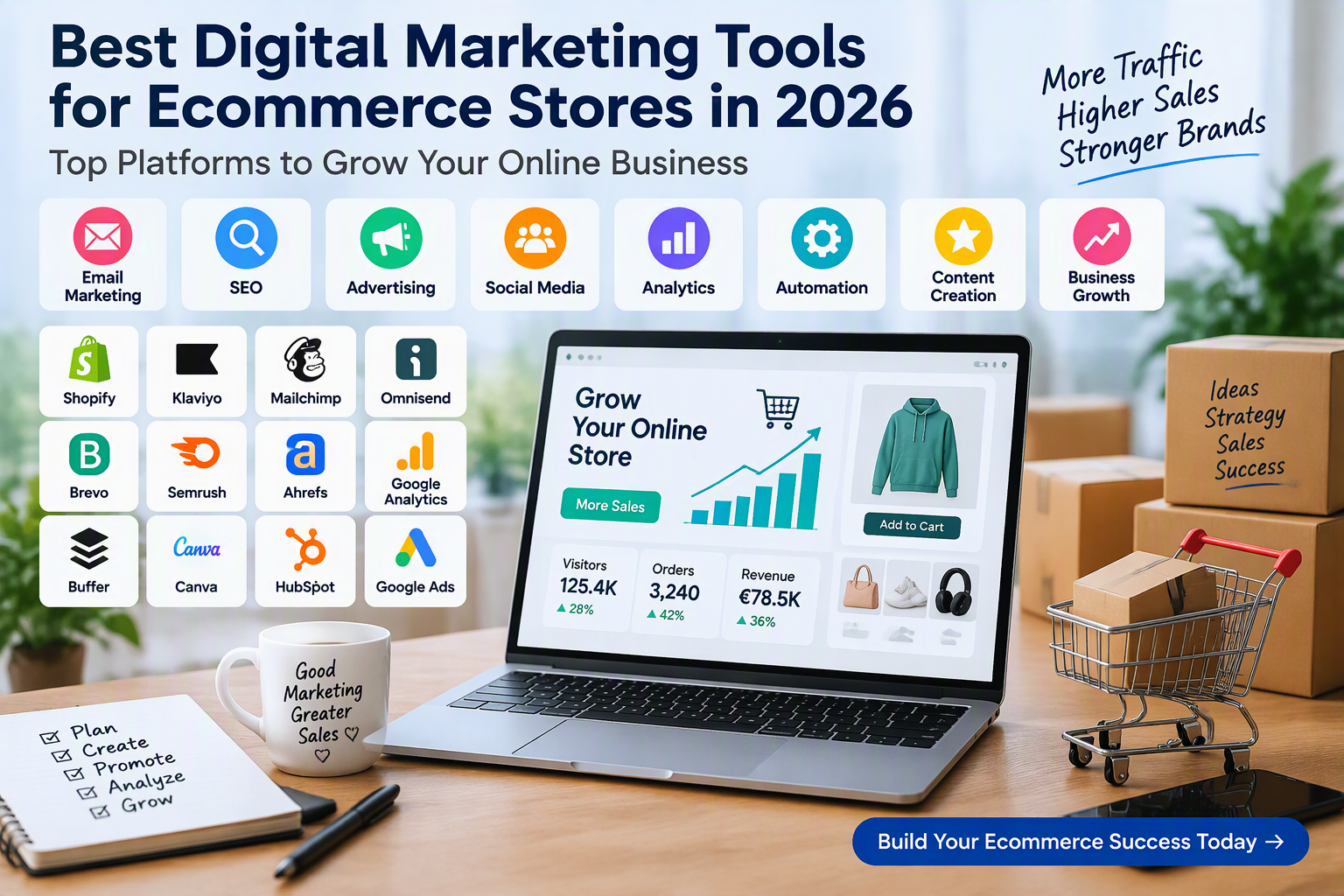
Best Digital Marketing Tools for Ecommerce Stores in 2026: Top Platforms to Grow Your Online Business
Choosing the best digital marketing tools for ecommerce stores is essential for attracting customers, increasing website traffic, improving conversion rates, and building long-term customer relationships. Online retailers operate in a competitive environment where an attractive website is not enough to guarantee sales. Businesses also need effective strategies for search engine optimization, email marketing, social media promotion, paid advertising, and performance analysis.
Modern ecommerce marketing tools help store owners manage campaigns, understand customer behavior, automate repetitive tasks, and measure results. Some platforms specialize in email marketing, while others focus on search engine optimization, social media scheduling, customer relationship management, or website analytics. Combining a few well-chosen tools can create a more efficient marketing system without requiring a large team.
In 2026, automation and artificial intelligence are increasingly integrated into digital marketing software. These features can help businesses segment audiences, prepare campaign drafts, analyze performance, and personalize communications. However, successful marketing still depends on accurate information, useful content, responsible data handling, and a clear understanding of customer needs.
This guide explores some of the best digital marketing tools for ecommerce stores, including their main features, benefits, limitations, and ideal uses. It also provides official software websites and Amazon Germany and European marketplace links for relevant marketing equipment.
1. Shopify Marketing Tools: Best for Shopify Stores
Shopify provides ecommerce businesses with a collection of tools and integrations for promoting products, communicating with customers, and analyzing store performance. Merchants can use its marketing features alongside their product catalog, checkout, and order-management systems.
Depending on the store configuration and available applications, Shopify merchants can create email campaigns, offer discounts, connect advertising channels, and automate selected customer communications. Its app ecosystem also provides access to additional marketing services for SEO, reviews, loyalty programs, and social media campaigns.
One of Shopify’s main advantages is the ability to manage many ecommerce activities from a centralized administration area. Store owners can connect compatible applications instead of building every marketing process from scratch.
Shopify is particularly suitable for businesses that already operate on its ecommerce platform. However, some marketing capabilities require third-party applications or additional subscriptions, so merchants should calculate the total cost before adding multiple services.
Key Features and Benefits:
- Marketing integrations for online stores.
- Email marketing capabilities through supported tools.
- Discount and promotional campaign management.
- Connections to selected advertising channels.
- Customer data and order information within the store ecosystem.
- App marketplace for additional marketing functions.
- Sales and store performance reporting.
- Automation options through compatible applications.
Potential Limitation: The availability of marketing features depends on the selected plan, region, and installed applications. Additional apps may increase operating costs.
Official Website: https://www.shopify.com/
2. Klaviyo: Best for Ecommerce Email and SMS Marketing
Klaviyo is a marketing platform designed to help businesses create targeted email and SMS campaigns using customer information and shopping activity. It is particularly useful for ecommerce brands that want to personalize communication throughout the customer journey.
The platform supports audience segmentation, campaign scheduling, automated customer journeys, and performance reporting. Stores can configure workflows for situations such as welcoming new subscribers, following up after purchases, and reminding eligible customers about items left in their shopping carts.
Klaviyo can connect with supported ecommerce platforms to use relevant customer and order data for more personalized communication. For example, a store may send product recommendations based on previous purchases or create different campaigns for new and returning customers.
These capabilities can help businesses develop more relevant marketing messages and reduce manual campaign management. However, email and SMS marketing must be configured responsibly, with appropriate consent and clear subscription-management options.
Key Features and Benefits:
- Email marketing campaigns.
- SMS marketing capabilities where supported.
- Customer segmentation based on available data.
- Automated customer journeys.
- Ecommerce platform integrations.
- Campaign performance analytics.
- Personalized product recommendations.
- Workflows for selected customer lifecycle events.
Potential Limitation: Costs may increase as contact lists and usage grow. Businesses should review current plan limits, SMS availability, and regional requirements before choosing a subscription.
Official Website: https://www.klaviyo.com/
3. Mailchimp: Best for Small and Growing Online Businesses
Mailchimp is an email marketing and customer communication platform that helps businesses create campaigns, organize audiences, and measure marketing performance. It can be useful for ecommerce stores that want to manage newsletters and promotional messages through a familiar interface.
The platform provides email templates, audience management, campaign reporting, and automation features. Depending on the subscription and integrations, businesses may also use landing pages, customer segmentation, and ecommerce-related workflows.
Online retailers can use Mailchimp to announce product launches, share seasonal promotions, introduce new collections, and communicate with customers who have chosen to receive marketing emails. Reporting tools help businesses review campaign engagement and identify opportunities to improve subject lines, content, and timing.
Mailchimp offers integrations with selected ecommerce platforms and other business applications. Merchants should verify that their store platform and required marketing workflows are supported before migrating an existing contact list.
Key Features and Benefits:
- Email campaign creation.
- Customizable email templates.
- Audience and contact management.
- Marketing automation features.
- Campaign performance reporting.
- Landing page and form options, depending on the plan.
- Ecommerce integrations.
- Tools for organizing customer segments.
Potential Limitation: Advanced automation and audience features may require a paid subscription. Plan limits and pricing can change, so review current terms before committing.
Official Website: https://mailchimp.com/
4. Omnisend: Best for Multichannel Ecommerce Marketing
Omnisend is an ecommerce marketing platform that combines email marketing with additional communication channels, including SMS where supported. It helps online stores coordinate campaigns and automate selected customer interactions.
The platform offers prebuilt automation workflows, campaign templates, audience segmentation, and reporting tools. Merchants can configure customer journeys for welcome messages, cart reminders, post-purchase communication, and other lifecycle events where supported by their store integration.
Omnisend is designed with ecommerce businesses in mind, making it a useful option for retailers who want to coordinate multiple marketing activities without managing completely separate systems.
Its automation capabilities can save time when campaigns are properly configured. However, merchants should check the pricing model, monthly message limits, supported integrations, and regional SMS availability to ensure that the service fits their needs.
Key Features and Benefits:
- Email marketing campaigns.
- SMS marketing in supported regions and plans.
- Automated ecommerce workflows.
- Customer segmentation.
- Campaign templates.
- Reporting and performance tracking.
- Integrations with supported online store platforms.
- Tools for coordinating customer communications.
Potential Limitation: Some features depend on the selected plan and ecommerce integration. SMS availability and costs can vary by country.
Official Website: https://www.omnisend.com/
5. Brevo: Best for Email Marketing and Customer Communication
Brevo is a digital marketing platform that offers email campaigns, automation, customer management, and additional communication features depending on the selected product and subscription.
For ecommerce businesses, Brevo can help organize customer contacts, create promotional newsletters, and automate selected messages. Businesses can also use supported integrations to connect marketing activity with customer information and other business systems.
The platform may suit small and medium-sized retailers looking for a practical way to coordinate customer communications without adopting several disconnected tools. Its reporting features help users monitor campaign engagement and assess how well their messages perform.
Businesses should evaluate the available features carefully, particularly when they need advanced ecommerce segmentation, detailed purchase-based automation, or specific integrations.
Key Features and Benefits:
- Email campaign creation and scheduling.
- Contact management.
- Marketing automation.
- Campaign analytics.
- Customer segmentation.
- Integration options for supported applications.
- Additional communication tools in eligible plans.
- Features for managing marketing workflows.
Potential Limitation: Sending limits, automation features, and other capabilities vary by plan. Review current pricing and regional availability before selecting the platform.
Official Website: https://www.brevo.com/
6. Semrush: Best for Ecommerce SEO and Competitor Research
Semrush is a digital marketing platform that provides tools for search engine optimization, keyword research, website analysis, and competitive research. It can help ecommerce businesses identify search opportunities and improve the visibility of product and category pages.
Keyword research features help store owners understand what potential customers search for online. Website auditing tools can identify technical SEO issues, while competitive research features can provide insight into other websites’ search visibility and advertising strategies.
Ecommerce businesses can use these insights to improve product descriptions, develop useful buying guides, plan blog content, and organize category pages around relevant search intent. Tracking tools can also help monitor keyword performance over time.
Semrush is particularly valuable for stores that want to build a long-term organic traffic strategy. However, the data should guide original content and informed decisions rather than encourage copying competitors’ text or images.
Key Features and Benefits:
- Keyword research.
- Website SEO audits.
- Competitor and market research.
- Backlink analysis.
- Position tracking for supported search terms.
- Content optimization tools.
- Paid search research features.
- Reports for evaluating search visibility.
Potential Limitation: Advanced research features may require paid plans, and the amount of data available depends on the subscription. Search estimates should be treated as indicators rather than exact measurements.
Official Website: https://www.semrush.com/
7. Ahrefs: Best for Keyword and Backlink Research
Ahrefs is an SEO platform used to research keywords, analyze backlinks, examine competing websites, and identify opportunities to improve organic search visibility.
For ecommerce stores, keyword research can reveal the phrases shoppers use when looking for products, comparisons, and buying advice. Backlink analysis can help businesses understand which websites link to competitors and identify opportunities to develop legitimate relationships with publishers and relevant websites.
Ahrefs can also support content planning by helping marketers explore related topics and assess the competitive landscape. Store owners can use these findings to create original product guides, buying advice, comparison articles, and educational content that answers customers’ questions.
The platform is most useful when a business has a consistent SEO strategy and can act on the information it collects.
Key Features and Benefits:
- Keyword research.
- Backlink analysis.
- Competitor website research.
- Organic search performance analysis.
- Content opportunity research.
- Website auditing features in supported plans.
- Tools for evaluating link profiles.
- Data to support SEO planning.
Potential Limitation: Some advanced reports and data limits depend on the subscription. SEO results take time and cannot be guaranteed by using any particular tool.
Official Website: https://ahrefs.com/
8. Google Analytics 4: Best for Ecommerce Marketing Analytics
Google Analytics 4, commonly called GA4, helps businesses understand how people interact with websites and applications. For ecommerce stores, it can provide information about traffic sources, user behavior, product interactions, and configured purchase events.
With appropriate implementation, store owners can examine how visitors arrive at the website, which pages they view, and where they leave the buying process. Ecommerce event tracking can help businesses assess product views, cart activity, checkout steps, and completed purchases.
These insights are useful for evaluating marketing campaigns and identifying areas where the customer experience may need improvement. For example, a retailer might discover that a campaign generates many visits but few completed purchases, indicating a need to investigate the landing page, product information, or checkout process.
Accurate measurement requires correct configuration and testing. Businesses operating in Germany and the European Union should also assess cookie consent, privacy disclosures, and data collection settings under applicable requirements.
Key Features and Benefits:
- Website traffic analysis.
- Acquisition channel reporting.
- Ecommerce event tracking.
- Conversion and purchase measurement.
- Audience and engagement reports.
- Campaign performance analysis.
- Integration with selected Google marketing products.
- Custom reporting options.
Potential Limitation: Reliable reporting depends on correct setup, consent configuration, and data quality. Analytics data may not represent every visitor or transaction.
Official Website: https://analytics.google.com/
9. Google Search Console: Best for Monitoring Organic Search Performance
Google Search Console is a free service that helps website owners understand how their sites perform in Google Search. It is an important tool for ecommerce businesses that want to improve organic visibility without immediately purchasing a paid SEO platform.
The service provides information about search queries, impressions, clicks, and average search positions for eligible pages. It can also report indexing issues and provide information about certain technical aspects of a website’s search presence.
Online retailers can use Search Console to identify product and category pages that receive search impressions but relatively few clicks. These findings may suggest opportunities to improve page titles, descriptions, content relevance, or search intent alignment.
It is also useful for checking whether important pages are indexed and investigating technical issues that may affect search visibility. However, Search Console does not replace a complete analytics platform or provide every type of competitor research.
Key Features and Benefits:
- Search performance reports.
- Query and page-level data.
- Click and impression monitoring.
- Indexing and technical issue reports.
- Sitemap submission.
- Monitoring of eligible website search features.
- Free access to core reporting tools.
- Support for ongoing SEO improvement.
Potential Limitation: Search Console focuses on Google Search and does not provide a complete view of every marketing channel or all competitor data.
Official Website: https://search.google.com/search-console/
10. Buffer: Best for Social Media Scheduling
Buffer is a social media management platform that helps businesses plan, schedule, and analyze content across supported social networks. It can be useful for ecommerce stores that want to maintain a consistent publishing schedule without manually posting every update.
Store owners can use Buffer to prepare promotional posts, share product information, publish educational content, and organize campaigns around seasonal events. Scheduling features help teams plan posts in advance, while analytics can provide information about content performance where supported.
For ecommerce businesses, a structured social media calendar can help balance promotional posts with useful content such as product demonstrations, care instructions, buying tips, and answers to common customer questions.
Buffer is generally more focused on publishing and managing social content than on advanced ecommerce advertising or customer relationship management. Businesses should confirm that the platforms they use and the analytics they require are supported.
Key Features and Benefits:
- Social media post scheduling.
- Content calendar.
- Support for selected social networks.
- Draft and publishing workflows.
- Social content analytics.
- Team collaboration options, depending on the plan.
- Tools for maintaining a consistent posting schedule.
- Features suitable for small marketing teams.
Potential Limitation: Available social channels, publishing functions, and analytics depend on the platform and subscription. Paid advertising management may require separate tools.
Official Website: https://buffer.com/
11. Canva: Best for Ecommerce Marketing Graphics
Canva is a visual content creation platform that helps businesses prepare marketing graphics without requiring advanced graphic design skills. Ecommerce stores can use it to create promotional banners, social media posts, email graphics, product announcement visuals, and presentation materials.
The platform provides templates, layout tools, typography options, and design elements that can be adapted to a store’s visual identity. Depending on the plan, users may also have access to brand management features, collaboration tools, and additional content resources.
A consistent visual style can help online retailers present their products more professionally across different marketing channels. However, businesses should use original designs or assets that are properly licensed for their intended purpose.
Canva is especially useful for small businesses that need to produce a steady stream of visual content without maintaining a large design team.
Key Features and Benefits:
- Social media design templates.
- Promotional banners and graphics.
- Marketing presentation tools.
- Brand style and design organization.
- Collaboration features.
- Image and layout editing tools.
- Resizing and content adaptation features, depending on the plan.
- Options for creating a consistent brand appearance.
Potential Limitation: Some design assets and advanced features require a paid subscription. Users must follow the applicable licensing terms for images, fonts, templates, and other included materials.
Official Website: https://www.canva.com/
12. HubSpot: Best for CRM and Marketing Automation
HubSpot offers a collection of customer relationship management and marketing tools that help businesses organize contacts, manage campaigns, and coordinate customer communication.
For ecommerce businesses, CRM features can help maintain customer records and track interactions across supported channels. Marketing tools may support email campaigns, forms, landing pages, audience segmentation, and automation, depending on the product and subscription.
Connecting marketing activities with customer records can help businesses understand how prospects interact with their content and how customers respond to different campaigns. For growing stores, a centralized system may also make it easier for marketing and sales teams to share information.
HubSpot is particularly useful for businesses that want to connect marketing with broader customer management processes. Smaller retailers should carefully review which features are included in each subscription before selecting a plan.
Key Features and Benefits:
- Customer relationship management.
- Contact and interaction records.
- Email marketing features.
- Forms and landing pages.
- Marketing automation in eligible plans.
- Campaign performance reporting.
- Integrations with supported business applications.
- Tools for coordinating customer journeys.
Potential Limitation: Advanced automation and reporting may require higher-tier plans. Costs can increase as businesses add users, contacts, or additional products.
Official Website: https://www.hubspot.com/
13. Meta Ads Manager: Best for Facebook and Instagram Advertising
Meta Ads Manager is used to create and manage advertising campaigns across supported Meta platforms, including Facebook and Instagram. It can help ecommerce businesses promote products, reach selected audiences, and evaluate advertising performance.
Retailers can create campaigns using images, videos, and other supported ad formats. Campaign settings allow businesses to define objectives, budgets, placements, and audience parameters. When properly configured, tracking tools can help measure actions such as product views, add-to-cart events, and purchases.
Meta advertising can be useful for product launches, seasonal campaigns, remarketing where permitted, and reaching potential customers who may be interested in a store’s products. Results depend on the quality of the offer, creative content, targeting, website experience, and budget.
Businesses should ensure that their advertising claims are accurate and that tracking technologies comply with applicable privacy and consent requirements.
Key Features and Benefits:
- Facebook and Instagram campaign management.
- Campaign budgeting and scheduling.
- Audience targeting options.
- Image and video advertising formats.
- Performance reporting.
- Conversion tracking through supported tools.
- Campaign testing and optimization options.
- Tools for managing multiple advertising campaigns.
Potential Limitation: Advertising requires a separate budget, and results are not guaranteed. Available targeting and measurement features may change according to platform policies and regional rules.
Official Website: https://www.facebook.com/business/tools/ads-manager
14. Google Ads: Best for Search-Based Ecommerce Advertising
Google Ads helps businesses advertise across supported Google properties and partner placements. Ecommerce retailers can use it to reach people searching for relevant products, promote product listings through eligible campaign types, and measure advertising performance.
Search campaigns can target queries related to products or services, while other campaign formats may support product advertising and broader audience reach. Eligible retailers can connect product data through Google Merchant Center to support shopping-related advertising formats.
One of the main advantages of Google Ads is its ability to reach users who are actively searching for specific products or solutions. Businesses can set budgets, define campaign objectives, and use conversion tracking to evaluate results.
However, paid search can become expensive if campaigns are poorly structured or if product pages fail to convert visitors. Retailers should monitor spending, search terms, product margins, and actual sales rather than relying solely on clicks or impressions.
Key Features and Benefits:
- Search advertising.
- Shopping-related campaign options for eligible stores.
- Campaign budget management.
- Keyword and audience targeting options.
- Conversion tracking.
- Campaign reporting.
- Product advertising integrations.
- Tools for testing and optimizing campaigns.
Potential Limitation: Advertising costs vary by competition, audience, and campaign settings. A carefully managed budget and accurate conversion tracking are essential.
Official Website: https://ads.google.com/
Best Digital Marketing Tools for Ecommerce Stores: Comparison
Different marketing tools solve different problems, so ecommerce businesses do not necessarily need every platform listed in this guide.
Shopify’s marketing ecosystem is suitable for merchants who want to manage campaigns and integrations within their online store platform. Klaviyo and Omnisend are strong options to evaluate for ecommerce-focused email automation, while Mailchimp and Brevo provide broader email marketing and customer communication capabilities.
Semrush and Ahrefs help with keyword research and SEO planning. Google Analytics 4 supports website and ecommerce measurement, while Google Search Console helps monitor performance in Google Search. Buffer focuses on social media scheduling, and Canva supports the creation of marketing graphics.
HubSpot combines CRM with marketing capabilities, while Meta Ads Manager and Google Ads are designed for paid advertising on their respective platforms.
Before selecting tools, consider your store platform, marketing goals, budget, team size, existing integrations, and data protection responsibilities. A smaller set of well-configured tools is often more useful than paying for many overlapping subscriptions.
How to Choose the Best Ecommerce Marketing Tools
Define Your Marketing Goals
Start by identifying the main problem you want to solve. A store that receives little organic traffic may need SEO research and technical monitoring. A store with existing customers may benefit from email automation, while a business seeking faster reach may consider paid advertising or social media promotion.
Clear goals make it easier to compare tools and avoid paying for features that do not support your business strategy.
Choose Tools That Integrate With Your Store
Check whether each platform supports your ecommerce system, payment setup, analytics configuration, and other applications. Integrations can reduce manual data entry and help marketing teams understand customer activity.
Confirm what information is shared between applications, whether the connection requires a third-party service, and whether additional fees apply.
Compare Free and Paid Plans
Many platforms offer free access, trials, or limited entry-level plans. These can be useful for testing basic workflows before investing in advanced capabilities.
Compare contact limits, monthly email allowances, connected social accounts, reporting options, automation features, and support availability. Review renewal terms and usage-based fees before subscribing.
Prioritize Analytics and Measurement
Marketing activity is easier to improve when results can be measured consistently. Configure relevant events, such as product views, add-to-cart actions, checkout starts, and purchases, where appropriate.
Use analytics to understand which channels contribute to meaningful outcomes. Avoid judging campaigns solely by likes, impressions, or website visits when the primary objective is profitable sales.
Consider Automation Carefully
Automation can save time by scheduling content, sending lifecycle emails, or organizing customer segments. Begin with simple workflows and test them before expanding.
Review automated messages regularly to ensure that product information, prices, availability, and promotional terms are accurate. Give customers clear options to manage their communication preferences.
Review Privacy and Legal Requirements
Marketing platforms may process contact information, purchase history, browsing activity, and other personal data. Businesses serving customers in Germany and the European Union should assess GDPR responsibilities and applicable electronic communications rules.
Depending on the technology and use case, cookies and other tracking technologies may require consent before activation. Email and SMS marketing also need appropriate legal grounds and clear subscription-management procedures. Consult qualified legal guidance when necessary rather than assuming that a software provider automatically guarantees compliance.
Benefits of Digital Marketing Tools for Online Stores
More Efficient Campaign Management: Centralized platforms and automation can reduce repetitive tasks and make marketing workflows easier to manage.
Better Audience Targeting: Segmentation tools can help businesses send more relevant messages to groups of customers based on permitted and available information.
Improved Search Visibility: SEO tools help retailers research keywords, identify technical problems, and create useful content that matches customer search intent.
More Consistent Social Media Activity: Scheduling tools make it easier to plan posts and maintain a regular publishing calendar.
Stronger Performance Measurement: Analytics tools can help businesses assess traffic sources, customer interactions, and campaign outcomes.
Better Customer Retention: Relevant follow-up messages, product information, and customer education can help maintain relationships with customers who have chosen to receive communications.
More Informed Decisions: Marketing reports can reveal which campaigns are performing well and where budget or content adjustments may be useful.
Support for Business Growth: A scalable marketing setup can help businesses manage additional products, channels, and campaigns as their operations expand.
Common Mistakes to Avoid
One common mistake is subscribing to too many marketing platforms at once. Overlapping tools can increase costs, complicate reporting, and create unnecessary administrative work. Start with the most important needs and expand only when a clear benefit justifies it.
Another mistake is focusing on traffic without evaluating sales quality. A campaign may attract many visitors but produce few purchases if the audience is poorly matched or the website experience is confusing. Measure meaningful outcomes and investigate the full customer journey.
Businesses should also avoid copying competitors’ website text, graphics, product photography, or marketing materials. Instead, create original content, use properly licensed assets, and verify the terms of any third-party resources.
Poor data quality can undermine even advanced marketing software. Keep product feeds, prices, stock information, customer lists, and campaign settings accurate. Review integrations regularly to detect missing or duplicated data.
Finally, avoid sending excessive promotional messages or activating tracking technologies without considering consent requirements. Respect customer preferences and make marketing communications clear, relevant, and appropriately timed.
Where to Buy Digital Marketing Tools and Related Equipment in Germany and Europe
Most digital marketing software is purchased directly from the provider through an online subscription. Official websites are the best place to check current plans, feature availability, trial conditions, integrations, and terms.
The following official websites provide information about the platforms covered in this guide:
- Shopify: https://www.shopify.com/
- Klaviyo: https://www.klaviyo.com/
- Mailchimp: https://mailchimp.com/
- Omnisend: https://www.omnisend.com/
- Brevo: https://www.brevo.com/
- Semrush: https://www.semrush.com/
- Ahrefs: https://ahrefs.com/
- Google Analytics: https://analytics.google.com/
- Google Search Console: https://search.google.com/search-console/
- Buffer: https://buffer.com/
- Canva: https://www.canva.com/
- HubSpot: https://www.hubspot.com/
- Meta Ads Manager: https://www.facebook.com/business/tools/ads-manager
- Google Ads: https://ads.google.com/
Businesses that need physical equipment for marketing work, including webcams, microphones, headsets, lighting, monitors, and content creation accessories, can compare products through Amazon’s European marketplaces.
Amazon Germany:
https://www.amazon.de/s?k=digital+marketing+equipment
Amazon France:
https://www.amazon.fr/s?k=digital+marketing+equipment
Amazon Italy:
https://www.amazon.it/s?k=digital+marketing+equipment
Amazon Spain:
https://www.amazon.es/s?k=digital+marketing+equipment
These links lead to marketplace search results rather than guaranteed product listings. Check product specifications, compatibility, seller details, delivery options, return conditions, and any applicable warranties before ordering.
Conclusion
The best digital marketing tools for ecommerce stores in 2026 depend on business goals, available resources, the ecommerce platform, and the customers a store wants to reach. Shopify provides a useful marketing ecosystem for its merchants, while Klaviyo, Mailchimp, Omnisend, and Brevo help businesses manage email campaigns and customer communication.
Semrush and Ahrefs support SEO research, while Google Analytics 4 and Google Search Console help retailers understand website and search performance. Buffer assists with social media scheduling, Canva supports visual content creation, and HubSpot connects customer management with marketing activities. Meta Ads Manager and Google Ads provide options for paid promotion.
Rather than subscribing to every available service, ecommerce businesses should select a practical combination of tools that addresses their most important marketing challenges. Compare integrations, pricing, reporting capabilities, automation features, and data protection requirements before making a decision.
By combining original content, responsible customer communication, consistent measurement, and well-chosen marketing software, online retailers can build a more organized marketing strategy and create better opportunities for sustainable business growth.


