
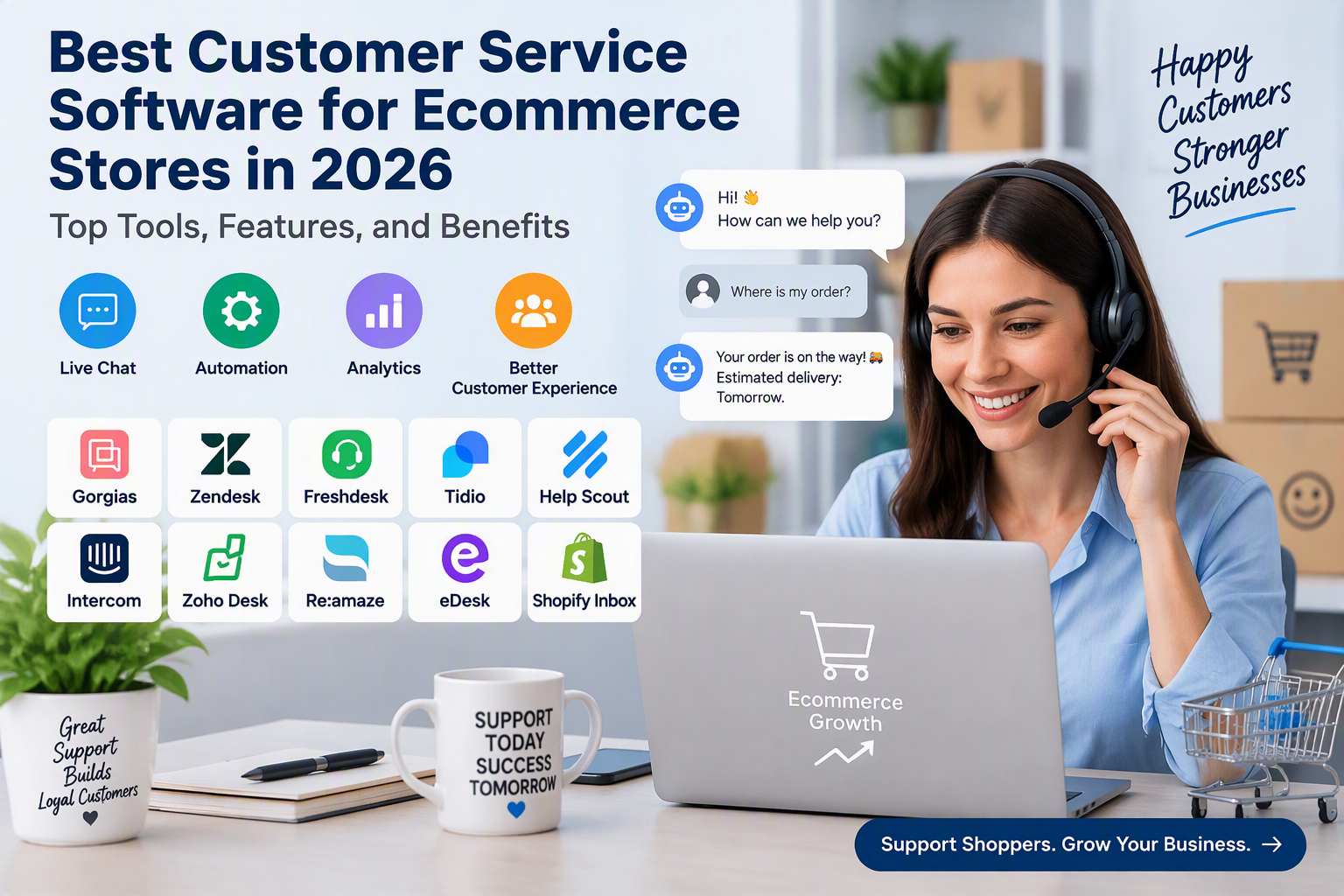
Best Customer Service Software for Ecommerce Stores in 2026: Top Tools, Features, and Benefits
Choosing the best customer service software for ecommerce stores is essential for businesses that want to provide reliable support, respond to customer questions quickly, and build long-term customer relationships. Online shoppers expect clear communication before and after purchasing products, including help with delivery updates, returns, refunds, payments, and product information. The right software helps businesses manage these requests efficiently while maintaining a professional customer experience.
Modern ecommerce customer service platforms bring conversations from different channels into a centralized workspace. Depending on the software, these channels may include email, live chat, social media messages, contact forms, and telephone support. Some tools also connect with ecommerce platforms to display order details, customer profiles, and purchase histories alongside support conversations.
In 2026, many customer service platforms also offer automation, AI-powered chatbots, self-service help centers, performance reports, and integrations with online stores. These features can reduce repetitive tasks and help support teams focus on more complicated customer requests. However, the best solution depends on the store’s size, sales channels, support volume, budget, and technical requirements.
This guide explores some of the best customer service software for ecommerce stores, including their main features, advantages, limitations, and ideal uses. It also explains how to choose the right platform for an online business in Germany and other European markets.
1. Gorgias: Best for Shopify-Focused Ecommerce Stores
Gorgias is a customer service platform designed specifically for ecommerce businesses. It is particularly relevant to online stores that use Shopify and want to manage customer support alongside order information.
The platform brings customer conversations into a shared helpdesk, helping support agents handle inquiries without constantly switching between separate applications. Depending on the integration and configuration, agents can access customer and order details while responding to questions about purchases, delivery, cancellations, and returns.
One of Gorgias’s main advantages is its focus on ecommerce workflows. Support teams can use automation rules, saved responses, customer information, and AI-assisted features to manage recurring questions more efficiently. Its reporting tools can also help businesses understand support activity and assess how customer interactions relate to sales.
Gorgias may be especially useful for growing direct-to-consumer brands that receive a high volume of questions through email, chat, and social media. However, businesses should review ticket allowances, AI usage charges, integrations, and subscription terms before choosing a plan.
Key Features and Benefits:
- Centralized customer support inbox.
- Ecommerce integrations, including Shopify.
- Access to relevant customer and order information.
- Automation rules and reusable responses.
- AI-assisted customer service features in eligible plans.
- Reporting tools for support performance.
- Workflows for common order-related inquiries.
- Features designed around ecommerce operations.
Potential Limitation: Pricing may depend on ticket volume and selected features, while additional AI usage can affect the total cost. Businesses using platforms other than Shopify should confirm integration compatibility before subscribing.
Official Website: https://www.gorgias.com/
2. Zendesk: Best for Growing and Enterprise Ecommerce Businesses
Zendesk is a customer service platform designed to help businesses manage support requests across multiple communication channels. It is suitable for online retailers that need structured ticket management, reporting, automation, and the ability to support large customer service teams.
Its ticketing system helps organize incoming inquiries, assign requests to appropriate agents, and track cases until they are resolved. Businesses can configure workflows, create response templates, establish service priorities, and monitor team performance through reporting tools.
Zendesk also offers knowledge base functionality and customer self-service options, allowing shoppers to find answers to common questions without contacting a support representative. Its broader integration ecosystem can help businesses connect customer support with ecommerce platforms and other business applications.
For larger stores, Zendesk may be valuable when several teams handle different product categories, brands, regions, or customer service channels. Its flexibility can support complex operations, although configuration and administration may require additional time and resources.
Key Features and Benefits:
- Centralized ticket management.
- Support for multiple customer communication channels.
- Automated ticket routing and workflow management.
- Knowledge base and self-service options.
- Reporting and performance analytics.
- Integration options for ecommerce and business applications.
- Team collaboration and case tracking.
- Scalable tools for larger support operations.
Potential Limitation: Advanced features and integrations may require higher-tier subscriptions or additional configuration. Smaller stores should compare the total cost against their actual support requirements.
Official Website: https://www.zendesk.com/
3. Freshdesk: Best for Small Businesses and Budget-Conscious Stores
Freshdesk is a customer support platform that helps businesses organize inquiries, manage support tickets, and communicate with customers from a shared workspace. It can be a practical starting point for small ecommerce businesses that need a structured support process without immediately adopting a complex enterprise solution.
The platform provides ticket management, automation, reporting, and collaboration features. Depending on the selected product and subscription, businesses may also access a knowledge base, customer messaging tools, and AI-assisted support capabilities.
Freshdesk can help online stores categorize incoming requests, prioritize urgent cases, assign tickets to team members, and maintain records of customer conversations. These capabilities are useful for common ecommerce issues such as delivery questions, product inquiries, payment concerns, and return requests.
Its main advantage is its flexibility as a general-purpose helpdesk. However, the depth of ecommerce integration may vary depending on the store platform, selected applications, and configuration.
Key Features and Benefits:
- Centralized customer support tickets.
- Ticket assignment and prioritization.
- Automated workflows and notifications.
- Reporting and service performance monitoring.
- Knowledge base options.
- Collaboration tools for support teams.
- AI-assisted features in eligible plans.
- Integration options for selected ecommerce platforms.
Potential Limitation: Some advanced automation, analytics, and AI capabilities require paid plans or additional usage. Businesses should verify that their ecommerce platform integrates with the features they need.
Official Website: https://www.freshworks.com/freshdesk/
4. Tidio: Best for Live Chat and Small Online Stores
Tidio combines live chat, customer messaging, and chatbot functionality to help ecommerce businesses communicate with website visitors. It can be useful for stores that want to answer product questions, assist shoppers during the buying process, and provide quick support without building a large customer service department.
The live chat feature allows visitors to ask questions while browsing a website. Support agents can respond to inquiries about product availability, shipping, sizing, and other purchasing concerns. Depending on the configuration, automated chat flows can also provide answers to common questions and direct customers toward relevant information.
Tidio offers AI-assisted customer service capabilities through its Lyro product, subject to the applicable plan and usage terms. These tools may help handle recurring questions, but businesses should review automated responses regularly to ensure that information about prices, delivery, returns, and product availability remains accurate.
For small ecommerce stores, Tidio can provide a relatively accessible way to add live chat and automated assistance to a website. Businesses with extensive phone, email, and social support requirements should evaluate whether its available channels and integrations meet their needs.
Key Features and Benefits:
- Website live chat.
- Chatbot and automated conversation flows.
- AI-assisted customer support through eligible products.
- Visitor communication tools.
- Integration options for ecommerce platforms.
- Support for common product and order questions.
- Customer conversation history.
- Features suitable for small and growing stores.
Potential Limitation: Advanced AI usage, automation, and support capacity may depend on subscription limits. Review current plans and available integrations before selecting the service.
Official Website: https://www.tidio.com/
5. Help Scout: Best for Email-Based Customer Support
Help Scout is a customer service platform that focuses on shared inboxes, customer conversations, and straightforward team collaboration. It is suitable for ecommerce businesses that handle many customer inquiries through email and prefer a simple interface.
Its shared inbox allows several agents to work on customer messages while coordinating responsibilities and maintaining conversation history. Teams can assign conversations, use saved replies, add internal notes, and organize requests to help ensure that customer inquiries receive appropriate attention.
Help Scout also provides knowledge base tools that businesses can use to publish shipping information, return policies, product instructions, and frequently asked questions. A well-organized help center can reduce the number of repetitive inquiries and allow customers to find answers independently.
Depending on the selected configuration, ecommerce integrations can provide additional customer or order context. Businesses should confirm which integrations are available and whether they meet their specific workflow requirements.
Help Scout is particularly useful for stores that prioritize personal, human-centered communication over complex enterprise workflows.
Key Features and Benefits:
- Shared customer service inbox.
- Email conversation management.
- Internal notes and team collaboration.
- Saved replies for recurring questions.
- Knowledge base and help center tools.
- Reporting and customer service analytics.
- Integration options for supported applications.
- Straightforward interface for support teams.
Potential Limitation: Stores that need advanced retail-specific order management or highly complex omnichannel automation may require additional applications or a more specialized platform.
Official Website: https://www.helpscout.com/
6. Intercom: Best for Conversational Support and Customer Engagement
Intercom is a customer service platform centered on messaging, live chat, automation, and conversational support. It can help ecommerce businesses answer questions from website visitors and provide assistance throughout the customer journey.
Its messaging tools allow businesses to communicate with customers through a website messenger and supported channels. Teams can configure automated workflows, create help content, and use AI-assisted features to respond to common questions or direct customers to the right support resource.
Intercom may be particularly useful for online businesses that want to combine customer support with proactive communication. For example, a store may use messaging to answer pre-purchase questions, explain how a service works, or guide customers toward relevant information.
Its capabilities and integrations vary by subscription and configuration. Ecommerce businesses should specifically confirm support for their store platform, order-management workflows, and preferred customer communication channels before committing to a plan.
Key Features and Benefits:
- Website messenger and live chat.
- Customer conversation management.
- Automated workflows and routing.
- Help center and self-service support.
- AI-assisted customer service features.
- Customer engagement and messaging tools.
- Integration options for supported applications.
- Reporting for support and engagement activities.
Potential Limitation: Costs may increase with additional users, advanced features, or AI usage. Some ecommerce-specific workflows may require integrations or additional configuration.
Official Website: https://www.intercom.com/
7. Zoho Desk: Best for Businesses Using Zoho Applications
Zoho Desk is a helpdesk platform designed to organize customer support requests and help teams manage service operations. It may be particularly useful for ecommerce businesses already using Zoho applications for customer relationship management, email, accounting, or other business processes.
The platform provides ticket management, customer communication records, automation, reporting, and knowledge base functionality. Support teams can organize incoming requests, assign them to agents, and monitor their progress through resolution.
Zoho Desk can also help businesses establish consistent support procedures through workflows, service rules, and reusable responses. These capabilities can be useful for handling common questions about shipping, returns, product information, and account issues.
Integration with other business tools may help support agents access relevant customer details and coordinate work across departments. However, the precise functionality available depends on the selected subscription and connected applications.
Zoho Desk is worth considering for small and medium-sized stores that want structured customer support and an opportunity to connect helpdesk operations with a wider business software ecosystem.
Key Features and Benefits:
- Centralized support ticket management.
- Customer communication history.
- Automated ticket assignment and workflows.
- Knowledge base and self-service tools.
- Reporting and service analytics.
- Integration with selected Zoho applications.
- Collaboration features for support teams.
- AI-assisted capabilities in eligible plans.
Potential Limitation: Businesses may need time to configure workflows and connect other applications. Check plan limits and integration availability before purchasing.
Official Website: https://www.zoho.com/desk/
8. Re:amaze: Best for Multichannel Ecommerce Support
Re is a customer support platform designed to help online businesses manage customer conversations across supported communication channels. It can be useful for retailers that want to combine customer messages, live chat, and support workflows in one place.
The platform offers a shared inbox and tools for organizing conversations from channels such as email, live chat, and social messaging, depending on the selected configuration. Ecommerce integrations can help support agents access customer information and relevant order details while responding to inquiries.
Re also provides automation options and customer messaging features that can help businesses reduce repetitive work. Teams can use these tools to manage frequently asked questions, assign requests, and maintain more consistent support procedures.
For stores operating several online brands or handling inquiries through multiple channels, a centralized support interface can make it easier to maintain visibility over customer conversations. Businesses should confirm compatibility with their ecommerce platform and communication channels before subscribing.
Key Features and Benefits:
- Shared customer support inbox.
- Live chat and supported messaging channels.
- Ecommerce integration options.
- Customer conversation management.
- Automated responses and workflows.
- Tools for handling recurring questions.
- Collaboration features for support agents.
- Support for businesses managing multiple customer channels.
Potential Limitation: Available integrations, automation features, and channel support depend on the product configuration and subscription. Businesses with specialized requirements should test their intended workflows before switching.
Official Website: https://www.reamaze.com/
9. eDesk: Best for Ecommerce Marketplace Sellers
eDesk is a customer service platform aimed at online retailers selling through marketplaces and ecommerce channels. It is particularly relevant to sellers who need to manage customer messages and order-related questions from several sales platforms.
Marketplace sellers may receive inquiries about delivery status, product details, refunds, returns, and order problems through different systems. A centralized support platform can help bring eligible messages into a shared workspace and reduce the need to switch between individual seller accounts.
eDesk is designed around ecommerce support workflows and offers integrations with supported marketplaces and online store platforms. Depending on the available connection, support agents may be able to view relevant order information while responding to customers.
This can be useful for sellers managing multiple storefronts or processing a high volume of marketplace orders. However, compatibility varies by marketplace, country, and subscription, so sellers should verify that their specific channels and account types are supported.
Key Features and Benefits:
- Centralized management of supported marketplace messages.
- Ecommerce-focused customer support workflows.
- Access to relevant order information through supported integrations.
- Ticket organization and assignment.
- Automation for recurring support tasks.
- Reporting tools for customer service operations.
- Integration options for selected online marketplaces.
- Features designed for multichannel sellers.
Potential Limitation: The value of eDesk depends on the marketplaces and sales channels a business uses. Check current integration coverage, subscription limits, and pricing before signing up.
Official Website: https://www.edesk.com/
10. Shopify Inbox: Best for Stores Using Shopify
Shopify Inbox is a messaging tool for businesses operating on Shopify. It helps merchants communicate with customers through supported store messaging features and manage conversations related to shopping and product questions.
For eligible stores, Shopify Inbox can provide context about customer interactions and help merchants respond to shoppers who need assistance before completing a purchase. Depending on the current product capabilities and store configuration, merchants may also access information that helps them understand a customer’s shopping activity.
One advantage of Shopify Inbox is that it belongs to the Shopify ecosystem, making it a natural starting point for merchants who want to add customer messaging without immediately purchasing a separate enterprise helpdesk.
It may be particularly suitable for small stores that receive a manageable number of inquiries and mainly need website messaging. Businesses requiring complex ticket routing, extensive phone support, advanced analytics, or a broad marketplace inbox should compare it with dedicated customer service platforms.
Key Features and Benefits:
- Customer messaging for eligible Shopify stores.
- Support for pre-purchase product questions.
- Integration with the Shopify ecosystem.
- Tools for organizing customer conversations.
- Shopping-related context where available.
- A practical starting point for small Shopify merchants.
- Reduced need for a separate messaging tool.
- Potential to expand support with additional applications.
Potential Limitation: Shopify Inbox is not a complete replacement for every enterprise helpdesk. Available channels and features may be more limited than those of specialized customer service platforms.
Official Website: https://www.shopify.com/inbox
Best Customer Service Software Comparison for Ecommerce Stores
The best customer service software depends on the way an online store operates and the types of questions its customers ask.
Gorgias is worth considering for Shopify-focused businesses that want ecommerce-related customer context within their support workflows. Zendesk is suitable for larger teams that require advanced ticket management, extensive configuration, and structured service processes.
Freshdesk can be a practical option for small businesses seeking general helpdesk capabilities, while Tidio is useful for stores that prioritize live chat and automated website assistance. Help Scout may suit businesses that handle most inquiries through email and want a straightforward shared inbox.
Intercom focuses on conversational support and customer engagement, while Zoho Desk is a logical option for businesses using other Zoho products. Re offers multichannel support features for ecommerce businesses, and eDesk is particularly relevant to sellers managing supported marketplace accounts.
Shopify Inbox can be a useful starting point for merchants who primarily need messaging within the Shopify ecosystem.
Before choosing a platform, compare integration compatibility, supported channels, automation limits, ticket or user allowances, data protection features, and total subscription costs. No single tool is the best fit for every online store.
How to Choose the Best Customer Service Software for Ecommerce
Selecting the right platform starts with understanding how customers contact your business and which tasks consume the most support time.
Identify Your Main Customer Support Channels
List the channels through which customers contact your store, such as email, website chat, social media, telephone, or marketplace messaging. Choose a platform that supports the channels you actually use and can bring relevant conversations into a manageable workflow.
If most inquiries arrive through email, a shared inbox may be sufficient. Stores receiving questions through many different channels may benefit from a broader omnichannel helpdesk.
Check Ecommerce Platform Integration
Your support software should work with your online store and the systems used to manage orders. Depending on your business, important integrations may include Shopify, WooCommerce, marketplace accounts, payment services, inventory systems, and shipping applications.
Check whether the integration is native, provided by a third party, or requires custom development. Confirm exactly what information agents can access and which actions they can perform.
Compare Automation and AI Features
Automation can help categorize tickets, assign conversations, send acknowledgments, and provide consistent answers to common questions. AI-powered features may assist with drafting responses, summarizing conversations, or handling selected inquiries automatically.
However, automated support should be tested carefully. Incorrect information about delivery dates, refunds, warranties, or product availability can damage customer trust. Businesses should establish clear escalation procedures so that complicated or sensitive cases can be handled by a person.
Evaluate the Total Cost
Subscription prices can depend on the number of agents, support tickets, contacts, automation features, or AI resolutions. Some platforms also charge separately for advanced integrations or additional usage.
Calculate the expected monthly and annual cost based on your actual workload. Include setup, training, migration, additional applications, and potential usage charges rather than comparing only the advertised starting prices.
Consider Ease of Use
Customer service software should be easy for employees to learn and use consistently. A complicated interface may slow responses and create unnecessary training costs.
Take advantage of demonstrations or trial periods where available. Test everyday tasks such as locating an order, assigning a conversation, responding to a customer, and escalating a complicated request.
Review Security and Data Protection
Ecommerce customer service platforms may process names, email addresses, order details, delivery information, and other personal data. Businesses operating in Germany and the wider European Union should review data processing terms, security controls, data retention options, access permissions, and relevant data transfer arrangements.
Using customer service software does not automatically guarantee compliance with the General Data Protection Regulation (GDPR). Businesses remain responsible for how they collect, use, store, and protect customer information.
Plan for Business Growth
Choose software that meets your current requirements while leaving room for additional agents, higher ticket volumes, new sales channels, and more complex workflows.
A small store may not need an enterprise platform immediately. Starting with a simple system and upgrading when necessary can help control costs and avoid unnecessary complexity.
Benefits of Customer Service Software for Ecommerce Businesses
Customer service software can help online stores improve their support operations by organizing communication and providing agents with better access to relevant information.
Faster Responses: Centralized inboxes, saved replies, and automated routing can help teams respond to common inquiries more efficiently.
Better Customer Experience: Clear communication about orders, products, shipping, and returns can make customers feel better supported throughout the buying process.
More Organized Support: Ticket management allows businesses to track requests, assign responsibility, and monitor whether customer issues have been resolved.
Reduced Repetitive Work: Automation can handle selected routine tasks and help agents spend more time on complex customer problems.
Consistent Communication: Shared response templates and documented policies can help teams provide more consistent information across different channels.
Improved Customer Insights: Reporting tools can reveal recurring problems, common questions, response times, and areas where product pages or policies may need improvement.
Support for Business Growth: A well-configured helpdesk can help a store manage increasing customer inquiries without relying entirely on manual processes.
Better Team Collaboration: Shared records and internal notes can help authorized staff coordinate responses and avoid duplicate work.
Common Mistakes to Avoid When Choosing Customer Service Software
One common mistake is choosing a platform based only on its popularity or the number of features it advertises. A store that needs simple email support may not benefit from paying for advanced enterprise functions.
Another mistake is overlooking integration compatibility. A helpdesk may have an impressive feature list but still require additional applications or manual processes to access important order information.
Businesses should also avoid underestimating usage-based charges. Ticket limits, AI resolutions, additional agents, and premium integrations can affect the final cost. Review the current pricing model and calculate expected usage before subscribing.
Poor knowledge base content can also reduce the effectiveness of automation. If shipping policies, return instructions, and product information are outdated, automated responses may provide inaccurate answers. Keep help articles and saved replies current.
Finally, do not rely on chatbots to handle every situation. Customers should have a clear way to contact a human representative when their issue is unusual, urgent, or requires individual judgment.
Where to Buy Customer Service Software and Related Equipment in Germany and Europe
Most customer service software is purchased directly from the provider through an online subscription rather than as a physical product on Amazon. Official websites are generally the best place to check current plans, available features, integrations, and terms.
For businesses operating in Germany and other European markets, the following official websites provide information about the platforms discussed in this guide:
- Gorgias: https://www.gorgias.com/
- Zendesk: https://www.zendesk.com/
- Freshdesk: https://www.freshworks.com/freshdesk/
- Tidio: https://www.tidio.com/
- Help Scout: https://www.helpscout.com/
- Intercom: https://www.intercom.com/
- Zoho Desk: https://www.zoho.com/desk/
- Re:amaze: https://www.reamaze.com/
- eDesk: https://www.edesk.com/
- Shopify Inbox: https://www.shopify.com/inbox
Prices, subscription conditions, supported countries, integrations, and feature availability may change. Check the provider’s current terms before purchasing or entering into a subscription.
Businesses looking for physical customer service equipment, such as USB headsets, webcams, microphones, or office accessories, can also compare suitable products on Amazon Germany and other European marketplaces:
- Amazon Germany: https://www.amazon.de/s?k=customer+service+office+equipment
- Amazon France: https://www.amazon.fr/s?k=customer+service+office+equipment
- Amazon Italy: https://www.amazon.it/s?k=customer+service+office+equipment
- Amazon Spain: https://www.amazon.es/s?k=customer+service+office+equipment
These are marketplace search links, not guarantees that a particular product is available or suitable. Before ordering physical equipment, check compatibility, technical specifications, seller information, delivery options, and return conditions.
Tips for Improving Ecommerce Customer Service
Choosing suitable software is only one part of building an effective customer service operation. Businesses should also establish clear procedures for handling customer inquiries and resolving common problems.
First, create a useful help center that answers frequent questions about shipping, payment methods, returns, refunds, product care, and order tracking. Clear information can help customers find answers without waiting for a support agent.
Second, prepare accurate response templates for recurring questions. Templates can save time, but they should still allow agents to adapt replies to the customer’s individual situation.
Third, set realistic response targets based on staffing and customer expectations. Monitor response and resolution times to identify bottlenecks, but avoid focusing on speed at the expense of accuracy and helpfulness.
Fourth, review customer feedback regularly. Repeated complaints about a product, delivery service, checkout process, or return policy may indicate an issue that needs to be addressed beyond the support department.
Finally, test automation before deploying it widely. Check whether automated responses are accurate, whether customers can reach a human representative, and whether important cases are escalated appropriately.
Conclusion
The best customer service software for ecommerce stores in 2026 depends on the store’s size, sales channels, customer support volume, and operational requirements. Gorgias is worth considering for Shopify-focused retailers, while Zendesk offers flexible support management for larger teams. Freshdesk can suit businesses seeking general helpdesk capabilities, and Tidio is a practical option for stores that prioritize live chat.
Help Scout provides a straightforward approach to email-based support, while Intercom focuses on conversational customer engagement. Zoho Desk may fit businesses already using Zoho applications, and Re offers multichannel support features for ecommerce operations. eDesk is particularly relevant to supported marketplace sellers, while Shopify Inbox provides a starting point for merchants who mainly need messaging within Shopify.
Before making a decision, compare integrations, support channels, automation capabilities, security requirements, ease of use, and the total cost of ownership. The right platform should help your team respond efficiently, keep customer conversations organized, and provide accurate information throughout the shopping experience.
By combining suitable customer service software with clear policies, reliable product information, and responsive human support, ecommerce businesses can improve customer satisfaction and build stronger relationships with shoppers over time.


