
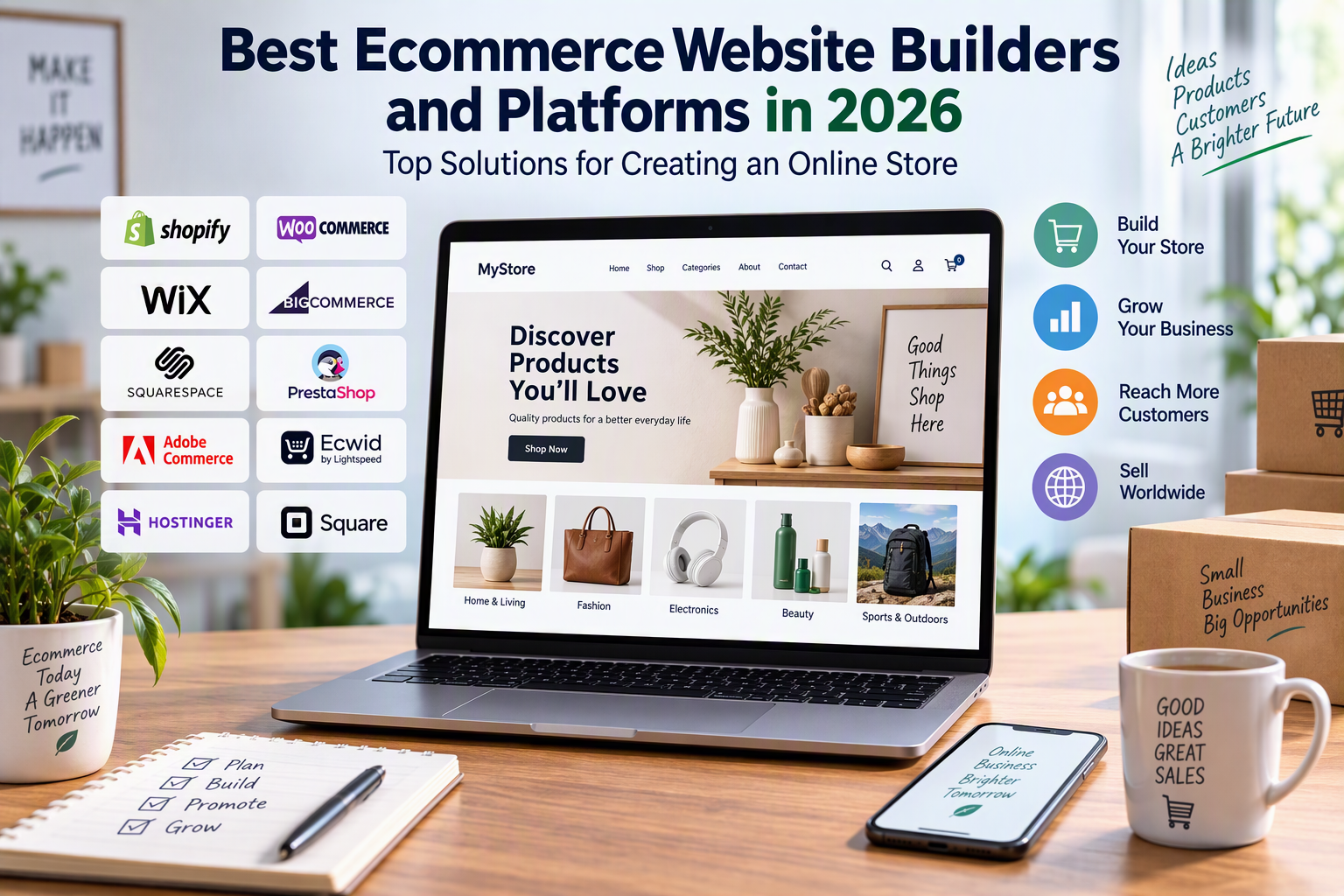
Best Ecommerce Website Builders and Platforms in 2026: Top Solutions for Creating an Online Store
Creating an online store has become an accessible way for entrepreneurs, small businesses, and established brands to sell products and services to customers around the world. The best ecommerce platforms provide the tools needed to build a professional website, manage products, accept payments, organize orders, and develop an effective online marketing strategy.
In 2026, ecommerce website builders offer a wide range of features, including customizable templates, mobile-friendly designs, inventory management, payment integrations, search engine optimization tools, and automated marketing functions. Some platforms focus on simplicity and ease of use, while others provide advanced customization and scalability for growing businesses.
Choosing the right platform depends on your budget, technical experience, business model, and long-term objectives. This guide explores some of the best ecommerce platforms, explains their main features and advantages, and helps you determine which solution may be suitable for your online business.
1. Shopify: Best Ecommerce Platform for Growing Online Businesses
Shopify is one of the most widely recognized ecommerce platforms, offering an integrated environment for creating and managing online stores. It is designed for entrepreneurs who want to sell products online without building an entire ecommerce system from scratch.
The platform combines website creation tools with product management, checkout functionality, payment integrations, order processing, and marketing features. Users can select a theme, customize the appearance of their store, upload product information, and configure their preferred payment and shipping options.
Shopify also supports businesses that want to expand beyond their websites. Depending on location, configuration, and available integrations, merchants can connect additional sales channels, social platforms, marketplaces, and physical retail operations.
Key features and benefits
Shopify offers customizable storefront themes, product catalogs, inventory management, order tracking, sales analytics, and access to a large application ecosystem. These features allow businesses to add functions such as customer reviews, email marketing, subscriptions, and advanced reporting.
Another advantage is its hosted infrastructure. Shopify manages the core hosting environment, helping merchants avoid many of the technical responsibilities associated with maintaining a self-hosted ecommerce website.
The platform is particularly suitable for beginners, established retailers, and businesses planning to scale their operations. However, subscription costs, payment processing charges, and paid applications should be considered when calculating the total cost of ownership.
Official website: https://www.shopify.com/
2. WooCommerce: Best Open-Source Ecommerce Solution for WordPress
WooCommerce is an open-source ecommerce plugin that transforms a WordPress website into an online store. It is an attractive option for users who want greater control over their website, content, design, and store functionality.
Unlike fully hosted ecommerce platforms, WooCommerce allows merchants to choose their own hosting provider and configure their websites according to their requirements. This flexibility makes it suitable for businesses that need customized shopping experiences or want to combine an online store with a content-rich website.
WooCommerce supports physical products, digital downloads, product variations, discount codes, shipping settings, and a range of payment integrations. Additional extensions can provide subscriptions, memberships, advanced inventory management, and other specialized functions.
Key features and benefits
One of WooCommerce’s strongest advantages is its flexibility. Users can select from a wide range of WordPress themes and plugins, customize many aspects of their stores, and retain substantial control over their website data and hosting environment.
The platform can also support content marketing and SEO strategies through WordPress publishing tools and compatible search optimization plugins. This combination is useful for businesses that want to attract visitors through informative articles, product guides, and search engine traffic.
The core WooCommerce plugin is available without a standard platform subscription fee, but operating a store may involve hosting, domain registration, premium themes, paid extensions, payment processing, and maintenance costs.
WooCommerce is best suited to users who value customization and are comfortable managing some technical aspects of their websites.
Official website: https://woocommerce.com/
3. Wix Ecommerce: Best for Beginners and Small Businesses
Wix is a website-building platform that allows users to create professional websites using visual editing tools. Its ecommerce features enable eligible users to build online stores without requiring advanced programming knowledge.
The platform offers customizable templates for different industries, including fashion, beauty, electronics, home accessories, and handmade products. Users can adjust layouts, add product pages, create promotional sections, and customize the appearance of their websites through a visual editor.
Wix also provides tools for managing products, processing orders, configuring shipping options, and connecting supported payment providers. Depending on the selected plan and available integrations, businesses can expand their stores with additional marketing and operational features.
Key features and benefits
Wix provides a beginner-friendly interface, customizable designs, integrated hosting, product management, and built-in website editing tools. Its visual approach makes it easier for small businesses to create a branded shopping experience without hiring a developer for every design change.
The platform also includes SEO settings that help users manage page titles, descriptions, URLs, and other important elements of search engine visibility.
Wix is especially suitable for small retailers, entrepreneurs, creators, and service-based businesses that want to combine an online store with appointment booking, business information, or a company blog.
However, users should compare ecommerce plans carefully because accepting online payments and accessing advanced store features require an eligible paid plan. The available customization and migration options may also differ from those of an open-source platform.
Official website: https://www.wix.com/
4. BigCommerce: Best for Expanding Ecommerce Businesses
BigCommerce is an ecommerce platform designed for businesses that need comprehensive selling tools and room to expand. It can support companies managing large product catalogs, multiple sales channels, and more complex operational requirements.
The platform includes tools for product management, inventory organization, promotions, customer accounts, and payment integration. Depending on the selected plan and configuration, merchants can also access advanced catalog management, business-to-business selling features, and integrations with external business systems.
BigCommerce can be particularly useful for retailers that want to develop their online operations without building every commerce function independently.
Key features and benefits
BigCommerce provides customizable storefronts, product catalog management, sales reporting, promotional tools, and integrations with third-party applications and services. Its built-in capabilities can reduce the need to install separate applications for certain store functions.
The platform is designed to support businesses as their requirements become more sophisticated. Companies may use it to manage larger inventories, connect additional selling channels, and improve the coordination of their ecommerce operations.
However, the administration interface and available features may require more time to learn than simpler website builders. Pricing plans, sales thresholds, payment processing charges, and any additional service costs should be reviewed before choosing a subscription.
BigCommerce is a strong option for growing retailers and businesses that need more advanced ecommerce capabilities than a basic online store provides.
Official website: https://www.bigcommerce.com/
5. Squarespace: Best for Design-Focused Online Stores
Squarespace is a website-building platform known for its visually polished templates and integrated design tools. It is especially suitable for businesses that want an attractive online presence alongside ecommerce functionality.
The platform provides professionally designed layouts that can be adapted to different industries. Merchants can use these templates to present products through high-quality images, organized product pages, promotional sections, and consistent branding.
Squarespace supports ecommerce functions such as product management, online payments, order administration, and selected marketing tools. Depending on the subscription and configuration, businesses may also be able to sell services, digital products, or eligible subscription offerings.
Key features and benefits
Squarespace combines website design, hosting, content management, and ecommerce functions in a unified environment. Its templates can help small businesses create a consistent visual identity without requiring extensive web development experience.
The platform is particularly attractive to photographers, designers, artists, independent fashion brands, and boutique retailers whose products benefit from strong visual presentation.
Its content tools can also support SEO and content marketing through structured pages, blog publishing, and customizable metadata.
However, merchants should review the ecommerce features included in each plan, payment processing costs, and the availability of particular integrations. Businesses with complex inventory or specialized operational requirements may prefer a platform with more extensive commerce-specific functionality.
Official website: https://www.squarespace.com/
6. PrestaShop: Best for Customizable Ecommerce Stores in Europe
PrestaShop is an ecommerce platform with an open-source foundation that is particularly relevant to businesses seeking customization and flexibility. It is widely considered by merchants who want greater control over their store structure and technical configuration.
The platform supports product catalogs, categories, customer accounts, order management, promotions, shipping configuration, and integrations with payment services. Additional modules can extend its capabilities to support different business models and operational requirements.
PrestaShop can be attractive to European businesses because its ecosystem includes modules and integrations intended for different markets, languages, currencies, and commercial requirements.
Key features and benefits
PrestaShop offers customizable store design, product management, multilingual capabilities, and an ecosystem of modules and themes. Depending on the selected configuration, merchants can adapt their stores to specific product categories and business processes.
The platform is useful for businesses that want more flexibility than a simplified hosted website builder provides. It can also support merchants who need to adapt their store to particular markets or connect external business systems.
However, the total cost depends on hosting, development, maintenance, modules, and technical support. Some integrations and advanced functions may require paid extensions or professional assistance.
PrestaShop is best suited to entrepreneurs and businesses that want control over their ecommerce environment and are prepared to manage the technical responsibilities associated with their chosen hosting arrangement.
Official website: https://prestashop.com/
7. Adobe Commerce: Best for Complex and Enterprise Ecommerce
Adobe Commerce is an ecommerce solution designed for businesses with sophisticated selling requirements. It is particularly relevant to established retailers and enterprises that need advanced customization, complex product structures, or integration with other business systems.
The platform can support extensive catalogs, customer segmentation, promotions, personalized shopping experiences, and complex business workflows. Depending on the implementation, it can also support multiple storefronts and different commercial operations within a broader ecommerce environment.
Its flexibility makes it suitable for companies that require customized functionality beyond the capabilities of a standard small-business website builder.
Key features and benefits
Adobe Commerce offers advanced catalog management, customizable shopping experiences, integrations, and tools for coordinating complex ecommerce operations. Businesses can adapt the platform to specialized requirements and connect it with other systems used for customer management, analytics, and business operations.
The solution can be valuable for large retailers, established brands, and businesses operating across multiple markets.
However, implementation and maintenance can be considerably more demanding than with beginner-friendly platforms. Hosting, development, integration, security, and ongoing technical support must all be considered when estimating costs.
Adobe Commerce is generally more appropriate for businesses with substantial ecommerce requirements and the resources to manage a more complex platform.
Official website: https://business.adobe.com/products/commerce.html
8. Ecwid by Lightspeed: Best for Adding an Online Store to an Existing Website
Ecwid by Lightspeed is an ecommerce solution that allows businesses to add online selling capabilities to an existing website or create a storefront using its available tools.
This approach can be useful for businesses that already have a website and want to introduce product sales without rebuilding their entire online presence.
Ecwid supports product catalogs, order management, payment integrations, and shipping configuration. Depending on the plan and available integrations, merchants can also connect supported social platforms and other sales channels.
Key features and benefits
One of Ecwid’s main advantages is its ability to integrate ecommerce functionality with an existing website. This can be useful for service businesses, independent creators, local retailers, and companies that want to expand into online sales gradually.
The platform provides centralized tools for managing products and orders, while available integrations can help businesses coordinate sales across supported channels.
However, the features available depend on the selected subscription. Merchants should review product limits, marketing capabilities, payment options, and integration requirements before committing to a plan.
Ecwid is worth considering for businesses that want a relatively straightforward way to introduce ecommerce without replacing their existing website.
Official website: https://www.ecwid.com/
9. Hostinger Website Builder: Best for Budget-Conscious Beginners
Hostinger Website Builder provides website creation tools designed for users who want to establish an online presence without managing a complex technical environment.
Depending on the selected plan and current availability, its ecommerce features can support product listings, online payments, store customization, and basic order management. The visual editor allows users to build pages and adjust the website’s appearance without writing extensive code.
This approach makes the platform relevant to new entrepreneurs, small retailers, and individuals testing an online business idea.
Key features and benefits
Hostinger focuses on accessible website creation, customizable templates, integrated hosting, and simplified management. Eligible ecommerce plans can provide a practical starting point for businesses that want to sell a limited range of products.
A simpler interface may also reduce the time required to launch a basic store. Users can concentrate on product presentation, pricing, customer communication, and marketing rather than managing every technical component separately.
However, available ecommerce functions, product limits, payment integrations, and promotional pricing can vary by plan and market. Businesses expecting rapid growth or requiring specialized integrations should evaluate these limitations before selecting the platform.
Official website: https://www.hostinger.com/
10. Square Online: Best for Businesses Selling Online and In Person
Square Online provides ecommerce tools for businesses that want to sell products through a website while coordinating their online and in-person sales.
It can be particularly useful for retailers, restaurants, and other businesses that already use compatible Square services. Depending on location and setup, the platform can connect online ordering and product sales with supported point-of-sale operations.
Merchants can create product listings, configure store pages, manage orders, and accept payments through available services. The exact capabilities depend on the country, plan, and Square products supported in the business’s location.
Key features and benefits
Square Online focuses on simplified store creation, product management, order handling, and connections with supported point-of-sale systems. Businesses that sell both online and in person may benefit from a more coordinated approach to managing sales.
The platform can be useful for small retailers and local businesses that want to develop online sales without maintaining a completely separate ecommerce system.
However, Square’s availability and supported features differ across markets. Businesses in Germany and other European countries should confirm local eligibility, payment processing options, and integration support before choosing this platform.
Official website: https://squareup.com/
Comparison of the Best Ecommerce Platforms in 2026
The following overview summarizes the main strengths of each platform.
Shopify: Best for businesses seeking an integrated ecommerce system with extensive selling tools and room to scale.
WooCommerce: Best for WordPress users who want open-source flexibility and substantial control over their store.
Wix Ecommerce: Best for beginners and small businesses that value visual editing and ease of use.
BigCommerce: Best for growing retailers that need more advanced catalog and ecommerce capabilities.
Squarespace: Best for design-focused brands, artists, and boutique stores.
PrestaShop: Best for businesses that want an adaptable ecommerce platform with control over technical configuration.
Adobe Commerce: Best for enterprises with complex product catalogs, integrations, and customized workflows.
Ecwid: Best for adding ecommerce functionality to an existing website.
Hostinger Website Builder: Best for beginners seeking a relatively simple and budget-conscious starting point.
Square Online: Best for eligible businesses that want to coordinate online and in-person sales.
No platform is ideal for every business. The right choice depends on the size of the catalog, required features, available budget, technical resources, and plans for future expansion.
How to Choose the Best Ecommerce Platform for Your Business
Choosing an ecommerce platform requires more than comparing website templates. You should evaluate the entire process of operating an online business, from presenting products to receiving payments and fulfilling orders.
Start by defining your business model. A small store selling handmade accessories may need only a straightforward product catalog and checkout system. A retailer selling thousands of products may require advanced inventory management, automated shipping workflows, and connections to accounting or warehouse software.
Next, evaluate ease of use. Hosted platforms such as Shopify and Wix handle many technical responsibilities, while open-source solutions such as WooCommerce and PrestaShop provide more flexibility but may require additional maintenance.
Consider your budget carefully. Subscription fees are only one part of the total cost. Domain registration, hosting, premium themes, extensions, payment processing, advertising, and professional development can increase your expenses.
Payment and shipping compatibility are especially important for businesses targeting customers in Germany and the wider European Union. Verify support for your preferred payment providers, delivery services, currencies, and tax configurations.
Finally, evaluate scalability. A platform should meet your current requirements while offering a practical path toward handling more products, orders, customers, and sales channels as the business grows.
Essential Features of a Successful Ecommerce Website
A successful online store needs more than an attractive design. It should provide a reliable and convenient shopping experience while making it easy for customers to find relevant products and complete their purchases.
Mobile responsiveness is essential because many customers browse and shop using smartphones. Product pages should load efficiently, display clear images, provide accurate descriptions, and present prices and delivery information in an understandable format.
Secure payment processing is another fundamental requirement. Select supported payment providers, configure security settings properly, and avoid collecting or storing sensitive payment information unnecessarily.
Inventory and order management tools can help prevent overselling, organize fulfillment, and improve customer communication. Automated order confirmations and shipping updates can also make the shopping experience more transparent.
Marketing and analytics functions are equally important. Tools for measuring traffic, analyzing conversions, managing product feeds, and collecting customer feedback can help merchants identify opportunities to improve performance.
Businesses should also consider accessibility, customer support, clear return policies, and straightforward navigation. These elements contribute to a more professional shopping experience and help build customer confidence.
SEO Strategies for Online Stores in 2026
Search engine optimization can help ecommerce businesses attract visitors who are actively searching for their products. A well-designed store should combine useful content, clear website structure, and technically sound pages.
Begin by researching keywords that match your products and customers’ search intentions. Use relevant terms naturally in page titles, product descriptions, headings, category pages, and image alternative text.
Write original product descriptions that explain practical benefits, materials, dimensions, compatibility, and other useful details. Avoid copying descriptions directly from manufacturers or other retailers. Unique, accurate descriptions can provide more value to shoppers and reduce unnecessary copyright risks.
Organize products into logical categories and create straightforward navigation. Internal links between related products, categories, and informative articles can help customers discover relevant items and help search engines understand the website’s structure.
Technical SEO is also important. Use mobile-friendly designs, secure HTTPS connections, descriptive URLs, appropriate canonical tags, and XML sitemaps. Structured data may help search engines interpret product information when implemented correctly.
Finally, create helpful content that answers customer questions. Buying guides, comparison articles, maintenance advice, and educational resources can support long-term organic traffic when they are original, accurate, and genuinely useful.
SEO results take time and are never guaranteed. Regularly reviewing search performance, user behavior, and conversion data can help you improve your strategy.
Legal and Copyright Considerations for Ecommerce Websites in Europe
Businesses operating in Germany or targeting customers in the European Union should consider legal compliance when choosing a platform and preparing their online stores.
Use original product descriptions, photographs you have created, or content for which you have obtained appropriate permission or a suitable commercial license. Do not assume that an image or description is free to reuse simply because it appears in search results or on a manufacturer’s website.
Review the licensing conditions of website themes, fonts, icons, plugins, and other design resources. Open-source software can be used under its applicable license terms, but this does not mean that every associated image, extension, or commercial asset is unrestricted.
Depending on the business model and target market, ecommerce operators may need to address consumer information requirements, pricing transparency, withdrawal rights, privacy notices, cookie consent, data protection, VAT, product safety, and other applicable obligations.
For stores targeting German consumers, requirements may include a legally compliant website notice, clear contact information, appropriate consumer terms, and transparent shipping and return information. The exact obligations depend on the business and products involved.
Use the platform’s tools to help manage these requirements, but do not assume that the platform automatically guarantees legal compliance. Businesses should review current requirements and obtain qualified legal or tax advice where necessary.
Conclusion
The best ecommerce platforms in 2026 provide different ways to create, manage, and grow an online business. Shopify is a strong option for merchants seeking an integrated selling system, while WooCommerce and PrestaShop offer greater flexibility for users who want more control over their websites. Wix and Hostinger are worth considering for beginners, Squarespace stands out for design-focused stores, and BigCommerce supports businesses with more advanced selling requirements.
Adobe Commerce is relevant to enterprises with complex ecommerce operations, while Ecwid can help businesses add online sales to an existing website. Square Online may be useful for eligible retailers that want to coordinate digital and in-person sales.
Before making a decision, compare features, total operating costs, payment options, customization, security, and scalability. Choose a platform that matches your current needs while allowing your business to develop over time.
With original product content, a user-friendly design, reliable payment processing, effective SEO, and careful attention to applicable legal requirements, an ecommerce platform can provide a solid foundation for building a sustainable online business.


