
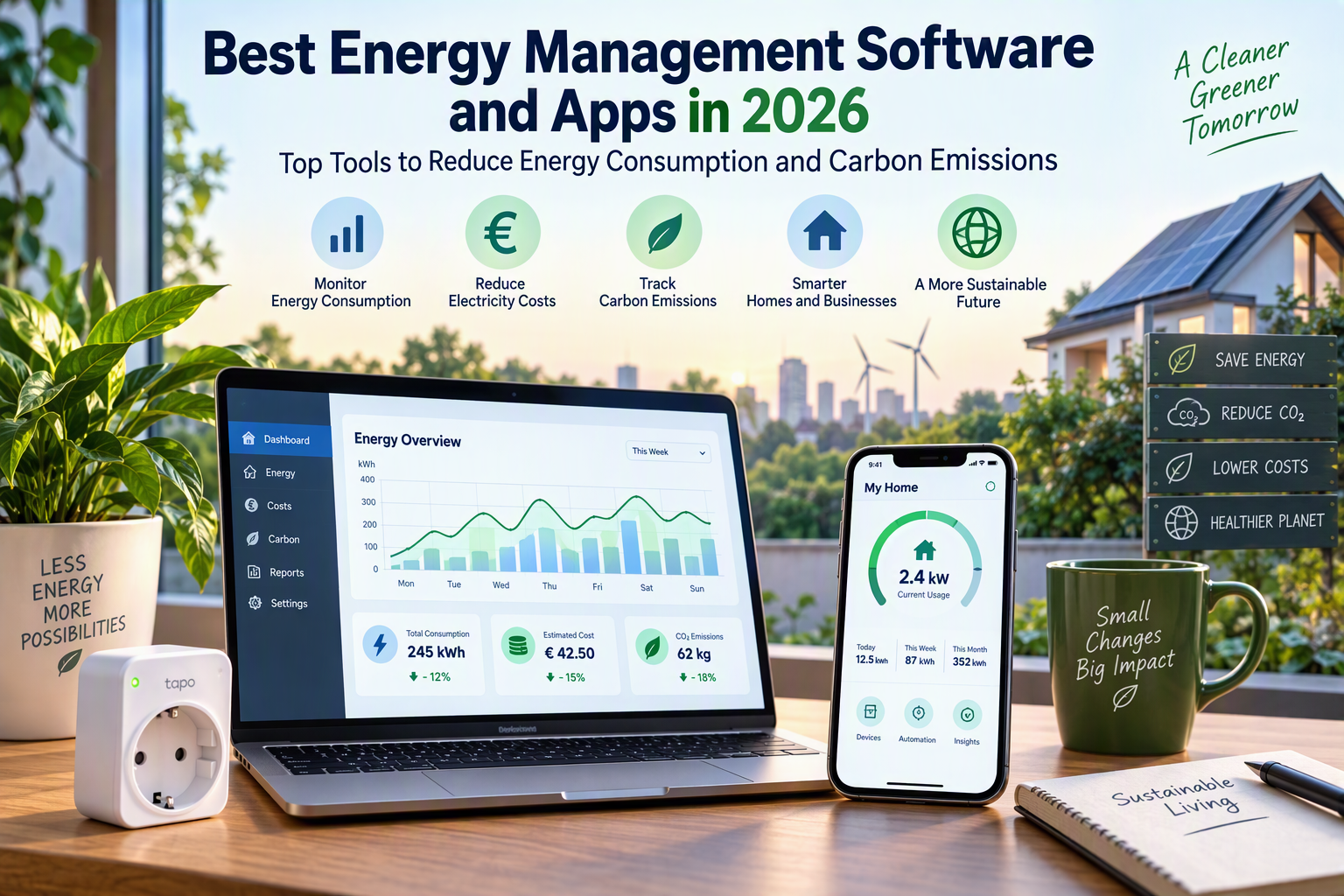
Best Energy Management Software and Apps in 2026: Top Tools to Reduce Energy Consumption and Carbon Emissions
Energy management software and applications have become valuable tools for households, businesses, and organizations seeking to reduce electricity consumption, control operating costs, and minimize their environmental impact. These digital solutions help users understand how energy is consumed, identify inefficient equipment, monitor renewable energy production, and measure progress toward sustainability goals.
The best energy management software and apps in 2026 offer features such as real-time energy monitoring, automated reports, carbon footprint calculations, consumption forecasts, and personalized recommendations. Some platforms are designed for individual households, while others support commercial buildings, factories, and large organizations with complex energy requirements.
Choosing the right solution depends on your energy consumption, budget, technical requirements, and environmental objectives. This guide explores several useful energy management platforms, explains their main features and benefits, and introduces complementary smart energy monitoring products available through Amazon Germany and other European marketplaces.
1. EnergyCAP: Energy Management and Utility Cost Tracking
EnergyCAP is an energy and utility management platform designed primarily for businesses, public institutions, educational organizations, and property managers. It helps organizations collect utility data, analyze energy consumption, manage invoices, and identify opportunities to improve efficiency.
One of its principal advantages is its ability to organize large amounts of utility information in a centralized system. Users can compare consumption between buildings, examine historical energy usage, track expenses, and prepare reports that support operational and sustainability decisions.
EnergyCAP can be particularly useful for organizations managing multiple buildings or locations. By identifying unusual consumption patterns and comparing energy performance across facilities, managers can investigate potential inefficiencies and prioritize improvements.
Key features and benefits:
EnergyCAP focuses on utility data management, energy accounting, cost analysis, and performance reporting. These capabilities help organizations understand where their energy budgets are being spent and determine which facilities require further investigation.
The platform is most suitable for organizations that need structured reporting and centralized oversight rather than a simple application for monitoring individual household appliances. Interested users should request a demonstration to confirm available modules, integration options, and pricing.
2. Schneider Electric EcoStruxure: Smart Building Energy Management
Schneider Electric EcoStruxure is a collection of digital solutions designed to improve the management of buildings, electrical infrastructure, industrial operations, and energy systems.
For building owners and facility managers, suitable EcoStruxure solutions can combine energy monitoring, building automation, equipment performance data, and operational analytics. This information helps users understand how lighting, heating, cooling, and other building systems affect overall energy consumption.
One important benefit is the ability to connect energy management with building operations. For example, an organization can analyze electricity consumption alongside heating and cooling requirements to identify opportunities to improve efficiency without unnecessarily reducing occupant comfort.
EcoStruxure is particularly relevant to commercial buildings, hotels, offices, and industrial facilities that require more advanced monitoring than consumer smart home applications provide.
Key features and benefits:
Depending on the selected product, features may include energy dashboards, building automation, equipment monitoring, performance analysis, and reporting tools. These capabilities can help reduce unnecessary energy use, improve operational visibility, and support environmental management programs.
Businesses should evaluate the specific EcoStruxure product they need because the portfolio includes different solutions with different functions, integrations, and licensing arrangements.
3. Siemens Energy Management Software: Industrial Efficiency and Monitoring
Siemens provides energy management and industrial automation solutions that help businesses monitor energy use across production facilities, equipment, and building infrastructure.
These solutions can be valuable for manufacturers and organizations with high electricity consumption. Monitoring energy demand at equipment, production-line, or facility level helps managers identify inefficient processes and understand how operational changes affect energy performance.
For example, a manufacturing business may compare energy consumption during different production periods to determine whether equipment is using unnecessary electricity when production is low. Historical data can also help identify unusual consumption patterns that require technical investigation.
Key features and benefits:
Depending on the selected Siemens solution, capabilities may include energy consumption monitoring, automated data collection, dashboards, performance analysis, and reporting. Some solutions also support carbon accounting or provide data that can be used in broader environmental reporting systems.
Siemens energy management software is generally more appropriate for industrial facilities and large buildings than for individuals looking for a basic smartphone application.
Organizations considering this option should review hardware compatibility, installation requirements, integration with existing automation systems, and the availability of reporting functions before purchasing.
4. IBM Envizi: Sustainability and Carbon Emissions Management
IBM Envizi is a sustainability data management platform designed to help organizations collect, organize, analyze, and report environmental information.
Unlike a basic electricity monitoring application, a sustainability management platform can cover several categories of environmental data. Depending on the configuration, these may include purchased electricity, fuel consumption, business travel, waste, water, and other sources of greenhouse gas emissions.
Centralizing this information helps sustainability teams develop a more comprehensive understanding of an organization’s environmental impact. It can also make it easier to compare performance over time and prepare documentation for internal management or applicable external reporting requirements.
Key features and benefits:
IBM Envizi focuses on sustainability data collection, greenhouse gas accounting, emissions reporting, and environmental performance analysis. These capabilities can help organizations identify major emissions sources and prioritize reduction initiatives.
The platform may be particularly useful for large companies, international businesses, and organizations managing sustainability information across multiple locations.
However, accurate carbon reporting depends on the quality of the underlying data, the selected calculation methods, and the emissions factors used. Organizations should verify that their chosen configuration meets their specific reporting needs and applicable legal requirements.
5. Energy Elephant: Energy and Sustainability Data Management
Energy Elephant is a digital energy and sustainability management platform designed to help organizations collect and analyze information about energy consumption, costs, and environmental performance.
For organizations with multiple buildings, utility accounts, or operational sites, collecting data from different sources can be difficult. A centralized platform can simplify this process by organizing energy information in one place and helping users identify trends that deserve attention.
The platform can support energy management activities by helping users understand consumption patterns, review performance, and identify opportunities to reduce unnecessary expenditure.
Key features and benefits:
Depending on the available service package, users may benefit from energy data management, performance dashboards, reporting, and sustainability-related analysis. Centralized information can help facility managers and sustainability teams compare sites and make more informed decisions.
Energy Elephant is worth evaluating for organizations that want to combine energy monitoring with broader environmental management activities.
Before selecting the service, businesses should confirm which integrations are supported, how historical data is handled, what reporting capabilities are included, and whether the pricing model suits their operational requirements.
6. Home Assistant: Smart Home Energy Monitoring and Automation
Home Assistant is an open-source home automation platform that allows users to connect compatible smart devices and monitor different aspects of their homes.
Its energy dashboard can help users track electricity consumption, solar energy production, and other supported energy measurements. When compatible devices and integrations are available, users can also create automations that help them manage energy use more efficiently.
For example, a household could monitor the electricity consumed by selected appliances, review solar energy production, or automate certain devices according to schedules and household requirements.
Home Assistant is particularly attractive to people who want flexibility and greater control over their smart home systems.
Key features and benefits:
Home Assistant supports a wide range of integrations, customizable dashboards, automation rules, and energy monitoring capabilities. Depending on the setup, it can combine data from smart plugs, energy meters, solar inverters, and other compatible equipment.
Its open-source nature allows users to build a monitoring system around their own requirements rather than depending entirely on one manufacturer’s ecosystem.
However, setup can require technical knowledge, compatible hardware, and occasional maintenance. Users should also consider data security, network configuration, and the compatibility of individual devices.
For people interested in understanding their household electricity consumption and reducing unnecessary usage, Home Assistant is one of the most flexible options to investigate.
7. Google Home: Simple Smart Home Energy Management
Google Home provides a convenient way to manage compatible smart home devices through a centralized application.
Although it is not a complete carbon accounting platform, it can support energy-saving routines when used with compatible smart plugs, lighting systems, thermostats, and other connected equipment.
Users can create schedules to switch off selected devices when they are not needed, manage compatible appliances remotely, and simplify everyday home automation.
For example, smart lighting can be scheduled to turn off at specific times, while compatible heating controls can help maintain suitable indoor temperatures without unnecessary energy use.
Key features and benefits:
Google Home offers centralized device management, supported voice controls, and automation routines. Its main advantage is convenience: users can coordinate compatible devices without operating each one separately.
However, energy monitoring depends on the connected equipment. Google Home alone does not provide comprehensive electricity consumption measurements for every appliance or calculate a complete household carbon footprint.
For better energy analysis, users can combine Google Home with compatible monitoring devices or a dedicated energy management platform.
8. Apple Home: Energy-Conscious Smart Home Automation
Apple Home helps users control compatible smart home accessories through supported Apple devices.
The platform can be useful for reducing unnecessary electricity consumption by automating compatible lights, switches, and other connected equipment. Users can create routines that match their daily schedules and control supported devices remotely.
For example, lighting can be switched off automatically when it is no longer needed, while compatible accessories can be incorporated into routines designed to simplify household energy management.
Key features and benefits:
Apple Home offers centralized control, automation, and integration with compatible smart home accessories. Depending on the devices and available integrations, users can build a more convenient and energy-conscious household environment.
It is important to distinguish smart home automation from detailed energy management. Not every accessory measures electricity consumption, and Apple Home does not automatically provide a complete carbon emissions inventory.
Users who want to measure energy usage should select accessories that explicitly support energy monitoring and confirm compatibility with their Apple Home setup.
9. Electricity Maps: Understanding the Carbon Intensity of Electricity
Electricity Maps is a digital platform that provides information about electricity generation and the carbon intensity of electricity systems in different regions.
Carbon intensity indicates the amount of greenhouse gas emissions associated with a unit of electricity, commonly expressed in grams of carbon dioxide equivalent per kilowatt-hour.
This information can help users understand why electricity-related emissions vary depending on location, time, and the electricity generation mix. It can also help energy professionals investigate how electricity demand and renewable generation affect emissions.
For example, an organization may use carbon intensity data to explore whether flexible electricity consumption can be shifted toward periods with lower reported emissions, where operational requirements and electricity tariffs permit.
Key features and benefits:
Electricity Maps offers electricity-related emissions information, regional comparisons, and data services for applications and analytical workflows. The availability of historical data, forecasts, and API features depends on the service and access plan.
It is particularly useful for researchers, sustainability professionals, energy analysts, and organizations interested in understanding the relationship between electricity consumption and emissions.
Electricity Maps should not be confused with an appliance-level energy meter. It helps users understand the emissions intensity of electricity rather than directly measuring how much electricity a specific household appliance consumes.
10. Carbon Footprint Calculators: Measuring Everyday Environmental Impact
Carbon footprint calculators help individuals and businesses estimate greenhouse gas emissions associated with their activities.
Depending on the calculator, users may enter information about electricity consumption, heating fuels, transportation, flights, food, purchases, and waste. The tool then estimates the associated emissions using its selected calculation methods and emissions factors.
These applications can help users identify which activities contribute most to their estimated carbon footprint and decide where practical changes may have the greatest effect.
For example, a household may discover that heating, driving, or electricity consumption represents a significant portion of its estimated emissions. This information can guide decisions about insulation, transport habits, energy efficiency, and renewable electricity.
Key features and benefits:
Useful carbon calculators provide clear input categories, transparent calculation methods, understandable results, and options for comparing estimates over time.
Some calculators are free, while others are included in paid sustainability platforms. The accuracy of the result depends on the completeness of the information provided and the quality of the underlying emissions factors.
For meaningful comparisons, users should choose a consistent calculation method and avoid treating estimates as exact measurements. Businesses with formal reporting obligations may need more comprehensive carbon accounting software.
Best Energy Monitoring Products to Complement Energy Management Apps
Software becomes more useful when it receives reliable information about actual electricity consumption. Smart plugs and energy meters can provide the measurements needed to identify high-consumption appliances and evaluate the results of energy-saving changes.
The following products are worth considering alongside the software and applications discussed above.
1. TP-Link Tapo P115 Smart Plug
The TP-Link Tapo P115 is a smart plug designed to monitor the electricity consumption of an individual connected appliance.
Its energy monitoring functions can help users understand how much electricity devices consume during daily operation. The associated application can display consumption information and, depending on the available features, help users manage schedules and control compatible equipment.
Main advantages:
The compact design makes it suitable for many household applications, including televisions, computer equipment, and other compatible appliances. Energy monitoring can help users identify devices that consume more electricity than expected, while scheduling features can reduce unnecessary operation.
Before purchasing, check the exact model, maximum supported electrical load, plug type, and compatibility with your preferred smart home system.
Amazon Germany and European Union shopping links:
- Amazon Germany: https://www.amazon.de/s?k=TP-Link+Tapo+P115
- Amazon France: https://www.amazon.fr/s?k=TP-Link+Tapo+P115
- Amazon Italy: https://www.amazon.it/s?k=TP-Link+Tapo+P115
- Amazon Spain: https://www.amazon.es/s?k=TP-Link+Tapo+P115
2. Shelly Plug PM Gen3
The Shelly Plug PM Gen3 is a smart energy monitoring plug designed to measure the electricity consumption of connected appliances.
It provides real-time power monitoring through compatible interfaces and can help users examine consumption patterns. It is particularly useful when a household wants to understand the electricity requirements of individual devices without installing a complete building energy management system.
Main advantages:
The plug offers a straightforward installation process, smartphone-based monitoring, and consumption alerts. Its monitoring capabilities can help users investigate unexpectedly high electricity use and assess the effects of changes in operating schedules.
An important distinction is that the Plug PM Gen3 measures energy consumption but does not provide an on/off switching relay. Buyers should not assume it can automatically disconnect appliances.
Amazon Germany and European Union shopping links:
- Amazon Germany: https://www.amazon.de/s?k=Shelly+Plug+PM+Gen3
- Amazon France: https://www.amazon.fr/s?k=Shelly+Plug+PM+Gen3
- Amazon Italy: https://www.amazon.it/s?k=Shelly+Plug+PM+Gen3
- Amazon Spain: https://www.amazon.es/s?k=Shelly+Plug+PM+Gen3
3. Meross Smart Plug with Energy Monitoring
Compatible Meross smart plugs can provide electricity consumption monitoring and remote device control, depending on the selected model.
These products are useful for households that want to measure the consumption of selected appliances and incorporate them into smart home routines. Some models also support scheduling and integration with particular voice assistants or smart home ecosystems.
Main advantages:
A compatible energy-monitoring model can help users review electricity consumption, automate operating schedules, and reduce unnecessary standby usage when the connected appliance can safely be switched off.
Buyers should check the precise model number because energy monitoring, connectivity, Apple Home compatibility, and maximum electrical load vary between Meross products.
Amazon Germany and European Union shopping links:
- Amazon Germany: https://www.amazon.de/s?k=Meross+Smart+Plug+Energy+Monitoring
- Amazon France: https://www.amazon.fr/s?k=Meross+Smart+Plug+Energy+Monitoring
- Amazon Italy: https://www.amazon.it/s?k=Meross+Smart+Plug+Energy+Monitoring
- Amazon Spain: https://www.amazon.es/s?k=Meross+Smart+Plug+Energy+Monitoring
4. Shelly Pro 3EM Energy Meter
The Shelly Pro 3EM is a three-phase energy meter designed for more advanced electricity monitoring applications.
Unlike a standard smart plug, this device is intended to measure energy flows across an electrical installation. Depending on the configuration, it can help users monitor consumption, examine historical measurements, and evaluate electricity flows associated with compatible solar energy systems.
Main advantages:
The device provides more comprehensive monitoring than individual appliance plugs and can be useful for larger homes, businesses, and properties with three-phase electrical supplies.
Its capabilities may help users understand overall demand, identify consumption patterns, and evaluate the relationship between electricity generation and consumption.
Installation requirements and compatibility depend on the electrical installation. Because the device connects to electrical infrastructure, installation should be performed by a qualified professional where required.
Amazon Germany and European Union shopping links:
- Amazon Germany: https://www.amazon.de/s?k=Shelly+Pro+3EM
- Amazon France: https://www.amazon.fr/s?k=Shelly+Pro+3EM
- Amazon Italy: https://www.amazon.it/s?k=Shelly+Pro+3EM
- Amazon Spain: https://www.amazon.es/s?k=Shelly+Pro+3EM
How to Choose the Best Energy Management Software
Selecting the right energy management application starts with identifying the problem you want to solve. A household trying to reduce electricity bills needs different tools from a company preparing emissions reports or a factory monitoring energy-intensive machinery.
For residential use, look for accessible dashboards, clear consumption measurements, compatible smart plugs, and useful automation features. Applications should make it easy to understand electricity use without requiring extensive technical knowledge.
For businesses, consider utility data integration, multi-site reporting, historical analysis, energy performance indicators, and compatibility with existing meters or building management systems. Organizations with sustainability reporting requirements should also evaluate emissions calculation methods, data traceability, and reporting capabilities.
Data privacy is another important consideration. Review the provider’s privacy policy, data storage arrangements, account permissions, and available export options. Organizations handling sensitive operational information should evaluate security controls before connecting their systems.
Finally, compare the total cost of ownership rather than the subscription price alone. Hardware, installation, integrations, employee training, and maintenance can all affect the long-term value of an energy management solution.
How Energy Management Apps Help Reduce Carbon Emissions
Energy management applications can support emissions reduction by making energy consumption more visible and helping users identify practical opportunities for improvement.
The first step is measurement. By collecting electricity readings, fuel consumption data, and other relevant information, users can establish a baseline against which future performance can be compared.
The next step is identifying inefficiencies. Unnecessary lighting, poorly controlled heating and cooling, inefficient equipment, and excessive standby consumption can contribute to avoidable energy use. Monitoring tools can help identify these issues so users can prioritize corrective actions.
Automation can provide additional benefits when used appropriately. Timers, occupancy-based controls, and intelligent heating schedules can reduce unnecessary operation without compromising safety or comfort.
Businesses can extend this approach by comparing facilities, monitoring production processes, and tracking emissions associated with purchased electricity and fuels. Sustainability software can then help organize the information needed to evaluate progress toward environmental objectives.
However, installing an application does not automatically reduce carbon emissions. Meaningful improvements depend on the actions taken in response to the information, the energy sources involved, and the effectiveness of the measures implemented.
Conclusion
The best energy management software and apps in 2026 can help households and organizations monitor electricity consumption, improve operational efficiency, control energy costs, and understand their environmental impact.
EnergyCAP is worth considering for utility cost management, while Schneider Electric EcoStruxure and Siemens offer solutions for more advanced building and industrial energy management. IBM Envizi and Energy Elephant can support broader sustainability data management, while Home Assistant, Google Home, and Apple Home provide useful options for compatible smart home automation. Electricity Maps offers additional insight into the carbon intensity of electricity.
For households, combining a suitable application with energy-monitoring smart plugs or meters can provide a clearer picture of electricity consumption and help identify opportunities to reduce waste. For businesses, selecting a platform with appropriate integrations, reporting capabilities, and reliable data management is essential.
The most effective approach is to measure energy use, identify the largest sources of waste, implement practical improvements, and review the results regularly. With the right tools and consistent action, energy management software can support lower energy consumption, more informed decisions, and measurable progress toward reduced carbon emissions.


