
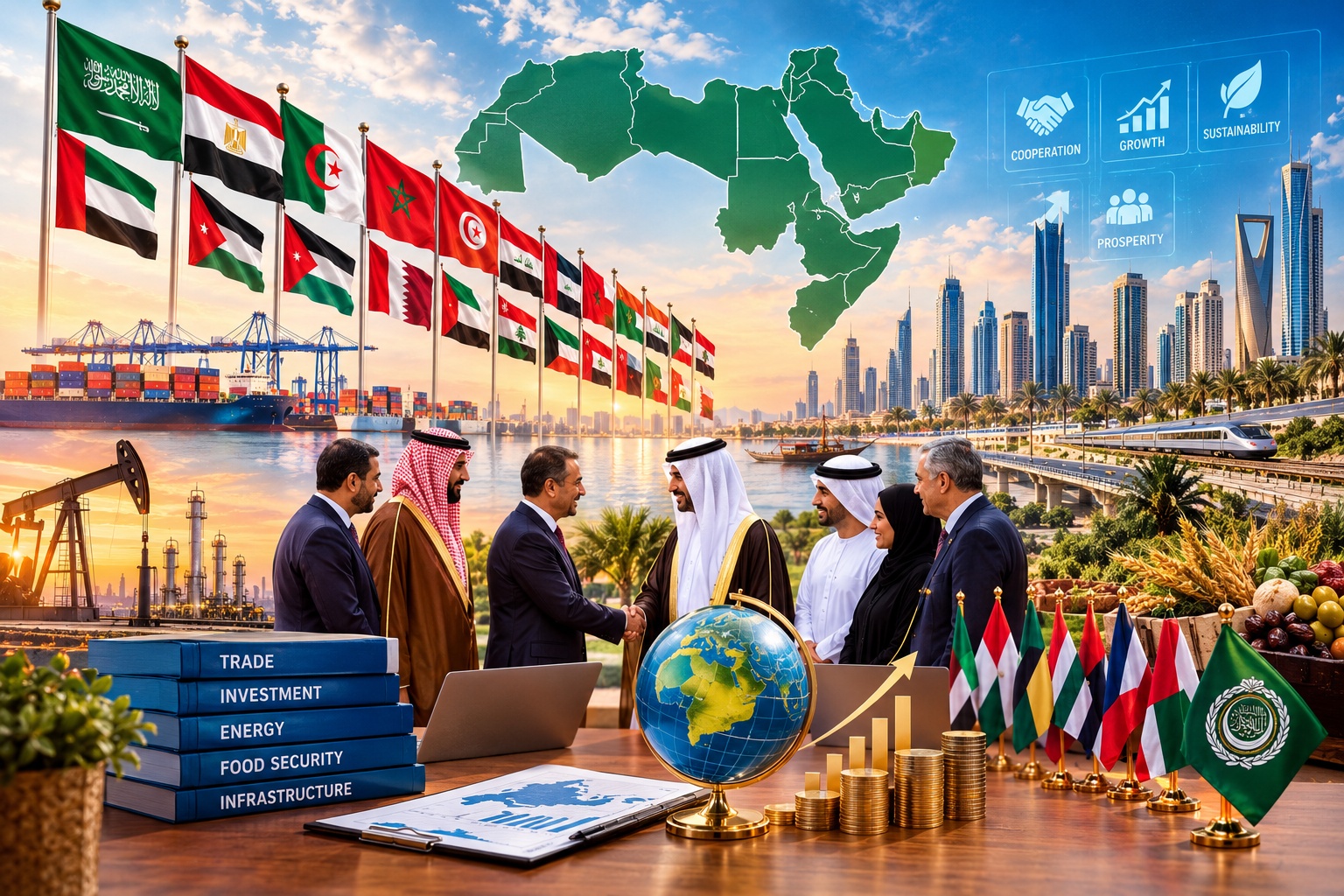
Economic and Political Relations Between Arab Countries: Cooperation, Trade, and Regional Integration
Introduction
Economic and political relations between Arab countries play an important role in shaping the Middle East and North Africa. These countries share historical connections, cultural ties, geographic proximity, and common interests in trade, investment, energy, food security, infrastructure, and regional stability. However, their economies, natural resources, political systems, and development priorities differ considerably.
Stronger cooperation could help Arab countries expand regional markets, attract investment, create employment opportunities, and improve their position in the global economy. At the same time, political disagreements, regional conflicts, and differences in national priorities continue to influence the pace of economic integration.
For a broader statistical overview, the Joint Arab Economic Report 2025 provides an institutional review of economic developments across Arab countries, including trade, energy, finance, agriculture, and public debt.
The Political Foundations of Arab Relations
Political relations between Arab countries are shaped by diplomacy, shared regional interests, security concerns, historical experiences, and the desire to maintain national sovereignty. Governments cooperate through bilateral agreements, regional meetings, diplomatic initiatives, and multilateral institutions. These relationships can support economic development when countries coordinate policies and maintain stable channels of communication.
Nevertheless, Arab countries do not always share the same positions on regional conflicts, foreign policy, security arrangements, or relations with international powers. Such differences can make it difficult to establish common policies. The result is a regional environment in which cooperation in one sector may continue even when political disagreements remain unresolved in another.
The Algerian Ministry of Foreign Affairs describes the Arab region as an important dimension of Algeria’s foreign policy and highlights the importance of peaceful approaches and political dialogue in addressing regional crises.
The Role of the League of Arab States
The League of Arab States provides a framework for political consultation and cooperation among Arab countries. Its work encompasses regional diplomacy, economic and social cooperation, cultural relations, and discussions of issues affecting member states. It offers a forum through which governments can exchange views and seek common positions on matters of shared interest.
However, regional agreements do not automatically produce uniform national policies. Implementation depends on decisions by individual governments, domestic legislation, administrative capacity, and the willingness of participating countries to coordinate their actions. This distinction is important when assessing the practical impact of Arab cooperation.
Economic cooperation also involves specialized institutions, including the Arab Monetary Fund and the Arab Fund for Economic and Social Development. Their research, financing activities, and policy work contribute to a wider institutional framework for regional economic development. The Arab Monetary Fund outlines the collaborative role of Arab institutions in preparing the annual Joint Arab Economic Report.
Economic Relations Between Arab Countries
Economic relations between Arab countries include trade in goods and services, investment, financial cooperation, transportation, tourism, and the movement of capital. These connections vary significantly from one country to another because national economies have different resource endowments, industrial capabilities, population sizes, and consumer markets.
Some Arab economies are major exporters of oil and natural gas, while others have developed manufacturing, agriculture, tourism, logistics, or service industries. These differences can create opportunities for mutually beneficial trade. Energy exporters may import food, machinery, and manufactured products, while countries with diversified production can seek regional markets for agricultural goods, textiles, pharmaceuticals, and other products.
Realizing this potential requires more than geographic proximity. Businesses also need predictable regulations, reliable transport links, efficient customs procedures, transparent investment rules, and access to information about regional demand. The World Bank’s research on regional trade and integration discusses how trade costs, logistics, regulation, and political obstacles can limit deeper economic connections across the wider Middle East and North Africa region.
Intra-Arab Trade and Regional Markets
Intra-Arab trade refers to the exchange of goods and services between Arab countries. Expanding this trade can give companies access to more customers, reduce dependence on a limited number of markets, and create opportunities for businesses to grow beyond their domestic economies.
Potential areas of cooperation include food products, construction materials, fertilizers, chemicals, industrial equipment, textiles, consumer goods, and digital services. Regional demand can also support smaller enterprises that may find it difficult to compete internationally without access to larger markets.
However, the Arab region should not be treated as a single unified market. Tariffs, product standards, customs procedures, transport costs, payment arrangements, and differences in commercial regulations can make cross-border transactions more complicated. Political tensions may also disrupt trade routes or weaken business confidence.
The Arab Development Portal’s trade database provides trade statistics and bilateral indicators that readers can use to examine exports and imports across Arab countries. Such data is useful for distinguishing actual trade flows from the broader potential for regional integration.
Energy Cooperation and Natural Resources
Energy is one of the most influential areas of economic cooperation among Arab countries. Several states have substantial oil and natural gas resources, while others are important consumers, transit countries, or potential markets for electricity and alternative energy. These different positions create opportunities for cooperation in production, refining, pipelines, electricity interconnection, and energy-related investment.
Cooperation can also extend beyond conventional fuels. Solar power, wind energy, electricity networks, energy storage, and green hydrogen projects may create new commercial relationships as countries seek to diversify their energy systems. The pace and economic viability of these projects depend on infrastructure, financing, technology, national strategies, and market demand.
Energy relationships can nevertheless be affected by global price fluctuations, production decisions, geopolitical tensions, and changes in international demand. Countries whose public finances depend heavily on hydrocarbon revenues may face particular challenges when prices decline, while energy-importing economies can be exposed to higher import costs.
The Organization of Arab Petroleum Exporting Countries (OAPEC) provides information on petroleum-related cooperation and energy developments among its member countries.
Investment and Joint Arab Projects
Investment is another important dimension of Arab economic relations. Cross-border investment can support factories, hotels, logistics centers, ports, renewable energy facilities, telecommunications infrastructure, housing, and other productive activities. When projects are commercially viable and properly managed, they can create jobs, transfer expertise, and strengthen connections between national economies.
Joint projects can also connect different stages of production. For example, one country may supply raw materials, another may provide industrial processing, and a third may offer access to transport networks or consumer markets. Such arrangements can help companies diversify suppliers and build regional production networks.
However, investment decisions depend on reliable legal frameworks, clear ownership rules, effective contract enforcement, financial transparency, and confidence in economic policy. Political instability and uncertainty about regulations can increase costs or delay projects. Governments seeking to attract responsible investment can help by publishing clear rules, improving administrative procedures, and ensuring fair competition.
The Arab Development Portal offers regional economic data and policy resources that can help researchers and businesses investigate investment-related development trends.
Food Security and Agricultural Cooperation
Food security is a shared economic and strategic concern for many Arab countries. The region includes countries with agricultural capacity as well as countries that rely heavily on imported food. Water scarcity, climate pressures, population growth, and disruptions to international supply chains make dependable food systems particularly important.
Arab countries can cooperate through agricultural investment, research, storage facilities, food processing, transport infrastructure, and more efficient supply chains. Countries with suitable land and water resources may contribute agricultural products, while others can provide financing, technology, distribution networks, or access to large consumer markets.
Effective cooperation must account for local environmental conditions. Agricultural expansion is not automatically sustainable, especially in areas facing water shortages or soil degradation. Investment decisions should therefore consider water efficiency, responsible land management, climate resilience, and the long-term needs of local communities.
The Food and Agriculture Organization of the United Nations provides regional information and resources on agriculture, food security, and sustainable food systems in the Near East and North Africa.
Transport, Logistics, and Digital Connectivity
Efficient transportation and digital connectivity can make economic cooperation more practical. Ports, roads, railways, airports, shipping services, border facilities, and logistics centers help businesses move products between markets. Better connections can reduce delivery times, improve supply-chain reliability, and make regional trade more competitive.
Digital infrastructure is equally important. Electronic customs systems, interoperable payment services, secure digital documentation, and online business platforms can reduce administrative burdens and help small and medium-sized enterprises reach customers in other countries.
Regional connectivity requires coordination across borders. A modern port or highway may deliver limited benefits if neighboring transport systems are poorly connected or if border procedures remain slow and unpredictable. Joint planning, compatible technical standards, and transparent procurement can help ensure that infrastructure investments provide lasting economic value.
The World Bank’s work on regional integration in the Middle East and North Africa examines trade, transport, capital flows, services, and cross-border infrastructure, including opportunities and constraints affecting economic integration in the Maghreb.
Tourism, Education, and Cultural Exchange
Tourism and cultural exchange contribute to economic relationships between Arab countries by supporting airlines, hotels, restaurants, travel agencies, entertainment, retail, and local service providers. Shared language and cultural connections can make regional travel attractive, while historical sites, coastal destinations, religious tourism, and modern urban attractions offer different experiences across the region.
Tourism cooperation may involve joint promotion, improved flight connections, coordinated travel services, professional training, and the exchange of expertise in hospitality and heritage preservation. These initiatives can help destinations reach broader markets, although their results depend on infrastructure, service quality, affordability, and security conditions.
Education and research also strengthen long-term relationships. University partnerships, student exchanges, vocational training, and collaborative research can develop skills and encourage professional networks that extend across national borders. These connections may support future cooperation in technology, healthcare research, engineering, agriculture, and business.
Political Disagreements and Regional Conflicts
Political disagreements remain among the major challenges facing economic cooperation in the Arab world. Conflicts and diplomatic tensions can interrupt trade routes, discourage investment, displace communities, damage infrastructure, and increase public spending on emergency needs. Even countries that are not directly involved may experience indirect effects through higher transport costs, weaker tourism, financial uncertainty, or disruptions to regional supply chains.
These effects are not identical across the region. Countries differ in their exposure to conflict, their fiscal resources, their trade links, and their ability to respond to economic shocks. A careful assessment must therefore distinguish between direct damage, indirect spillovers, and longer-term structural challenges.
Diplomacy, dialogue, respect for international law, and practical cooperation on shared concerns can help reduce uncertainty. Technical cooperation in areas such as public health, transport, water management, and disaster response may also continue where broader political agreements remain difficult to achieve.
The International Monetary Fund’s April 2026 Regional Economic Outlook Update discusses how conflict-related disruptions can affect energy exports, trade, logistics, tourism, financial conditions, and economic confidence across the wider region.
The Arab Maghreb and North African Economic Relationships
North African Arab countries have opportunities to deepen economic connections through agriculture, manufacturing, energy, tourism, transport, and services. Geographic proximity and shared links with European, African, and Mediterranean markets give the Maghreb a potentially valuable position in regional and international trade.
Closer economic cooperation could help businesses access larger markets, develop cross-border supply chains, and coordinate infrastructure investments. Energy, renewable power, food processing, fertilizers, transport services, and digital industries are among the sectors where cooperation may be relevant, depending on national priorities and commercial feasibility.
Progress, however, depends on practical implementation. Differences in trade rules, transport networks, investment conditions, and political relations can limit the benefits of geographic proximity. Businesses need dependable procedures and predictable access to markets before they can make long-term cross-border commitments.
The World Bank’s study of economic integration in the Maghreb reviews regional and international integration, including trade in goods and services, labor and capital flows, and cross-border infrastructure.
The Gulf States and Economic Diversification
The Gulf Arab economies have important roles in energy markets, international investment, aviation, logistics, finance, tourism, and large-scale infrastructure. Their economic relationships with other Arab countries can involve investment funds, construction projects, transport connections, trade in goods and services, and cooperation in sectors beyond hydrocarbons.
Economic diversification is a significant shared theme, although each country follows its own development strategy. Investments in technology, manufacturing, renewable energy, tourism, education, and financial services may create opportunities for partnerships with Arab businesses and institutions.
The benefits of these relationships depend on sound project selection, transparent business arrangements, workforce development, and realistic assessments of commercial demand. Large investments can support growth, but they do not guarantee broad-based benefits unless projects are economically sustainable and connect effectively with local suppliers and workers.
The Joint Arab Economic Report provides a useful regional reference for comparing economic developments, public finances, investment-related conditions, and sectoral trends across Arab economies.
The Importance of Small and Medium-Sized Enterprises
Small and medium-sized enterprises can help turn regional agreements into everyday economic activity. These businesses operate in areas such as food production, retail, manufacturing, software, logistics, tourism, professional services, and construction. Access to customers in neighboring countries can help them expand sales and reduce dependence on a single domestic market.
To benefit from regional trade, smaller firms need clear information about product requirements, customs procedures, payment options, shipping costs, and business regulations. Affordable financing, digital skills, reliable logistics, and fair access to commercial opportunities are also important.
Governments and business organizations can support cross-border enterprise through trade fairs, digital marketplaces, export training, simplified documentation, and transparent business-to-business networks. These measures are most effective when they address practical barriers faced by firms rather than relying solely on high-level declarations of cooperation.
The Arab Development Portal provides regional data resources that can support economic research and help businesses and policymakers better understand trade patterns.
The Future of Economic and Political Relations Between Arab Countries
The future of Arab relations will depend partly on whether countries can translate shared interests into practical, measurable cooperation. Trade facilitation, investment protection, infrastructure connectivity, education, food security, and energy diversification offer areas where progress may be possible even when national priorities differ.
Several steps could strengthen regional integration. These include improving customs procedures, making commercial rules more predictable, publishing reliable economic data, expanding transport and digital connections, supporting small businesses, and encouraging transparent investment partnerships. Regular consultation between governments and the private sector can help identify the barriers that matter most to actual trade and investment.
Political stability also matters because companies and investors need confidence that contracts, transport routes, and regulations will remain reasonably predictable. Diplomatic engagement cannot remove every disagreement, but constructive communication and practical agreements can help prevent disputes from unnecessarily disrupting economic activity.
Progress should be assessed through measurable outcomes, such as lower trade costs, more diversified exports, stronger private-sector participation, better infrastructure links, and more resilient supply chains. These indicators provide a clearer picture of integration than political statements alone.
Conclusion
Economic and political relations between Arab countries combine significant opportunities with persistent challenges. Shared language, geographic proximity, complementary resources, and common development concerns create a basis for stronger trade, investment, energy cooperation, food security, tourism, and infrastructure connectivity.
At the same time, political disagreements, regional conflicts, regulatory differences, and logistical barriers continue to limit the full potential of regional integration. Sustainable progress requires practical agreements, transparent institutions, reliable data, effective implementation, and cooperation that respects the different circumstances of individual countries.
A more connected Arab economy would not require every country to follow the same political or economic model. It would require governments and businesses to identify common interests, reduce unnecessary barriers, and develop projects that produce clear and lasting benefits for people and enterprises across the region.


