
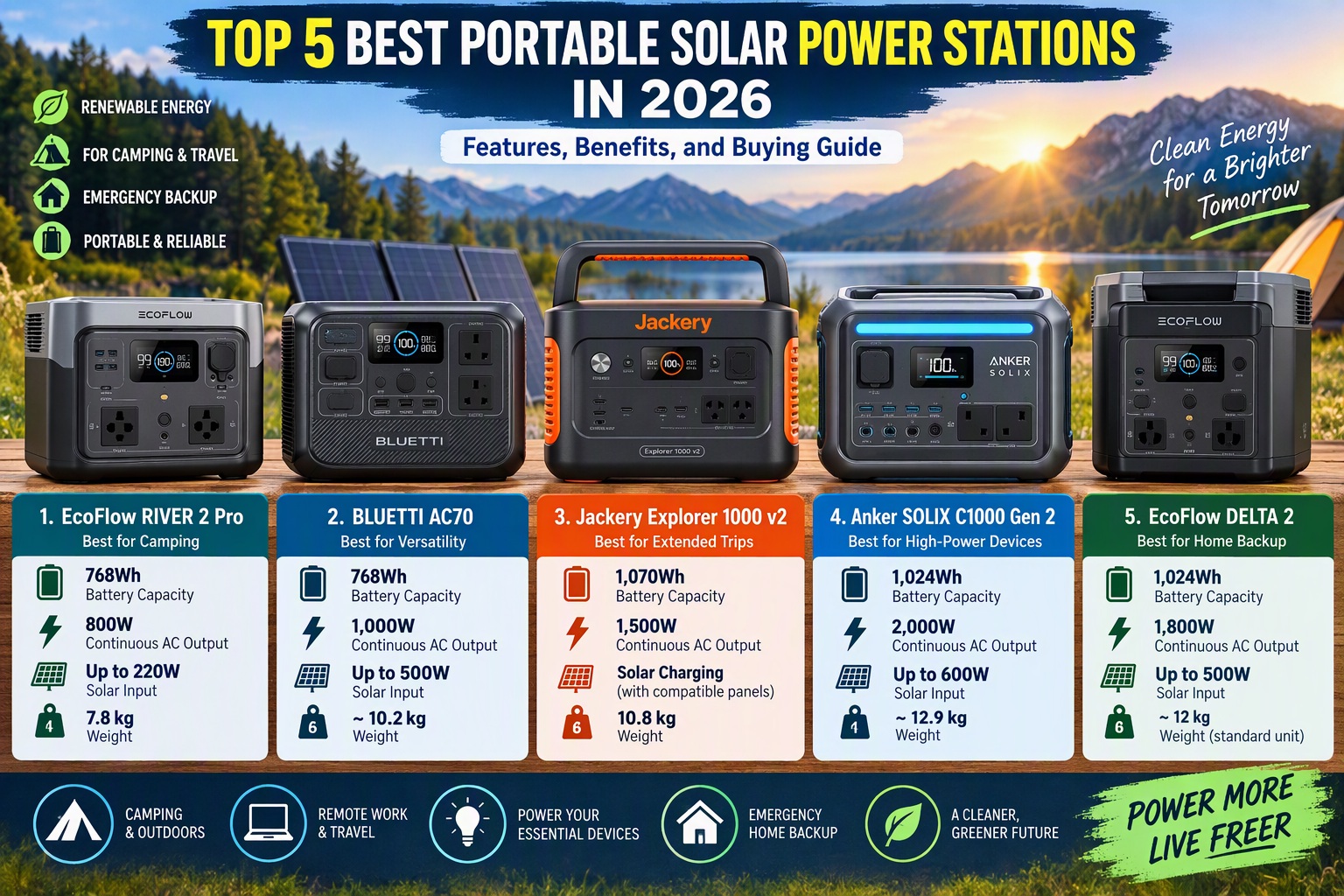
Top 5 Best Portable Solar Power Stations in 2026: Features, Benefits, and Buying Guide
Portable solar power stations are becoming increasingly popular among campers, travelers, homeowners, and people looking for reliable backup electricity. These versatile devices store energy in rechargeable batteries and can power a wide range of electronic devices, including smartphones, laptops, lights, small refrigerators, and other compatible appliances. When paired with compatible solar panels, they can recharge using sunlight, making them a practical option for outdoor activities and emergency preparedness.
Choosing the best portable solar power station in 2026 requires comparing battery capacity, continuous power output, solar charging capabilities, portability, battery technology, and available connections. Some models are designed for lightweight camping trips, while others provide enough power for more demanding applications and temporary home backup.
In this guide, we explore five popular portable power stations from EcoFlow, BLUETTI, Jackery, and Anker SOLIX. Each product offers different advantages, allowing buyers to choose a suitable model according to their electricity requirements and budget.
1. EcoFlow RIVER 2 Pro: Best Portable Solar Power Station for Camping
The EcoFlow RIVER 2 Pro is an excellent choice for people looking for a portable solar power station that combines practical performance, fast charging, and a relatively compact design. With a 768Wh battery capacity and an 800W continuous AC output, it is suitable for camping, road trips, outdoor activities, and powering essential electronic devices during temporary power interruptions.
One of the main advantages of the EcoFlow RIVER 2 Pro is its lithium iron phosphate (LiFePO4) battery technology. According to the manufacturer, the battery can retain more than 80% of its original capacity after 3,000 charge cycles under specified conditions. This makes it an attractive option for users who want a rechargeable power station designed for regular use.
The device supports several charging methods, including household AC electricity, compatible solar panels, car charging, and USB-C charging. Its maximum solar input is 220W, allowing users to recharge the battery using suitable solar panels when sufficient sunlight is available. The manufacturer also specifies a charging time of approximately 70 minutes for a full AC recharge under supported conditions.
Additional features include multiple AC and USB ports, a digital display, and app-based monitoring through Wi-Fi and Bluetooth. Weighing approximately 7.8kg, it is relatively easy to transport compared with larger power stations.
The EcoFlow RIVER 2 Pro is particularly suitable for campers, travelers, students, and users who need portable electricity without carrying a large battery system. However, its 768Wh capacity and 800W continuous output make it less suitable for extended operation of high-power appliances.
Key features and benefits:
- 768Wh battery capacity.
- 800W continuous AC output.
- Up to 220W solar charging input.
- LiFePO4 battery technology.
- AC, solar, car, and USB-C charging options.
- Wi-Fi and Bluetooth app connectivity.
- Approximately 7.8kg in weight.
Where to buy:
- Amazon Germany: https://www.amazon.de/s?k=EcoFlow+RIVER+2+Pro
- Amazon France: https://www.amazon.fr/s?k=EcoFlow+RIVER+2+Pro
- Amazon Italy: https://www.amazon.it/s?k=EcoFlow+RIVER+2+Pro
- Amazon Spain: https://www.amazon.es/s?k=EcoFlow+RIVER+2+Pro
2. BLUETTI AC70: Best Portable Solar Generator for Versatility
The BLUETTI AC70 is a versatile portable power station designed for people who need a balance between battery capacity, output power, and portability. With a 768Wh battery and an 1,000W continuous AC output, it is suitable for camping, mobile workstations, outdoor activities, and emergency electricity needs.
One of the AC70’s main advantages is its ability to supply power to several types of electronic equipment. Depending on their individual power requirements, users can operate laptops, smartphones, LED lights, cameras, and selected household appliances. Its inverter can also provide a higher temporary output for compatible loads, although the actual capabilities depend on the appliance and the manufacturer’s operating conditions.
The power station uses LiFePO4 battery technology, which is valued for its durability and thermal stability compared with some other lithium-ion battery chemistries. BLUETTI specifies a battery life of more than 3,000 charge cycles before capacity reaches the stated retention threshold under its testing conditions.
Solar charging is another important advantage. The AC70 supports a maximum solar input of approximately 500W, depending on the model specifications and charging conditions. When paired with compatible solar panels, it can collect energy during the day and store it for use after sunset.
Other useful features include multiple charging ports, a digital display, app-based control, and AC charging capabilities. These features make it easier to monitor battery levels, check power consumption, and manage the available electricity.
The BLUETTI AC70 is a good option for users who want a portable solar power station with a relatively high inverter output and flexible charging options. Before purchasing, buyers should check the European version’s specifications, supported solar input, and included accessories.
Key features and benefits:
- 768Wh battery capacity.
- 1,000W continuous AC output.
- Up to approximately 500W solar input.
- LiFePO4 battery technology.
- Multiple AC and USB charging ports.
- App-based monitoring and control.
- Suitable for camping, travel, and temporary backup power.
Where to buy:
- Amazon Germany: https://www.amazon.de/s?k=BLUETTI+AC70
- Amazon France: https://www.amazon.fr/s?k=BLUETTI+AC70
- Amazon Italy: https://www.amazon.it/s?k=BLUETTI+AC70
- Amazon Spain: https://www.amazon.es/s?k=BLUETTI+AC70
3. Jackery Explorer 1000 v2: Best Portable Solar Power Station for Extended Outdoor Trips
The Jackery Explorer 1000 v2 is designed for users who need more stored energy for camping, road trips, remote work, and emergency preparedness. Its 1,070Wh battery capacity provides more energy storage than compact power stations, making it suitable for running several small devices over an extended period.
The station features a LiFePO4 battery and a rated AC output of 1,500W, with a higher short-duration surge rating specified by the manufacturer. This output level can support many electronic devices and selected household appliances, provided their power requirements remain within the station’s limits.
One of the most important benefits of this model is its combination of battery capacity and portability. Although it is larger than entry-level power stations, its integrated carrying design makes transportation manageable for many outdoor applications. The unit weighs approximately 10.8kg.
Solar charging is supported through compatible Jackery SolarSaga panels and suitable connections. A 200W solar panel can be used with the appropriate configuration, although actual charging times depend on sunlight intensity, panel positioning, temperature, and energy consumption during charging.
The Explorer 1000 v2 also includes multiple output options for different devices. Depending on the regional configuration, these can include AC outlets, USB-A ports, USB-C ports, and a 12V car outlet. Buyers in Germany and other European countries should confirm that the selected version has the correct 230V AC output and regional compatibility.
Its relatively large battery capacity makes it suitable for users who need more energy than a compact camping station can provide. However, buyers should consider the weight and the cost of any additional solar panels when comparing complete systems.
Key features and benefits:
- 1,070Wh battery capacity.
- 1,500W rated AC output.
- LiFePO4 battery technology.
- Solar charging with compatible panels.
- Multiple ports for charging electronics.
- Portable design with integrated carrying handles.
- Suitable for camping, road trips, and emergency power.
Where to buy:
- Amazon Germany: https://www.amazon.de/s?k=Jackery+Explorer+1000+v2
- Amazon France: https://www.amazon.fr/s?k=Jackery+Explorer+1000+v2
- Amazon Italy: https://www.amazon.it/s?k=Jackery+Explorer+1000+v2
- Amazon Spain: https://www.amazon.es/s?k=Jackery+Explorer+1000+v2
4. Anker SOLIX C1000 Gen 2: Best Portable Solar Power Station for High-Power Devices
The Anker SOLIX C1000 Gen 2 is a powerful portable energy solution for people who need substantial inverter output in a relatively compact battery system. It is designed for camping, mobile offices, temporary backup electricity, and other applications that require more power than small portable generators can deliver.
The station offers approximately 1,024Wh of battery capacity and up to 2,000W of continuous AC output. This combination allows it to support many everyday electronic devices and selected higher-power appliances, provided that their electrical requirements fall within the manufacturer’s limits.
A major advantage is its solar charging capability. The C1000 Gen 2 supports up to 600W of solar input, subject to the specified voltage, current, and connector requirements. With suitable solar panels and favorable weather conditions, this can help replenish the battery without relying entirely on household electricity.
The device also features a rechargeable battery system designed for repeated use, several output connections, and monitoring features that help users understand their electricity consumption. Its relatively high output is particularly useful for people who want to power several devices simultaneously.
Battery capacity and inverter output should be considered separately when choosing this model. The 1,024Wh battery determines how much energy is stored, while the 2,000W output rating determines the maximum supported continuous load. A powerful appliance can therefore consume the stored energy much more quickly than a laptop or LED light.
The Anker SOLIX C1000 Gen 2 is a strong candidate for buyers who prioritize output power, solar charging performance, and versatile everyday use. Before ordering, confirm the European version’s electrical specifications and whether solar panels are included in the selected package.
Key features and benefits:
- Approximately 1,024Wh battery capacity.
- Up to 2,000W continuous AC output.
- Up to 600W solar input.
- Multiple output connections.
- Designed for portable and backup electricity.
- Suitable for selected high-power appliances.
- Practical for camping, mobile work, and temporary power interruptions.
Where to buy:
- Amazon Germany: https://www.amazon.de/s?k=Anker+SOLIX+C1000+Gen+2
- Amazon France: https://www.amazon.fr/s?k=Anker+SOLIX+C1000+Gen+2
- Amazon Italy: https://www.amazon.it/s?k=Anker+SOLIX+C1000+Gen+2
- Amazon Spain: https://www.amazon.es/s?k=Anker+SOLIX+C1000+Gen+2
5. EcoFlow DELTA 2: Best Portable Solar Power Station for Home Backup
The EcoFlow DELTA 2 is designed for users who need a larger and more versatile portable power station for home backup, camping, outdoor projects, and mobile work. Its 1,024Wh battery capacity and 1,800W continuous AC output provide a useful balance between stored energy and appliance compatibility.
One of the model’s main advantages is its expandable battery capacity. With compatible additional batteries, the system can store more energy than the standard unit alone. This flexibility makes it attractive to users whose electricity requirements may increase over time.
The DELTA 2 uses LiFePO4 battery technology and supports several charging methods, including AC electricity, compatible solar panels, and car charging. Its maximum solar input is rated at 500W, allowing the battery to be recharged from sunlight when suitable panels and weather conditions are available.
Multiple AC outlets and USB connections allow the station to supply electricity to various compatible devices. These may include laptops, smartphones, networking equipment, LED lighting, and selected household appliances. Actual operating time depends on the power consumption of the connected devices and energy losses during conversion.
For temporary backup power, the DELTA 2 can help keep selected essential electronics running during an interruption to the household electricity supply. It should not be treated as a whole-house backup system without appropriate equipment and professional installation where required.
The EcoFlow DELTA 2 is especially suitable for buyers who want a portable power station that can serve immediate needs while allowing additional battery capacity later. Its larger design and weight make it less convenient to carry frequently than smaller camping-focused models.
Key features and benefits:
- 1,024Wh standard battery capacity.
- 1,800W continuous AC output.
- Up to 500W solar input.
- LiFePO4 battery technology.
- Expandable capacity with compatible batteries.
- Multiple AC, USB, and DC outputs.
- Suitable for camping, remote work, and temporary home backup.
Where to buy:
- Amazon Germany: https://www.amazon.de/s?k=EcoFlow+DELTA+2
- Amazon France: https://www.amazon.fr/s?k=EcoFlow+DELTA+2
- Amazon Italy: https://www.amazon.it/s?k=EcoFlow+DELTA+2
- Amazon Spain: https://www.amazon.es/s?k=EcoFlow+DELTA+2
How to Choose the Best Portable Solar Power Station in 2026
Choosing the best portable solar power station starts with understanding how much electricity your devices consume. Battery capacity is measured in watt-hours (Wh), while power output is measured in watts (W). Capacity indicates how much energy the battery stores, whereas output indicates how much power the station can deliver at a given moment.
For example, a power station with a 1,000Wh battery does not necessarily operate a 1,000W appliance for a full hour. Conversion losses and the appliance’s actual consumption reduce the available operating time. A useful preliminary estimate is to divide the battery capacity by the device’s wattage, then allow for energy losses.
Battery Capacity
For charging smartphones, powering LED lights, and operating small electronic devices, a compact station may be sufficient. For longer camping trips, laptops, and multiple devices, a model in the 700–1,100Wh range may provide a more flexible solution. Users who need to run several appliances for extended periods should consider larger systems or expandable battery configurations.
Continuous Power Output
Always check the continuous AC output before connecting an appliance. A station with a large battery can still be unsuitable for a device that exceeds its inverter’s power rating. Appliances with electric motors or heating elements may also have high starting or operating power requirements.
Solar Charging Capability
Solar input determines how much power a station can accept from compatible solar panels. A higher input rating can support faster charging under suitable conditions, but the result depends on sunlight, panel orientation, temperature, shading, and the station’s charging limits.
Before purchasing a solar panel, confirm its voltage, current, connector type, and rated power are compatible with the power station. A solar panel sold separately may substantially increase the total purchase cost.
Battery Chemistry and Lifespan
LiFePO4 batteries are common in modern portable power stations because they can offer long cycle life and favorable thermal stability. However, battery lifespan depends on operating temperatures, charging practices, depth of discharge, and the manufacturer’s specifications.
Compare the stated cycle life, warranty, and battery capacity retention figures rather than relying on battery chemistry alone.
Weight and Portability
A compact station is usually easier to carry on camping trips, while a larger model can provide more stored energy and higher output. Consider the combined weight of the power station, solar panels, and accessories before selecting a system for frequent travel.
Ports and Connectivity
Check the number and type of available connections. AC outlets are useful for compatible household electronics, USB-C ports can charge many modern laptops and mobile devices, and 12V outputs can support selected vehicle accessories.
App connectivity and a clear display may also help users monitor battery levels, power consumption, and charging progress.
European Compatibility
When shopping on Amazon Germany or other European Amazon marketplaces, confirm that the selected model is intended for the European market. Check the AC output voltage, plug type, frequency, included accessories, warranty coverage, and availability of replacement components.
Product listings can contain several versions of the same model, and not every package includes solar panels.
Are Portable Solar Power Stations Worth Buying?
Portable solar power stations can be a practical investment for people who need electricity away from conventional outlets. They are useful for camping, outdoor work, road trips, and keeping selected electronic devices operating during temporary power interruptions.
Their main advantage is the ability to store energy and recharge through different methods. When paired with compatible solar panels, they can provide renewable electricity without requiring continuous access to the power grid. Unlike traditional fuel-powered generators, battery power stations do not produce exhaust emissions at the point of use.
However, they have limitations. Battery capacity is finite, charging speed depends on the available power source, and high-power appliances can drain a battery quickly. Solar charging performance can also decrease substantially during cloudy weather or when panels are shaded.
For occasional camping and mobile electronics, a compact model may be sufficient. For higher-power devices and temporary home backup, a station with around 1,000Wh of capacity or more may be a better starting point.
How to Use Amazon Links Safely on a Commercial Website
For publishers creating product comparison articles, Amazon search links are a practical way to direct readers to product listings without copying product photographs, descriptions, or other protected material.
The links included in this article lead to Amazon search results rather than reproducing another publisher’s product content. Product availability, prices, and listing details can change, so readers should verify the information on the retailer’s website before making a purchase.
If the article is monetized through affiliate marketing, publishers should use their own authorized affiliate links and comply with the applicable Amazon Associates program requirements. In Germany and other European markets, commercial websites must also follow relevant advertising disclosure, consumer protection, privacy, and data protection rules.
To reduce copyright and legal risks, use original writing, avoid copying manufacturer or retailer descriptions verbatim, and obtain permission or an appropriate license before using product photographs, logos, or other third-party creative assets. Product names can generally be used to identify the products being reviewed, but brand references should not imply sponsorship or official endorsement where none exists.
Amazon links do not guarantee product availability, a particular price, or delivery to every European country. Publishers should check their links regularly and update their articles when product models, specifications, or regional listings change.
Conclusion
The best portable solar power station in 2026 depends on your energy requirements, budget, and preferred use. The EcoFlow RIVER 2 Pro is a practical option for camping and portable electronics, while the BLUETTI AC70 offers a versatile balance of capacity and output. The Jackery Explorer 1000 v2 provides a larger battery for extended outdoor trips, and the Anker SOLIX C1000 Gen 2 is suitable for users who prioritize high continuous output and solar charging capacity. For those who want expandable storage and temporary home backup, the EcoFlow DELTA 2 remains a useful option to consider.
Before purchasing, compare battery capacity, continuous power output, solar input, weight, warranty, and compatibility with European electrical standards. Choosing a station that matches your actual electricity needs can help you get better value and make more effective use of portable solar energy.


