
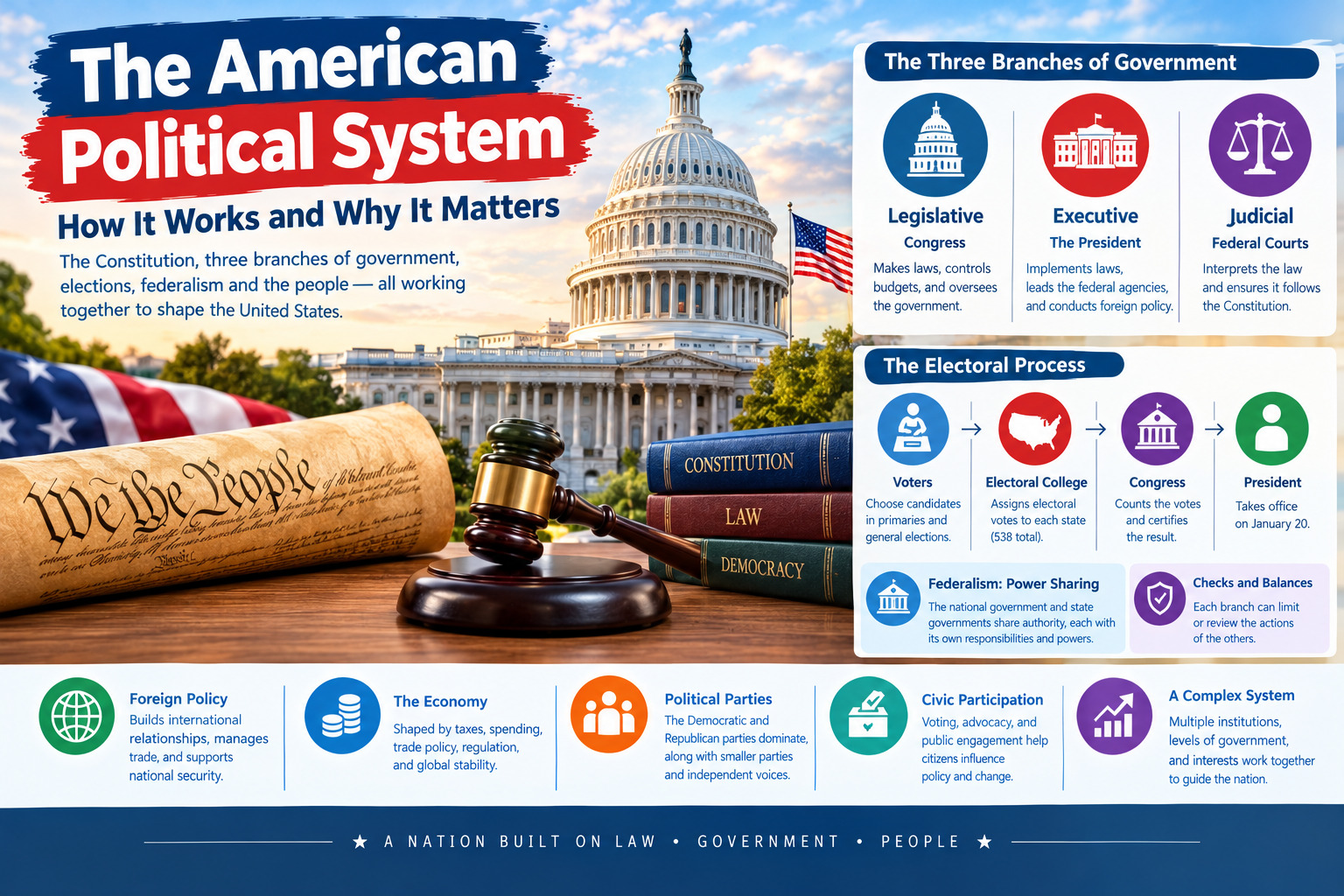
The American Political System: How It Works
The American political system is one of the most influential political systems in the world. It determines how national laws are created, how the president is elected, how government institutions share power, and how citizens participate in public life. Established under the United States Constitution, the system combines representative democracy, federalism, and a separation of powers designed to prevent excessive authority from concentrating in one institution. Understanding how these elements work together helps explain American elections, government decisions, and the country’s political debates. Source: National Archives — The U.S. Constitution
1. The Constitution: The Foundation of American Government
The United States Constitution is the supreme legal foundation of the federal government. Written in 1787, ratified in 1788, and put into operation in 1789, it establishes the main government institutions, defines their powers, and sets limits on their authority. It also explains how the Constitution can be amended and how the federal government relates to the states. The first three articles establish the legislative, executive, and judicial branches, which form the core of the American political system. Source: U.S. Senate — Constitution of the United States
The Constitution is supported by 27 amendments, which address important aspects of government and individual rights. The first ten amendments, known as the Bill of Rights, protect fundamental freedoms, including freedom of speech, religious exercise, and protections in criminal proceedings. Other amendments have changed the political system over time, including amendments that expanded voting rights and established presidential term limits. These constitutional provisions help define what the government may do and what protections individuals possess. Source: National Archives — The Bill of Rights
2. The Three Branches of the Federal Government
The American federal government is divided into three branches: legislative, executive, and judicial. Each branch has specific responsibilities, but their powers overlap in carefully defined ways. This arrangement is intended to prevent any single branch from exercising unchecked authority. For example, Congress can pass legislation, the president can approve or veto bills, and courts can decide legal disputes involving the interpretation or constitutionality of government actions. Source: The White House — Our Government
The Legislative Branch: Congress
Congress is the legislative branch of the federal government. It consists of two chambers: the House of Representatives and the Senate. Together, they introduce, debate, amend, and vote on proposed federal laws. Congress also plays a major role in taxation, federal spending, oversight of government agencies, and decisions concerning national policy. A proposed law generally must pass both chambers in the same form before it can be sent to the president. Source: U.S. House of Representatives — Branches of Government
The House of Representatives has 435 voting members, with seats distributed among the states according to population. Representatives serve two-year terms, so the entire House faces election every two years. The Senate has 100 members, with each state electing two senators regardless of population. Senators serve six-year terms, and approximately one-third of the Senate is up for election every two years. This structure gives the House a closer connection to population size while providing equal state representation in the Senate. Source: U.S. House of Representatives and U.S. Senate
The Executive Branch: The President and Federal Agencies
The executive branch is responsible for implementing and enforcing federal laws. It is led by the president, who serves as both head of state and head of government, and includes the vice president, executive departments, and numerous federal agencies. The president directs major areas of national administration and foreign policy within the limits of the Constitution and federal law. Executive agencies carry out specialized responsibilities, such as managing public programs, enforcing regulations, and administering national services. Source: The White House — Our Government
The president is elected for a four-year term through the Electoral College system. The president nominates candidates for many senior government positions, including federal judges and Cabinet officials, although certain appointments require Senate confirmation. The president can sign bills into law or veto them, but Congress can override a presidential veto with the constitutionally required two-thirds vote in both chambers. These rules ensure that presidential authority operates within a broader system of institutional checks. Source: U.S. Constitution, Article II
The Judicial Branch: Federal Courts
The judicial branch interprets and applies the law in cases brought before the courts. It includes the Supreme Court of the United States and lower federal courts established by Congress. Federal courts hear cases involving federal statutes, constitutional questions, disputes between certain parties from different states, and other matters within federal jurisdiction. State courts handle many other legal matters, including a large share of criminal cases and disputes arising under state law. The exact court responsible for a case depends on its legal subject and jurisdiction. Source: United States Courts — Court Role and Structure
The Supreme Court is the highest court in the federal judicial system. It reviews selected cases involving significant questions of federal law and the Constitution. Through judicial review, federal courts may determine that a law or government action conflicts with the Constitution. Supreme Court justices are nominated by the president and confirmed by the Senate, and they generally serve for life during good behavior. This arrangement is intended to support judicial independence, although judicial decisions remain an important subject of public and legal debate. Source: United States Courts — Supreme Court
3. Checks and Balances: How the Branches Limit Each Other
Checks and balances are a central feature of the American political system. Rather than allowing one institution to control every major government function, the Constitution gives each branch tools to limit or review certain actions by the others. The president may veto legislation, Congress may override that veto under specific voting requirements, the Senate reviews many presidential appointments, and courts can rule on constitutional disputes. Congress also conducts oversight of the executive branch and controls federal appropriations through the legislative process. Source: National Archives — What the Constitution Says
This system often makes government decision-making slower, particularly when the president and one or both chambers of Congress disagree. A proposal may face committee reviews, negotiation, amendments, votes in both chambers, and presidential approval before becoming law. These obstacles are not necessarily signs that the system has stopped working; they are partly the result of a structure designed to require agreement across institutions. However, disagreements can also produce delays, budget disputes, and policy uncertainty. Source: U.S. House of Representatives — Branches of Government
4. Federalism: Sharing Power Between National and State Governments
The United States is a federal republic, meaning that authority is divided between the national government and state governments. The federal government handles matters assigned to it by the Constitution, including national defense, currency, and aspects of interstate and international commerce. State governments have their own constitutions, legislatures, governors, and courts, and they exercise broad authority over areas such as public education, state criminal law, local infrastructure, and many public services. The precise division of responsibilities depends on constitutional provisions and applicable laws. Source: United States Courts — Comparing Federal and State Courts
Local governments, including counties and municipalities, also influence everyday life. They may manage local roads, public transport, zoning, waste collection, and community services under authority granted by state law. As a result, rules and public services can differ considerably between states and cities. A policy that applies in one state may not apply in the same way elsewhere, which makes the American system both diverse and sometimes complex for residents and businesses. Source: USA.gov — State and Local Governments
5. How Presidential Elections Work
Presidential elections take place every four years. Before the general election, political parties and candidates conduct campaigns and, in many states, primary elections or caucuses to help determine party nominees. Candidates present their policy proposals, participate in public debates, seek support from voters, and raise funds subject to applicable campaign finance laws. The general election is held in November, but the formal constitutional process for choosing the president continues after voters cast their ballots. Source: Federal Election Commission — Election and Voting Information
The president is chosen through the Electoral College rather than by a direct nationwide popular vote. The system has 538 electoral votes, and a candidate generally needs at least 270 to win. Each state receives electoral votes equal to its total representation in the House and Senate, while the District of Columbia receives three electoral votes. In most states, the candidate who wins the statewide popular vote receives all of that state’s electoral votes; Maine and Nebraska use systems that can divide them. The details are important because winning the nationwide popular vote does not, by itself, guarantee victory in the Electoral College. Source: National Archives — What Is the Electoral College?
After the state-level results are certified, appointed electors cast their votes, and Congress counts the electoral votes under the constitutional and statutory process. The president and vice president take office on January 20 following the election. If no presidential candidate receives a majority of electoral votes, the Constitution provides a contingent election process in which the House of Representatives chooses the president, with each state delegation casting one vote, while the Senate chooses the vice president under separate rules. This procedure is unusual but is part of the formal system. Source: National Archives — Electoral College Process
6. Congressional Elections and Midterm Elections
Congressional elections determine who represents citizens in the House of Representatives and the Senate. House elections occur every two years, while Senate elections are staggered so that approximately one-third of Senate seats are contested in each regular election cycle. These elections influence the legislation Congress considers, its oversight priorities, and the degree of support the president receives from lawmakers. Voters can therefore affect national policy even in years when there is no presidential election. Source: Federal Election Commission — Election and Voting Information
Midterm elections occur halfway through a president’s four-year term. They often become a public assessment of the administration’s performance, economic conditions, and policy decisions, although local issues and individual candidates also matter. When the president’s party loses seats, the opposition may gain control of one or both chambers of Congress. This can change the prospects for legislation, federal spending agreements, investigations, and confirmations of certain officials. It does not automatically remove the president from office or end the administration’s constitutional authority. Source: U.S. House of Representatives
7. Political Parties and the Two-Party System
American politics is dominated nationally by two major parties: the Democratic Party and the Republican Party. They contain a wide range of viewpoints, and their members do not always agree on every issue. In broad terms, the parties often differ over taxation, the role of government in the economy, healthcare, environmental regulation, immigration, social policy, and the appropriate scope of federal authority. These are general patterns rather than fixed positions shared by every elected official or voter. Source: U.S. House of Representatives — Members
Third parties and independent candidates also participate in American elections. However, ballot access rules, campaign funding, the structure of congressional elections, and the Electoral College can make it difficult for smaller parties to compete successfully at the national level. As a result, many voters choose between the two major parties even when they disagree with parts of both platforms. Primaries, local political organizations, advocacy groups, and independent media also influence which issues receive attention and which candidates gain support. Source: Federal Election Commission
8. How a Bill Becomes a Federal Law
The process of making a federal law generally begins when a member of Congress introduces a bill. The proposal is usually referred to a committee, where lawmakers may review its provisions, hold hearings, request evidence, and recommend changes. If the bill advances, the relevant chamber debates and votes on it. To proceed through the ordinary legislative process, the bill must pass both the House and Senate in the same form before being presented to the president. Source: U.S. House of Representatives — The Legislative Process
The president may sign the bill, veto it, or allow it to become law under the constitutional rules governing presidential action. Congress can override a veto if two-thirds of the members voting in each chamber support the override, provided the required quorum is present. If the House and Senate pass different versions of a proposal, they must resolve their differences and approve identical text. This process encourages negotiation but can also prevent proposals from becoming law when lawmakers cannot reach an agreement. Source: U.S. Senate — Legislative Process
9. Civil Liberties and the Role of Citizens
Citizens influence the political system through voting, contacting elected representatives, participating in public meetings, joining civic organizations, and expressing their views. The First Amendment protects important freedoms involving speech, religion, the press, peaceful assembly, and petitioning the government, subject to applicable legal limits. These rights enable public debate and give individuals ways to challenge government decisions and advocate for policy changes. Source: National Archives — Bill of Rights
Political participation extends beyond presidential elections. Citizens may follow congressional hearings, comment on proposed regulations where public comment is invited, attend local government meetings, or participate in community initiatives. Access to reliable information is particularly important because campaign messages, opinion pieces, and online discussions may present different interpretations of the same event. Comparing claims with primary documents and official records can help readers distinguish established facts from political arguments. Source: USA.gov — Voting and Elections
10. How the American Political System Influences the Economy
Political decisions affect the economy through taxes, government spending, regulation, trade policy, immigration rules, and public investment. Congress has a central role in taxation and federal appropriations, while the executive branch administers programs and implements laws. Policy changes can influence business costs, consumer demand, employment incentives, and investor expectations. Their actual economic effects depend on the policy’s design, broader market conditions, and how households and businesses respond. Source: Congressional Budget Office
The relationship between politics and the economy is not always straightforward. A tax reduction may increase disposable income for some households or encourage certain investments, while also affecting government revenue. Public infrastructure spending can support construction and improve long-term productivity, but its effects depend on project quality, funding, and implementation. Trade restrictions may benefit some domestic producers while increasing costs for businesses that rely on imported materials. For these reasons, evaluating economic policy requires looking at evidence, trade-offs, and outcomes rather than assuming that one political approach always produces the same result. Source: Congressional Budget Office and Source: U.S. International Trade Commission
11. Foreign Policy and the Separation of Responsibilities
The United States conducts foreign policy through several institutions rather than through the president alone. The president directs diplomacy and serves as commander in chief of the armed forces, while Congress has constitutional powers involving appropriations, foreign commerce, and declarations of war. The Senate also has a role in approving treaties, requiring the support of two-thirds of senators present for treaty ratification, and confirming many senior diplomatic and national security appointments. The exact legal authority for an action depends on the Constitution and relevant legislation. Source: U.S. Senate — Constitution of the United States
Foreign policy can influence international security, energy markets, supply chains, investment, and diplomatic relationships. Decisions involving tariffs, sanctions, defense cooperation, and international agreements may create economic consequences for both the United States and other countries. Because responsibilities are divided among institutions, major foreign policy initiatives may involve negotiations between the executive branch and Congress, as well as legal review where relevant. This structure can provide oversight but can also create disagreements over priorities and authority. Source: U.S. House of Representatives — Branches of Government
12. Why the American Political System Can Be Complex
The American political system combines national leadership, state authority, elected representatives, courts, political parties, and public participation. These institutions do not always share the same priorities, and elections can produce divided government, where different parties control the presidency and one or both chambers of Congress. When that happens, some policies may require extensive negotiation, while other decisions can proceed through existing legal authorities or administrative processes. Source: National Archives — The Constitution
The system’s complexity reflects its effort to balance effective government with limits on power. Its outcomes depend not only on the president but also on Congress, the courts, state governments, elections, public opinion, and the legal framework. Understanding these relationships provides a clearer view of why American political decisions sometimes move quickly and sometimes take years to resolve. It also explains why no single election or institution determines every aspect of national policy.
Conclusion
The American political system is built around a written Constitution, three branches of federal government, shared authority between national and state institutions, and elections that allow citizens to choose many of their representatives. Congress makes federal laws, the president leads the executive branch, and the courts interpret and apply the law within their jurisdiction. Checks and balances, federalism, political parties, and civic participation all shape how the system operates.
Understanding how these institutions interact makes it easier to follow American elections, evaluate public policies, and understand the country’s domestic and international decisions. Although the system can be slow and politically contentious, its structure is designed to distribute authority, establish legal limits, and provide multiple ways for public institutions and citizens to influence government.


