European Politics and the Future of the European Union
European politics plays a major role in shaping the continent’s economy, security, democratic institutions, and international influence. The European Union (EU) brings together countries that cooperate on shared challenges while retaining their own national governments, laws, and political traditions. Its future will depend on how effectively its members balance national interests with common goals, strengthen economic competitiveness, protect democratic values, and respond to changes in the global political environment. Understanding European politics therefore requires looking at both the institutions that govern the EU today and the choices that could shape its development in the years ahead. Source: European Union — EU Priorities 2024–2029
1. Understanding European Politics
European politics operates at several interconnected levels. National governments make decisions on domestic issues, while EU institutions coordinate policies and adopt common rules in areas where member countries have agreed to share authority. Political debates often concern economic growth, migration, security, climate policy, public spending, democratic accountability, and the distribution of power between national capitals and European institutions. These debates influence not only government decisions but also the daily lives of residents, workers, students, and businesses across the continent. Source: European Union — Types of Institutions and Bodies
The European Union is not a single country, nor is it simply a traditional international organization. It has its own institutions, legal framework, common market, and shared policies, but its member states remain sovereign countries with national constitutions and governments. Some decisions are made jointly at EU level, while others remain primarily national responsibilities. This combination allows European countries to cooperate on cross-border problems without eliminating their separate political identities. Source: European Union — How EU Policy Is Decided
2. How the European Union’s Political System Works
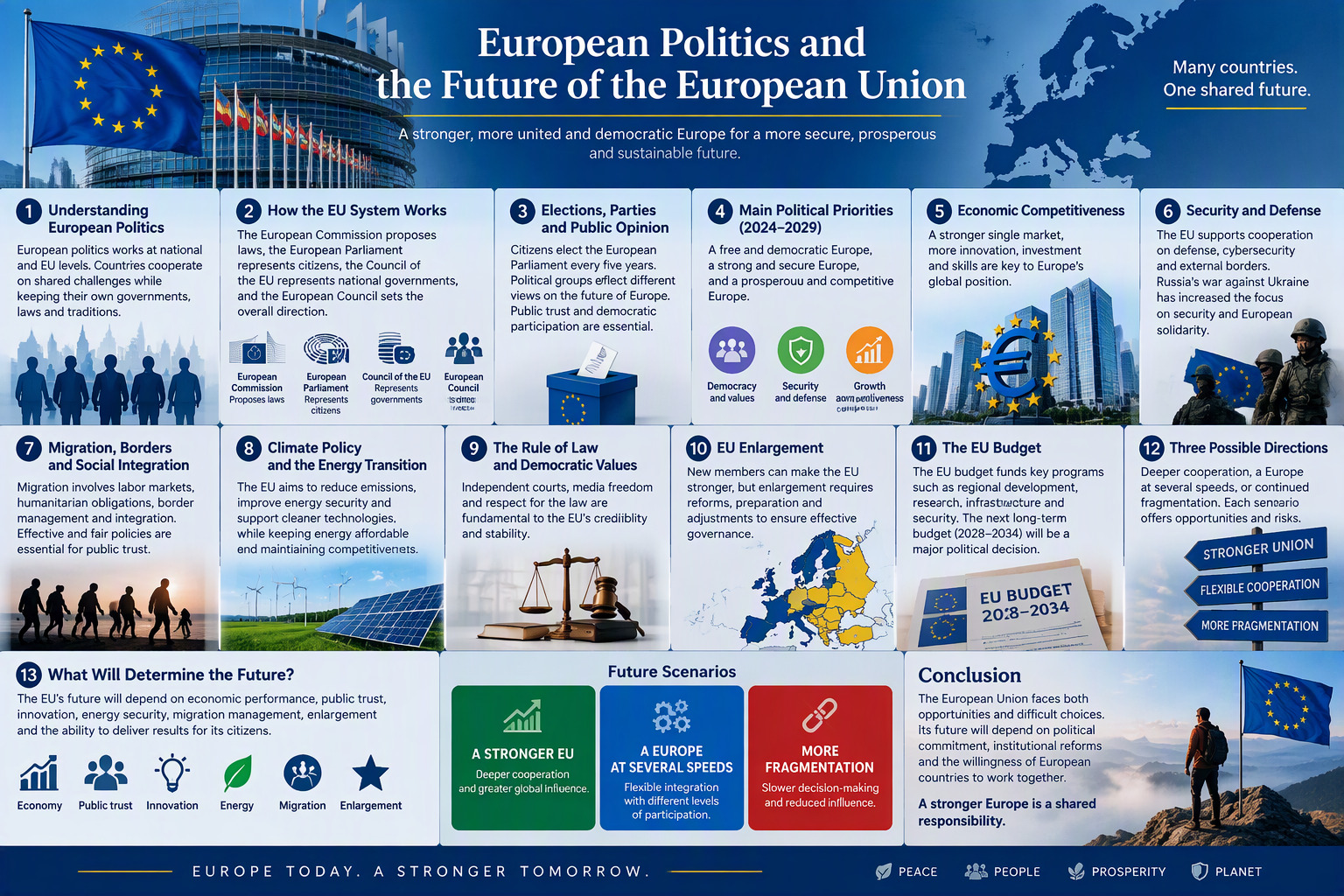
The EU has several institutions with different responsibilities. The European Commission proposes legislation and oversees the implementation of EU policies. The European Parliament represents citizens and is directly elected by voters in EU member states. The Council of the European Union represents national governments through their ministers, while the European Council brings together national leaders to establish the Union’s overall political direction. These institutions cooperate, negotiate, and sometimes disagree before major decisions are adopted. Source: European Union — Types of Institutions and Bodies
Under the ordinary legislative procedure, the European Commission generally proposes new legislation, and the European Parliament and Council of the European Union examine and adopt it jointly. The process may include committee reviews, amendments, negotiations, and public consultation. Once a law is adopted, member states and EU institutions apply it according to its legal form and the relevant rules. This arrangement gives both elected representatives and national governments a role in shaping common legislation. Source: European Union — How EU Policy Is Decided
It is important to distinguish the Council of the European Union from the European Council. The first consists of national ministers who meet according to the policy area under discussion and help adopt EU laws. The second consists of heads of state or government and sets broad political priorities, but it does not normally act as a legislative chamber. Understanding this difference helps readers interpret European news accurately and avoid confusing institutions with similar names. Source: European Union — Types of Institutions and Bodies
3. Elections, Political Parties, and Public Opinion
European Parliament elections allow citizens across the EU to choose representatives every five years. Members of the European Parliament organize themselves into political groups based primarily on their political views rather than their nationality. These groups influence legislative negotiations, budget decisions, parliamentary scrutiny, and the direction of European policy. National elections remain equally important because governments elected within individual member states participate directly in the Council of the European Union and the European Council. Source: European Parliament — Roles and Powers
European politics includes a broad range of political traditions, from pro-European integration movements to parties that favor stronger national control over policy. Disagreements can involve immigration, economic regulation, climate measures, social policy, public spending, and the balance between national sovereignty and collective decision-making. Political preferences also differ between countries and communities, so the EU should not be treated as if its citizens share one uniform political outlook. Elections and parliamentary negotiations determine how these competing priorities influence policy. Source: European Union — EU Priorities 2024–2029
Public trust is an important factor in the future of European politics. Citizens are more likely to support common policies when they believe institutions are transparent, responsive, and capable of delivering practical results. At the same time, complex negotiations and disagreements between national governments can make European decision-making difficult to understand. Improving communication, encouraging informed public debate, and making institutions accountable are therefore important to maintaining democratic legitimacy across the Union. Source: European Commission — Rule of Law
4. The European Union’s Main Political Priorities
The EU’s strategic agenda for 2024–2029 emphasizes three broad objectives: a free and democratic Europe, a strong and secure Europe, and a prosperous and competitive Europe. These priorities cover democratic institutions, security and defense, migration management, economic development, innovation, and the green and digital transitions. They provide a framework for policy discussions, although the final outcome of individual proposals depends on legislation, funding, negotiations, and cooperation among member states. Source: European Union — EU Priorities 2024–2029
One continuing political challenge is how to translate broad European objectives into practical outcomes for different countries. Governments may agree on the need for economic growth or stronger security while disagreeing about the amount of public money required, the responsibilities of individual states, or the best way to achieve those goals. Such differences are a normal part of a political union composed of countries with different economies, histories, and electoral priorities. Progress often depends on finding compromises that can gain sufficient support across the Union. Source: European Parliament — Priorities
5. Economic Competitiveness and Europe’s Global Position
Economic competitiveness is likely to remain one of the most important questions in European politics. European businesses operate in global markets where technological innovation, energy costs, investment, workforce skills, and access to finance can influence their ability to compete. The EU has identified a stronger and more integrated economy as a strategic objective, including efforts to reduce unnecessary barriers within the single market and make it easier for companies to expand across borders. Source: European Commission — One Europe, One Market Roadmap
The single market enables the movement of goods, services, capital, and people under common rules, subject to relevant exceptions and national arrangements. Its size can help businesses reach customers across multiple countries, while shared standards can reduce some barriers to cross-border trade. However, differences in national regulations, access to investment, infrastructure, and administrative procedures can still limit economic integration. Further progress will depend on how successfully EU institutions and member states address these obstacles without weakening legitimate consumer, labor, environmental, or safety protections. Source: European Commission — One Europe, One Market Roadmap
Technology and innovation will also influence Europe’s political and economic future. Artificial intelligence, digital infrastructure, advanced manufacturing, and research can create opportunities for productivity and new industries, but they also raise questions about skills, competition, privacy, and responsible regulation. If European policies support innovation while providing clear and workable rules, they may help businesses grow and attract investment. If regulation becomes unnecessarily fragmented or investment remains insufficient, European companies may find it harder to scale internationally. These outcomes are possibilities, not guaranteed predictions. Source: European Parliament — Priorities
6. European Security and Defense Cooperation
Security has become a central issue in European political discussions. Member states face questions about military readiness, defense investment, cybersecurity, critical infrastructure, and the protection of external borders. The EU can support cooperation through common policies, funding, industrial initiatives, and coordination, but national governments retain important responsibilities for their own armed forces and national security. Cooperation with NATO remains significant for many European countries, while the EU develops its own tools to address security and defense needs. Source: European Union — EU Priorities 2024–2029
Russia’s full-scale invasion of Ukraine has intensified debate about European security, support for Ukraine, defense capabilities, and the long-term stability of the continent. EU countries do not always agree on the level or form of support, the use of common funding, or the balance between diplomacy and deterrence. The future direction of European security policy will depend on developments in the region, national political decisions, available resources, and coordination with international partners. Source: European Parliament — Priorities
A more coordinated European approach could help member states share resources, improve military procurement, strengthen industrial capacity, and respond more effectively to cross-border threats. Nevertheless, deeper cooperation requires agreement on funding, strategic objectives, and the division of responsibilities between national and European institutions. Security integration is therefore likely to remain a political negotiation rather than a simple administrative process. Source: European Union — EU Priorities 2024–2029
7. Migration, Borders, and Social Integration
Migration is one of the most debated subjects in European politics because it connects labor markets, humanitarian obligations, border management, national identity, and public services. EU countries may disagree about how responsibility should be shared, how asylum applications should be processed, and how to manage irregular migration while protecting the rights of people who qualify for international protection. National circumstances also differ: some countries receive more arrivals, while others are important destinations or transit routes. Source: European Union — EU Priorities 2024–2029
The long-term challenge is to develop migration policies that are effective, legally sound, and workable for member states. This includes cooperation on border procedures, asylum systems, returns where legally appropriate, and integration measures for people who are permitted to stay. Public confidence can be affected when citizens believe that policies are poorly managed or that responsibilities are unfairly distributed. Clear rules, effective implementation, and cooperation between national authorities are therefore important to maintaining trust in common European arrangements. Source: European Commission — EU Enlargement and Policy Highlights
Migration will continue to influence political debate, but its effects should not be reduced to a single economic or social outcome. Results depend on factors such as skills, employment opportunities, housing availability, language learning, public-service capacity, and the design of integration policies. Evidence-based discussion can help governments assess costs and benefits without relying on stereotypes or treating all migrants and communities as identical. Source: European Union — EU Priorities 2024–2029
8. Climate Policy and the Energy Transition
Climate and energy policy present another major test for European cooperation. The EU seeks to reduce emissions, encourage cleaner technologies, protect the environment, and improve energy security. These goals can create opportunities for investment in renewable energy, electricity networks, energy efficiency, and low-carbon industries. However, the pace and cost of transition remain politically sensitive, particularly for households facing high energy bills and industries exposed to international competition. Source: European Union — EU Priorities 2024–2029
Member states have different energy resources, industrial structures, and levels of dependence on imported fuels. This means that a policy that is manageable for one country may be more difficult for another. European institutions must balance emissions targets with reliable energy supplies, affordable prices, industrial competitiveness, and support for communities affected by economic change. The long-term success of climate policy will depend not only on legislation but also on investment, infrastructure, technology, and public acceptance. Source: European Commission — EU Enlargement Policy Highlights
9. The Rule of Law and Democratic Values
The rule of law is a foundational principle of the European Union. It means, among other things, that public authorities must act within the law, courts must be able to operate independently, and legal processes should be transparent and fair. These principles matter for democratic accountability and also provide a stable framework for businesses, citizens, and public institutions. The EU treaties and legal framework set out obligations that member states are expected to respect. Source: European Commission — Rule of Law
Disagreements over judicial independence, corruption, media freedom, and institutional accountability can create tension between EU institutions and national governments. Such disputes raise difficult questions about how common values should be enforced while respecting the powers of member states. The Union’s credibility depends in part on applying its legal principles consistently and through established procedures rather than treating them only as political slogans. Source: European Commission — Rule of Law
In the future, democratic resilience may depend increasingly on the ability of institutions to respond to misinformation, political polarization, and threats to public trust. Protecting open debate does not mean accepting every claim as factual; it means allowing discussion while using transparent evidence, independent journalism, and fair legal processes to assess public issues. European democracy will be stronger if citizens can access reliable information and hold decision-makers accountable. Source: European Parliament — Priorities
10. EU Enlargement: Could the Union Become Larger?
EU enlargement refers to the process through which eligible European countries can become members of the Union. Applicants must meet established conditions, including stable democratic institutions, respect for the rule of law and fundamental rights, a functioning market economy, and the ability to implement EU rules and obligations. Membership is not automatic: the process involves assessments, negotiations, reforms, and agreement by the existing member states under the applicable procedures. Source: European Union — EU Enlargement
Enlargement could increase the EU’s economic scale, strategic influence, and cooperation with neighboring regions. It may also support reforms in candidate countries by providing a clear framework for strengthening institutions and aligning national rules with European standards. However, a larger Union would need to consider how to manage its budget, represent different national interests, implement common laws, and make decisions efficiently. The benefits of enlargement depend on careful preparation by both candidate countries and the EU itself. Source: European Commission — Preparing for a Wider European Union, 6 October 2026
The future of enlargement remains uncertain because each candidate’s progress depends on its reforms and the political decisions of current members. EU institutions have been examining how policies, funding arrangements, and governance could adapt to a larger Union. This suggests that enlargement is not only a question of which countries may join, but also of whether the EU can adjust its own institutions to remain effective while preserving its legal and democratic standards. Source: European Commission — Preparing for a Wider European Union, 6 October 2026
11. The European Union’s Budget and Long-Term Priorities
The EU budget is a practical expression of its political priorities. It supports programs and investments in areas such as agriculture, regional development, research, infrastructure, external action, and other agreed policy objectives. The annual budget operates within a longer-term financial framework negotiated by member states and approved through the EU’s institutional process. Decisions about how much money to raise and how to allocate it often reveal differences between countries, sectors, and political groups. Source: European Parliament — Priorities
The next long-term budget period, covering 2028–2034, is a major political issue as the Union considers how to finance existing commitments alongside emerging priorities such as competitiveness, security, research, and enlargement. Member states may differ over the overall size of the budget, contributions, and the balance between traditional spending and new priorities. As negotiations continue, the eventual agreement will influence which projects receive support and how the EU responds to future challenges. Source: European Parliament — Priorities
A central question is whether the EU can direct public resources toward long-term needs while maintaining accountability and fair distribution among member states and regions. Spending more does not automatically produce better results; outcomes depend on project selection, implementation, oversight, and the ability to measure progress. A credible financial framework will need to balance investment ambitions with the different fiscal circumstances and political preferences of member countries. Source: European Union — Types of Institutions and Bodies
12. Three Possible Directions for Europe’s Political Future
One possible direction is deeper cooperation among member states. Under this scenario, governments make progress on common defense capabilities, economic integration, energy infrastructure, and coordinated foreign policy. Better cooperation could strengthen Europe’s ability to respond to international crises and improve the functioning of the single market. However, achieving this outcome would require sustained political agreement, reliable funding, and a willingness to compromise on national priorities. Source: European Union — EU Priorities 2024–2029
A second possibility is gradual and uneven integration. Some member states could support deeper cooperation in particular areas while others prefer to retain greater national control. This approach may allow progress where agreement is possible, but it could also produce a more complicated system in which participation and policy commitments differ across countries. Its effectiveness would depend on whether flexible cooperation remains compatible with common rules and the overall functioning of the Union. Source: European Union — How EU Policy Is Decided
A third possibility is continued political fragmentation, in which disagreements over migration, spending, security, or national sovereignty slow the adoption of common policies. Such a scenario would not necessarily mean the EU would collapse, but it could make coordinated action more difficult and reduce the Union’s ability to respond quickly to shared problems. These scenarios are analytical possibilities rather than predictions; actual developments will depend on elections, economic conditions, international events, and decisions made by European citizens and governments. Source: European Union — EU Priorities 2024–2029
13. What Will Determine the EU’s Future?
The future of the European Union will depend on whether it can deliver practical benefits while maintaining democratic legitimacy and cooperation among its members. Economic performance, public trust, technological innovation, energy security, and the ability to manage migration will all influence how citizens evaluate European institutions. Political leaders will need to demonstrate that common action can address problems that individual countries may struggle to solve alone, while recognizing that national circumstances and priorities are not identical. Source: European Union — EU Priorities 2024–2029
The EU will also need to determine how to balance enlargement with effective governance. Welcoming new members could expand Europe’s influence and economic opportunities, but it may require adjustments to decision-making procedures, funding arrangements, and the implementation of common rules. Preserving the rule of law and democratic standards will remain important if the Union is to maintain confidence among existing members, candidate countries, businesses, and citizens. Source: European Commission — Preparing for a Wider European Union, 6 October 2026
Ultimately, Europe’s future will not be determined by a single election, leader, or policy. It will emerge from repeated negotiations among national governments, EU institutions, political parties, businesses, and citizens. The Union’s ability to adapt, cooperate, and turn shared priorities into measurable results will shape its role in the European continent and the wider world.
Conclusion
European politics is a complex process of balancing national sovereignty, common rules, democratic representation, economic interests, and collective security. The European Union’s institutions provide a framework for countries to cooperate on legislation, trade, investment, environmental policy, and other cross-border issues, while national governments retain important powers over domestic affairs.
Looking ahead, the EU faces both opportunities and difficult choices. Stronger economic integration, effective security cooperation, responsible enlargement, and protection of democratic values could strengthen its position. Persistent disagreements, weak implementation, or declining public trust could make collective action more difficult. The most credible view of the EU’s future is therefore not a guaranteed success or inevitable decline, but an outcome that will depend on political choices, institutional reforms, and the willingness of European countries to work together.